

People use notarized documents in Ontario for everything from property deals to travel and legal disputes. Most folks assume a notary stamp guarantees their paperwork stays valid forever. But the truth is surprising. Some notarized documents in Ontario are only accepted for six months or less depending on where you submit them. So even with the right signature and seal you could end up holding paperwork that suddenly loses its power just because the rules quietly shifted. Here’s what really decides how long your notarized documents will last.
Table of Contents
- How Long Are Notarized Documents Valid In Ontario?
- Legal Requirements For Notarized Documents In 2025
- Common Reasons For Invalid Notarized Documents
- How Businesses And Individuals Can Ensure Validity
Quick Summary
| Takeaway | Explanation |
|---|---|
| Document Validity is Context-Dependent | The validity of notarized documents varies based on the document type, its intended use, and institutional requirements, making it essential to verify current validity expectations with the organization requesting the document. |
| Legal Requirements for Notaries | Only licensed lawyers and paralegals in good standing are authorized to act as notaries in Ontario, ensuring document authentication integrity. It is crucial to verify their current credentials before notarization. |
| Common Pitfalls Leading to Invalidity | Procedural errors, identification verification issues, and non-compliance with legal standards can all result in invalid notarized documents. Awareness of these risks helps in maintaining document integrity. |
| Proactive Document Management | Regularly review and update notarized documents while ensuring compliance with evolving authentication processes and maintaining current identification to minimize risks of invalidation. |
| Consulting Legal Professionals | Seeking advice from notary publics or legal experts can provide definitive guidance on document validity and help navigate complex notarization and legal requirements in Ontario. |
How Long Are Notarized Documents Valid in Ontario?
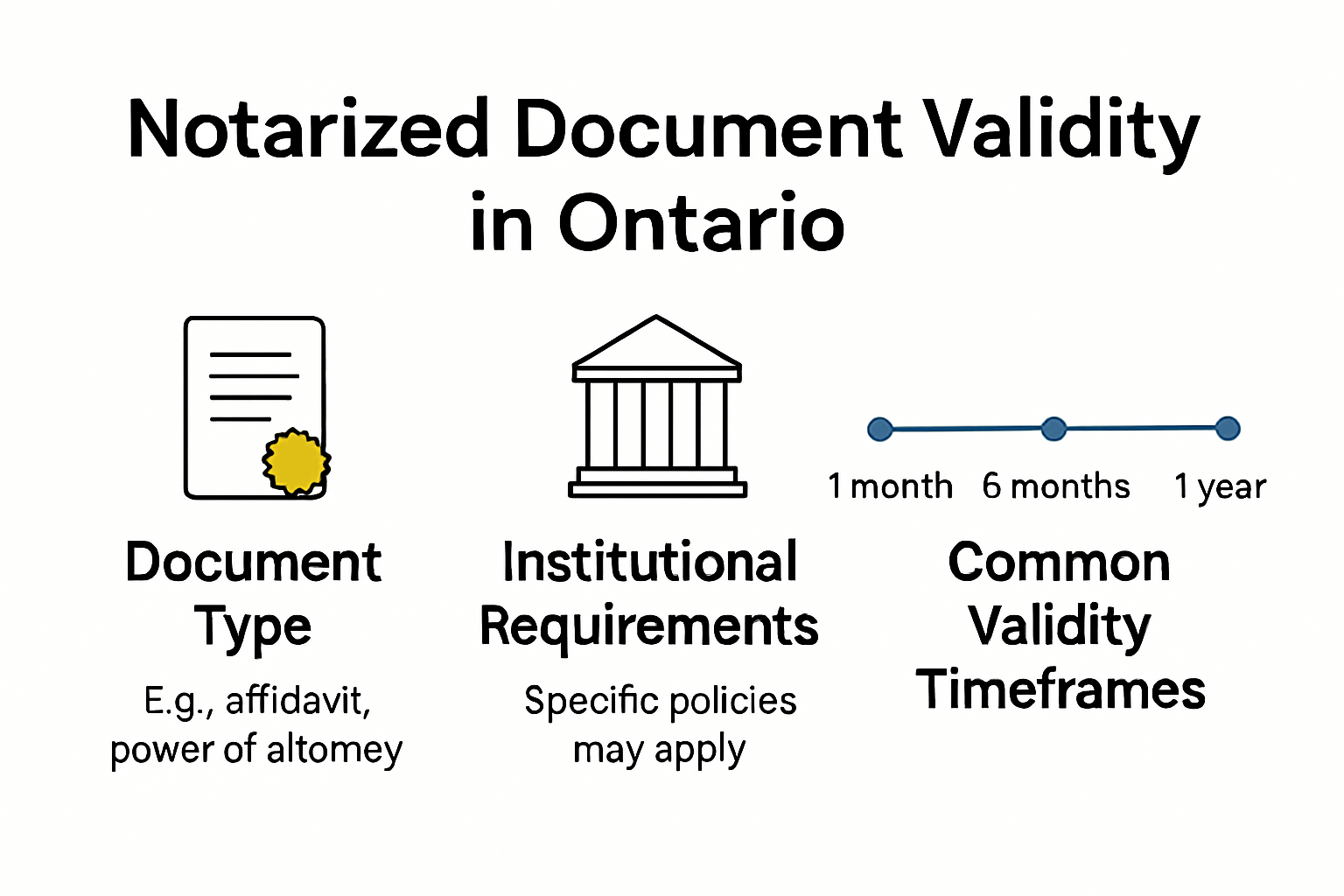
Notarized documents in Ontario do not have a universal expiration date. Their validity depends on multiple factors, including the specific document type, legal requirements, and the purpose for which they were created. Understanding these nuances is crucial for individuals and businesses seeking to use notarized documents effectively.
Document Type and Purpose Variations
The validity of a notarized document varies significantly based on its intended use. Some documents have inherent time-sensitive characteristics, while others remain valid indefinitely. For instance, legal affidavits, real estate documents, and immigration papers each have unique validity considerations.
According to the Law Society of Ontario, notarization serves to authenticate document execution and certify copies as true. This means the notarization confirms the document’s authenticity at the time of signing, but does not automatically impose a strict expiration timeline.
Typical Validity Timeframes
While no universal rule exists, certain document categories have generally accepted validity periods. Passport supporting documents, for example, typically remain valid for six months to a year. Statutory declarations might have different timelines depending on the issuing authority and specific legal requirements.
The Ontario government’s official documentation suggests that document validity is context-dependent. Some government agencies and international organizations may have specific requirements about how recently a document must have been notarized.
Businesses and individuals should always verify current requirements with the specific institution or organization requesting the notarized document. What remains valid in one context might require recent notarization in another.
For those seeking comprehensive guidance on document authentication, our comprehensive online notary guide provides detailed insights into navigating Ontario’s notarization landscape. Understanding these nuances ensures your documents remain legally recognized and professionally processed.
Key considerations for document validity include:
- Purpose of the Document: Immigration, legal, or business documents have different validity expectations.
- Receiving Organization’s Requirements: Each institution may have unique timelines.
- Document Type: Some documents inherently have shorter valid periods than others.
Professional advice remains the most reliable method for confirming a specific document’s validity. Consulting with a notary public or legal professional can provide definitive guidance tailored to your exact situation.

Legal Requirements for Notarized Documents in 2025
Navigating the legal landscape of notarized documents in Ontario requires a comprehensive understanding of current regulations and professional standards. As of 2025, specific legal requirements govern the creation, authentication, and acceptance of notarized documents across various professional and governmental contexts.
Notary Public Qualification and Authorization
In Ontario, the legal framework for notarization is strictly regulated. According to the Law Society of Ontario, only specific professionals can serve as authorized notaries. Practicing lawyers and paralegals in good standing can apply for a lifetime notary public designation. This rigorous qualification process ensures that only professionals with comprehensive legal knowledge can authenticate documents.
The appointment process involves submitting a formal application through the notary public portal, accompanied by the required documentation and fees. These stringent requirements maintain the integrity and reliability of notarized documents in the province.
Document Authentication and Validation
Document authentication in Ontario follows specific legal protocols. The Ontario government’s official guidelines outline precise requirements for document validation. Certain documents issued by official institutions like the Superior Court of Justice can be authenticated without additional notarization. However, documents requiring external use often need explicit notarial certification.
Key legal considerations for document authentication include verifying the notary’s current professional status, ensuring all signature and seal requirements are met, and confirming the document’s original purpose matches its intended use. Professionals must meticulously follow these guidelines to ensure legal compliance.
Emerging Legal Trends and Technological Considerations
The legal landscape for notarized documents continues to evolve. While our comprehensive online notary guide explores current trends, it is crucial to understand the current limitations. As of 2025, Ontario maintains strict in-person notarization requirements. Online notary services remain restricted, with notaries mandated to be physically present during document execution.
Businesses and individuals must stay informed about these legal nuances. Potential changes in regulations could impact document validity, authentication processes, and the overall notarization landscape. Consulting with legal professionals remains the most reliable method to navigate these complex requirements.
Key legal requirements for notarized documents in 2025 include:
- Professional Credentials: Only licensed lawyers and paralegals can serve as notaries.
- Physical Presence: Notarization requires in-person verification.
- Institutional Compliance: Different organizations may have unique validation standards.
Staying current with legal requirements ensures your notarized documents remain valid, recognized, and legally binding across various contexts in Ontario.
Here is a summary table comparing key legal requirements for notarized documents in Ontario as of 2025:
| Requirement | Description | Who Must Comply |
|---|---|---|
| Professional Credentials | Only licensed lawyers & paralegals may notarize documents | Notary Public |
| Physical Presence | Notarization must be done in-person | Notary and Signatory |
| Institutional Compliance | Follow specific validation rules of each organization | Document Submitter |
| Proper Identification | Acceptable government-issued photo ID required | Signatory & Notary |
| Valid Notary Commission | Notary’s commission must be active at time of notarization | Notary Public |
Common Reasons for Invalid Notarized Documents
Notarized documents can become invalid for numerous reasons, potentially rendering critical legal and personal paperwork ineffective. Understanding these common pitfalls is essential for anyone seeking reliable document authentication in Ontario.
Procedural and Technical Errors
Procedural mistakes frequently compromise document validity. Research from the United States Notary Association reveals that incomplete notarial certificates, expired commission seals, and inadequate record-keeping are primary reasons for document invalidation. In Ontario, similar strict standards apply.
Key procedural errors include:
- Incomplete Notary Information: Missing registration numbers or commission details
- Incorrect Date or Seal: Using an expired notary seal or incorrect date
- Improper Signature Placement: Signatures not matching designated areas
Identification and Verification Issues
According to the Ontario government’s authentication guidelines, proper identification verification is crucial. Documents can be invalidated if the signatory cannot provide acceptable government-issued identification or if the notary fails to confirm the individual’s identity comprehensively.
Common identification-related problems include:
- Insufficient Identification: Lack of valid government photo ID
- Name Discrepancies: Differences between identification and document names
- Expired Identification Documents: Using outdated identification
Legal and Compliance Complications
Legal non-compliance represents another significant risk for document invalidation. Our comprehensive online notary guide highlights the importance of understanding current regulatory requirements. As of 2025, Ontario maintains strict in-person notarization standards, meaning documents processed through unauthorized channels may be considered invalid.
Significant legal compliance issues include:
- Unauthorized Notarization: Using non-certified notaries
- Jurisdictional Limitations: Documents not meeting specific institutional requirements
- Incomplete Documentation: Missing essential supporting documents
Professional verification remains the most reliable method to ensure document validity. Consulting with a licensed notary public can help individuals navigate these complex requirements and avoid potential invalidation risks. Understanding these common pitfalls empowers Ontario residents to prepare accurate, legally recognized documents that meet rigorous provincial standards.
Remember that document validity extends beyond mere notarization. Careful attention to detail, comprehensive verification, and adherence to current legal requirements are paramount in maintaining the integrity and effectiveness of your important paperwork.
Below is a checklist table summarizing common reasons for invalid notarized documents and whether each area is fully addressed:
| Potential Issue | Description | Status/Check |
|---|---|---|
| Incomplete Notary Information | Missing details like registration number | Review Completed? |
| Expired Notary Seal/Date | Outdated or incorrect notary stamp/date | Review Completed? |
| Improper Signature Placement | Signature not in designated area | Review Completed? |
| Insufficient Identification | Lacking valid government-issued photo ID | Review Completed? |
| Name Discrepancies | Name mismatch between ID and document | Review Completed? |
| Unauthorized Notary Used | Notary isn’t licensed/authorized | Review Completed? |
| Incomplete Supporting Documents | Essential documentation missing | Review Completed? |
How Businesses and Individuals Can Ensure Validity
Ensuring the validity of notarized documents requires a proactive and strategic approach for both businesses and individuals in Ontario. Understanding the intricate requirements and best practices can significantly reduce the risk of document rejection or legal complications.
Verification of Notary Credentials
According to the Law Society of Ontario, verifying the notary’s current professional status is paramount. Businesses and individuals must confirm that the notary public is a licensed lawyer or paralegal in good standing. This verification process involves checking the notary’s current registration, commission validity, and professional credentials.
Key steps for credential verification include:
- Professional Registration Check: Confirm the notary’s current license status
- Commission Expiration Review: Verify the notary’s active commission period
- Institutional Compliance: Ensure the notary meets all current legal requirements
Document Authentication Strategies
The Ontario government’s authentication guidelines provide crucial insights into ensuring document validity. With Canada joining the Apostille Convention, international document authentication has become more streamlined. Our comprehensive guide to document authentication offers detailed strategies for businesses and individuals seeking to validate their documents effectively.
Critical authentication considerations include:
- Purpose-Specific Verification: Different institutions may have unique validation requirements
- International Use Preparation: Understanding Apostille Convention requirements
- Comprehensive Documentation: Maintaining complete and accurate supporting documents
Proactive Validity Maintenance
Staying ahead of potential validity issues requires ongoing diligence. The Ontario Bar Association highlights the importance of understanding evolving authentication processes. Businesses and individuals should develop a systematic approach to document management, including regular reviews and updates of critical paperwork.
Practical steps for maintaining document validity include:
- Regular Document Review: Periodic assessment of existing notarized documents
- Updated Identification: Keeping supporting identification current
- Professional Consultation: Seeking expert advice for complex documentation needs
Navigating the complex landscape of document validity demands attention to detail and a comprehensive understanding of legal requirements. While the process may seem challenging, careful preparation and professional guidance can significantly reduce the risk of document invalidation.
Key takeaways for ensuring document validity:
- Thorough Verification: Check every aspect of document preparation
- Professional Guidance: Consult experts when in doubt
- Proactive Management: Stay informed about changing regulations
Businesses and individuals who invest time in understanding and implementing these validation strategies will be better positioned to create and maintain legally recognized documents that meet Ontario’s rigorous standards.
Frequently Asked Questions
How long are notarized documents valid in Ontario?
The validity of notarized documents in Ontario depends on the document type and its intended use. Some documents, like passport supporting documents, may be valid for only six months, while others may have longer validity periods. Always check with the requesting organization for specific requirements.
What are the legal requirements for notaries in Ontario?
In Ontario, only licensed lawyers and paralegals in good standing can serve as notaries public. They must comply with strict qualification procedures and maintain an active notary commission to ensure the integrity of notarized documents.
What common mistakes can lead to the invalidation of notarized documents?
Common reasons for invalid notarization include procedural errors (like missing signatures or incorrect seals), identification issues (such as lacking valid ID), and non-compliance with legal requirements. Awareness of these pitfalls can help maintain the validity of your documents.
How can I ensure the validity of my notarized documents?
To ensure the validity of notarized documents, verify the notary’s credentials, follow specific authentication strategies, and maintain proactive document management. Regularly review your documents and consult with professionals when needed to navigate legal requirements effectively.
Ensure Your Notarized Documents Stay Valid and Recognized in Ontario
Worried your notarized paperwork could become invalid just because the rules changed? In Ontario, document validity depends on strict details and up-to-date legal standards. The article explains how even small errors or outdated notarization can cause major setbacks, rejection, or legal complications. If you need affidavits, invitation letters, statutory declarations, or solemn declarations, not getting it done right can delay your plans or put deals at risk.

Give yourself confidence and convenience. Use theonlinentoary.ca for secure, legally compliant online notary services made for Ontario’s 2025 requirements. Our experienced team helps you avoid the pain points outlined in the Notarized Document Validity in Ontario: 2025 Guide, with step-by-step support for every document type.
Get started today and keep your documents valid when it matters most. Visit our online notary service to protect your paperwork now.
Recommended
- Why Opt for an Online Notary in Ontario – The Online Notary CA
- The Complete Guide to Using an Online Notary Public for Affidavits and Declarations in Ontario (2025) – The Online Notary CA
- Professional Online Notary Services in Canada – The Online Notary CA
- Everything You Need to Know About Online Notarization in Ontario: Fast, Legal, and Convenient for Affidavits and Declarations (2025) – The Online Notary CA
- Common Documents That Require Notarization in Ontario – My Mobile Notary