
Certified translation affidavits are more than just paperwork for Ontario. They can determine whether your legal or immigration documents are accepted or instantly rejected. Here is the part that surprises most people. Every certified translation affidavit must be completed by a qualified professional and then validated with a sworn statement and a notary’s seal. That extra layer of verification is not just for show. It is what gives your translated documents official power in courts, schools, visa applications, and business deals from day one.
Table of Contents
- What Is A Certified Translation Affidavit?
- Why Is A Certified Translation Affidavit Important?
- How Does The Certified Translation Affidavit Process Work?
- Key Concepts Related To Certified Translation Affidavits
- Real-World Applications Of Certified Translation Affidavits In Ontario
Quick Summary
| Takeaway | Explanation |
|---|---|
| Qualified translators are essential. | Certified translations must be performed by linguists recognized by professional associations to ensure accuracy. |
| Notarization guarantees authenticity. | An official stamp from a notary public or commissioner of oaths confirms the legality and accuracy of the translation. |
| Required for various legal scenarios. | Essential for immigration, legal proceedings, and academic evaluations where precise language is critical. |
| Prevents misrepresentation of documents. | The verification process reduces risks of intentional or unintentional translation errors in legal contexts. |
| Streamlines bureaucratic processes. | Certified translation affidavits facilitate successful submission of documents across multiple official channels in Ontario. |
What is a Certified Translation Affidavit?
A certified translation affidavit is a specialized legal document that provides an officially verified and authenticated translation of documents from one language to another, specifically designed for use in legal, governmental, and professional contexts in Ontario. This comprehensive process ensures the accuracy, completeness, and legal validity of translated materials.
Understanding the Core Components
A certified translation affidavit involves several critical elements that distinguish it from standard translations. The translation must be completed by a qualified professional who possesses proven language expertise and can verify the document’s complete and accurate conversion from the original language.
Key characteristics of a certified translation affidavit include:
- Completed by a certified translator recognized by professional associations
- Includes a signed statement affirming the translation’s accuracy
- Typically accompanied by the original document for reference
- Provides a word-for-word or meaning-for-meaning translation
Legal Verification Process
The verification process transforms a standard translation into a legally recognized document. According to the Ontario Immigrant Nominee Program, translations must meet specific standards to be considered valid for official purposes.
A notary public or commissioner of oaths plays a crucial role in this process. They review the translated document, compare it with the original, and then provide an official stamp or seal that confirms the translation’s authenticity. This step is essential for documents submitted to government agencies, courts, educational institutions, or immigration services.
When Certified Translation Affidavits Are Required
Certified translation affidavits become necessary in multiple scenarios where precise linguistic accuracy is paramount. Common situations include:
- Immigration and visa applications
- Academic credential evaluations
- Legal proceedings involving international documents
- Business contract translations
- Professional certification processes
The comprehensive nature of a certified translation affidavit ensures that the intended meaning of the original document is preserved, providing confidence and legal standing in official transactions across different linguistic contexts.
Below is a table summarizing the core components that differentiate a certified translation affidavit from other types of document translations.
| Component | Description |
|---|---|
| Certified Translator | Must be a linguist recognized by official associations with demonstrated language expertise. |
| Translator’s Statement | A signed declaration affirming the translation’s accuracy and fidelity to the original. |
| Original Document Attached | Includes the original source document for reference and comparison. |
| Translation Approach | Uses word-for-word or meaning-for-meaning translation to preserve intent. |
| Legal Authentication | Verified by a notary public or commissioner of oaths with an official stamp or seal. |
Why is a Certified Translation Affidavit Important?
A certified translation affidavit serves as a critical legal instrument that ensures accurate communication across language barriers, providing official validation and credibility to translated documents. Its importance extends far beyond simple linguistic conversion, functioning as a legally recognized mechanism for preserving the integrity and authenticity of critical information.
Legal and Official Recognition
Certified translation affidavits are essential for official documentation where precision and accuracy are paramount. Government agencies, courts, academic institutions, and immigration services require these documents to verify that the translated content completely and accurately reflects the original text.
Key reasons for their critical importance include:
- Preventing misunderstandings in legal and professional contexts
- Ensuring complete and accurate representation of original documents
- Providing a legally binding guarantee of translation accuracy
- Meeting strict regulatory requirements for document submission
Protecting Against Misrepresentation
According to Immigration, Refugees and Citizenship Canada, certified translation affidavits play a crucial role in preventing potential document fraud or misrepresentation. By requiring translations to be completed by qualified professionals and verified through an official process, these documents create a robust mechanism for maintaining document authenticity.
The verification process involves a professional translator providing a sworn statement about the translation’s accuracy, which is then endorsed by a notary public or commissioner of oaths. This multilayered approach significantly reduces the risk of intentional or unintentional mistranslation.
Professional and Personal Implications
Beyond legal requirements, certified translation affidavits have profound implications for individuals and organizations. They are critical in scenarios such as:
- International business negotiations
- Academic credential evaluations
- Immigration and visa applications
- Legal proceedings involving multilingual documentation
- Professional certification and licensing processes
For those navigating complex bureaucratic systems, a certified translation affidavit can be the difference between successful document submission and potential rejection. Learn more about online notarization services that can streamline this important process for Ontario residents.
How Does the Certified Translation Affidavit Process Work?
The certified translation affidavit process is a meticulous and structured approach designed to ensure the highest standards of linguistic accuracy and legal validity. This comprehensive procedure involves multiple professional stakeholders who collaborate to transform a standard translation into a legally recognized document.
Initial Translation Preparation
The process begins with selecting a qualified translator who is proficient in both the source and target languages. In Ontario, this typically means working with a translator recognized by professional associations like the Association of Translators and Interpreters of Ontario (ATIO).
Key initial steps include:
- Obtaining the original document requiring translation
- Selecting a certified translator with appropriate language expertise
- Creating a precise, word-for-word or meaning-for-meaning translation
- Preparing a draft translation that maintains the original document’s intent
Professional Verification and Certification
According to Immigration, Refugees and Citizenship Canada, the translation must undergo rigorous verification. After completing the initial translation, the professional translator prepares a sworn statement affirming the translation’s complete accuracy.
This critical stage involves:
- Comparing the original document with the translated version
- Drafting a formal statement of translation accuracy
- Preparing documentation for official notarization
- Ensuring all linguistic nuances are precisely captured
Final Notarization and Validation
The concluding phase involves formal legal authentication. A notary public or commissioner of oaths reviews the translated document and the translator’s sworn statement. They verify the translator’s credentials and confirm the translation’s authenticity by applying an official seal or stamp.
Notarization transforms the translation into a legally recognized document. Learn more about commissioning affidavits online for a comprehensive understanding of this crucial step. The final certified translation affidavit includes:
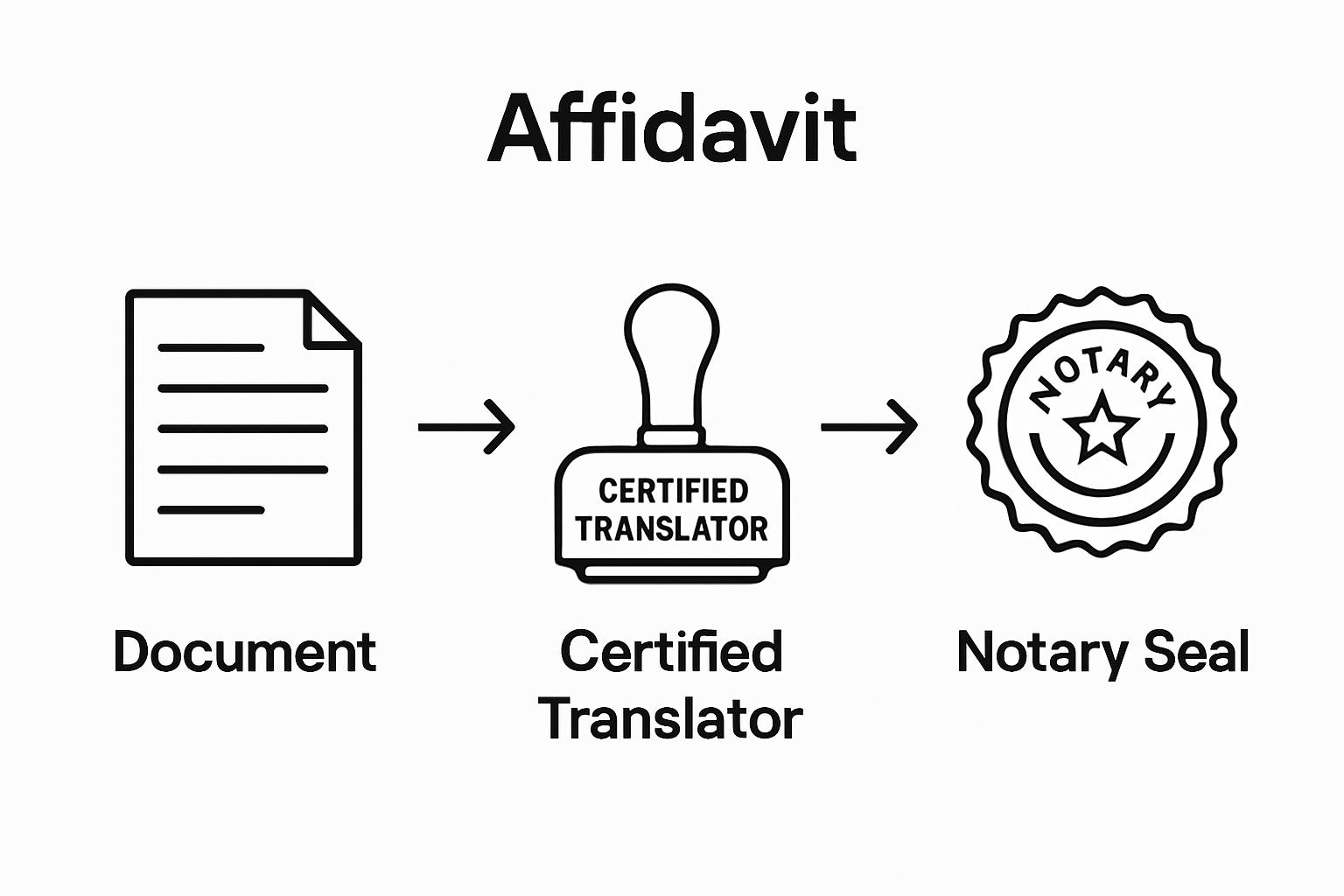
- Original document
- Translated document
- Translator’s sworn statement
- Notary’s official validation stamp
This multilayered process ensures that the translated document meets the highest standards of accuracy, reliability, and legal acceptance across various official platforms in Ontario and beyond.
Key Concepts Related to Certified Translation Affidavits
Certified translation affidavits involve several nuanced legal and linguistic concepts that are critical to understanding their purpose, application, and significance in official documentation. These specialized documents represent a complex intersection of language expertise, legal validation, and professional authentication.
Fundamental Terminology and Definitions
Certification in translation goes beyond simple linguistic conversion. It encompasses a comprehensive process of verifying the accuracy, completeness, and legal standing of a translated document. Understanding the key terminology is essential for navigating this specialized field.
Critical terms and definitions include:
- Affidavit: A sworn written statement made under oath, legally binding and signed before an authorized official
- Certified Translator: A professional linguist recognized by official associations with proven language proficiency
- Notarization: The process of official authentication by a licensed notary public
- True Translation: A word-for-word or meaning-for-meaning conversion that preserves the original document’s intent
Professional Standards and Qualifications
According to Ontario’s Official Document Authentication Guidelines, professional standards play a crucial role in certified translation affidavits. Translators must meet rigorous qualification criteria to provide legally acceptable translations.
Key professional requirements encompass:
- Membership in recognized translation associations
- Demonstrated bilingual proficiency
- Ability to provide sworn statements of translation accuracy
- Understanding of legal and technical terminology
Legal and Procedural Considerations
Certified translation affidavits involve complex legal and procedural frameworks that ensure document integrity. Learn more about online notary services that can help streamline this intricate process.
Essential legal considerations include:
- Compliance with provincial and federal documentation standards
- Maintaining the original document’s legal validity
- Providing an official record of linguistic conversion
- Ensuring admissibility in various legal and administrative contexts
These interconnected concepts form the foundation of certified translation affidavits, creating a robust system for accurate and legally recognized document translation in Ontario and beyond.
This table organizes key terms and definitions found in the certified translation affidavit process for easier reference and understanding.
| Term | Definition |
|---|---|
| Affidavit | A sworn written statement made under oath, legally binding and signed before an authorized official |
| Certified Translator | A professional linguist recognized by official associations with proven language proficiency |
| Notarization | The process of official authentication by a licensed notary public |
| True Translation | A word-for-word or meaning-for-meaning conversion that preserves the original document’s intent |
Real-World Applications of Certified Translation Affidavits in Ontario
Certified translation affidavits play a critical role in numerous professional and personal contexts, serving as essential documents that bridge linguistic gaps and ensure legal compliance across various sectors in Ontario. These specialized documents provide official validation and credibility in situations where precise communication is paramount.
Immigration and Professional Licensing
Immigration processes represent a primary domain where certified translation affidavits are indispensable. Individuals seeking to establish themselves in Ontario must navigate complex documentation requirements that demand absolute linguistic accuracy.
Key immigration and professional scenarios include:
- Translating academic credentials for credential assessment
- Converting international professional certifications
- Documenting personal identification for permanent residency applications
- Verifying professional qualifications for licensing boards
- Supporting work permit and visa applications
Legal and Judicial Proceedings
According to Ontario’s Official Document Authentication Guidelines, legal contexts require meticulous translation documentation. Certified translation affidavits serve as critical instruments in judicial and legal environments.
Significant legal applications involve:

- Translating evidence documents for court proceedings
- Converting international legal agreements
- Providing accurate documentation for civil and criminal cases
- Supporting international contract negotiations
- Authenticating foreign legal judgments and settlements
Business and Academic Contexts
Beyond legal frameworks, certified translation affidavits are essential in business and academic domains where precision and official recognition are crucial. Learn more about online notary services that can facilitate these complex processes.
Comprehensive business and academic applications include:
- Translating international business contracts
- Converting academic transcripts for university admissions
- Supporting international research collaborations
- Documenting corporate financial statements
- Facilitating cross-border educational credential recognition
These real-world applications demonstrate the critical importance of certified translation affidavits in ensuring accurate, legally recognized communication across diverse professional landscapes in Ontario.
Take the Stress Out of Certified Translation Affidavits in Ontario
Navigating the demands of official documents in Ontario can be overwhelming, especially when you need a certified translation affidavit for legal, immigration, or academic purposes. Every error or delay could put your application on hold or risk rejection, making trusted verification and fast service more important than ever. If you are feeling anxious about accuracy, notarization, or how to move forward, you are not alone.

Let us simplify your path. With convenient online notary services, you can get affidavits, statutory declarations, invitation letters, and solemn declarations handled securely without leaving your home. Our expert team understands what Ontario institutions require and guides you step by step, ensuring your affidavit meets strict legal standards. Act now to avoid needless stress and process delays—visit our website and get your certified translation affidavit ready the easy way.
Frequently Asked Questions
What is a certified translation affidavit?
A certified translation affidavit is a legal document that provides an officially verified translation of documents from one language to another, particularly for use in legal, governmental, and professional contexts in Ontario.
When is a certified translation affidavit required?
Certified translation affidavits are necessary for situations such as immigration and visa applications, academic credential evaluations, legal proceedings involving international documents, and professional certification processes.
How does the certified translation affidavit process work?
The process involves selecting a qualified translator, preparing an accurate translation, and then obtaining notarization from a notary public or commissioner of oaths to ensure the document’s legal validity and authenticity.
What are the key components of a certified translation affidavit?
Key components include a signed statement from a certified translator affirming the accuracy of the translation, the original document for reference, and the official notary stamp or seal that verifies its authenticity.
Recommended
- Everything You Need to Know About Online Notarization in Ontario: Fast, Legal, and Convenient for Affidavits and Declarations (2025) – The Online Notary CA
- Why Opt for an Online Notary in Ontario – The Online Notary CA
- What is an Online Notary? – The Online Notary CA
- The Complete Guide to Using an Online Notary Public for Affidavits and Declarations in Ontario (2025) – The Online Notary CA