
Did you know that a single well-crafted legal letter can often resolve disputes before they ever reach court? Legal letters shape the outcome of conflicts, make your intentions clear, and can offer powerful protection for your rights. Whether dealing with business, personal, or professional matters, understanding how to use these documents wisely puts you in control and helps you navigate tricky situations with confidence.
Key Takeaways
| Point | Details |
|---|---|
| Purpose of Legal Letters | Legal letters serve as formal documentation for dispute resolution and legal communications, protecting rights and setting clear expectations. |
| Types of Legal Letters | The primary types include Cease and Desist Letters for stopping unlawful actions, and Demand Letters for claiming restitution or compliance with obligations. |
| Essential Components | Key items in a legal letter include sender and recipient information, a clear summary of the dispute, and supporting documentation to enhance credibility. |
| Common Pitfalls | Avoid aggressive language and unsubstantiated claims, as these can weaken the letter’s effectiveness and harm your legal position. |
Table of Contents
- Understanding Legal Letters And Their Purpose
- Key Types Of Legal Letters In Ontario
- Essential Components Of A Legal Letter
- Legal Requirements And Framework In Ontario
- Risks, Liabilities, And Common Mistakes
Understanding Legal Letters and Their Purpose
Legal letters are powerful communication tools that serve as formal, written documentation for resolving disputes, making official requests, or setting legal expectations. These documents are not just pieces of paper, but strategic instruments that can protect your rights, communicate serious intentions, and potentially prevent costly legal conflicts.
Legal letters come in several distinct forms, each serving a unique purpose:
Cease and Desist Letters: According to Legal Line, these are formal notices demanding someone stop an unlawful activity. They typically outline the specific wrongdoing, provide the legal basis for the complaint, set a compliance deadline, and warn of potential legal consequences if the recipient fails to act.
Demand Letters: As defined by research from Wikipedia, these are formal statements that articulate a legal claim and demand restitution or performance of a specific obligation. They often serve as a critical preliminary step before initiating court proceedings.
The primary goal of a legal letter is clear communication backed by potential legal authority. Whether you’re addressing a contractual dispute, intellectual property infringement, or requesting specific action, these documents signal serious intent and provide a documented record of your attempt to resolve an issue professionally and legally. Check out our guide on notarized letter samples to understand how proper documentation can strengthen your legal communication.
Key Types of Legal Letters in Ontario
Legal letters in Ontario serve as critical communication tools across various professional and personal scenarios, each designed to address specific legal concerns with precision and clarity. Understanding these different types can help you navigate complex legal interactions more effectively and protect your rights.
Cease and Desist Letters are powerful legal instruments used in Ontario for multiple scenarios. According to Legal Line, these letters are typically employed in cases involving:
- Intellectual property infringement
- Contract breaches
- Defamation claims
- Harassment situations
- Unfair competitive practices
These letters formally notify the recipient of their unlawful activity and provide a clear warning about potential legal consequences if the behavior continues. They serve as an official first step before initiating more complex legal proceedings.
Demand Letters represent another crucial legal communication method in Ontario. Supportive Law highlights that these letters are commonly used in scenarios such as:
- Recovering unpaid debts from contracts or loans
- Requesting severance payments under the Employment Standards Act
- Addressing breaches of service contracts
- Seeking compensation for defective goods
Learn more about creating notarized consent letters to understand how proper documentation can strengthen your legal communications. Each type of legal letter serves a strategic purpose, transforming written communication into a precise, legally recognized instrument for resolving disputes and protecting your interests.
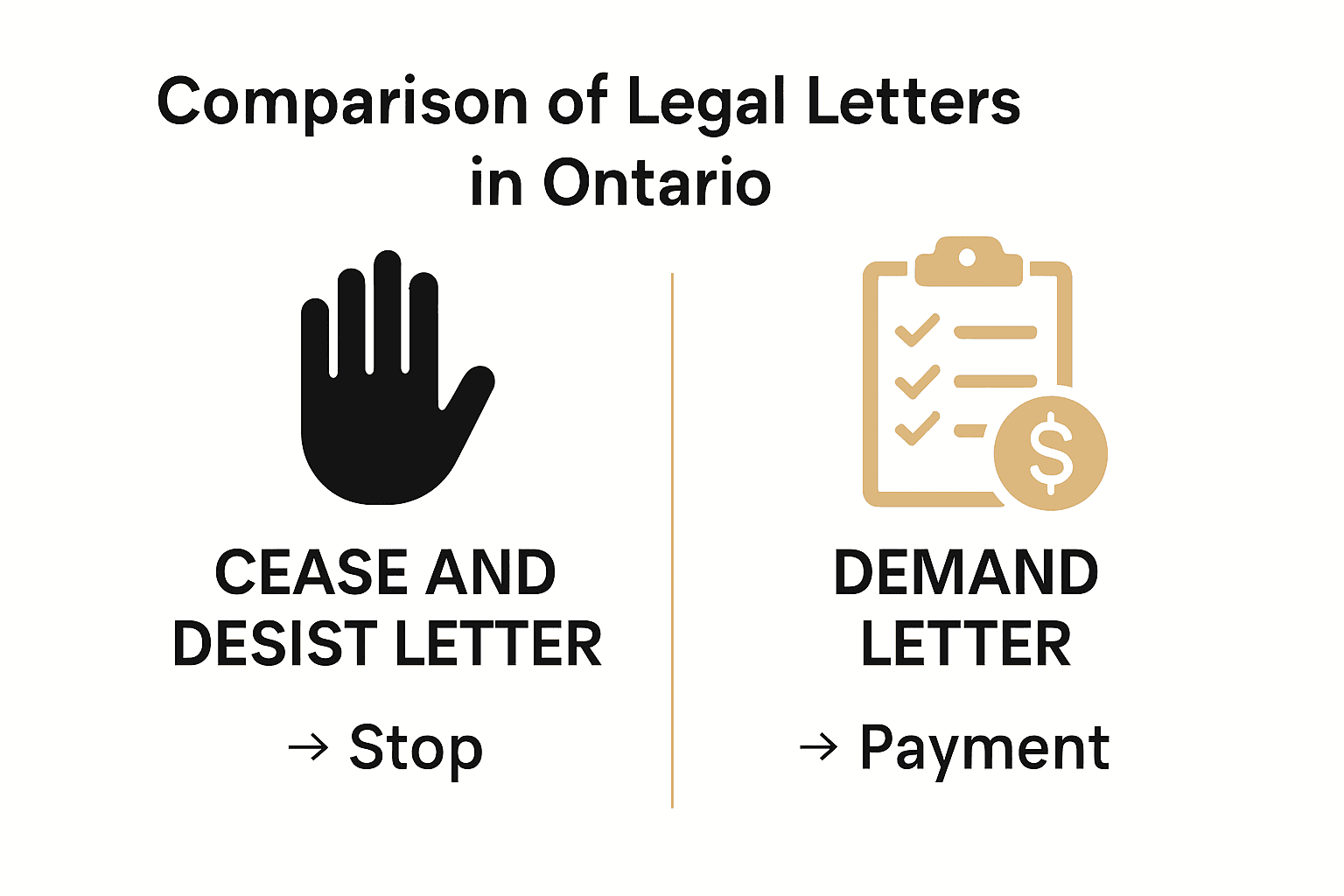
Here’s a comparison of the two main types of legal letters discussed:
| Feature | Cease and Desist Letter | Demand Letter |
|---|---|---|
| Primary Purpose | Stop unlawful activity | Demand payment or action |
| Common Scenarios | IP infringement Defamation Harassment | Debt recovery Breach of contract Severance requests |
| Typical Contents | Outline wrongdoing Legal basis Compliance deadline Warning of consequences | Statement of claim Restitution request Response deadline |
| Legal Effect | Warns of legal action Creates formal record | May precede court action Encourages settlement |
| Documentation Needed | Proof of wrongdoing Evidence of activity | Contracts Correspondence Invoices |
Essential Components of a Legal Letter
Crafting a legally effective letter requires careful attention to specific components that ensure clarity, professionalism, and potential legal enforceability. A well-structured legal letter can make the difference between a dismissed communication and one that compels action.
According to Square One, the critical foundational elements of a legal letter include:
- Date of communication
- Complete sender and recipient contact information
- Optional “without prejudice” heading
- Specific notice classification (e.g., “formal notice” or “default notice”)
- Detailed delivery method documentation
The substantive content must provide a comprehensive narrative. Genie AI recommends including a clear summary of the dispute, which should outline:
- Specific details of the legal obligation
- Precise legal basis for the claim
- Explicit payment or compliance terms
- Specific deadline for response
- Potential consequences of non-compliance
Supporting documentation can significantly strengthen your legal letter’s credibility. This might include contracts, correspondence records, or other relevant evidence that substantiates your claims. Learn more about the nuances of legal documentation to ensure your letter carries maximum legal weight. A meticulously constructed legal letter is not just a document—it’s a strategic communication tool designed to protect your interests and prompt appropriate action.

Legal Requirements and Framework in Ontario
Navigating the legal landscape for professional communications in Ontario requires a nuanced understanding of specific requirements and regulations. Legal letters are not just formal documents, but carefully constructed communications that must adhere to precise standards to maintain their credibility and potential enforceability.
According to Legal Line, Ontario law establishes clear guidelines for legal notices. Key requirements include:
- Written documentation
- Clear identification of the sender
- Specific description of the alleged wrongdoing
- Verifiable delivery method (such as registered mail)
The Law Society of Ontario provides additional guidance on professional communications. Their guidelines emphasize that while there are no strict rules about letterhead, professionals must ensure their communications are:
- Not misleading or deceptive
- Compliant with relevant business structure statutes
- Transparent in representing professional credentials
Learn more about when notarization is required in Ontario to understand how additional legal authentication can strengthen your documents. Ultimately, legal letters in Ontario are more than just pieces of paper—they are carefully crafted instruments that must balance legal precision with clear, professional communication.
Risks, Liabilities, and Common Mistakes
Legal letters can be powerful tools, but they also come with significant potential pitfalls that can undermine their effectiveness or even create additional legal complications. Understanding these risks is crucial for anyone preparing to send a formal legal communication.
According to Square One, several critical mistakes can significantly weaken a legal letter’s impact:
- Using aggressive or inflammatory language
- Making unsubstantiated claims or threats
- Failing to maintain a professional tone
- Omitting crucial “without prejudice” language
- Neglecting to preserve proof of delivery
Pro Paralegal highlights additional substantial risks that can compromise your legal communication:
- Unclear identification of involved parties
- Vague or unsupported legal claims
- Unreasonable response deadlines
- Lack of supporting documentation
- Imprecise or ambiguous demands
Potential consequences extend beyond just an ineffective letter. Poorly constructed legal communications can potentially:
- Damage your legal standing
- Provide ammunition for counterarguments
- Reduce your credibility in potential future proceedings
Learn more about the nuances of legal documentation to ensure your legal letters are both precise and strategically sound. Careful preparation and attention to detail can transform a potential liability into a powerful communication tool.
Take the Next Step: Professional Legal Letters and Reliable Notarization in Ontario
Feeling overwhelmed by the complexities of writing a legally sound letter in Ontario? This guide has shown just how crucial it is to use precise language, strong documentation, and proper legal formatting when preparing your notice, demand, or cease and desist correspondence. But even with all the right strategies, a letter only carries its full weight when it is properly notarized and officially recognized. That is where The Online Notary comes in.

Save time and take the uncertainty out of your legal letters. Our team provides secure online notary services for affidavits, statutory declarations, invitation letters, and more, helping to ensure your documents meet Ontario’s requirements from start to finish. Ready to protect your interests and make your communications count? Visit The Online Notary – Uncategorized for more details or start your professional notarization process now at https://theonlinentoary.ca. Get peace of mind by acting today.
Frequently Asked Questions
What is the purpose of a legal letter?
Legal letters serve as formal communications to resolve disputes, make official requests, or set legal expectations. They document your intent and can protect your rights while potentially preventing costly legal conflicts.
What are the key components of a legal letter?
A legal letter should include the date, sender and recipient contact information, the classification of notice, a detailed narrative of the dispute, specific terms, and possible consequences of non-compliance. Supporting documentation can also enhance its credibility.
What are the differences between a cease and desist letter and a demand letter?
A cease and desist letter demands someone stop an unlawful activity, while a demand letter articulates a legal claim and requests payment or performance of an obligation. Each serves different purposes and scenarios in legal communication.
What are common mistakes to avoid when writing a legal letter?
Common mistakes include using aggressive language, making unsubstantiated claims, failing to maintain a professional tone, neglecting supporting documentation, and omitting crucial ‘without prejudice’ language.
Recommended
- 7 Notarized Letter Samples to Guide Your Writing – The Online Notary
- How to Get a Notarized Consent Letter in Ontario 2025 – The Online Notary
- How to Create an Affidavit in Ontario (2025 Guide) – The Online Notary
- Notary Public vs Lawyer in Ontario: Key Differences for 2025 – The Online Notary
- Ontario Top Employment Law Cases You Need to Know