Getting a document certified in Ontario is about more than a signature or a seal. As of 2025, the province now supports digital certification for land registration, with over 120 countries accepting Ontario’s new apostille seal after Canada joined the Hague Apostille Convention. Think that means certification is easier than ever now. Not quite. Because the real challenge is knowing which method to use—and who can even certify your paperwork in the first place.
Table of Contents
- Understanding Certification Of Documents In Ontario
- Who Can Certify Documents In Ontario
- Steps To Certify Your Documents In 2025
- Tips For Businesses Needing Certified Documents
Quick Summary
| Takeaway | Explanation |
|---|---|
| Understand document certification types | Familiarize yourself with notarization, commissioner certifications, and international authentication methods to choose the best approach for your needs. |
| Identify authorized certification professionals | Know who can certify documents in Ontario, including notaries, lawyers, and commissioners to ensure your documents are properly authenticated. |
| Follow proper preparation steps | Prepare documents by gathering originals, ensuring they are legible, and providing necessary identification for a smoother certification process. |
| Leverage digital certification options | Explore expanding digital certification capabilities for convenience, especially for land and international document registrations as of 2025. |
| Implement strategic document management | Establish comprehensive document management practices to enhance security, compliance, and efficiency in the certification process. |
Understanding Certification of Documents in Ontario
Certification of documents in Ontario represents a critical process for individuals and businesses seeking to validate the authenticity of important paperwork. This formal verification ensures that documents are genuine, accurate, and legally recognized both within Canada and internationally.
The Legal Framework of Document Certification
In Ontario, document certification involves a systematic approach to confirming the legitimacy of various official papers. Learn more about legal document verification through authorized professionals who play a crucial role in this process. The certification process serves multiple purposes, including preventing fraud, establishing document credibility, and providing legal assurance for critical transactions.
The Ontario government has established specific guidelines for document certification. According to the Ontario Authentication Services, individuals can certify different types of documents, including:
- Personal Identification Documents: Birth certificates, passports, driver’s licenses
- Academic Credentials: Diplomas, transcripts, educational certificates
- Legal Documents: Affidavits, statutory declarations, power of attorney
- Business Documents: Corporate registration papers, financial statements
Types of Document Certification in Ontario
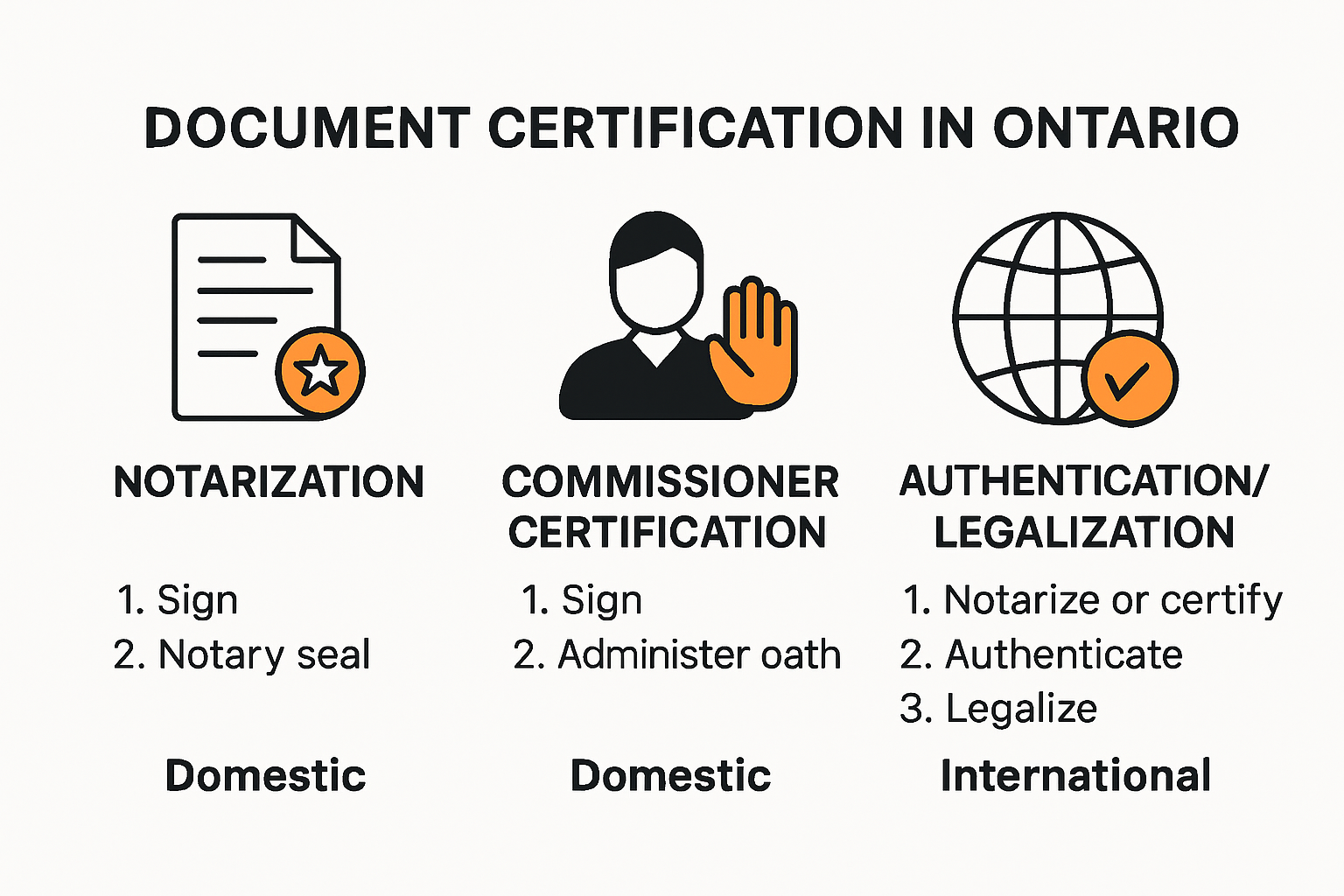
Document certification in Ontario encompasses several distinct methods of verification. The Document Registration Guide highlights three primary certification approaches:
Notarization: A notary public confirms the identity of the document signer and witnesses the signature, adding an official seal to validate the document’s authenticity.
Commissioner Certification: Commissioners for taking affidavits can certify various documents, typically used for statutory declarations and affidavits within Ontario.
Authentication and Legalization: For documents intended for use in foreign countries, this process involves multiple verification steps to ensure international recognition.
Understanding the nuanced requirements of document certification is crucial for Ontario residents and businesses. Each certification type serves a specific purpose, from local legal proceedings to international document validation. Professionals must carefully select the appropriate certification method based on the document’s intended use and destination.
The digital transformation has significantly impacted document certification. As of 2025, Ontario has expanded its digital certification capabilities, particularly in areas like land registration. The Electronic Land Registration System now provides automatic verification for certain document types, streamlining the certification process and enhancing overall efficiency.
Whether you’re preparing documents for personal, academic, or business purposes, understanding the intricacies of document certification in Ontario is essential. Proper certification ensures your documents carry the legal weight and credibility required in various professional and personal contexts.
To help compare the main document certification methods in Ontario, the following table summarizes key features of each approach.
| Certification Method | Who Can Perform | Typical Use Cases | International Recognition |
|---|---|---|---|
| Notarization | Notary Public | Legal documents, identity papers | Often, with further steps |
| Commissioner Certification | Commissioner of Oaths | Statutory declarations, affidavits | Generally within Ontario |
| Authentication & Legalization | ODS/Global Affairs + Notary | Documents for use abroad | Yes, after apostille/legalization |
Who Can Certify Documents in Ontario
Document certification in Ontario requires specific professional authorization, with carefully defined roles and responsibilities. Not everyone can certify documents, making it crucial to understand who has the legal capacity to perform these critical verification services.
Authorized Certification Professionals
In Ontario, several professional categories are legally empowered to certify documents. According to the Ontario Authentication Services, the primary authorized professionals include:
- Notaries Public: Appointed by the Ministry of Government and Consumer Services, notaries public have comprehensive authority to certify true copies of documents and witness signatures.
- Lawyers: Licensed by the Law Society of Ontario, lawyers can certify documents as part of their professional services.
- Commissioners of Oaths: Authorized to administer oaths and affirmations, these professionals can certify specific types of documents within Ontario.
Learn about online notarization options for convenient document certification processes that meet legal standards. The digital transformation has expanded certification methods, offering more flexible solutions for individuals and businesses.
International Document Authentication
For documents intended for international use, Ontario provides specialized authentication services. The Official Documents Services (ODS) plays a critical role in verifying document validity. As of January 11, 2024, Canada joined the Hague Apostille Convention, significantly simplifying international document recognition.
Under this convention, documents certified by authorized Ontario professionals can receive an apostille certificate. This internationally recognized seal eliminates the need for additional legalization steps in member countries. The apostille serves as a standardized form of authentication, ensuring document credibility across borders.
Critical considerations for document certification include:
- Verifying the specific professional’s current authorization
- Understanding the scope of their certification capabilities
- Ensuring the document meets all required verification standards
Professionals must maintain current credentials and stay informed about evolving certification requirements. Individuals seeking document certification should always confirm the current status and specific capabilities of their chosen certification professional.
The landscape of document certification continues to evolve, with digital technologies creating new opportunities for efficient and secure verification processes. Whether for personal, academic, or business purposes, understanding the authorized professionals and their certification capabilities is essential for navigating Ontario’s document authentication system.
Here is a summary table outlining who can certify documents in Ontario and what they are authorized to do.
| Professional Type | Authorized Actions | Typical Documents Handled |
|---|---|---|
| Notary Public | Certify true copies, witness signatures, notarize | Legal, personal, business docs |
| Lawyer | Certify as true copy, witness, notarize | Legal, business, academic |
| Commissioner of Oaths | Administer oaths, certify certain declarations/affidavits | Statutory declarations, affidavits |
Steps to Certify Your Documents in 2025
Certifying documents in Ontario requires a systematic approach that balances traditional methods with emerging digital technologies. Understanding the precise steps can help individuals and businesses navigate the certification process efficiently and accurately in 2025.
Preparing Your Documents
Before beginning the certification process, thorough document preparation is crucial. Explore online notarization options to understand the most convenient certification methods available. Ensure your documents meet these critical preparation requirements:
- Gather all original documents
- Ensure documents are clean, legible, and without alterations
- Verify that document copies are exact reproductions of the original
- Collect supporting identification for the certification process
According to the Ontario Authentication Services, different document types may require specific preparation steps. For instance, academic transcripts might need additional verification from the issuing institution, while personal identification documents require valid government-issued photo identification.
Certification Process and Digital Transformation
The 2025 document certification landscape in Ontario reflects significant technological advancements. As of June 2, 2025, ServiceOntario has expanded its Digital Certification functionality, particularly in land registration systems. The certification process now typically involves these key steps:
- Document Review: Authorized professionals thoroughly examine the document’s authenticity
- Identity Verification: Confirm the identity of the document owner
- Signature Witnessing: Professionally witness and validate signatures
- Seal and Certification: Apply official certification marks or digital authentication
For international document use, the Apostille Convention has streamlined the process. Canada’s implementation allows for a single certificate that validates documents across over 120 member countries, reducing previous complex authentication procedures.
Choosing the Right Certification Method
Selecting the appropriate certification method depends on your specific document and intended use. Options include:
- In Person Certification: Traditional method with direct professional interaction
- Online Notarization: Digital platforms offering remote document certification
- Institutional Verification: Direct authentication through issuing organizations
Consider factors such as document type, destination, urgency, and specific legal requirements when choosing your certification approach. Some documents may require multiple verification steps or specialized professional involvement.
While technology has transformed document certification, attention to detail remains paramount. Always double check requirements, maintain clear communication with certification professionals, and keep copies of all authenticated documents.
The evolving landscape of document certification in Ontario continues to prioritize security, efficiency, and accessibility. By understanding these steps and leveraging both traditional and digital certification methods, individuals and businesses can successfully navigate the certification process in 2025.
Tips for Businesses Needing Certified Documents
Businesses operating in Ontario face complex document certification requirements that demand strategic planning and meticulous attention to detail. Navigating these processes efficiently can significantly impact organizational productivity and legal compliance.
Document Management and Preparation
Learn about secure online notarization to streamline your business document certification processes. When preparing documents for certification, businesses must prioritize comprehensive organization and information protection.
According to Canada Revenue Agency guidelines, critical considerations for business document management include:
- Protecting personal information by redacting sensitive details
- Maintaining organized digital and physical document repositories
- Implementing secure document transmission protocols
- Creating systematic backup and archival processes
Businesses must also be aware of emerging digital certification technologies. As of June 2, 2025, ServiceOntario has expanded Digital Certification functionality in land registry systems, particularly for Transfer and Discharge of Charge document types, signaling a significant shift towards digital document authentication.
Compliance and International Documentation
For businesses operating across jurisdictions, understanding international document certification becomes paramount. The Apostille Convention has simplified international document verification, allowing businesses to authenticate documents more efficiently across 120 member countries.
Key compliance strategies for businesses include:
- Proactive Document Verification: Regularly audit and update certification processes
- Professional Consultation: Engage legal professionals specializing in document authentication
- Digital Transformation: Adopt technology that supports secure, efficient document certification
Businesses must also stay informed about evolving digital communication standards. Starting May 12, 2025, the Canada Revenue Agency will transition to online mail as the default communication method, emphasizing the importance of digital document management and certification.
Strategic Document Certification Approach
Successful document certification requires a holistic strategy that balances legal compliance, technological efficiency, and organizational needs. Businesses should develop a comprehensive document certification framework that:
- Establishes clear internal protocols for document authentication
- Leverages both traditional and digital certification methods
- Ensures consistent quality and legal compliance
- Adapts to changing technological and regulatory landscapes
By implementing a robust document certification strategy, businesses can mitigate risks, enhance operational efficiency, and maintain legal and professional credibility. The key lies in understanding the nuanced requirements of document certification and proactively adapting to technological and regulatory changes.
In the rapidly evolving landscape of 2025, businesses that invest in sophisticated document certification processes will position themselves for greater success, transparency, and legal compliance.

Frequently Asked Questions
What is the process for certifying documents in Ontario?
To certify documents in Ontario, you must prepare your documents, gather original copies, and provide identification. Then, choose an authorized professional such as a notary public or a commissioner of oaths to complete the certification process.
Who can certify documents in Ontario?
In Ontario, documents can be certified by notaries public, lawyers, and commissioners of oaths. These professionals are authorized to verify the authenticity of various types of documents based on their specific legal powers.
What types of documents can be certified in Ontario?
Commonly certified documents in Ontario include personal identification documents (like birth certificates and driver’s licenses), academic credentials (such as diplomas), legal documents (including affidavits and powers of attorney), and business documents (like corporate registrations and financial statements).
How has digital certification changed in Ontario as of 2025?
As of 2025, Ontario has expanded its digital certification capabilities, particularly for land registrations. Digital certification allows for a streamlined process where documents can be verified electronically, making it easier for individuals and businesses to authenticate documentation for international use.
Certify Your Ontario Documents Online Quickly and Securely
Struggling to find fast, reliable ways to certify documents in Ontario? If you are facing uncertainty over which professionals are authorized, worried about digital versus in-person certification, or just need to secure an affidavit or statutory declaration for business or personal use, you are not alone. Many people are anxious about delays, confusion, and evolving 2025 regulations for document validation. That is why we offer a better way.

Take the stress out of Ontario document certification. With secure online notary services, you can notarize affidavits, invitation letters, or solemn declarations without leaving your home or office. Our platform connects you with authorized professionals who meet all the legal standards discussed in this guide. Put your trust in an easy process designed for today’s digital requirements. Act now and get started with your online document certification so you can move forward with confidence and compliance.
Recommended
- The Complete Guide to Using an Online Notary Public for Affidavits and Declarations in Ontario (2025) – The Online Notary CA
- Why Opt for an Online Notary in Ontario – The Online Notary CA
- Everything You Need to Know About Online Notarization in Ontario: Fast, Legal, and Convenient for Affidavits and Declarations (2025) – The Online Notary CA
- Professional Online Notary Services in Canada – The Online Notary CA