
Affidavits are everywhere in Ontario legal life and can completely change the outcome of court cases, property deals, or government applications. Most people think it’s just a matter of filling out a form and signing your name. But the truth is, a single careless error or unverified fact in your affidavit can land you in legal trouble or even get your document thrown out entirely. There is a right way and a wrong way to write an affidavit, and missing the details could cost you much more than you expect.
Table of Contents
- Understanding Affidavits And Their Importance
- Essential Steps To Write An Affidavit In Ontario
- Legal Requirements And Notarization In 2025
- Common Mistakes And Pro Tips For Affidavits
Quick Summary
| Takeaway | Explanation |
|---|---|
| Affidavits are sworn statements. | They are legally binding documents declaring facts under oath, impacting legal proceedings. |
| Follow strict formatting guidelines. | Include your full name, details, and use clear language with numbered paragraphs for better organization. |
| Engage an authorized official for notarization. | Only notarized affidavits, sworn before lawyers or notaries, hold legal credibility in Ontario. |
| Ensure factual accuracy to avoid legal repercussions. | Include only verifiable information to prevent the risk of perjury or other legal issues. |
| Double-check for errors and clarity. | Proofread your affidavit thoroughly to correct mistakes, enhance clarity, and ensure legal compliance. |
Understanding Affidavits and Their Importance
An affidavit is a powerful legal document that serves as a critical tool in various legal and administrative processes across Ontario. At its core, an affidavit is a written statement of facts voluntarily sworn or affirmed under oath, providing a legally binding declaration of truth that can be used in court proceedings, government applications, and other official contexts.
What Exactly is an Affidavit?
In Ontario, an affidavit is a sworn statement made by an individual known as the ‘deponent,’ who confirms the truthfulness of the information contained within the document. Discover how to get an affidavit online with ease and convenience. According to the Ontario Commissioners for taking Affidavits Act, these documents must be signed in the presence of an authorized official such as a lawyer, notary public, or commissioner of oaths. The key distinction of an affidavit lies in its legal weight the deponent can be held accountable for any false statements, potentially facing serious legal consequences.
Legal Significance and Common Uses
Affidavits play a crucial role in multiple legal and administrative scenarios. They are commonly used in court proceedings as evidence, supporting legal claims or providing testimony when a person cannot appear in person. Government applications frequently require affidavits to verify personal information, immigration documents, property transfers, and various official processes. In business contexts, affidavits can confirm financial statements, verify identities, or provide sworn statements about specific events or transactions.
The process of creating an affidavit involves careful preparation and strict adherence to legal requirements. The document must clearly state the facts, be written in a concise and straightforward manner, and include specific details that support the deponent’s claims. When swearing an affidavit, individuals have two options: they can either take an oath (typically involving a religious text) or make a solemn affirmation if they prefer a non religious declaration.
It is important to understand that an affidavit is more than just a simple written statement. According to official Ontario government guidelines, the deponent must personally appear before an authorized commissioner, lawyer, or notary public to swear or affirm the contents of the document. This in person verification adds a layer of authenticity and legal credibility to the affidavit, ensuring that the information provided is accurate and voluntarily declared.
Whether you are dealing with legal proceedings, government applications, or business transactions, understanding the importance and proper creation of an affidavit is crucial. The document serves as a formal, legally binding declaration of truth that can significantly impact various aspects of personal and professional life in Ontario.
Essential Steps to Write an Affidavit in Ontario
Creating an affidavit in Ontario requires careful attention to detail and adherence to specific legal requirements. The process involves several critical steps that ensure the document’s legal validity and effectiveness in various administrative and judicial contexts.
Gathering and Organizing Accurate Information
Before drafting an affidavit, you must compile comprehensive and precise information. According to the Ontario Works Policy Directives, the content must be factual, clear, and directly relevant to the matter at hand. Begin by collecting all necessary documents, evidence, and supporting materials that substantiate the statements you plan to include. Learn more about preparing legal documents online to streamline your process.
Each statement within the affidavit should be based on personal knowledge or direct observation. Avoid speculation, hearsay, or opinions. The document must contain only verifiable facts that you can confidently swear are true. Number each paragraph sequentially and ensure that the information flows logically, providing a clear and coherent narrative of the events or circumstances you are describing.
Formatting and Drafting the Document
The structural requirements for an Ontario affidavit are precise. According to the Ministry of Children, Community and Social Services, the document must include specific elements to be considered legally valid. Start with a title clearly identifying the document as an ‘Affidavit’ and include your full legal name, address, and occupation at the top of the document.
Write in the first person and use clear, straightforward language. Each paragraph should contain a single, distinct fact or statement. Use numbered paragraphs to enhance readability and make referencing easier. Include specific dates, names, locations, and other relevant details that provide context and credibility to your statements.
Swearing or Affirming the Affidavit
The final and most crucial step is the formal swearing or affirmation of the document. As outlined in the Guide for Newly Appointed Commissioners, you must appear in person before an authorized official such as a lawyer, notary public, or commissioner of oaths. This official will verify your identity and administer the oath or affirmation.
During this process, you will be asked to confirm that the contents of the affidavit are true to the best of your knowledge. You can choose between taking a traditional oath (typically involving a religious text) or making a solemn affirmation. The official will then complete the jurat, which is the closing section of the affidavit that includes the date, location, and official’s signature, thereby authenticating the document.
Preparing an affidavit requires precision, honesty, and a thorough understanding of legal requirements. By following these essential steps meticulously, you can create a legally robust document that serves its intended purpose effectively in Ontario’s legal and administrative systems.
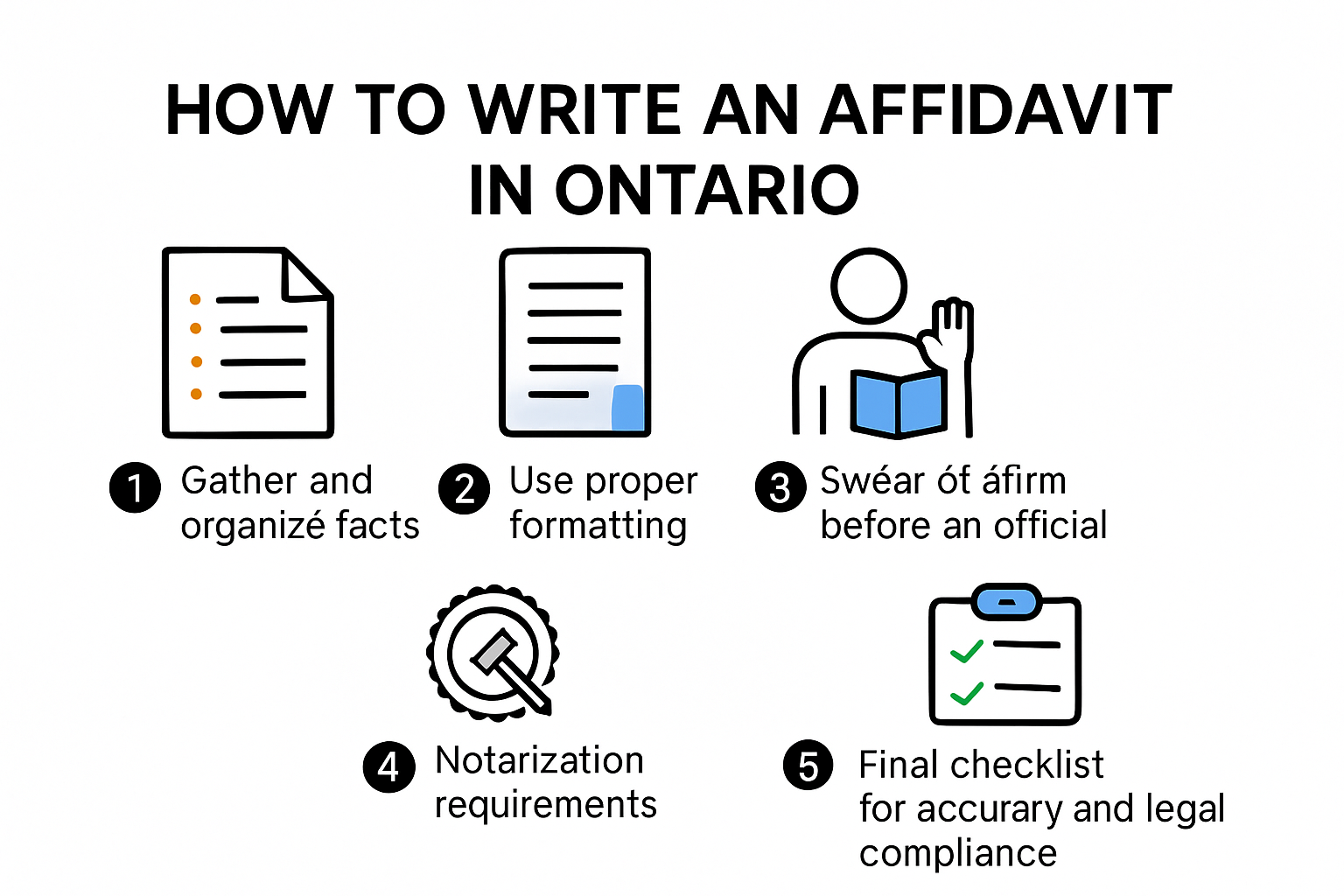
To help you navigate the affidavit creation process in Ontario, the table below summarizes the essential steps and their key requirements.
| Step | Key Actions/Requirements |
|---|---|
| Gather Accurate Information | Collect all relevant documents, evidence, and ensure statements are firsthand and verifiable. |
| Organize Information | Structure facts logically with numbered paragraphs and one fact per paragraph. |
| Draft the Document | Use clear language, include your name, address, occupation, and all other required details. |
| Swear or Affirm Before Official | Appear in person before a lawyer, notary, or commissioner; verify identity; take oath or affirmation. |
| Complete the Jurat | Official adds date, location, and signature to authenticate. |
Legal Requirements and Notarization in 2025
The landscape of legal documentation and notarization in Ontario continues to evolve, with specific regulations governing the creation, authentication, and validity of affidavits and other legal documents. Understanding these legal requirements is crucial for ensuring the proper execution and recognition of your affidavit in 2025.
Authorized Officials and Notarial Powers
In Ontario, only specific professionals are authorized to notarize documents and administer oaths for affidavits. According to the Law Society of Ontario, licensed lawyers and paralegals in good standing can apply to be appointed as notaries public. These professionals have comprehensive powers that extend beyond traditional notarization. Explore the details of online notarization to understand the current legal framework.
Notaries public in Ontario possess unique legal capabilities. They can witness document signings, administer oaths and declarations, and certify true copies of original documents. The Notaries Act provides a clear framework for these professionals, ensuring that their actions carry legal weight in various administrative and judicial contexts.
Document Authentication and Verification
The authentication process for affidavits in 2025 remains stringent. According to the Ontario Commissioners for taking Affidavits Act, documents must be verified in person by an authorized official. As of October 23, 2024, remote or virtual notarization is not permitted in Ontario, meaning that physical presence remains a critical requirement for document authentication.
When creating an affidavit, several key verification steps must be followed. The authorized official must:
- Confirm the identity of the deponent
- Ensure the document is voluntarily signed
- Verify that the deponent understands the contents of the document
- Administer an oath or solemn affirmation
- Complete the official jurat certifying the document
Emerging Legal Considerations
The legal landscape for document authentication continues to adapt to technological advancements and changing societal needs. While current regulations require in person verification, there are ongoing discussions about potential future modifications to notarization processes. Legal professionals and government bodies are carefully examining ways to balance traditional authentication methods with emerging digital technologies.
It is essential to stay informed about the most current legal requirements. Even though remote notarization is not currently permitted, the legal framework is dynamic and subject to change. Consulting with a licensed professional or authorized official remains the most reliable way to ensure your affidavit meets all current legal standards in Ontario.
Navigating the legal requirements for affidavits and notarization can be complex. By understanding the current regulations, working with authorized professionals, and staying informed about potential changes, you can ensure that your legal documents are properly authenticated and legally recognized in Ontario.
Common Mistakes and Pro Tips for Affidavits
Creating an affidavit requires precision and careful attention to detail. Even minor errors can significantly compromise the legal validity and effectiveness of your document. Understanding common pitfalls and professional strategies can help you navigate the complex process of drafting a legally robust affidavit in Ontario.
Critical Errors to Avoid
The most fundamental mistake individuals make is including speculative or hearsay information. According to the Ontario Superior Court of Justice, affidavits must contain only factual, firsthand information. Any statements based on rumors, assumptions, or second hand knowledge can render your entire document inadmissible. Learn more about preparing accurate legal documents to ensure your affidavit meets strict legal standards.
Additionally, many people underestimate the importance of organization. The Supreme Court of British Columbia recommends following the ‘S.O.S.’ principle: keeping the document Simple, Organized, and Short. This means structuring your affidavit with clear, numbered paragraphs, using straightforward language, and eliminating unnecessary details that could potentially confuse or dilute your primary message.
Professional Preparation Strategies
Professional legal experts emphasize the critical importance of thorough preparation. According to Bell Temple LLP, inadequate document preparation can result in significant legal complications and additional costs. Before drafting your affidavit, gather all relevant supporting documentation, chronologically organize your facts, and ensure every statement can be substantiated with evidence.
Verification is another crucial step often overlooked. Double check every detail for accuracy, including names, dates, addresses, and specific circumstances. Proofread multiple times to eliminate grammatical errors, typos, or inconsistent formatting that could potentially undermine the document’s credibility. Consider having another professional review the document before final submission.
Legal and Ethical Considerations
Ethical considerations are paramount when creating an affidavit. The legal consequences of false statements can be severe. In Ontario, providing false information in an affidavit can lead to serious legal repercussions, including potential perjury charges. This means you must be absolutely certain of the truthfulness of every statement you make.
Remember that an affidavit is a sworn statement made under oath. This means you are legally declaring the contents to be true to the best of your knowledge. Any intentional misrepresentation or deliberate omission of critical information can result in significant legal penalties. When in doubt about the accuracy of a statement, it is always better to consult with a legal professional who can provide guidance.
By understanding these common mistakes and implementing professional strategies, you can create a comprehensive, legally sound affidavit that effectively communicates your intended message while maintaining the highest standards of legal integrity. Careful preparation, attention to detail, and unwavering commitment to truthfulness are the cornerstones of a successful affidavit.

Below is a table summarizing common mistakes in affidavit preparation and the suggested professional strategies to avoid them.
| Common Mistake | Why It’s a Problem | Pro Tip/Strategy to Avoid |
|---|---|---|
| Including hearsay or opinion | Makes affidavit inadmissible, weakens credibility | Use only firsthand, verifiable facts |
| Poor organization | Causes confusion, dilutes main message | Follow S.O.S. (Simple, Organized, Short) |
| Inadequate preparation | Results in legal complications and added costs | Gather all supporting documentation |
| Lack of verification | Leads to factual errors, undermines document integrity | Double-check all names, dates, and details |
| Grammatical/formatting errors | Reduces professionalism and may cause misunderstanding | Proofread thoroughly; have others review |
| False or misleading statements | Can result in legal penalties and document rejection | Only swear to what you absolutely know is true |
Frequently Asked Questions
What is an affidavit in Ontario?
An affidavit is a sworn written statement made by an individual, known as the ‘deponent,’ declaring specific facts under oath. It is used in various legal and administrative processes, holding significant weight in court and other official contexts.
How do I properly format an affidavit in Ontario?
When formatting an affidavit, include a title identifying it as an ‘Affidavit,’ along with your full legal name, address, and occupation. Use numbered paragraphs for clarity, state facts in the first person, and ensure each paragraph contains a single statement or fact.
What are the legal requirements for notarizing an affidavit in Ontario?
In Ontario, affidavits must be sworn or affirmed in person before an authorized official, such as a licensed lawyer, notary public, or commissioner of oaths. This person will verify your identity and administer the oath or affirmation.
What common mistakes should I avoid when creating an affidavit?
Common mistakes include including hearsay or opinion, poor organization, inadequate preparation, lack of verification, and grammatical errors. To avoid these issues, ensure the document contains only firsthand facts, follow a clear structure, and thoroughly proofread before submission.
Create an Error-Free Affidavit in Minutes with Online Notary Experts
Tired of feeling anxious about missing a legal detail or making a costly mistake in your affidavit? You just learned how critical accuracy and proper notarization are for legal documents in Ontario. Even a simple error can cause delays or rejection. Why risk legal headaches in 2025 when you can ensure every step meets Ontario’s current standards, all from the comfort of your home?

Let The Online Notary help you complete your affidavit the right way. Our secure digital platform connects you to licensed notaries who handle affidavits, statutory declarations, and more. Ready to avoid common pitfalls and get your sworn statement accepted? Start your affidavit online now and experience peace of mind knowing your document is valid, compliant, and fully notarized for use anywhere in Ontario.
Recommended
- How to Get an Affidavit Online in Ontario 2025 – The Online Notary CA
- Everything You Need to Know About Online Notarization in Ontario: Fast, Legal, and Convenient for Affidavits and Declarations (2025) – The Online Notary CA
- The Complete Guide to Using an Online Notary Public for Affidavits and Declarations in Ontario (2025) – The Online Notary CA
- How to Notarize Documents in Ontario: Easy 2025 Guide – The Online Notary CA