
Many Ontario residents believe any document can be notarized online, but legal restrictions apply. Virtual notarization offers a safe and compliant option for specific documents like affidavits and declarations. This guide clarifies the legal, technological, and practical aspects so you can confidently use secure online notary services in Ontario.
Table of Contents
- Legal Framework For Virtual Notarization In Ontario
- Technological Security Measures In Virtual Notarization
- Types Of Documents Eligible For Virtual Notarization In Ontario
- Common Misconceptions About Virtual Notary Safety
- Comparison: Virtual Vs Traditional Notarization Safety And Convenience
- Practical Steps To Use A Compliant Virtual Notary Service In Ontario
- Summary And Next Steps
- Secure Online Notarization Services Tailored For Ontario
Key takeaways
| Point | Details |
|---|---|
| Legal restrictions apply | Ontario law limits virtual notarization to specific documents like affidavits and statutory declarations. |
| Strong security measures | Virtual notaries use encryption, multi-factor ID verification, and recorded sessions to protect your documents. |
| Some documents are ineligible | Wills, powers of attorney, and passport copies cannot be notarized virtually in Ontario. |
| Faster and more convenient | Virtual notarization offers quick turnaround with recorded audit trails and no travel required. |
| Choose licensed providers | Selecting compliant services ensures legal acceptance and prevents fraud. |
Legal framework for virtual notarization in Ontario
Ontario’s legal landscape shapes how virtual notary services operate. The Notaries Act requires physical presence for notarization, limiting full virtual notary use in the province. However, Ontario Regulation 431/20 introduced a specific exception allowing commissioners to administer oaths and declarations via video for certain documents.
The Law Society of Ontario warns against using unlicensed virtual notaries because their acts may be legally invalid. This creates confusion for residents seeking convenient online options. Clear legal boundaries define which documents and notarial acts qualify for virtual services.
Key legal points include:
- Physical presence remains the default requirement under the Notaries Act
- Regulation 431/20 permits video oaths for specific document types only
- Commissioners must be properly licensed to perform virtual notarizations
- Unlicensed services risk producing invalid or unacceptable documents
Understanding these restrictions helps you avoid costly mistakes. Not every notarial service translates to the virtual environment under current Ontario law. You need to verify both the document type and the notary’s authority before proceeding.
Pro Tip: Always check if your specific document qualifies under Ontario Regulation 431/20 before booking a virtual notary appointment to avoid wasted time and money.
Technological security measures in virtual notarization
Virtual notary platforms implement multiple layers of security to protect your sensitive documents. Bank-level encryption safeguards data transmission and storage, while compliance with Canada’s Personal Information Protection and Electronic Documents Act (PIPEDA) ensures your privacy rights remain protected.

Identity verification goes beyond what traditional notaries can achieve. Multi-factor authentication combines government ID scans with live video confirmation, making impersonation extremely difficult. These digital checks often exceed the security of quick in-person ID glances.
Remote online notarization provides a secure audit trail with recorded video and electronic journals maintained for 5 to 10 years. These permanent records deter fraud and support legal challenges if questions arise about document authenticity. Traditional paper journals can be lost, altered, or destroyed.
Security features include:
- End-to-end encryption protecting all data transmission
- PIPEDA compliance for Canadian privacy standards
- Government ID verification with liveness detection
- Complete session recordings stored securely
- Tamper-proof electronic journals with timestamps
These technological safeguards create a more traceable and accountable process than traditional notarization. Every step is documented and verifiable. The combination of encryption, identity checks, and permanent records makes virtual notarization remarkably secure for eligible documents.
Pro Tip: Before submitting documents, verify the platform displays current security certifications and clearly explains its encryption protocols and data retention policies.
Types of documents eligible for virtual notarization in Ontario
Ontario regulations strictly limit which documents qualify for virtual notarization. Affidavits, statutory declarations, and solemn declarations are eligible under provincial rules. These documents involve sworn statements where commissioners can administer oaths via video conferencing.
Restricted documents include wills, powers of attorney, and certified true copies of passports. Attempting to notarize these documents virtually in Ontario creates serious legal risks. The notarization may be deemed invalid, leaving you with a rejected document and wasted money.
Eligible documents typically include:
- Affidavits for court proceedings or legal matters
- Statutory declarations for government applications
- Solemn declarations for official statements
- Invitation letters requiring commissioner signatures
- Business affidavits and corporate declarations
Ineligible documents require traditional in-person notarization:
- Last wills and testaments
- Powers of attorney for property or personal care
- Certified true copies of passports or citizenship documents
- Real estate transfer documents in many cases
- Documents requiring notary public seals (not commissioner stamps)
Understanding these boundaries prevents costly mistakes. Always confirm your document type before selecting virtual notarization. Using virtual services for restricted documents wastes time and money while creating potential legal problems.
Common misconceptions about virtual notary safety
Many Ontario residents hold incorrect beliefs about virtual notarization that prevent them from using these convenient services. The biggest myth claims all online notary services are illegal or unrecognized in Ontario. In reality, properly licensed commissioners offering video oath administration comply fully with provincial regulations.
Another misconception suggests virtual notarization equals traditional notarization for every document type. Legal restrictions mean certain documents remain ineligible regardless of how secure the technology becomes. Understanding these limits prevents frustration and rejected applications.
Some assume virtual notarization is less secure than in-person services. Virtual notaries in Ontario employ stricter identity verification than traditional methods, including multi-factor checks and complete session recordings. These digital safeguards often surpass the quick ID glance typical of in-person notarization.
Common myths include:
- All virtual notary services are illegal in Ontario
- Virtual notarization works for any document type
- Identity verification is weaker online than in person
- Digital notarizations lack legal standing in courts
- Traditional methods are always more secure
The truth is that licensed virtual notaries combine advanced technology with legal compliance. Recorded sessions create audit trails impossible with traditional methods. Encryption protects your documents better than physical transport. Multi-factor identity checks reduce fraud risk significantly.
Pro Tip: Verify a virtual notary’s licensing status with the Law Society of Ontario before using their services to ensure legal compliance and document acceptance.
Comparison: virtual vs traditional notarization safety and convenience
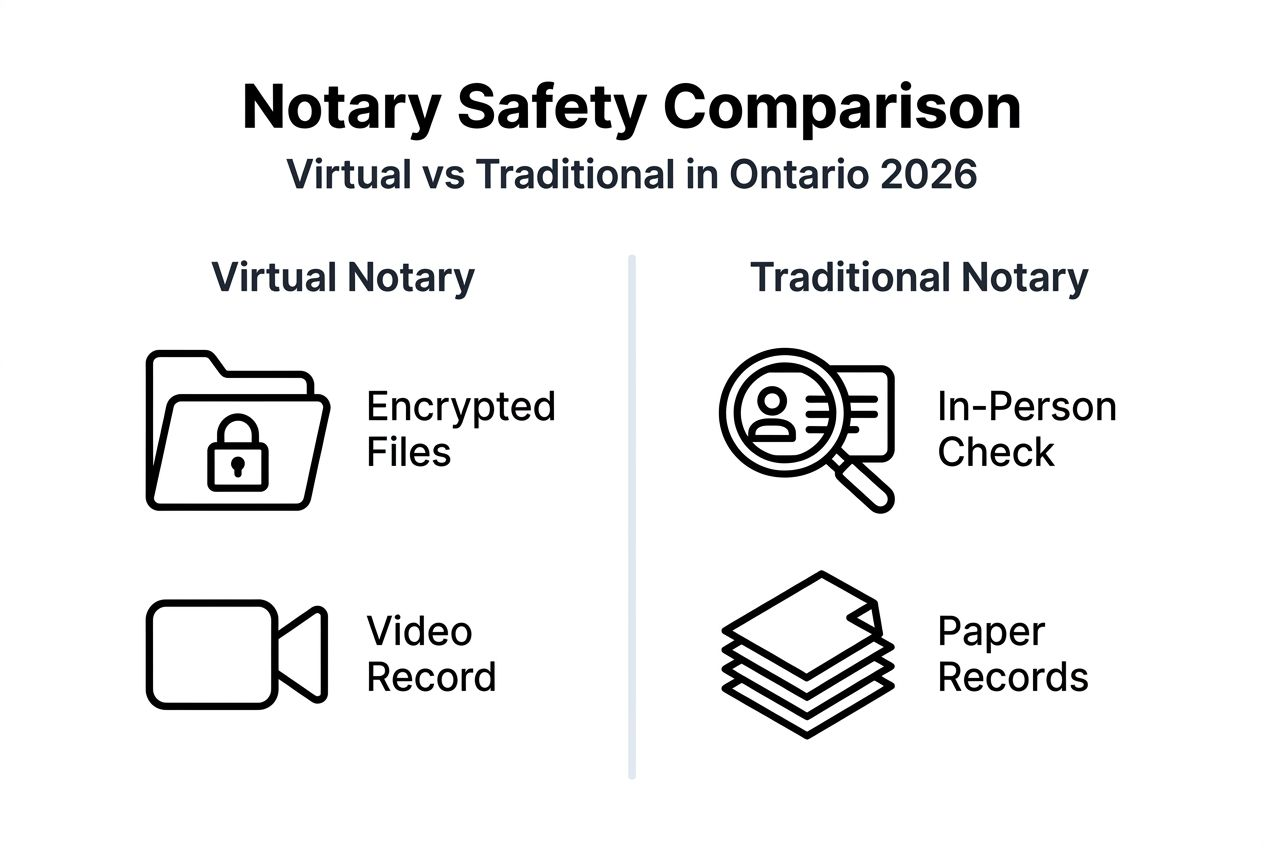
Virtual and traditional notarization each offer distinct security features and convenience factors. Understanding these differences helps you choose the right option for your specific needs and document types.
| Feature | Virtual Notarization | Traditional Notarization |
|---|---|---|
| Identity verification | Multi-factor digital ID scan plus live video with liveness detection | Visual inspection of physical ID card |
| Session documentation | Complete video recording with timestamps and encrypted storage | Handwritten journal entries |
| Data protection | End-to-end encryption and PIPEDA compliance | Physical document security |
| Fraud prevention | Permanent audit trail with tamper-proof records | Paper journals that can be altered or lost |
| Convenience | 24/7 availability from any location with internet | Limited to notary office hours and locations |
| Turnaround time | Often same day or within hours | Depends on appointment availability and travel |
Virtual notarization uses encrypted sessions, multi-factor identity verification, and recorded video audit trails. These digital safeguards create stronger fraud prevention than traditional manual ID checks. The permanent video record proves exactly who appeared and what was signed.
Traditional notarization requires physical presence, manual ID inspection, and physical journal records. This approach remains necessary for restricted documents like wills and powers of attorney. Face-to-face interaction provides a different kind of assurance for complex legal matters.
Key security advantages of virtual notarization:
- Digital identity verification reduces impersonation risk
- Encrypted transmission protects document confidentiality
- Recorded sessions provide irrefutable proof of signing
- Electronic journals cannot be easily altered or destroyed
Traditional notarization maintains importance for documents requiring physical presence under Ontario law. Geographic and scheduling barriers disappear with virtual services, but legal eligibility remains the determining factor. Choose based on your document type and legal requirements rather than assumptions about security.
Practical steps to use a compliant virtual notary service in Ontario
Following a clear process ensures your virtual notarization meets Ontario legal requirements while protecting your documents and identity.
- Confirm the virtual notary service is licensed and compliant with Ontario regulations by checking Law Society of Ontario records.
- Verify the service follows multi-factor identity verification including government ID scanning and live video confirmation.
- Check your document’s eligibility for virtual notarization under Ontario Regulation 431/20 before starting the process.
- Prepare valid government-issued photo ID such as a driver’s license or passport for the identity verification process.
- Ensure you have a stable internet connection, working camera, and microphone for the live video session.
- Join the secure video session at your scheduled time and follow the notary’s instructions for identity confirmation.
- Present your ID to the camera as directed and complete any additional identity verification steps required.
- Review your document on screen and confirm you understand its contents before signing electronically.
- Sign the document during the recorded session while the notary administers the oath or declaration.
- Receive and download your digitally notarized document with the official digital seal immediately after completion.
Verifying licensing and following multi-factor identity protocols ensure successful, legally compliant virtual notarization in Ontario. Taking these steps protects you from invalid notarizations and potential document rejection. The process typically takes 10 to 15 minutes once you have everything prepared.
Most reputable services provide clear instructions and technical support throughout the process. If you encounter technical difficulties, contact support immediately rather than rushing through. Proper completion matters more than speed.
Summary and next steps
Virtual notary services in Ontario are safe and legally compliant when following provincial laws and technological best practices. Licensed commissioners can administer oaths via video for eligible documents like affidavits and statutory declarations. Strong encryption, multi-factor identity verification, and recorded sessions provide security that often exceeds traditional methods.
Certain documents like wills and powers of attorney remain ineligible for virtual notarization in the province. Understanding these restrictions prevents wasted time and invalid documents. Always verify both document eligibility and notary licensing before proceeding.
Choosing licensed virtual notaries ensures legal acceptance and reduces fraud risk significantly. The combination of advanced technology and regulatory compliance creates a secure, convenient option for eligible documents. You can confidently use virtual notary services while staying within legal boundaries.
Stay informed about your specific document requirements and prepare proper identification. Following the practical steps outlined above leads to smooth, successful virtual notarization that meets all Ontario legal standards.
Secure online notarization services tailored for Ontario
Ready to experience safe, compliant virtual notarization? Our trusted notary online services are specifically designed for Ontario residents and fully compliant with provincial regulations.

We offer 24/7 expert notary support through encrypted platforms with comprehensive multi-factor verification. Our licensed commissioners specialize in affidavits, statutory declarations, and solemn declarations. You can notarize documents online in Ontario from anywhere, saving time while maintaining the highest security standards. Our digital notary security protocols meet all Ontario requirements while protecting your sensitive information.
Frequently asked questions
Is virtual notarization legally accepted in Ontario courts?
Yes, for eligible documents following Ontario regulations, virtual notarization is legally accepted in courts and government agencies. Proper licensing and compliance ensure legal validity. Documents notarized by licensed commissioners using approved video platforms carry the same legal weight as traditional notarization for qualifying document types.
Which documents cannot be notarized virtually in Ontario?
Wills, powers of attorney, and certified true copies of passports cannot be notarized virtually in Ontario. These documents require traditional in-person notarization. Using virtual services for restricted documents may invalidate them, leading to rejection by courts or agencies.
How does identity verification work in virtual notary services?
Identity verification combines scanning your government-issued photo ID with live video confirmation during the session. Advanced systems use liveness detection to prevent photo or video fraud. Recorded sessions and multi-factor checks often provide stronger security than quick in-person ID glances.
What should I check before using a virtual notary in Ontario?
Confirm the notary’s licensing status with the Law Society of Ontario or relevant authorities. Verify your document is eligible for virtual notarization under current Ontario regulations. Ensure the platform uses strong encryption and supports comprehensive multi-factor ID verification to protect your information and ensure legal compliance.
Recommended
- Digital Notary Security: Legal Compliance in Ontario – The Online Notary
- Notary Online in Ontario: Fast and Secure Options for 2025 – The Online Notary
- Online Notary Public in Ontario: Services and Benefits 2025 – The Online Notary
- Digital Certificates Explained: Secure PDF Workflows Guide –
- Perché la didattica digitale è sicura oggi – Recupero Anni Scolastici e Diploma Online