

Notaries in Ontario do much more than just stamp paperwork. A recent regulatory change now lets paralegals act as notaries and even allows for remote notarization. That might sound like a small detail, but here’s what catches people off guard. These changes are transforming how residents and businesses secure their most important legal documents, making protection against fraud and international recognition more accessible than ever.
Table of Contents
- What Is The Notary Public Role In Ontario?
- Key Duties And Legal Responsibilities
- How Businesses And Residents Benefit
- Steps To Find A Notary Public In Ontario
Quick Summary
| Takeaway | Explanation |
|---|---|
| Notaries Public Are Essential for Document Authentication | In Ontario, notaries public verify and authenticate important documents and legal transactions, playing a crucial role in preventing fraud and ensuring legal validity. |
| Recent Regulatory Changes Enhance Notary Capabilities | Amendments to the Notaries Act have expanded the scope of notaries by allowing remote notarization and appointment of paralegals, improving accessibility and convenience for clients. |
| Benefits for Businesses and Residents | Notarization provides legal protection, prevents fraud, and offers international document recognition, making it valuable for both personal and business needs. |
| Variety of Sources to Find Notary Services | Residents can locate notaries through law firms, digital platforms, and community resources, ensuring convenience and accessibility for their notarization needs. |
What Is the Notary Public Role in Ontario?
Notaries public play a crucial legal role in Ontario, serving as authorized professionals who verify and authenticate important documents and legal transactions. These professionals provide essential services that help individuals and businesses ensure the legitimacy and integrity of critical paperwork.
Official Authorization and Responsibilities
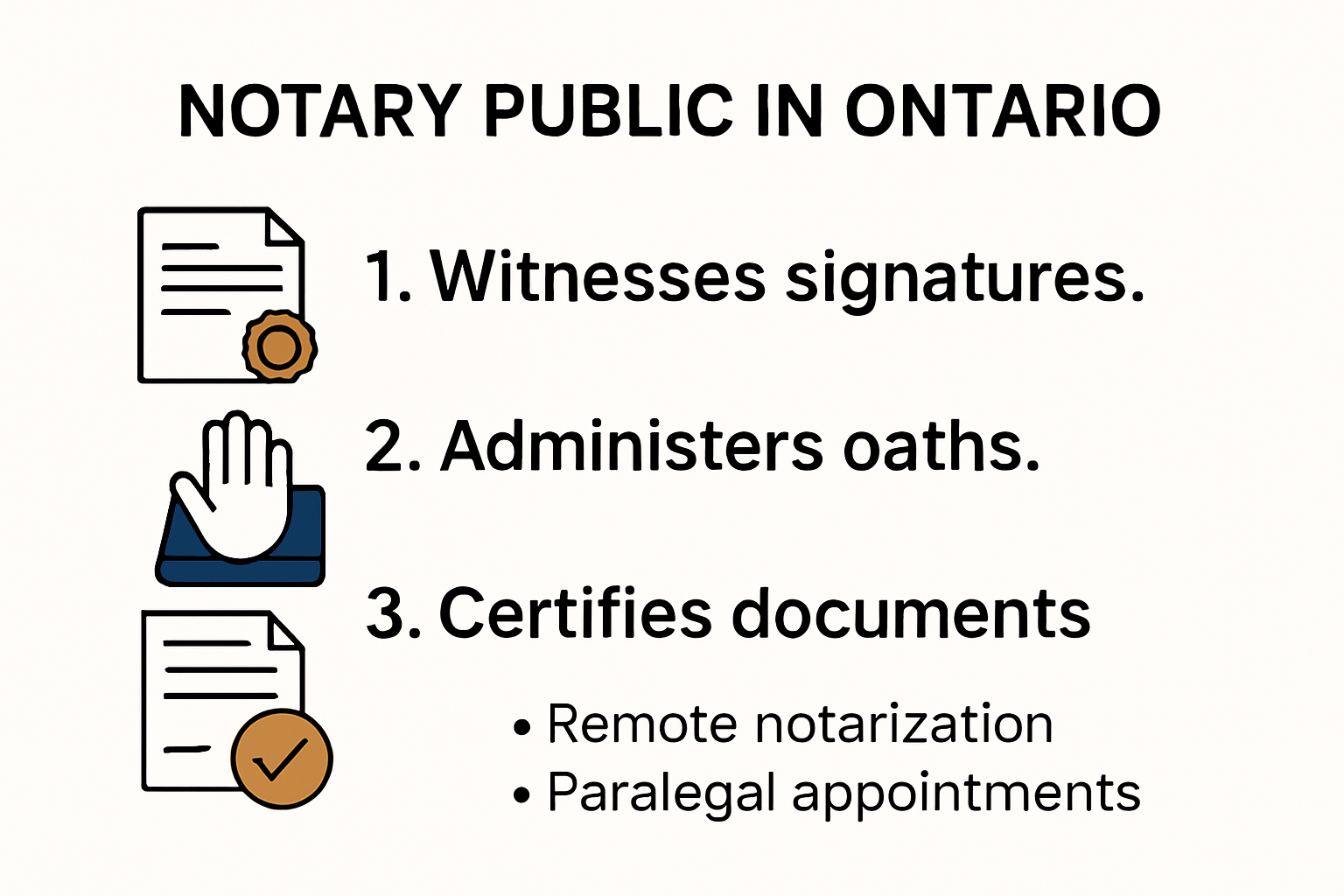
In Ontario, notaries public are specially appointed professionals with specific legal powers. The Law Society of Ontario confirms that licensed lawyers and paralegals can be appointed as notaries, holding a lifetime appointment contingent upon maintaining good standing with regulatory authorities. Their core responsibilities include:
- Document Witnessing: Verifying the identity of individuals signing important documents
- Oath Administration: Administering legal oaths and solemn declarations
- Document Certification: Certifying true copies of original documents
The scope of a notary public’s role extends beyond simple signature witnessing. They provide critical authentication services that help prevent fraud and ensure the legal validity of various documents.
Legal Frameworks and Recent Developments
Significant changes have occurred in Ontario’s notary public regulations. The Notaries Act was amended on August 1, 2020, introducing pivotal modifications to the profession. These amendments expanded notarial capabilities by:
- Allowing paralegals to become appointed notaries
- Permitting remote and virtual notarization
- Creating more flexible authentication processes
These updates reflect the evolving legal landscape and the increasing need for accessible, technology enabled document verification services. Notaries public now have greater flexibility in how they conduct their professional duties, making document authentication more convenient for Ontario residents.
Professional Standards and Integrity
Notaries public in Ontario are held to rigorous professional standards. They must:
- Maintain absolute confidentiality
- Verify the identity of individuals
- Ensure the willingness and understanding of document signers
- Refuse to notarize documents under suspicious circumstances
The meticulous nature of their work requires exceptional attention to detail and an unwavering commitment to legal and ethical standards. By providing reliable document authentication, notaries public contribute significantly to Ontario’s legal infrastructure, helping protect individuals and organizations from potential legal complications.
Key Duties and Legal Responsibilities
Notaries public in Ontario carry significant legal responsibilities that extend far beyond simple document signing. Their role involves complex legal authentication processes that require precision, integrity, and a deep understanding of legal protocols.
Document Authentication and Verification
The primary duty of a notary public involves comprehensive document authentication. The Law Society of Ontario outlines specific procedures for verifying document legitimacy. This process includes:
- Identity Confirmation: Rigorously checking government issued identification
- Signature Verification: Ensuring the individual signing understands the document
- Willingness Assessment: Confirming the signer is acting voluntarily
Notaries must meticulously examine documents to prevent potential fraud. They assess whether signers comprehend the legal implications of the documents they are executing. This responsibility requires exceptional attention to detail and an understanding of potential legal vulnerabilities.
Oath Administration and Legal Declarations
Ontario’s Notaries Act empowers notaries to administer oaths and take solemn declarations. These legal processes involve helping individuals make formal statements with legal weight. Notaries ensure that:
- Individuals understand the serious nature of their declarations
- Statements are made voluntarily
- The declarant is of sound mind
- The declaration meets specific legal requirements
This responsibility extends to various contexts including affidavits, statutory declarations, and other legally binding statements. The notary public serves as an impartial witness to these critical legal moments.
Specialized Document Services

Beyond standard notarization, notaries in Ontario provide specialized document services. The Professional Notary Association highlights several advanced responsibilities:
- Certifying true copies of original documents
- Witnessing the execution of specific legal instruments
- Preparing and authenticating international documents
- Providing certification for documents requiring cross border recognition
Notaries must stay current with evolving legal standards and international documentation requirements. Their expertise ensures documents maintain legal validity across different jurisdictions. This role demands continuous professional development and a comprehensive understanding of legal frameworks.
The intricate responsibilities of notaries public underscore their critical role in Ontario’s legal ecosystem. They serve as guardians of document integrity, protecting individuals and organizations from potential legal complications through meticulous verification and authentication processes.
How Businesses and Residents Benefit
Notarization provides substantial advantages for both businesses and residents in Ontario, offering critical legal protections and streamlining complex documentation processes. Understanding these benefits helps individuals and organizations make informed decisions about when and why to utilize notary public services.
Legal Protection and Fraud Prevention
Research from the Ontario Bar Association indicates that notarization serves as a powerful mechanism for preventing fraudulent activities. By requiring rigorous identity verification and voluntary document signing, notaries create an additional layer of legal protection. This process offers significant benefits:
- Identity Verification: Comprehensive checks that minimize impersonation risks
- Voluntary Confirmation: Ensuring signatories understand and willingly execute documents
- Unbiased Witnessing: Providing an impartial third party authentication
Businesses particularly benefit from these protections, as notarized documents reduce potential legal disputes and provide clear evidence of transaction legitimacy. For residents, this means enhanced personal security when executing important legal paperwork.
International Document Recognition
Global Legal Services Research highlights that notarized documents enjoy broader acceptance across different jurisdictions. This international recognition becomes crucial for various scenarios:
- Facilitating international business transactions
- Supporting immigration and travel documentation
- Authenticating academic and professional credentials
- Enabling cross border legal agreements
Notarization transforms local documents into internationally credible instruments. This capability proves especially valuable for businesses operating globally and residents engaging in international activities. The standardized verification process ensures documents maintain their legal integrity beyond Ontario’s borders.
Efficiency and Cost Effectiveness
The Canadian Legal Technology Association reports that notarization significantly reduces administrative complexities and potential legal challenges. By providing immediate document authentication, notaries help businesses and residents save time and potential future litigation costs. Key efficiency benefits include:
- Reducing document rejection rates
- Minimizing potential legal disputes
- Streamlining complex transaction processes
- Providing clear evidentiary documentation
For businesses, these efficiency gains translate into reduced administrative overhead and faster transaction completion. Residents benefit from simplified legal processes and increased confidence in their documentation. The relatively modest cost of notarization represents a strategic investment in legal security and procedural clarity.
Notarization ultimately serves as a critical tool for protecting legal interests, whether for individual residents or complex business operations. By providing robust authentication and international recognition, notary public services offer comprehensive value that extends far beyond simple document signing.
Steps to Find a Notary Public in Ontario
Locating a reliable notary public in Ontario requires strategic approaches and understanding of various service channels. Residents and businesses have multiple options for finding professional notarization services tailored to their specific needs.
Professional and Institutional Sources
ServiceOntario recommends several official channels for finding qualified notaries. Individuals can explore multiple professional avenues:
- Law Firms: Many law offices offer notary services with experienced professionals
- Local Courthouses: Provide direct access to authorized notaries and commissioners
- Professional Associations: Offer directories of certified notary professionals
- Government Service Centers: Provide direct notarization and commissioner of oaths services
These institutional sources guarantee professional standards and legal compliance. They often provide comprehensive documentation services beyond standard notarization, ensuring high quality authentication processes.
Digital and Online Platforms
The Law Society of Ontario acknowledges the growing trend of digital notarization services. Online platforms now offer convenient alternatives to traditional in person notarization:
- Virtual notary services with secure video authentication
- Online document verification platforms
- Mobile notary applications
- Professional legal service websites
Digital platforms provide flexibility for individuals unable to visit physical locations. These services streamline document authentication while maintaining rigorous verification standards. Users can often schedule appointments, upload documents, and complete notarization processes remotely.
Community and Local Resources
Ontario Community Services suggests exploring local community resources for accessible notary services. Practical options include:
- Public libraries offering commissioner of oaths services
- Local government service centers
- Community legal clinics
- Professional paralegal offices
- Municipal government administrative offices
These local resources often provide more affordable and convenient notarization options. They understand regional documentation requirements and can offer personalized guidance through complex authentication processes.
When selecting a notary public, individuals should verify professional credentials, understand service fees, and confirm the specific types of documents the notary can authenticate. Preparing documents in advance and bringing appropriate identification streamlines the notarization experience. By exploring these diverse channels, Ontario residents can find reliable notary services that meet their specific legal documentation needs.
To help readers quickly compare common ways to find a notary public in Ontario, the table below summarizes available channels, their key advantages, and examples:
| Channel | Key Advantages | Notable Examples |
|---|---|---|
| Law Firms | Professional expertise | Local law offices |
| Courthouses | Legal compliance | Municipal/provincial courthouses |
| Professional Associations | Certified professionals | Law Society, Notary Associations |
| Government Service Centers | Accessibility | ServiceOntario locations |
| Digital/Online Platforms | Convenience, remote use | Online notary services, mobile apps |
| Community/Local Resources | Affordability, access | Libraries, community clinics, paralegals |
The following table organizes major benefits of notarization for both businesses and residents in Ontario:
| Benefit | Description | Who Benefits |
|---|---|---|
| Legal Protection | Reduces risk of fraud and legal disputes | Businesses, Residents |
| International Recognition | Ensures documents are accepted across jurisdictions | Businesses, Residents |
| Efficiency | Speeds up and streamlines documentation processes | Businesses, Residents |
| Cost Effectiveness | Helps avoid future litigation or administrative costs | Businesses, Residents |
| Evidentiary Documentation | Creates legal proof of transactions or declarations | Businesses, Residents |
Frequently Asked Questions
What is the role of a notary public in Ontario?
Notaries public in Ontario are authorized professionals responsible for verifying and authenticating important documents and legal transactions. They ensure the legitimacy of critical paperwork through services like document witnessing, oath administration, and document certification.
How have recent regulatory changes affected notaries in Ontario?
Recent amendments to the Notaries Act allow paralegals to become appointed notaries and enable remote notarization. These changes enhance access and convenience for clients seeking notarization services.
What are the benefits of using a notary public?
Using a notary public provides legal protection against fraud, facilitates international document recognition, and increases efficiency in document processing, ultimately benefiting both individuals and businesses.
How can I find a notary public in Ontario?
Residents can find notary services through law firms, local courthouses, professional associations, online platforms for digital notarization, and community resources like libraries or municipal offices.
Don’t Let Document Delays or Legal Risks Hold You Back
Are you frustrated by long wait times or worried about the hassle of finding a trusted notary in Ontario? The article highlighted challenges with in-person visits and the need for reliable authentication for affidavits, invitation letters, or statutory declarations. With new rules allowing remote notarization and paralegal notaries, there’s never been a better time to simplify your experience and protect your peace of mind.

Experience secure and speedy online notary services with The Online Notary. Whether you need an affidavit, solemn declaration, or other legal documents notarized from home, you can trust our Ontario-licensed professionals. Avoid the risk of rejected paperwork and ensure your documents are accepted anywhere they’re needed. Get started today with The Online Notary and see how quick and simple notarization can be.