
TL;DR:
- A notarized immigration document verifies the signer’s identity and voluntary signature but does not confirm the content’s truthfulness. Such documents include affidavits, true copies, and sworn translator statements in Ontario, while vital records require certified copies from issuing agencies. Proper preparation and understanding differentiating notarization, certification, and apostilles prevent costly rejections and streamline the immigration process.
A notarized document for immigration is a signed document verified by a commissioned notary public to authenticate the signer’s identity and confirm they signed willingly, adding legal credibility required for specific immigration submissions. Ontario applicants navigating Canadian immigration processes through Immigration, Refugees and Citizenship Canada (IRCC) regularly encounter notarization requirements for affidavits, certified true copies, and sworn translator statements. Understanding exactly what notarization accomplishes, and what it does not, prevents costly delays and outright rejections.

Notarization is not a blanket stamp of approval on a document’s truthfulness. A notarized signature confirms identity and voluntary signing but does not prove the document’s legal validity or factual accuracy. Immigration authorities treat notarized documents as authentic in origin, not as verified in content. That distinction shapes every decision you make about which documents to notarize and how to prepare them.
What notarized documents for immigration are typically required in Ontario
Common immigration documents requiring notarization include affidavits of identity, proof of relationship affidavits, and certified true copies of diplomas or professional licenses. The list below covers the categories Ontario applicants encounter most frequently.
- Affidavits and sworn statements. An affidavit of support, an affidavit of identity, or a statutory declaration confirming a relationship must be sworn before a notary public or commissioner of oaths in Ontario.
- Certified true copies. Copies of educational credentials, driver’s licenses, or professional certifications can be notarized as true copies of the originals you present in person.
- Sworn translator affidavits. IRCC requires that foreign-language documents be accompanied by a certified translation and a sworn translator affidavit sworn before an authorized person, including a notary or commissioner in Ontario.
- Employment reference letters and proof of relationship affidavits. These are frequently requested for work permit and family sponsorship applications.
- Invitation letters. A notarized invitation letter for a visitor visa or temporary resident permit carries more weight than an unverified letter.
One category sits outside notarial authority entirely. Only the issuing government agency can provide certified copies of vital records. A notary cannot certify a copy of a birth certificate, death certificate, or marriage certificate. For those documents, you request a certified copy directly from the provincial registrar or the foreign government that issued the original.
Pro Tip: Before booking a notary appointment, confirm with your immigration consultant or lawyer whether the receiving authority wants a notarized copy or a certified copy from the issuing agency. Submitting the wrong type is one of the most common and easily avoidable errors.
How notarization differs from certified translation, apostille, and certified copies
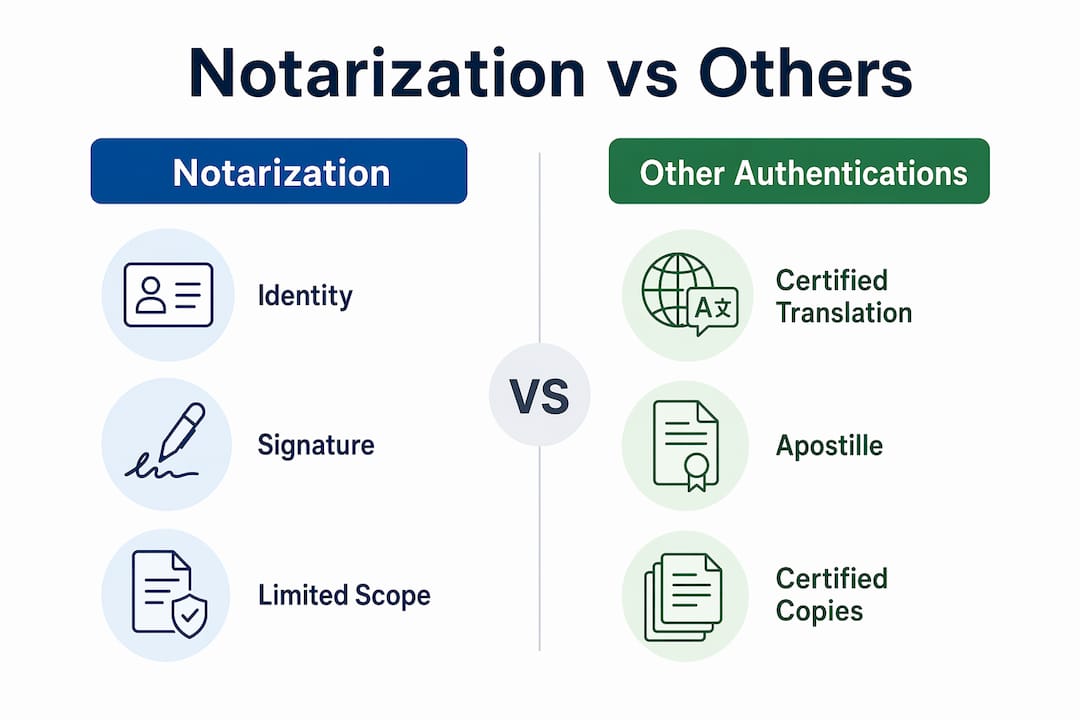
These four terms appear constantly in immigration paperwork, and confusing them causes real problems. The table below clarifies each one.
| Authentication type | Who performs it | What it confirms | When immigration requires it |
|---|---|---|---|
| Notarization | Licensed notary public or commissioner of oaths | Signer’s identity and voluntary signature | Affidavits, sworn statements, certified true copies |
| Certified translation | Professional translator | Accuracy and completeness of translation | All foreign-language documents for IRCC |
| Apostille | Competent authority in the issuing country | Authenticity of a public document for international use | Documents from Hague Convention countries destined for foreign authorities |
| Certified copy | Issuing government agency | Exact reproduction of an original vital record | Birth, death, and marriage certificates |
The most persistent misconception is that a notary seal certifies translation accuracy. It does not. USCIS requires a certified translation with the translator’s signed certification of accuracy, and notarization of translations is not required. The same logic applies to IRCC submissions. What matters is the translator’s sworn statement of competence and accuracy, not a notary seal on the translated text itself.
Apostilles apply in a narrower set of circumstances. Canada is a signatory to the Hague Apostille Convention, which means documents issued in Canada and destined for use in another member country may need an apostille rather than, or in addition to, notarization. If you are submitting documents to a foreign embassy in Canada, check whether that country requires an apostille before you book a notary appointment.
Legal and procedural requirements for notarizing immigration documents in Ontario
Ontario authorizes two categories of officials to administer oaths and notarize documents: notaries public and commissioners of oaths. Ontario notaries and commissioners are authorized to notarize affidavits and sworn translator affidavits relevant to immigration documents. Notaries public hold broader authority, including certifying true copies of non-vital documents, while commissioners of oaths are limited to administering oaths and affirmations.
The steps below outline what the legal process requires from you as the signer.
- Prepare your document fully before the appointment. The notary witnesses your signature. They do not draft your affidavit or review its contents for accuracy. Arrive with a complete, unsigned document.
- Bring government-issued photo identification. A valid Ontario driver’s license, Canadian passport, or permanent resident card satisfies identity verification requirements. Some notaries require two pieces of ID for immigration documents.
- Sign in the notary’s physical or virtual presence. You cannot pre-sign a document and then present it for notarization. The signature must occur while the notary observes.
- Understand what the notarial certificate confirms. The certificate attached to your document states that you appeared before the notary, proved your identity, and signed willingly. It does not state that the contents are true.
- Retain certified copies of everything. Keep at least two certified copies of every notarized document before submitting originals to any immigration authority.
Remote notarization involves identity verification via multi-factor authentication and recorded audio-video sessions. Ontario offers commissioner services with specific requirements for remote delivery. Theonlinenotary provides this service for Ontario applicants who cannot attend an in-person appointment, which is particularly useful for applicants in northern Ontario or those with mobility constraints.
Two critical limitations apply regardless of the notary you use. Notarization authenticates the signer’s identity and confirms they signed willingly. It does not verify the truthfulness of the document’s contents. Submitting a notarized affidavit containing false information is still fraud, and immigration authorities investigate inconsistencies regardless of notarization status.
Pro Tip: If your immigration application involves documents from multiple countries, map out which documents need notarization, which need apostilles, and which need certified copies from issuing agencies before you start. Doing this upfront saves weeks of back-and-forth.
Step-by-step process to get your immigration documents notarized in Ontario
Getting a notarized document for immigration right the first time requires preparation before you ever sit down with a notary. Follow this sequence to avoid the most common rejection triggers.
- Identify every document requiring notarization. Review your IRCC checklist or consult an immigration lawyer. Separate documents needing notarization from those needing certified copies or apostilles.
- Draft affidavits carefully. For sworn statements, use the Ontario affidavit guide to structure your document correctly. Errors in format or jurat language cause rejections.
- Select a qualified Ontario notary public. Confirm the notary holds a current Ontario commission. For immigration-specific documents, choose a notary with direct experience in immigration document notarization.
- Book your appointment and prepare your identification. Bring your original documents, not photocopies. Bring two pieces of government-issued photo ID.
- Sign in the notary’s presence. Do not sign beforehand. The notary will read the jurat, administer the oath or affirmation, and witness your signature.
- Review the notarial certificate before leaving. Check that your name, the date, and the notary’s seal and signature are all present and legible. A smudged seal or missing date can invalidate the document.
After notarization, organize your documents according to your application checklist. Place notarized documents in the order specified by IRCC. For notarization for Canadian citizenship applications specifically, confirm whether IRCC requires original notarized documents or accepts certified copies of notarized documents.
The most frequent causes of rejection due to notarization issues are: a document signed before the appointment, a notary whose commission has expired, missing translator affidavits for foreign-language documents, and submitting notarized copies of vital records instead of certified copies from the issuing authority.
Key takeaways
A notarized document for immigration authenticates the signer’s identity and signature, not the factual accuracy of the document’s contents, making preparation and correct document selection the most critical factors in a successful submission.
| Point | Details |
|---|---|
| Notarization scope | Confirms identity and signature only; it does not validate factual content or legal truth. |
| Vital records exception | Birth, death, and marriage certificates require certified copies from the issuing agency, not notarization. |
| Translation requirements | IRCC requires a sworn translator affidavit, not a notary seal, to authenticate foreign-language documents. |
| Remote notarization | Ontario permits remote notarization with multi-factor identity verification and recorded video sessions. |
| Preparation prevents rejection | Pre-signing, expired commissions, and wrong document types are the leading causes of notarization-related rejections. |
Why most notarization problems are preparation problems
I have reviewed hundreds of immigration document packages over the years, and the pattern is consistent. The rejections almost never come from a notary making an error. They come from applicants who misunderstood what they needed before they walked into the appointment.
The biggest misconception I encounter is the belief that a notary seal makes a document “official” in a comprehensive sense. It does not. The seal tells the receiving authority that a real person appeared before a licensed official, proved their identity, and signed that document voluntarily. That is genuinely valuable for fraud prevention. But it says nothing about whether the facts inside are accurate, whether the translation is correct, or whether the document meets the substantive requirements of the application.
The second most common problem is the vital records confusion. I have seen applicants submit notarized photocopies of birth certificates and then wait months for a rejection letter explaining that only the issuing province can certify those documents. That delay is entirely preventable. Check the adjustment of status documentation requirements for the specific application type you are filing, because the rules differ by application category.
My practical advice: treat notarization as one step in a larger authentication chain, not the final step. Map your entire document set before booking a single appointment. Know which documents need notarization, which need apostilles, and which need government-certified copies. That upfront work is what separates applicants who submit clean packages from those who spend months correcting avoidable errors.
— Ken
Get your immigration documents notarized online in Ontario
Theonlinenotary provides certified online notary services for Ontario applicants who need affidavits, statutory declarations, invitation letters, solemn declarations, and certified true copies notarized for immigration submissions.

Appointments are available around the clock, which matters when you are working against an IRCC deadline or coordinating documents across time zones. Every session includes identity verification, a recorded video session, and a notarial certificate that meets Ontario legal standards. Whether you need a single affidavit or a full package of notarized immigration documents, Theonlinenotary handles it without requiring you to travel to a physical office. Book your appointment directly through the Theonlinenotary services page and get your documents completed correctly the first time.
FAQ
What is a notarized document for immigration?
A notarized document for immigration is a document signed in the presence of a licensed notary public who verifies the signer’s identity and witnesses the signature, adding legal authenticity required by immigration authorities. It does not certify the factual accuracy of the document’s contents.
Can a notary certify a copy of a birth certificate for immigration?
No. Only the issuing government agency can provide certified copies of vital records such as birth, death, or marriage certificates. A notary can certify true copies of non-vital documents like diplomas or licenses.
Does IRCC require notarized translations?
IRCC requires a certified translation accompanied by a sworn translator affidavit sworn before an authorized official such as a notary or commissioner in Ontario. The notary seal is not required on the translation itself; the translator’s sworn statement of accuracy is what matters.
Is remote notarization valid for immigration documents in Ontario?
Remote notarization is available in Ontario and involves multi-factor identity verification and a recorded audio-video session. Acceptance depends on the specific immigration authority and application type, so confirm with your immigration representative before proceeding remotely.
How do I write an affidavit for an immigration application in Ontario?
An affidavit must be drafted in full before your notary appointment, structured with a proper jurat and sworn statement. Review the Ontario affidavit writing guide for format requirements, then sign only in the presence of your notary.