
TL;DR:
- Online notary services in Ontario are limited by jurisdictional requirements, document types, and acceptance by institutions. Both the signer and notary must be physically present in Ontario during the session, with certain legal documents like wills and powers of attorney typically excluded. Acceptance of electronically notarized documents depends on each recipient’s policies, which can result in rejection despite legal validity.
The limit of online notary services is defined by the legal and procedural boundaries that govern when and how documents can be notarized remotely. In Ontario, these boundaries cover four distinct areas: jurisdictional authority, document type eligibility, identity verification technology, and acceptance by receiving institutions. Remote online notarization (RON) offers real convenience, but understanding its restrictions before you book a session saves you time, money, and the frustration of a rejected document. This article breaks down every major restriction so you can approach online notarization in Ontario with full confidence.
What are the jurisdictional and legal limits of online notary services in Ontario?
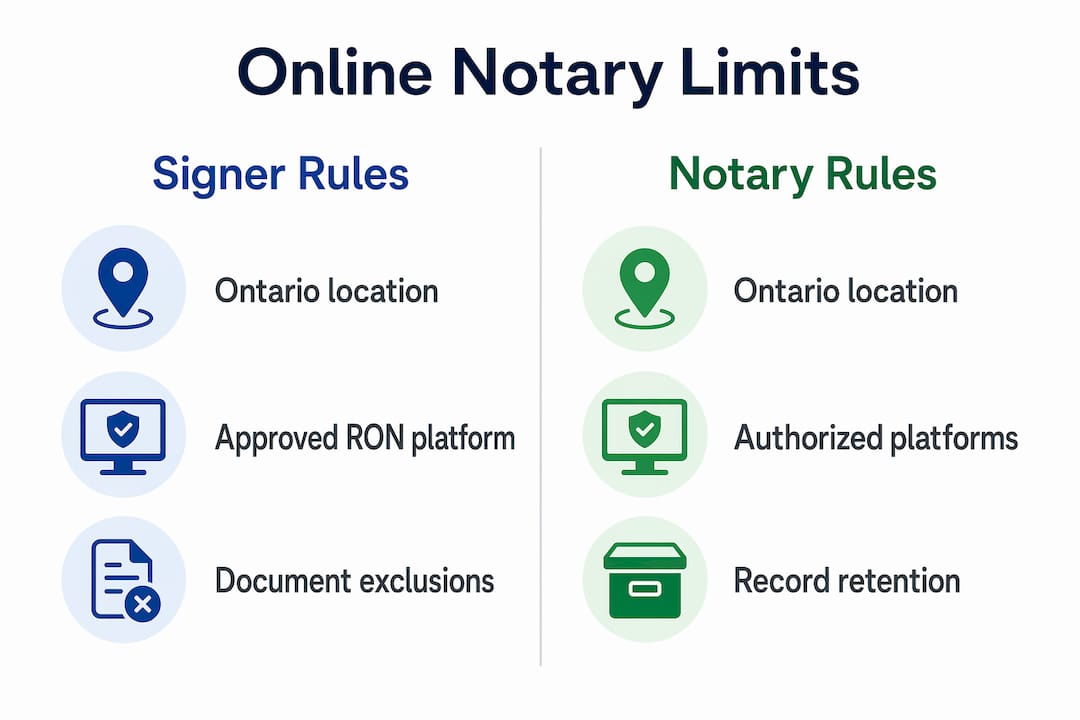
The most fundamental online notary limit is geographic. The signer must be physically located in a jurisdiction that authorizes remote notarization for the notarization to be legally valid. In Ontario, that means you must be physically present within the province at the time of the session, even if the document itself relates to another country or province.
The notary carries an equally strict geographic obligation. A notary commissioned in Ontario must also be physically located in Ontario during the session. This dual-location rule closes a common loophole where either party attempts the session from a different jurisdiction. Both conditions must be satisfied simultaneously.
Ontario notaries must also operate through approved RON platforms, not generic video software. The legal implications of online notarization in Ontario include strict platform standards, session recording obligations, and retention requirements. Many jurisdictions require notaries to retain recordings and electronic records of remote notarial acts for 5 to 10 years, which supports legal audits if document authenticity is ever challenged.
| Jurisdiction | Signer location rule | Notary location rule | Record retention |
|---|---|---|---|
| Ontario | Must be in Ontario | Must be in Ontario | Varies; typically 5+ years |
| Most U.S. states | Must be in authorizing state | Must be in commissioning state | 5 to 10 years |
| Quebec (civil law) | Highly restricted; mostly in-person | In-province only | Strict authentic act rules |
Pro Tip: Before booking any RON session, confirm with the notary that both you and the notary will be physically in Ontario at the session time. A session conducted while either party is traveling outside the province is legally invalid.
Which documents are excluded from online notarization in Ontario?
Not every document qualifies for remote notarization, and this is where many Ontario residents get caught off guard. Certain document types like wills, trusts, and some real estate documents are frequently excluded from remote notarization due to heightened fraud risk and witnessing requirements that demand physical presence.
The core restricted categories in Ontario include:
- Wills and codicils: Ontario’s Succession Law Reform Act requires witnesses to be physically present with the testator. Remote witnessing carries elevated fraud risk and courts scrutinize these documents closely.
- Powers of attorney for property and personal care: These documents grant significant legal authority and typically require in-person witnessing under Ontario law.
- Certain real estate transfer documents: Land registries and mortgage lenders often require wet signatures or in-person notarization for title transfers and mortgage instructions.
- Documents requiring court filing: Some Ontario courts maintain their own acceptance policies and may reject electronically notarized affidavits depending on the proceeding type.
- Documents with foreign government requirements: Embassies and consulates frequently require original ink signatures and in-person notarization regardless of Ontario’s domestic RON rules.
The reason these restrictions exist is not arbitrary. Civil-law jurisdictions impose more restrictive online notarization limits due to unique requirements for authentic acts and witnessing. Quebec operates under a civil law system, which explains why its restrictions are far tighter than Ontario’s common law framework.
Pro Tip: Always contact the receiving party, whether a court, lender, government agency, or foreign embassy, before your notarization session to confirm they accept electronically notarized documents. A legally valid notarization is worthless if the recipient refuses it.
For documents that do not qualify for RON, your best path is to work with a notary who offers both online and in-person services, so you can handle your full document portfolio through one professional relationship. Understanding the limitations of virtual notary services in Ontario helps you plan which documents need an in-person appointment from the start.
What identity verification and technology limits apply to online notary services?
Identity verification is the technical backbone of every RON session, and it carries its own set of hard limits. Ontario-compliant RON platforms must perform credential analysis, knowledge-based authentication, and biometric checks. Consumer-grade video tools like Zoom or FaceTime are insufficient for compliance because they lack the secure audio-visual recording and tamper-evident digital seal capabilities that provincial rules require.
Here is how a compliant identity verification process works in practice:
- Credential analysis: The platform scans your government-issued photo ID, checking security features, expiry dates, and data consistency. Even minor wear on a driver’s license or glare on a passport photo can trigger a failure.
- Knowledge-based authentication (KBA): You answer questions drawn from your personal credit or public records history. These questions are generated in real time and must be answered within a strict time window.
- Biometric check: Your live video image is compared against your ID photo to confirm you are the person presenting the document.
- Secure session recording: The entire session is recorded with a tamper-evident audit trail. This recording is what gives the notarized document its legal weight if challenged later.
Proper preparation of identification documents is critical. Credential analysis systems are sensitive to glare, physical wear, data mismatches, and expired documents. A passport with a smudged photo or a driver’s license with a peeling laminate can cause an authentication failure that ends your session before it begins.
The practical implication is clear: gather your ID documents in advance, check them under good lighting, and confirm they are current. If your primary ID has any visible damage, bring a secondary government-issued document to the session as a backup.

How do acceptance policies at agencies and institutions influence online notary limits?
Legal validity and institutional acceptance are two separate things, and confusing them is one of the most expensive mistakes Ontario residents make with online notarization. Even legally valid online notarizations may be rejected by receiving agencies or institutions that maintain their own document acceptance policies.
The gap between legal validity and practical acceptance shows up in several common scenarios:
- A mortgage lender accepts electronically notarized documents for pre-approval but requires wet signatures for final closing documents.
- A foreign embassy accepts notarized invitation letters only if the notary’s physical seal and ink signature appear on the document.
- An Ontario court accepts electronically notarized affidavits for civil matters but not for family law proceedings.
- A bank accepts a statutory declaration for account opening but requires in-person notarization for estate-related documents.
Verifying acceptance with courthouses, lenders, or registries beforehand reduces the risk of rejection. The verification step takes five minutes and can save you the cost and delay of repeating the entire notarization process. Ask the receiving party one direct question: “Do you accept documents notarized through a remote online notarization platform?”
The format of the final document also matters. Some institutions require a specific paper size, a wet seal, or a particular certification wording. Confirm these format requirements at the same time you confirm acceptance. A notarized document that meets every legal standard but arrives in the wrong format will still be rejected.
What are the typical cost and time limits for online notary sessions?
The practical limits on cost and session time are straightforward, but they vary enough to affect your planning. Standard RON sessions typically last between 10 and 20 minutes and cost between $25 and $75 for standard documents. Mortgage or complex legal documents often incur higher fees, and some jurisdictions prohibit extra technology fees beyond a maximum notary charge.
| Document type | Typical session length | Typical cost range |
|---|---|---|
| Affidavit or statutory declaration | 10 to 15 minutes | $25 to $50 |
| Invitation letter or solemn declaration | 10 to 15 minutes | $25 to $50 |
| Complex legal document | 20 to 30 minutes | $50 to $150+ |
| Mortgage-related document | 30 to 45 minutes | $75 to $200+ |
For individuals and small businesses in Ontario, the cost structure of online notarization is generally favorable compared to in-person alternatives when you factor in travel time and office visit fees. The time savings are most significant for straightforward documents like affidavits, invitation letters, and statutory declarations, which Theonlinenotary handles regularly. Where costs escalate is in mortgage closings and multi-document packages, where platform fees, legal review, and complexity add up quickly.
Key takeaways
The limit of online notary services in Ontario is determined by jurisdiction, document type, identity verification technology, and institutional acceptance policies working together as a single compliance framework.
| Point | Details |
|---|---|
| Jurisdictional location rule | Both signer and notary must be physically in Ontario during the session for the notarization to be valid. |
| Document type exclusions | Wills, powers of attorney, and certain real estate documents are frequently restricted or excluded from RON. |
| Technology compliance | Only approved RON platforms with credential analysis and secure recording meet Ontario’s legal standards. |
| Acceptance is not guaranteed | A legally valid online notarization can still be rejected by courts, lenders, or foreign agencies with their own policies. |
| Cost and time benchmarks | Standard sessions run 10 to 20 minutes and cost $25 to $75, with higher fees for complex or mortgage documents. |
Why the acceptance gap is the limit most people overlook
I have worked with enough Ontario clients to know that the jurisdictional rules and document exclusions get most of the attention. People read up on what is legal, confirm they are in Ontario, and book their session. What catches them off guard every time is the acceptance gap.
The law says a remotely notarized document is valid. The bank, the embassy, or the court says it is not what they need. Both statements can be true at the same time, and that is the part that frustrates people most. A legally notarized document via RON does not guarantee acceptance. The legal framework and the institutional framework operate on separate tracks.
My honest view is that the acceptance gap will narrow over the next few years as institutions update their internal policies to reflect the legal reality. Ontario’s online notary legality framework is already well-established, and the pressure on institutions to modernize their acceptance policies is growing. But right now, in 2026, you cannot assume acceptance. You have to confirm it.
The other thing I would tell anyone preparing for a RON session is to treat your ID preparation as seriously as you treat the document itself. Automated credential analysis failures often stem from subtle ID issues that users never anticipated. A passport photo with slight glare under your home lighting can fail a system that processes thousands of IDs a day. Check your documents the night before, not five minutes before the session.
— Ken
Get your documents notarized online with Theonlinenotary
Theonlinenotary provides certified online notary services for Ontario residents and businesses, available 24/7 through a fully compliant RON platform. Whether you need an affidavit, invitation letter, statutory declaration, or solemn declaration notarized, Theonlinenotary handles the process from identity verification through to the final certified document.

Every session uses approved technology that meets Ontario’s legal standards for credential analysis, secure recording, and tamper-evident digital seals. If you are unsure whether your document qualifies for online notarization or need guidance on acceptance requirements, Theonlinenotary’s team can advise you before you book. Visit the services page to review available document types and schedule your session today.
FAQ
What is the main limit of online notary services in Ontario?
The primary limit is jurisdictional: both the signer and the notary must be physically located in Ontario during the session. Documents like wills and powers of attorney are also excluded from remote notarization under Ontario law.
Is online notarization legal in Ontario?
Yes, online notarization is legal in Ontario when conducted through an approved RON platform with proper identity verification and session recording. Legal validity does not guarantee acceptance by all institutions, so confirming with the receiving party is required.
What documents cannot be notarized online in Ontario?
Wills, powers of attorney for property and personal care, and certain real estate transfer documents are frequently restricted or excluded from online notarization in Ontario due to witnessing requirements and fraud risk.
How much does an online notary session cost in Ontario?
Standard online notarization sessions cost between $25 and $75 and run 10 to 20 minutes for straightforward documents. Complex or mortgage-related documents carry higher fees and longer session times.
Can a foreign embassy reject an online-notarized document?
Yes. Even a legally valid online-notarized document can be rejected by foreign embassies, courts, or lenders that maintain their own acceptance policies. Always confirm acceptance requirements with the receiving institution before your session.
Recommended
- Online Notary Legality in Ontario: What You Need to Know – The Online Notary
- Online Notary Accessibility—What It Means in Ontario – The Online Notary
- Are Online Notaries Legal in Ontario? What You Need to Know – The Online Notary
- Online Notary Services in Ontario: What You Need to Know 2025 – The Online Notary