
Legal documents can make or break a case, and affidavits or sworn statements are often at the center of it all. Most people assume these forms are basically interchangeable, just different paperwork for the same job. But the real surprise is that a notarized affidavit is seen as far more credible in court, and sworn affidavits carry so much legal weight that false statements can lead to criminal perjury charges and even jail time. That single signature might hold more power than you think.
Table of Contents
- Defining Affidavit And Sworn Statement: Core Concepts
- The Legal Framework: Importance And Validity
- Contexts And Uses: When To Choose Each Document
- Key Differences: Affidavit Vs Sworn Statement Explained
- Real-World Implications: Significance In Legal Proceedings
Quick Summary
| Takeaway | Explanation |
|---|---|
| Affidavits require notarization. | An affidavit must be signed in front of a notary, ensuring formal verification of the declarant’s identity and the truthfulness of the statement. |
| Sworn statements lack formal notarization. | Unlike affidavits, sworn statements do not require a notary, making them less formal but still credible for personal verification. |
| Truthfulness is legally mandatory. | Providing false information in these documents can lead to criminal charges of perjury, emphasizing the need for honesty. |
| Select document based on legal needs. | Choose between affidavits and sworn statements based on specific requirements, jurisdictional rules, and the intended legal purpose. |
| Documentation quality impacts legal outcomes. | High-quality, accurate affidavits and sworn statements hold significant evidentiary weight in legal and administrative contexts, influencing decisions. |
Defining Affidavit and Sworn Statement: Core Concepts
An affidavit and a sworn statement represent critical legal documents used to provide verified information under oath. While these terms are often used interchangeably, they carry specific legal nuances that distinguish their application and significance.
Understanding Legal Declarations
A sworn statement is a written declaration where an individual affirms the truthfulness of specific facts or information. This document does not necessarily require formal notarization but demands the declarant acknowledge their statement is true to the best of their knowledge. The core purpose remains establishing credibility and accountability for the information presented.
An affidavit, by contrast, represents a more formalized legal document. It requires the individual to sign the document in the presence of an authorized official such as a notary public, who verifies the person’s identity and administers an oath. The notary’s official seal and signature provide additional legal weight and authenticity to the document.
Key Characteristics of Legal Verification
Both sworn statements and affidavits share fundamental characteristics that establish their legal significance:
The verification and authentication of affidavits and sworn statements share similarities, but also important distinctions. The table below breaks down the core characteristics of both document types.
| Characteristic | Applies to Affidavit | Applies to Sworn Statement |
|---|---|---|
| Voluntary Declaration | Yes | Yes |
| Personal Knowledge | Yes | Yes |
| Truthfulness Commitment | Yes | Yes |
| Notarization | Yes | No |
| Used in Legal Contexts | Yes | Yes |
- Voluntary Declaration: The individual must willingly provide information without coercion
- Personal Knowledge: Statements must be based on direct personal experience or observation
- Truthfulness Commitment: The declarant pledges to provide accurate information
Legal professionals recognize these documents as critical tools for providing verified information in various contexts. According to Cornell Law School, these legal declarations serve essential functions in judicial proceedings, administrative hearings, and official documentation processes.
While subtle differences exist, both sworn statements and affidavits fundamentally aim to establish a legally recognized record of factual information. Find out more about online notarization options for these documents.
The Legal Framework: Importance and Validity
The legal framework surrounding affidavits and sworn statements establishes critical guidelines that ensure the credibility, admissibility, and enforceability of these important legal documents. Understanding this framework helps individuals and professionals navigate the complex landscape of legal documentation.
Legal Recognition and Admissibility
Legal systems recognize affidavits and sworn statements as substantive evidence with specific procedural requirements. These documents must meet stringent standards to be considered valid and admissible in various legal proceedings. The fundamental requirement is that the declarant provides truthful information voluntarily and with full awareness of potential legal consequences.
The validity of these documents depends on several key factors:
- Competence of the Declarant: The individual must be legally capable of making the statement
- Personal Knowledge: Information must be based on direct observation or experience
- Absence of Coercion: The declaration must be made without external pressure
Consequences of False Declarations
False statements in affidavits or sworn statements carry serious legal ramifications. Individuals who knowingly provide false information can face criminal charges of perjury, which may result in significant financial penalties and potential imprisonment. This legal deterrent underscores the importance of absolute truthfulness when preparing these documents.
According to the U.S. Department of State’s Foreign Affairs Manual, legal declarations must contain precise language that confirms the declarant’s commitment to truthfulness. The document must explicitly state that the information provided is true to the best of the individual’s knowledge, subject to legal penalties for misrepresentation.
The legal framework surrounding these documents ensures that they serve as reliable mechanisms for presenting factual information in judicial, administrative, and official contexts. Learn more about document verification processes to understand how legal systems maintain the integrity of sworn statements and affidavits.
Contexts and Uses: When to Choose Each Document
Selecting between an affidavit and a sworn statement requires understanding their unique applications and legal implications.
Each document serves specific purposes across different professional and personal scenarios, making it crucial to recognize their distinct characteristics and appropriate usage.
Professional and Legal Applications
Affidavits are typically required in more formal legal proceedings where stringent documentation standards are essential. These include court cases, property transactions, immigration processes, and complex legal disputes. The notarized nature of an affidavit provides an additional layer of authentication that significantly enhances its credibility.
Sworn statements, conversely, offer more flexibility and can be used in scenarios that demand personal verification but do not require the extensive formality of a fully notarized document. Common applications include:
- Insurance Claims: Providing personal accounts of incidents
- Employment Verification: Confirming work history or professional credentials
- Academic Documentation: Attesting to educational background
Selecting the Appropriate Document
The decision between an affidavit and a sworn statement hinges on several critical considerations:
- Legal Requirement: Determine whether the specific context mandates a notarized document
- Jurisdictional Rules: Understand local legal guidelines governing document acceptance
- Evidentiary Weight: Consider the level of legal scrutiny the document must withstand
According to Cornell Law School’s Legal Information Institute, the choice depends on the specific legal context and the level of formal verification required. Judicial proceedings typically demand the most rigorous documentation standards.
Professionals and individuals must carefully evaluate their specific situation to determine the most appropriate document. Explore online notarization options for your documentation needs to ensure you select the right approach for your specific circumstances.
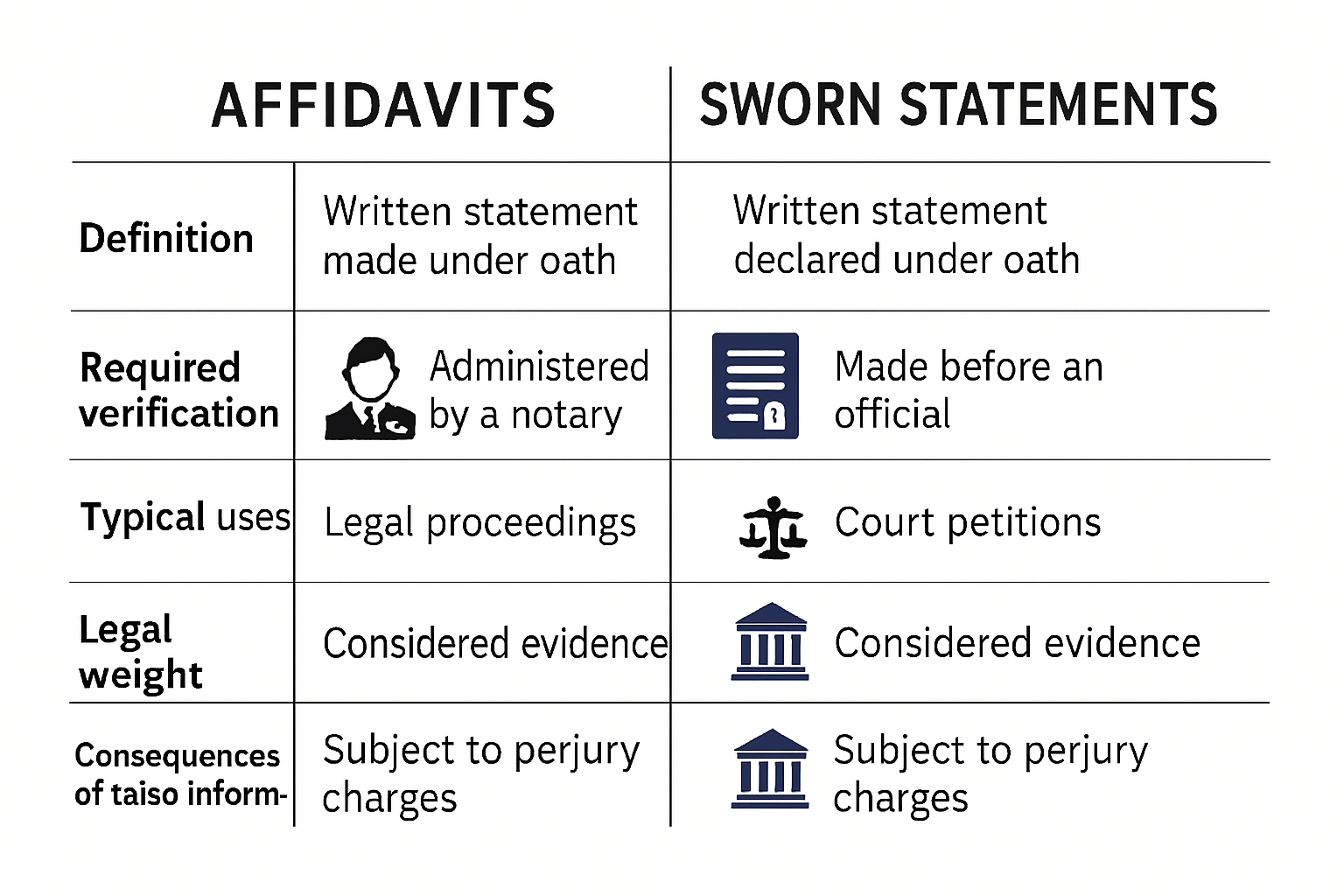
Key Differences: Affidavit vs Sworn Statement Explained
While affidavits and sworn statements share fundamental similarities, several critical distinctions set them apart in legal and professional contexts. Understanding these nuanced differences helps individuals select the most appropriate document for their specific needs.
Verification and Authentication Process
The primary distinguishing factor between affidavits and sworn statements lies in their verification mechanisms. An affidavit requires formal notarization, meaning an authorized official like a notary public must:
- Verify the identity of the person signing
- Administer an official oath
- Apply an official seal to the document
- Witness the signature in person
Sworn statements, by contrast, can be less formally authenticated. They may be signed in the presence of an authorized individual but do not necessarily demand the comprehensive verification process of a notarized affidavit.
Legal Weight and Admissibility
Affidavits carry significantly more legal weight due to their rigorous authentication process. Courts and official institutions typically view notarized affidavits as more credible and reliable evidence.

Sworn statements, while still carrying legal significance, might require additional corroboration or supporting documentation.
The hierarchy of legal credibility means that in complex legal proceedings, affidavits are generally preferred over standard sworn statements. This preference stems from the additional layers of verification and accountability inherent in the notarization process.
To help readers quickly distinguish between affidavits and sworn statements, the following table summarizes key differences in their characteristics and legal significance.
| Feature | Affidavit | Sworn Statement |
|---|---|---|
| Notarization Required | Yes; must be signed in front of a notary public | No; notarization is not required |
| Verification Process | Notary verifies identity and administers an oath | May be signed in presence of authorized individual |
| Formality | More formal; includes notary seal and signature | Less formal; self-declared by the signer |
| Legal Weight in Court | Higher; considered more credible and reliable | Lower; may require additional corroboration |
| Typical Use Cases | Court cases, property transactions, immigration, legal disputes | Insurance claims, employment verification, academic records |
| Consequences of False Statements | Perjury charges, fines, possible imprisonment | Perjury charges, fines, possible imprisonment |
According to Cornell Law School’s Legal Information Institute, the choice between these documents depends on the specific legal context and required level of formal verification. Judicial proceedings typically demand the most stringent documentation standards.
Discover how to obtain professionally verified legal documents quickly and efficiently in your specific jurisdiction.
Real-World Implications: Significance in Legal Proceedings
The practical applications of affidavits and sworn statements extend far beyond theoretical legal concepts, playing critical roles in various judicial and administrative proceedings. Understanding their real-world impact helps individuals and professionals navigate complex legal landscapes more effectively.
Judicial Decision Making
Affidavits serve as pivotal evidence in court proceedings, providing judges with written testimonies that can substantively influence legal outcomes. Unlike verbal testimony, these documents offer a permanent, verifiable record that can be carefully examined and cross-referenced. They become particularly crucial in scenarios where:
- Direct Witness Testimony is unavailable
- Historical Documentation needs comprehensive verification
- Complex Legal Disputes require detailed written accounts
In civil and criminal cases, the notarized nature of affidavits lends them significant credibility. Judges often view these documents as more reliable than standard sworn statements due to their rigorous authentication process.
Administrative and Regulatory Contexts
Beyond courtroom proceedings, affidavits and sworn statements play fundamental roles in administrative processes. Government agencies, immigration departments, and regulatory bodies frequently require these documents for:
- Identity Verification: Confirming personal information
- Background Checks: Establishing professional and personal histories
- Compliance Documentation: Meeting regulatory requirements
The legal weight of these documents can determine outcomes in bureaucratic systems, making their preparation and execution critically important. A poorly constructed document might result in delays, rejections, or potential legal complications.
According to Cornell Law School’s Legal Information Institute, the evidentiary value of these documents depends on their precision, authenticity, and adherence to legal standards. Judicial proceedings consistently prioritize documents that demonstrate comprehensive verification.
Learn about preparing legally robust documentation to ensure your statements meet the highest legal standards.
Get Verified Legal Documents Effortlessly in Ontario
Confused about when you need an affidavit or sworn statement? Making the wrong choice can delay urgent matters, create legal complications and lead to unwanted stress. Whether you are dealing with a court case, property transfer, or immigration process, making sure your documents are properly verified is essential. As explained in our article, the difference between a notarized affidavit and a sworn statement often determines if your paperwork will be accepted.

Do not risk rejection or wasted time. Have your affidavits, statutory declarations and solemn declarations notarized by Ontario professionals who understand every requirement. With The Online Notary, you can securely upload your documents, schedule an online meeting and receive legally recognized paperwork without leaving home. If you are unsure which document you need, our affidavit and sworn statement resources offer guidance to help you decide. Visit The Online Notary now to get started and meet your legal deadlines with confidence.
Frequently Asked Questions
What is the primary difference between an affidavit and a sworn statement?
An affidavit requires notarization and is signed in the presence of a notary public, while a sworn statement can be less formally authenticated and does not necessarily need notarization.
When should I use an affidavit instead of a sworn statement?
Use an affidavit in formal legal proceedings or situations requiring stronger documentation, such as court cases or property transactions, while a sworn statement is appropriate for less formal uses, like insurance claims or employment verification.
What are the legal consequences of providing false information in an affidavit or sworn statement?
Providing false information can lead to serious legal consequences, including charges of perjury, which can result in fines and imprisonment.
How do the verification processes differ for affidavits and sworn statements?
Affidavits involve a comprehensive verification process, including the notary’s identification of the signer and administration of an oath, while sworn statements can be signed in the presence of an authorized individual without the complete formal notarization process.
Recommended
- How to Get an Affidavit Online in Ontario 2025 – The Online Notary CA
- Everything You Need to Know About Online Notarization in Ontario: Fast, Legal, and Convenient for Affidavits and Declarations (2025) – The Online Notary CA
- Solicitor vs Notary: Key Differences in Ontario 2025 – The Online Notary CA
- Notary Public vs Lawyer in Ontario: Key Differences for 2025 – The Online Notary CA
- California Small Estate Affidavit: Essential Guide for 2025 – Law Office of Eric Ridley