
Deciding who can help with your legal documents in Ontario is not always straightforward. Most people are surprised to learn that over 60 percent of common paperwork, like affidavits and certified copies, can be handled by a notary public instead of a lawyer. Here is the twist. While notaries handle these everyday tasks at a fraction of the cost, only lawyers are equipped to guide you through complex legal disputes and agreements. This difference can save you money and time—or leave you unprotected if you choose the wrong professional.
Table of Contents
- Roles And Services Of Notaries Vs Lawyers
- Legal Documents: Who Can Handle What
- Choosing The Right Professional In Ontario
- Costs And Access For Businesses And Residents
Quick Summary
| Takeaway | Explanation |
|---|---|
| Notaries handle specific tasks | Notary publics are primarily responsible for document authentication, such as signature witnessing and providing certified copies, but cannot offer legal advice or representation in court. |
| Lawyers provide comprehensive services | Lawyers can offer a wide array of services, including legal advice, documentation drafting, and client representation in legal matters, making them essential for complex legal issues. |
| Choose based on your needs | For simple tasks like document certification, a notary is generally sufficient, but consult a lawyer for any legal disputes or intricate documents. |
| Cost varies between professionals | Notaries typically charge lower fees for basic services compared to lawyers, who have higher rates reflecting their extensive training and the complexity of their services. |
| Verify professional credentials | It is crucial to check the qualifications and regulatory status of legal professionals in Ontario to ensure you receive reliable and appropriate legal services. |
Roles and Services of Notaries vs Lawyers
Understanding the distinct professional roles of notaries and lawyers is crucial for anyone navigating legal documentation and services in Ontario. While both professionals play important parts in the legal system, their core responsibilities and scope of practice differ significantly.
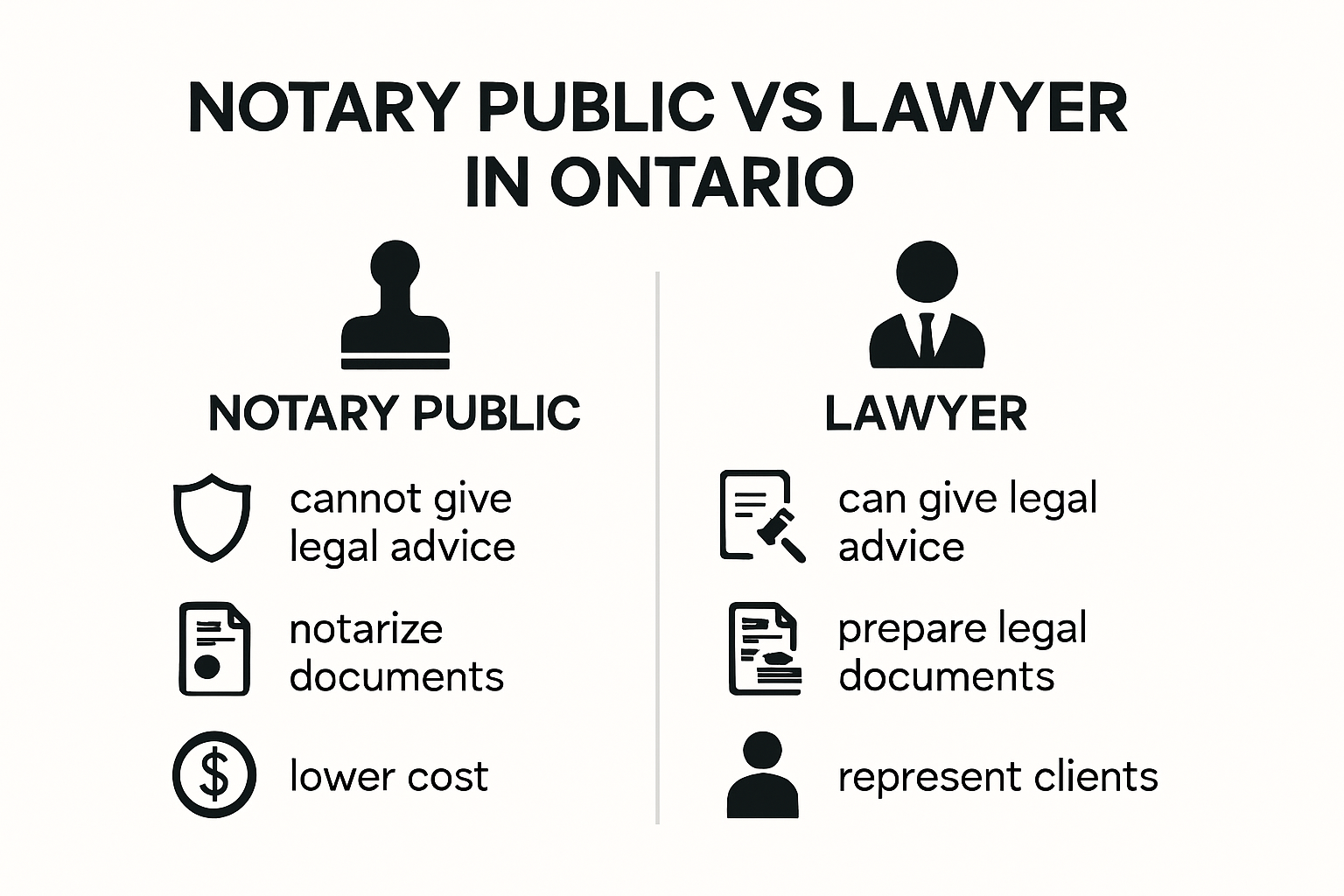
Notary Public Services: Document Authentication and Verification
Notary publics in Ontario serve a specific and limited set of functions focused on document authentication and verification. The Law Society of Ontario defines notaries as professionals authorized to perform essential administrative tasks. Their primary responsibilities include:
- Signature Witnessing: Verifying the identity of individuals signing important documents
- Document Certification: Creating certified true copies of original documents
- Administering Oaths: Formally witnessing sworn statements and declarations
A notary public cannot provide legal advice or represent clients in court proceedings. Their role is fundamentally administrative, ensuring the authenticity and integrity of documents through official certification.
Lawyers: Comprehensive Legal Representation and Advice
Lawyers offer a much broader range of professional services compared to notaries. The Canadian Bar Association highlights that lawyers are trained legal professionals who can:
- Legal Consultation: Provide detailed legal advice across multiple practice areas
- Client Representation: Represent clients in court and legal proceedings
- Document Preparation: Draft complex legal documents with professional expertise
- Legal Strategy: Develop comprehensive legal strategies for individuals and businesses
While lawyers can also perform notarial functions, their training and professional mandate extend far beyond document authentication. They are equipped to interpret laws, negotiate on behalf of clients, and provide strategic legal guidance.
Choosing Between a Notary and a Lawyer
The decision to work with a notary or a lawyer depends on your specific needs. For straightforward document authentication and certification, a notary public is typically sufficient. Ontario’s legal guidelines recommend consulting a lawyer when dealing with complex legal matters requiring interpretation, representation, or strategic advice.
For instance, if you need a passport document certified or an affidavit witnessed, a notary public can handle these tasks efficiently. However, if you are navigating a legal dispute, drafting a complex contract, or require ongoing legal representation, a lawyer is the appropriate professional to consult.
Ultimately, understanding the complementary yet distinct roles of notaries and lawyers helps individuals and businesses in Ontario make informed decisions about their legal service needs.
Here is a table to help you quickly compare the main services and limitations of notaries public vs lawyers in Ontario:
| Service/Feature | Notary Public | Lawyer |
|---|---|---|
| Document Authentication | Yes | Yes |
| Certified Copies | Yes | Yes |
| Witnessing Signatures | Yes | Yes |
| Administering Oaths | Yes | Yes |
| Legal Advice | No | Yes |
| Document Drafting | Limited (basic forms only) | Yes (including complex documents) |
| Client Representation in Court | No | Yes |
| Legal Strategy | No | Yes |
| Fees | Low (per document) | High (hourly or per task) |
Legal Documents: Who Can Handle What
Navigating the complex world of legal documents requires understanding which professionals can handle specific tasks. In Ontario, the ability to process and authenticate legal documents varies significantly between notaries, lawyers, and other legal professionals.
Document Authentication and Certification
Notary publics play a critical role in document authentication. The Law Society of Ontario specifies that notaries can handle several specific document-related tasks:
- Signature Verification: Confirming the identity of individuals signing documents
- True Copy Certification: Creating official certified copies of original documents
- Oath Administration: Formally witnessing statutory declarations and affidavits
Professional paralegals in Ontario can also be appointed as notaries, expanding the pool of professionals who can perform these essential authentication services.
Comprehensive Legal Document Preparation
Lawyers offer a more extensive range of legal document services. The Canadian Bar Association confirms that lawyers can:
- Complex Document Drafting: Create intricate legal documents like contracts, wills, and property agreements
- Legal Interpretation: Provide professional analysis of document implications
- Comprehensive Review: Examine legal documents for potential risks or inconsistencies
- Strategic Document Development: Design legal documents that protect clients interests
While notaries can witness and certify documents, lawyers can create and interpret them with legal expertise. This distinction is crucial when dealing with complex legal matters that require nuanced understanding.
Specialized Document Handling
Some legal documents require specific professional handling. Ontario legal guidelines outline specific scenarios where professional expertise is critical:
- Real estate transactions demand comprehensive legal documentation typically managed by lawyers
- Corporate legal documents often require lawyer preparation and review
- Immigration and international document processing may need specialized legal expertise
For those seeking efficient and secure document services, expert online notary options provide convenient alternatives for basic document authentication and certification.
Understanding these professional boundaries helps individuals and businesses select the right legal professional for their specific documentation needs in Ontario.
The following table summarizes which professional can typically handle certain types of legal documents and services in Ontario:
| Document/Task Type | Notary Public | Lawyer | Paralegal (if Appointed Notary) |
|---|---|---|---|
| Signature Verification | Yes | Yes | Yes |
| True Copy Certification | Yes | Yes | Yes |
| Witnessing Statutory Declarations/Affidavits | Yes | Yes | Yes |
| Drafting Contracts/Wills/Agreements | No | Yes | No |
| Legal Analysis/Interpretation | No | Yes | No |
| Real Estate Transaction Docs | No | Yes | No |
| Court Representation | No | Yes | Some Tribunals |
Choosing the Right Professional in Ontario
Selecting the appropriate legal professional in Ontario requires careful consideration of your specific needs, document complexity, and legal requirements. Understanding the nuanced roles of notaries, lawyers, and other legal professionals helps ensure you receive the most effective and appropriate service.
Assessing Your Specific Documentation Needs
The Law Society of Ontario recommends a strategic approach to choosing the right professional. Different legal documents and situations demand varying levels of expertise:
- Simple Document Authentication: Notary publics are ideal for straightforward tasks like signature witnessing and document certification
- Complex Legal Matters: Lawyers provide comprehensive legal support for intricate legal documentation and advice
- Specific Legal Proceedings: Paralegals can handle certain administrative and tribunal-related legal services
The key is matching the professional’s expertise with the complexity of your specific legal documentation requirements.
Cost and Efficiency Considerations
Canadian legal guidelines highlight the importance of understanding the cost implications of different legal services. Notaries typically charge lower fees for basic document authentication compared to lawyers, making them a cost-effective option for simple tasks.
- Notary services are generally more affordable for basic document certification
- Lawyer fees are higher but include comprehensive legal analysis and strategic advice
- Professional online notary services offer convenient and often more economical alternatives for document authentication

Professional Qualifications and Regulation
The Canadian Bar Association emphasizes the importance of verifying professional credentials. In Ontario, legal professionals are regulated to ensure high standards of service:
- Lawyers must complete extensive legal education and pass bar examinations
- Notaries public require specific appointments and background checks
- Paralegals are licensed and regulated by the Law Society of Ontario
When selecting a professional, always verify their credentials and regulatory standing. This ensures you receive reliable and legally recognized services.
Ultimately, your choice depends on the specific nature of your legal documentation needs. Carefully evaluate the complexity of your task, budget constraints, and required level of legal expertise to make an informed decision in Ontario’s legal landscape.
Costs and Access for Businesses and Residents
Navigating legal services in Ontario requires understanding the financial implications and accessibility of different professional options for both businesses and residents. The landscape of legal document services presents varied cost structures and access points that can significantly impact decision making.
Service Cost Comparisons
Ontario legal guidelines reveal distinct pricing models for different legal professionals. Notaries public typically offer more affordable services for basic document authentication, while lawyers provide comprehensive but more expensive legal support.
- Notary Services: Generally range from $20 to $75 per document certification
- Lawyer Fees: Can range from $150 to $500 per hour depending on complexity
- Online Notary Options: Often provide more cost-effective and flexible pricing models
Legal industry research indicates that small businesses and individual residents can save significant costs by selecting the appropriate professional for their specific needs.
Below is a table summarizing typical cost ranges for different legal service options in Ontario:
| Service Type | Typical Cost |
|---|---|
| Notary Public (in-person) | $20 – $75 per document |
| Lawyer (general) | $150 – $500 per hour |
| Online Notary Service | Varies, often $20 – $60 per document |
Accessibility and Convenience Factors
Modern legal service delivery in Ontario has transformed with technological advancements. The Canadian Bar Association highlights emerging trends in legal service accessibility:
- Digital Notarization: Professional online notary services enable remote document authentication
- Flexible Service Models: Many professionals now offer virtual consultations
- Transparent Pricing: Online platforms provide upfront cost estimates
These innovations have made legal services more accessible and transparent for Ontario businesses and residents.
Risk Management and Professional Protection
Ontario legal regulations emphasize the importance of professional liability and protection. Lawyers are required to carry professional liability insurance, providing an additional layer of security for clients:
- Lawyers must maintain comprehensive professional liability coverage
- Notaries public are not mandated to carry the same level of insurance
- Businesses can mitigate potential risks by understanding these distinctions
Businesses and residents should consider not just the immediate cost but also the long-term protection and potential risk mitigation when selecting a legal service professional.
By carefully evaluating cost, accessibility, and professional protection, Ontario businesses and residents can make informed decisions that balance financial considerations with their specific legal documentation needs.
Frequently Asked Questions
What is the difference between a notary public and a lawyer in Ontario?
A notary public handles specific tasks like document authentication and signature witnessing, while a lawyer provides broader legal services, including legal advice, representation, and complex document preparation.
When should I choose a notary public over a lawyer?
Choose a notary public for simple tasks such as document certification and signature witnessing. For complex legal matters involving disputes or intricate agreements, a lawyer is the appropriate choice.
How much do notaries public charge compared to lawyers in Ontario?
Notaries typically charge lower fees, ranging from $20 to $75 per document for authentication, while lawyers’ fees can range from $150 to $500 per hour depending on the complexity of the services.
Can a notary public provide legal advice in Ontario?
No, a notary public cannot provide legal advice. Their role is limited to administrative tasks such as document verification and authentication. For legal advice, you should consult a lawyer.
Get Your Ontario Documents Notarized Online—No Lawyer Required
Are you tired of paying high legal fees or waiting days just to get a simple document authenticated? The article you just read explained how notaries public can handle most of your everyday paperwork, like affidavits and statutory declarations, often at a fraction of the cost of a lawyer. Many Ontarians share your frustration: you want quick, secure service from home, not another complicated process or extra expense. That is where we step in. Our team at The Online Notary specializes in online document authentication for everything from invitation letters to solemn declarations—letting you skip the stress while staying fully compliant.

Why wait and spend more? Book your fast, legally recognized online notary session today. You get affordable pricing and expert service from licensed Ontario notaries, all without visiting an office. Secure your notarized documents now—discover how easy it can be with us. Act now to avoid legal delays and keep your important paperwork moving forward.
Recommended
- Why Opt for an Online Notary in Ontario – The Online Notary CA
- The Complete Guide to Using an Online Notary Public for Affidavits and Declarations in Ontario (2025) – The Online Notary CA
- Professional Online Notary Services in Canada – The Online Notary CA
- Everything You Need to Know About Online Notarization in Ontario: Fast, Legal, and Convenient for Affidavits and Declarations (2025) – The Online Notary CA
- How to Become a Notary Public in Ontario: A Step-by-Step Guide – My Mobile Notary