
Most people think identification documents are just photo IDs and utility bills. Turns out, when those are missing, a single sworn statement can carry surprising legal force. In Ontario, a proof of address affidavit is so powerful that government agencies, banks, and schools all accept it as formal address verification, even when nothing else works.
Table of Contents
- What Is A Proof Of Address Affidavit?
- Why Is A Proof Of Address Affidavit Important?
- How Does A Proof Of Address Affidavit Work?
- Key Concepts Associated With Proof Of Address Affidavits
- Practical Applications In Ontario
Quick Summary
| Takeaway | Explanation |
|---|---|
| A proof of address affidavit verifies residency | This document provides an official statement confirming an individual’s residential address when traditional documentation is lacking. |
| It must be sworn before an authorized official | The affidavit must be signed and affirmed in the presence of a notary public or similar authority to ensure its legal validity. |
| Essential for various administrative processes | Proof of address affidavits are crucial for accessing services like banking, healthcare, and government assistance when standard proof is unavailable. |
| Falsifying information has legal consequences | Providing incorrect information on the affidavit can lead to potential legal repercussions, emphasizing the need for accuracy. |
| Smoothens administrative procedures for residents | They serve as a flexible solution to document verification, easing barriers for those in transitional living situations or lacking conventional proofs. |
What is a Proof of Address Affidavit?
A proof of address affidavit is a legally binding document that formally verifies an individual’s residential address through a sworn statement. This official document serves as a critical form of identification verification when standard proof of address documents are unavailable or insufficient.
Understanding the Legal Framework
In Ontario, a proof of address affidavit is a statutory declaration where an individual swears or affirms the truthfulness of their residential address under oath. According to Ontario Works policy directives, these affidavits are legally recognized documents that carry significant weight in administrative and legal proceedings.
The key characteristics of a proof of address affidavit include:
- A formal written statement declaring current residential address
- Signed and sworn before an authorized official like a notary public
- Legally binding document with potential consequences for false statements
- Accepted by government agencies, financial institutions, and other official entities
Practical Applications and Significance
Proof of address affidavits become essential in scenarios where traditional address documentation is challenging to obtain. These situations might include recent relocation, living in temporary accommodations, or experiencing documentation gaps. Government services, banking institutions, healthcare providers, and educational organizations often require such documentation to verify an individual’s residential status.
The document typically includes specific details such as:
- Full legal name of the declarant
- Complete residential address
- Statement affirming the address’s accuracy
- Date of declaration
- Signature of the person making the declaration
- Signature and seal of the authorized witness
While the affidavit provides a flexible solution for address verification, individuals must understand that providing false information can result in legal consequences.
Below is a table summarizing the core features and legal requirements of a proof of address affidavit in Ontario for easy reference.
| Feature / Requirement | Description |
|---|---|
| Purpose | Sworn statement to verify an individual’s residential address when standard documents are unavailable |
| Legal Status | Legally binding document recognized by government agencies, banks, and schools |
| Signatory Requirement | Must be signed by the declarant in the presence of an authorized official (notary, commissioner, lawyer) |
| Key Document Details | Includes declarant’s full name, complete address, affirmation of truthfulness, date, and signatures |
| Verification Process | Identity is verified by presenting government-issued ID to the authorized witness |
| Consequences of False Statement | Legal liability for providing incorrect information |
| Acceptance | Widely accepted for government, banking, healthcare, and educational administrative processes |
Why is a Proof of Address Affidavit Important?
A proof of address affidavit plays a crucial role in establishing an individual’s residential legitimacy across various official and administrative contexts. Its significance extends far beyond a simple documentation requirement, serving as a foundational element in verifying personal identity and residency status.
Establishing Legal and Administrative Credibility
Proof of address affidavits are essential for confirming an individual’s residential legitimacy in numerous legal and administrative scenarios. According to Canadian government documentation, these documents are critical for determining eligibility for government services, benefits, and official transactions.
Key areas where proof of address affidavits become indispensable include:
- Applying for government identification
- Registering for social services
- Opening bank accounts
- Enrolling in educational institutions
- Accessing healthcare services
Addressing Documentation Challenges
In an increasingly complex administrative landscape, proof of address affidavits provide a flexible solution for individuals experiencing documentation gaps. Whether someone has recently relocated, lives in temporary housing, or lacks traditional address verification documents, an affidavit offers a legally recognized alternative.
The importance of these documents is further amplified by their ability to:
- Validate residential status without conventional documentation
- Provide a formal mechanism for address confirmation
- Offer legal protection through sworn statements
- Create a standardized method of address verification
By understanding online notarization processes, individuals can efficiently obtain these crucial documents, ensuring they meet administrative requirements with minimal bureaucratic friction. The proof of address affidavit represents more than a mere paperwork formality it is a fundamental tool for establishing personal identity and residential legitimacy in modern administrative systems.
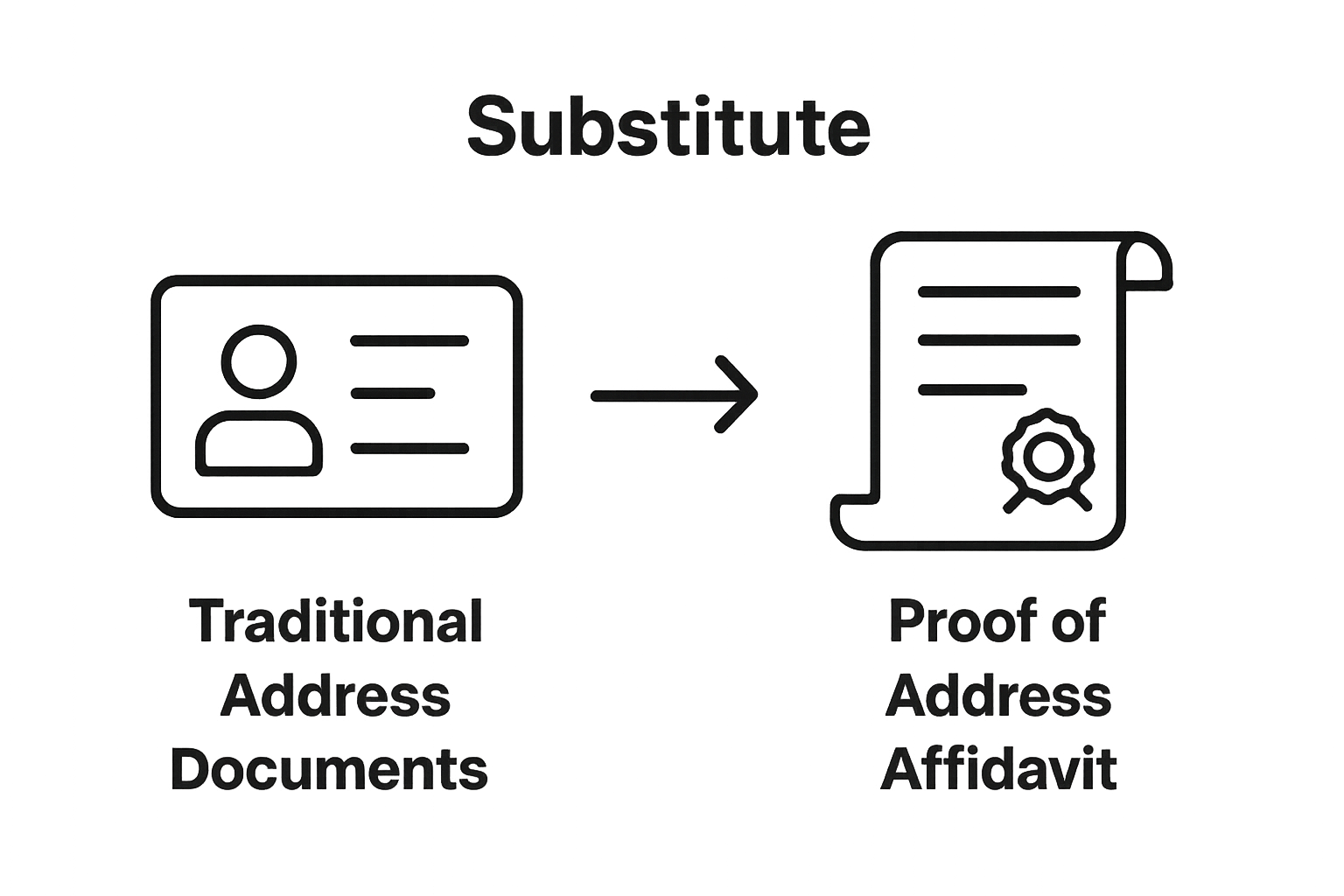
How Does a Proof of Address Affidavit Work?
A proof of address affidavit operates through a structured legal process that transforms a simple written statement into a formally recognized document with significant administrative and legal weight. This process ensures the authenticity and credibility of an individual’s residential declaration.
The Formal Declaration Process
According to the Ontario Ministry of Public and Business Service Delivery, the proof of address affidavit begins with a comprehensive written statement detailing an individual’s current residential information. The process requires precise documentation and adherence to specific legal protocols.
Key components of the formal declaration include:
- Detailed personal identification information
- Complete and accurate residential address
- Sworn statement of address truthfulness
- Signature of the declarant
- Witness signature and official seal
Verification and Authentication Mechanisms
The authentication of a proof of address affidavit involves a critical step of being sworn or affirmed before an authorized official. This could be a notary public, commissioner of oaths, or lawyer who verifies the individual’s identity and witnesses the declaration. Learn more about how to get an affidavit online in Ontario to understand the modern streamlined processes.
The verification process typically involves:
- Presenting valid government-issued identification
- Signing the document in the presence of the authorized official
- Taking an oath or making a solemn affirmation about the statement’s truthfulness
- Receiving an official seal or stamp confirming the declaration
Once completed, the proof of address affidavit becomes a legally binding document that can be used across various administrative and governmental contexts. The sworn nature of the document creates a powerful legal instrument that carries significant credibility, making it an essential tool for individuals needing to verify their residential status when traditional documentation is unavailable.
Key Concepts Associated with Proof of Address Affidavits
Proof of address affidavits encompass a complex legal framework that extends beyond simple documentation. Understanding the nuanced concepts surrounding these critical documents helps individuals navigate administrative requirements more effectively.
Legal and Ethical Foundations
According to Ontario’s legal guidelines, a proof of address affidavit represents a sworn statement with significant legal implications. The document’s core principles revolve around truthfulness, personal accountability, and formal recognition of residential status.
Critical legal concepts underlying proof of address affidavits include:
- Sworn testimony under legal oath
- Personal liability for statement accuracy
- Formal recognition by governmental institutions
- Potential legal consequences for false declarations
- Standardized verification mechanisms
Jurisdictional and Procedural Considerations
The effectiveness of a proof of address affidavit depends on strict adherence to jurisdictional protocols and procedural requirements. Learn more about online notarization processes to understand the modern mechanisms of document authentication.
Key procedural elements that define the document’s validity encompass:
- Authorized witness certification
- Comprehensive personal identification verification
- Precise residential information documentation
- Official seal and signature requirements
- Compliance with provincial administrative standards
The intricate nature of proof of address affidavits reflects the delicate balance between individual documentation needs and institutional verification requirements. These documents serve as a critical bridge between personal declaration and official recognition, ensuring transparency and accountability in administrative processes.
Practical Applications in Ontario
Proof of address affidavits serve a critical function across various administrative and legal contexts in Ontario, providing individuals with a flexible mechanism for verifying residential status when traditional documentation falls short.
Government and Administrative Services
According to the Ontario Ministry of the Attorney General, proof of address affidavits play a fundamental role in updating legal records and facilitating government interactions. These documents become essential in scenarios requiring precise residential verification.
Typical government and administrative applications include:
- Updating driver’s license information
- Registering for provincial health services
- Applying for social assistance programs
- Changing voter registration details
- Securing government identification documents
Legal and Financial Contexts
Beyond governmental services, proof of address affidavits hold significant importance in legal and financial domains. Learn more about online notary services in Ontario to understand how these documents are authenticated and processed.
Critical legal and financial scenarios where these affidavits become crucial include:
- Opening bank accounts
- Initiating legal proceedings
- Applying for loans and financial services
- Registering property transactions
- Establishing legal residency for tax purposes
The versatility of proof of address affidavits makes them an indispensable tool for Ontario residents navigating complex administrative landscapes.
This table outlines common situations and practical applications in Ontario where a proof of address affidavit plays a key role.
| Application Area | Examples of Usage |
|---|---|
| Government Services | Updating driver’s license, health services access, social assistance applications, voter registration, government ID issuance |
| Financial Institutions | Opening bank accounts, applying for loans, property transactions |
| Legal Proceedings | Initiating legal actions, establishing legal residency for taxes |
| Education | School and college enrollments |
| Healthcare | Registering and accessing provincial healthcare |
| Transitional/Temporary Housing | Verifying residence for those without standard documentation |

Get Your Proof of Address Affidavit Online—Fast and Legally Accepted
Missing standard documents or struggling with residency proof in Ontario can feel stressful. Many people discover that a proof of address affidavit is the only solution for verifying their current address when traditional paperwork is unavailable. You have likely seen just how vital a properly notarized affidavit is for banking, education, legal proceedings, and government services. Without it, your life can be put on hold.

Why wait and risk further delays? With The Online Notary, you can create, notarize, and submit your Ontario affidavit entirely online. No need to worry about appointments or long lines. Your signed proof of address affidavit is ready for use quickly and meets all legal standards in Ontario. Visit our main site to get started or learn more about the process on how to get an affidavit online in Ontario. Take control of your documentation now and unlock fast access to the services you need.
Frequently Asked Questions
What is a proof of address affidavit?
A proof of address affidavit is a legally binding document that verifies an individual’s residential address through a sworn statement, often used when conventional proof of address documents are unavailable.
How do I create a proof of address affidavit in Ontario?
To create a proof of address affidavit in Ontario, you must prepare a written declaration with your personal and address details, swear or affirm the statement before an authorized official, and ensure it is signed and sealed.
What situations might require a proof of address affidavit?
A proof of address affidavit may be necessary if you recently relocated, live in temporary accommodations, or lack standard documentation like utility bills or lease agreements to verify your residence.
Who can witness a proof of address affidavit in Ontario?
In Ontario, a proof of address affidavit must be witnessed by an authorized official, such as a notary public, commissioner of oaths, or a lawyer, who will verify your identity and witness your sworn statement.