Every year, thousands in Ontario rely on official documents for business, education, and immigration abroad. With Canada joining the Hague Apostille Convention in January 2024, the entire verification process has shifted. This change now allows Ontario to issue apostilles directly, making global document acceptance faster and more reliable. Understanding these updates helps you avoid delays and ensures your documents are ready whenever you need them for international use.
Key Takeaways
| Point | Details |
|---|---|
| Recent Changes in Authentication | Ontario now issues apostilles and certificates of authentication for documents, following Canada’s entry into the Hague Apostille Convention. |
| Types of Documents for Authentication | Vital, business, legal, and educational documents are eligible for apostilles or certificates without additional notarization. |
| Processing Methods | Document authentication can be initiated online, via mail, or in-person, each with varying processing times and conveniences. |
| Common Errors to Avoid | Ensure documents meet formatting and signature requirements to prevent disqualification from the authentication process. |
Table of Contents
- Defining Document Authentication In Ontario
- Types Of Documents Requiring Authentication
- Legal Process And Required Authorities
- Authenticating Documents Online Versus In Person
- Common Risks And Mistakes To Avoid
- Alternatives To Document Authentication Ontario
Defining Document Authentication in Ontario
Document authentication is a critical process that verifies the legitimacy of official documents for international use, ensuring they are recognized and accepted across different jurisdictions. In Ontario, this process has recently undergone significant transformations with Canada’s entry into the Hague Apostille Convention on January 11, 2024.
According to Global Affairs Canada, provinces like Ontario are now directly responsible for issuing apostilles on public documents issued or notarized within their jurisdiction. This marks a substantial change in how documents are authenticated and validated for international purposes.
The authentication process in Ontario is managed by the Official Documents Services (ODS), which handles two primary scenarios:
- For Hague Convention countries: Issuing an apostille that simplifies document verification
- For non-Hague Convention countries: Providing a certificate of authentication to validate signatures and seals
With these new protocols, Ontario residents and businesses can now navigate international document requirements more efficiently, reducing bureaucratic complexities and streamlining cross-border document recognition. Read more about document certification details to understand the nuanced processes involved.
Types of Documents Requiring Authentication
Document authentication in Ontario covers a wide range of official papers that individuals and businesses might need to use internationally. Understanding which documents require authentication is crucial for smooth cross-border transactions and legal processes.
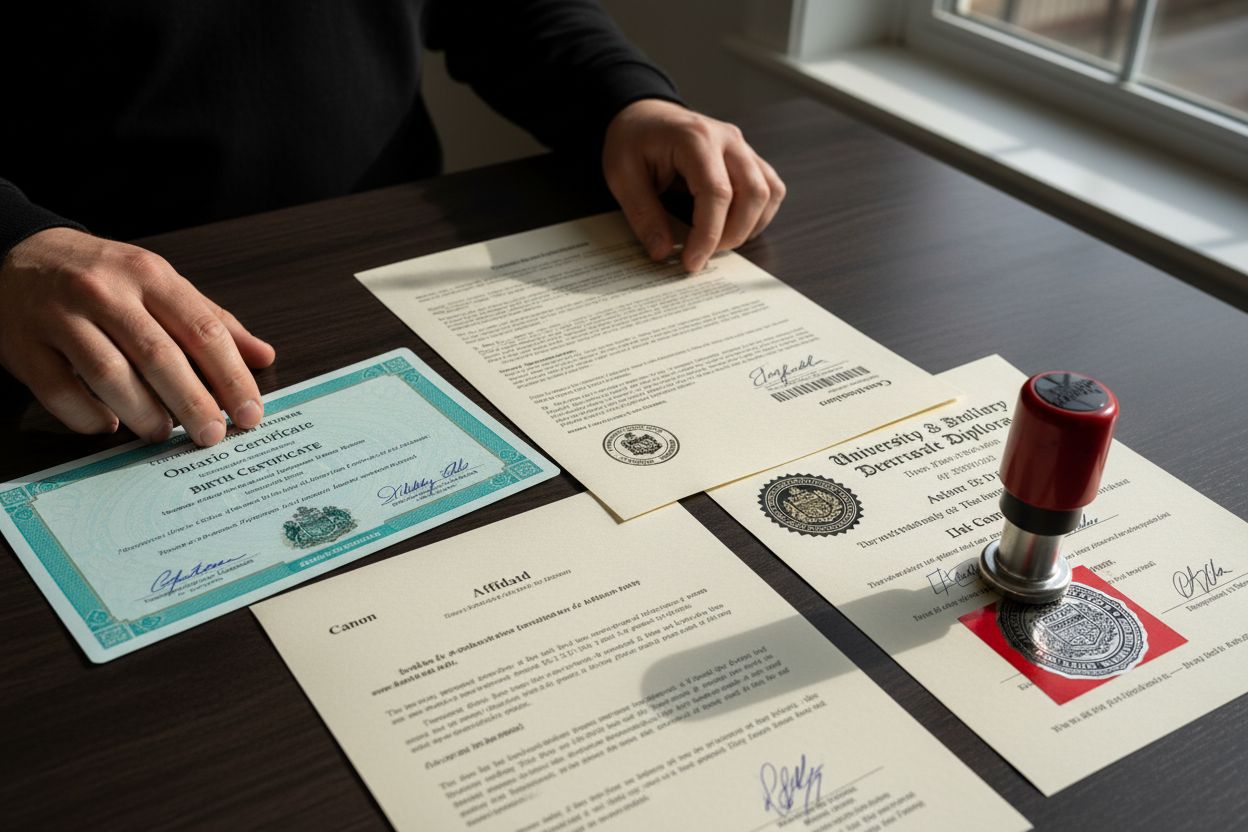
According to the Ontario Government, several types of public documents are now eligible for authentication or apostille without additional notarization. These include:
Vital Statistics Documents
- Birth certificates
- Marriage certificates
- Death certificates
Business and Corporate Documents
- Business registry documents (issued since 1991)
- Corporate registration papers
- Commercial contracts
Legal and Judicial Documents
- Court documents from Superior or Ontario Court (issued since July 10, 2023)
- Affidavits
- Statutory declarations
- Powers of attorney
Educational Documents
- Post-secondary diplomas
- Academic degrees
- Educational transcripts (issued since January 1, 2019)
As DoDoNotary highlights, these documents are typically intended for use abroad, whether for employment, education, immigration, or business purposes. Learn more about document legalization processes to ensure your specific document meets international requirements.
Here’s a summary of document types and their authentication eligibility in Ontario:
| Document Type | Examples | Eligible for Apostille? | Eligible for Authentication? |
|---|---|---|---|
| Vital Statistics | Birth certificate Marriage certificate Death certificate | Yes | Yes |
| Business/Corporate | Business registry Corporate registration Commercial contract | Yes | Yes |
| Legal/Judicial | Court documents Affidavit Power of attorney | Yes | Yes |
| Educational | Diploma Degree Transcript | Yes | Yes |
Legal Process and Required Authorities
The document authentication process in Ontario involves a structured legal framework that determines how different types of documents are verified and prepared for international use. Since January 11, 2024, significant changes have reshaped how official documents are authenticated across Canada.
According to Global Affairs Canada, the authentication authorities are now clearly divided: Global Affairs Canada handles documents from other provinces or federal entities, while the Ontario Official Documents Services (ODS) manages documents issued or notarized within Ontario.
The authentication process typically involves several key steps:
Document Preparation
- Ensure document is an original or certified true copy
- Check document meets eligibility criteria
Submission Methods
- In-person submission at ODS office
- Mail submission with required documentation
Verification Process
- ODS reviews seals and signatures
- Checks against official records
- Determines appropriate authentication method
Depending on the document’s origin and destination, you’ll receive either an apostille for Hague Convention countries or a certificate of authentication for non-Hague countries.
Learn more about notary requirements in specific legal situations to ensure your document meets all necessary legal standards.
Authenticating Documents Online Versus In Person
Authentication of documents in Ontario now offers multiple flexible approaches, giving individuals and businesses choices that suit their specific needs and time constraints. The process has evolved to accommodate both digital convenience and traditional in-person verification methods.
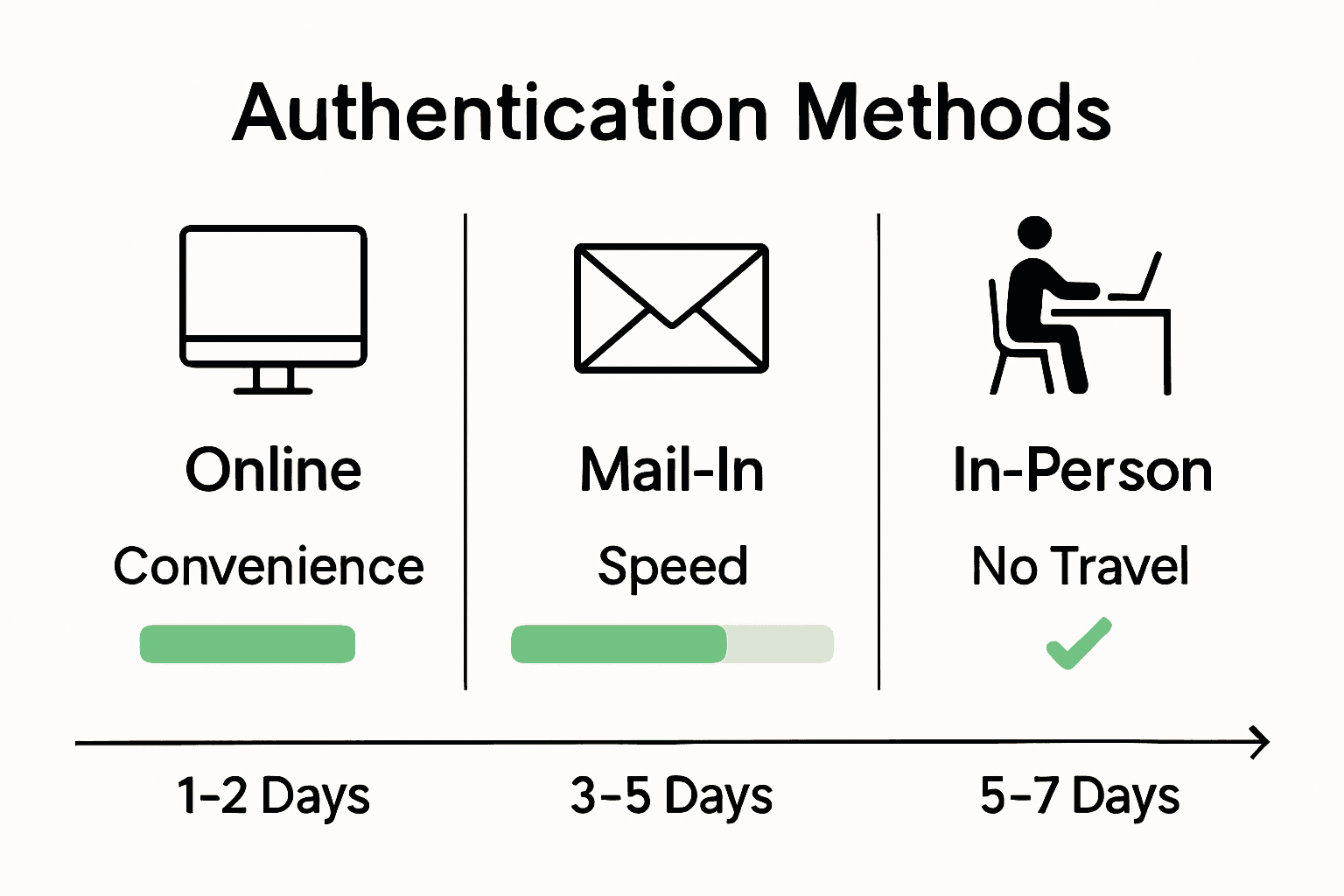
According to the Ontario Government, authentication requests can now be initiated through an online document authentication portal, with subsequent processing options that include mailing documents or dropping them off in person at Official Documents Services (ODS) or select ServiceOntario locations.
Processing Options Comparison:
| Method | Processing Time | Advantages | Considerations |
|---|---|---|---|
| Online Initiated | 2-10 business days | Convenient start | Requires physical document submission |
| Mail-In | 2-5 business days | No travel required | Potential postal delays |
| In-Person | Potentially same-day | Immediate verification | Requires physical visit |
DoDoNotary highlights that processing times can vary significantly. In-person submissions might offer the fastest turnaround, especially for urgent documents.
 Additionally, in-person authentication can sometimes bypass further consular legalization if the destination country is a Hague Convention member. Explore online notary options to understand how digital solutions can complement traditional authentication processes.
Common Risks and Mistakes to Avoid
Document authentication is a precise process where even minor errors can derail your entire submission. Understanding potential pitfalls is crucial to ensuring your documents are processed smoothly and accepted internationally.
According to the Ontario Government, several common mistakes can immediately disqualify your document from authentication. These critical errors often involve document preparation and formatting:
Document Submission Risks:
- Incomplete signatures or official seals
- Incorrect document formatting
- Missing translations for non-English/French documents
- Failure to verify specific destination country requirements
Unacceptable Document Characteristics:
- Photocopies instead of original documents
- Laminated or glued documents
- Documents from unrecognized institutions
- Religious documents without official standing
- Documents with unverifiable signatures
Global Document Solutions emphasizes that these risks can lead to immediate authentication refusal, potentially causing significant delays in your international document processing. Careful preparation and attention to detail are your best defense against these common pitfalls. Learn more about understanding online notary requirements to ensure your documents meet all necessary standards before submission.
Alternatives to Document Authentication Ontario
Document authentication isn’t always a straightforward government-only process. While official channels remain the primary route, several alternative approaches can help individuals and businesses navigate complex international document verification requirements.
Global Document Solutions highlights the emergence of private service providers that offer specialized support for authentication and apostille services. These providers work closely with Global Affairs Canada to process documents from other provinces or federal government entities, often providing faster turnaround times compared to traditional bureaucratic channels.
Alternative Authentication Options:
Private Authentication Services
- Faster processing times
- Personalized document guidance
- Support for complex international requirements
Online Notarization Platforms
- Digital verification of signatures
- Remote authentication services
- Convenient for time-sensitive documents
Consular Pre-Verification
- Direct consultation with destination country’s consulate
- Preliminary document review
- Reduces potential authentication complications
These alternatives can complement traditional authentication methods, offering more flexibility and potentially quicker resolution for urgent document needs. Check out our guide on online notarization in Ontario to explore digital solutions that might streamline your document verification process.
Make Ontario Document Authentication Simple and Stress-Free
Are you worried your documents will be rejected due to small mistakes or complicated requirements? Navigating Ontario’s document authentication, from verifying signatures to choosing between apostille and certificate of authentication, is often confusing and time-consuming. This guide highlighted the frustrations of handwritten errors, uncertain criteria, and delays that can put your international plans at risk. Take advantage of a better solution with help from The Online Notary.

Get your affidavits, statutory declarations, or invitation letters notarized online in just minutes. No more waiting in lines or struggling with paperwork alone. Our team understands Ontario’s latest authentication rules and will ensure your documents are prepared correctly right from the start. Start now at The Online Notary to protect your time and guarantee peace of mind.
Frequently Asked Questions
What is document authentication?
Document authentication is the process of verifying the legitimacy of official documents for international use, ensuring they are accepted across various jurisdictions. It involves issuing apostilles or certificates of authentication depending on whether the destination country is a member of the Hague Convention.
What types of documents require authentication in Ontario?
Documents that commonly require authentication include vital statistics documents (like birth, marriage, and death certificates), business registry documents, legal and judicial documents (such as court documents and powers of attorney), and educational documents (like diplomas and academic degrees).
How can I submit my documents for authentication?
You can submit your documents for authentication either in person at the Official Documents Services (ODS) office or through mail. Additionally, you can initiate the process online and choose to mail your documents or drop them off in person.
What are common mistakes to avoid during the document authentication process?
Common mistakes include submitting photocopies instead of original documents, missing signatures or seals, incorrect document formatting, and failing to meet specific requirements for the destination country. Ensuring all documents are correctly prepared can help prevent authentication refusal.
Recommended
- Certification of Documents in Ontario: 2025 Guide for Individuals & Businesses – The Online Notary
- How to Legalize a Document in Ontario: A Step-by-Step Guide – The Online Notary
- How to Legalize a Document in Ontario: A Step-by-Step Guide – The Online Notary
- Certified Copy Requirements in Ontario: What You Need to Know – The Online Notary
- 7 Essential Legal Document Process Tips for Smooth Results – YM Doc Services