
Notarization can feel like just another layer of paperwork in Ontario. And yet, skipping it could jeopardize everything from your real estate purchase to your child’s travel plans. In fact, Ontario law demands notarization for core documents like affidavits and deeds or they could be flat-out rejected. Most people only realize the true cost when deals stall or legal cases unravel—simply because a signature never got officially verified.
Table of Contents
- Common Documents Requiring Notarization In Ontario
- Legal And Business Scenarios Necessitating A Notary
- What Happens If You Skip Notarization
Quick Summary
| Takeaway | Explanation |
|---|---|
| Notarization is essential for legal documents | Key documents like affidavits and deeds in Ontario require notarization to be valid. Without it, they may be rejected. |
| International documents often need notarization | For documents used outside Canada, notarization ensures authentication and is often a requirement for acceptance abroad. |
| Skipping notarization can lead to severe consequences | Documents may be deemed invalid, leading to legal disputes, financial losses, or delays in processing. |
| Business documents typically require notarization | Corporate agreements and contracts usually need notarization to maintain legal standing and authenticity. |
| Notarization protects against fraud | Obtaining notarization provides an official verification process that safeguards all parties involved in legal transactions. |
Common Documents Requiring Notarization in Ontario
Notarization plays a crucial role in validating the authenticity of important legal and personal documents in Ontario. The process ensures that critical paperwork meets legal standards and provides an official verification of signatures, identities, and document integrity.
Here is a summary table outlining common types of documents in Ontario that typically require notarization, along with examples and their primary purposes.
| Document Type | Examples | Purpose |
|---|---|---|
| Affidavits | Sworn statements for court or government use | Legal verification of statements |
| Statutory Declarations | Declarations of facts or circumstances | Official affirmation of information |
| Certified Copies | Authenticated copies of original documents | Establish validity of photocopies |
| Real Estate Documents | Property transfers, mortgages, power of attorney forms | Confirm authenticity in real estate transactions |
| International Documents | Immigration papers, travel consents, educational credentials | Meet foreign legal or institutional standards |
| Corporate Documentation | Articles of incorporation, shareholder agreements, contracts | Legal validation for business operations |
| Professional Certifications | Academic transcripts, licensing documents | Authenticate qualifications and credentials |
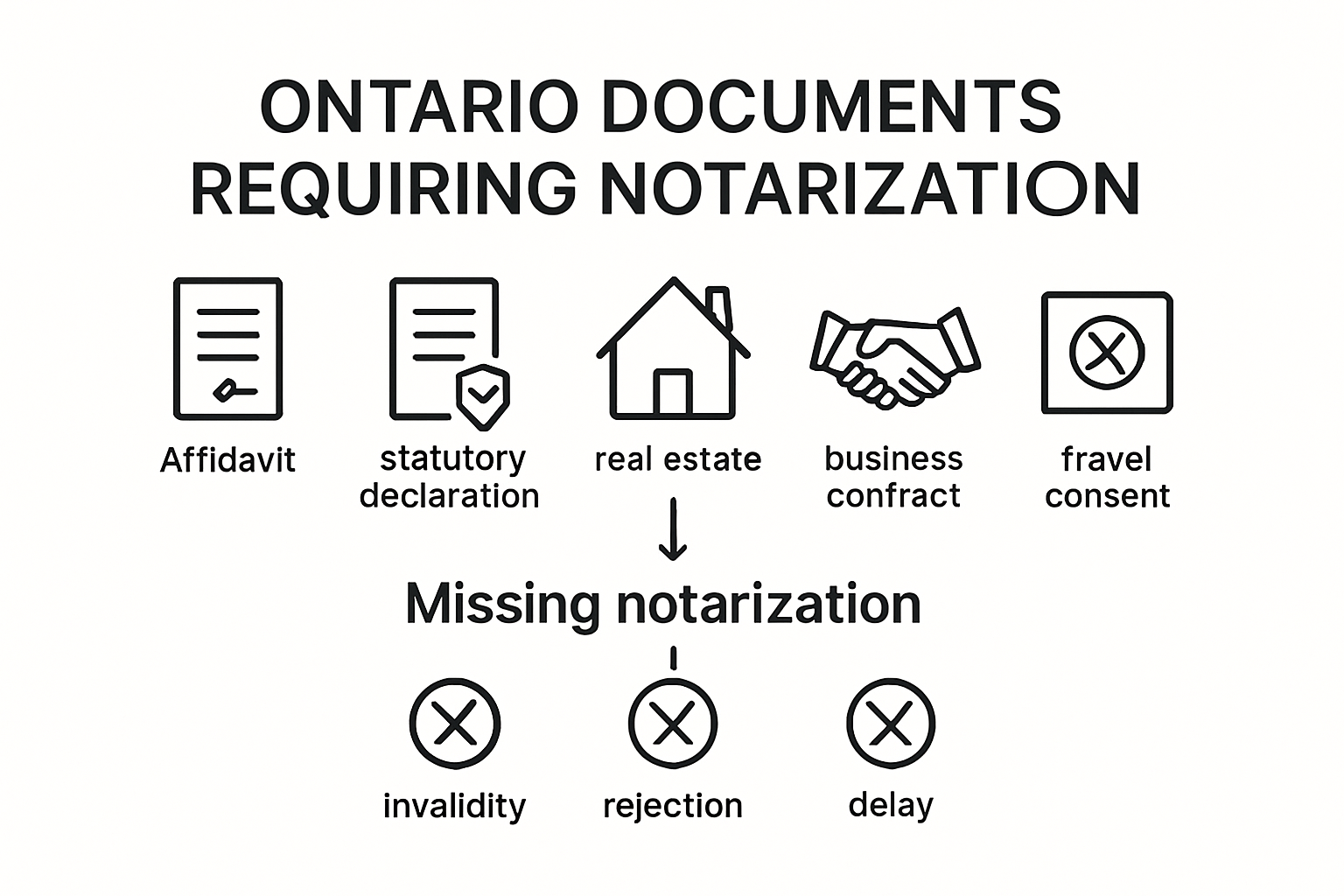
Legal and Personal Documents Requiring Notarization
Certain documents in Ontario demand notarization to be considered legally valid. According to the Ontario Ministry of the Attorney General, several key document types require official notarization:
- Affidavits: Legal sworn statements used in court proceedings or government applications
- Statutory Declarations: Official documents declaring specific facts or circumstances
- Certified Copies: Original documents that need authenticated duplicates
Beyond these core categories, many specific scenarios necessitate notarization. Real estate transactions frequently require notarized documents, including property transfer agreements, mortgage documents, and power of attorney forms. International documents such as immigration papers, educational credential verifications, and travel consent letters often demand notarial certification to be recognized across jurisdictions.
Professional and Business Documentation
Business environments in Ontario rely heavily on notarized documents to establish legal credibility. Corporate documents like articles of incorporation, shareholder agreements, and business contract amendments typically require notarization. Professional certifications, academic transcripts, and professional licensing documents also frequently need official notarial verification.
Specialized documents such as invitation letters for immigration purposes, consent forms for minors traveling internationally, and inheritance-related paperwork all fall under the umbrella of documents that benefit from or mandate notarization. Check out our comprehensive guide on document notarization to understand the nuanced requirements for various document types.
The notarization process provides an extra layer of legal protection and authenticity. By having a certified notary public witness and validate documents, individuals and organizations can ensure their paperwork meets rigorous legal standards. Whether for personal, professional, or legal purposes, understanding when notarization is required helps Ontario residents navigate complex documentation requirements with confidence.
Legal and Business Scenarios Necessitating a Notary
Notarization serves as a critical legal safeguard in numerous professional and personal scenarios across Ontario. Understanding when a notary is required can help individuals and businesses navigate complex legal documentation with confidence and precision.
International Document Authentication
Documents intended for use outside Canada often require specialized notarization. According to the Ontario government, certain documents need authentication for international recognition. This process typically involves multiple steps, with notarization serving as a foundational verification method.
International scenarios demanding notarization include:
- Visa application support documents
- Immigration paperwork
- Educational credential verifications
- Employment contracts for international positions
- Inheritance documentation for cross-border estates
Business and Corporate Legal Requirements
Business environments frequently encounter situations where notarization becomes essential. Oduraa Legal Services highlights several critical business scenarios requiring notarial certification:
- Shareholder agreements
- Business contract amendments
- Powers of attorney for corporate representatives
- Trademark and intellectual property documentation
- Consent forms for significant corporate transactions
Personal Legal Documentation
Individuals face numerous personal legal scenarios necessitating notarization. Learn more about notary requirements to understand the full scope of document authentication. Critical personal documents often requiring notarization include:
- Consent letters for minors traveling internationally
- Real estate transaction documents
- Wills and estate planning paperwork
- Affidavits for legal proceedings
- Name change documentation

As Pravo Law notes, while some documents can be commissioned online, many critical legal documents still require in-person notarization to ensure absolute authenticity and legal validity. This meticulous verification process protects all parties involved by providing an official, trusted mechanism for document certification.
What Happens If You Skip Notarization
Skipping notarization can lead to significant legal, financial, and procedural complications that extend far beyond simple administrative inconvenience. Understanding the potential consequences helps individuals and businesses recognize the critical importance of proper document authentication.
The following table summarizes key consequences of skipping notarization, based on scenarios discussed in the article.
| Issue Area | Potential Consequence | Typical Impact |
|---|---|---|
| Legal Validity | Document rejection by courts or agencies | Delayed/lost legal proceedings |
| Financial/Professional Risk | Loss of business deals, extra legal fees | Financial losses/contract issues |
| Long-term Legal Risk | Litigation, retrospective challenges | Undermined agreements, lawsuits |
| International Documentation | Refusal of visas, credential rejections | Blocked travel or employment |
Legal Invalidation and Rejection
Non-notarized documents often face immediate legal challenges that can render them ineffective or completely invalid. According to legal experts, documents without proper notarization may be summarily rejected by government agencies, courts, and international institutions. Learn more about document authentication requirements to understand the potential risks.
Specific scenarios where skipping notarization can result in document rejection include:
- Immigration and visa applications
- Real estate transactions
- Court proceedings
- International business contracts
- Academic and professional credential verifications
Financial and Professional Risks
The financial implications of skipping notarization can be substantial. Unverified documents might lead to:
- Delayed legal processes
- Additional legal fees for document reprocessing
- Potential contract invalidation
- Loss of business opportunities
- Potential legal disputes
Professional environments are particularly sensitive to documentation accuracy. Ontario government regulations emphasize that certain documents require authentication, which often begins with proper notarization. Failing to meet these standards can result in significant professional repercussions.
Potential Long-Term Consequences
Beyond immediate rejection, skipping notarization can create complex, long-lasting legal challenges. Unnotarized documents might be challenged retrospectively, potentially undermining past agreements or transactions. This can lead to:
- Litigation risks
- Compromised legal standing
- Difficulties in proving document authenticity
- Potential financial losses
Critical documents such as wills, property transfers, and international business agreements require absolute legal clarity. Notarization provides an official verification mechanism that protects all parties involved. While the process might seem administrative, it serves as a crucial legal safeguard against potential misrepresentation or fraud.
The minimal time and cost associated with notarization pale in comparison to the potential legal and financial risks of proceeding without proper document authentication. Professionals and individuals alike should view notarization not as an optional step, but as an essential component of responsible legal and business practice.
Frequently Asked Questions
When is notarization required for documents in Ontario?
Notarization is typically required for legal documents such as affidavits, statutory declarations, certified copies, and real estate documents. It is essential for documents used in court proceedings or for international purposes.
What are the consequences of skipping notarization in Ontario?
Skipping notarization can lead to document rejection by courts or agencies, which might delay legal proceedings and result in financial losses. Unnotarized documents can also be challenged in the future, leading to potential litigation or contractual disputes.
Are international documents subject to notarization requirements in Ontario?
Yes, international documents often require notarization to ensure their validity and acceptance abroad. This includes immigration papers, employment contracts for international positions, and educational credential verifications.
Which personal legal documents typically require notarization?
Personal legal documents that generally require notarization include consent letters for minors traveling internationally, wills, real estate transaction papers, and affidavits for legal proceedings.
Ensure Your Documents Are Legally Accepted—No Matter the Situation
Are you worried that missing notarization could put your legal or personal documents at risk? The struggle is real. As this article explains, skipping this crucial step can lead to delays, rejections, or even financial loss for documents like affidavits, statutory declarations, and travel consent forms. You should not have to stress about your paperwork being refused in Ontario courts, real estate transactions, or by foreign authorities.

Choose certainty with The Online Notary. With our fully remote service, you can notarize affidavits, solemn declarations, invitation letters, and more—often within minutes—from anywhere in Ontario. Do not risk delays or rejection. Explore how easy it is to get your documents notarized online so your signature is recognized whenever it counts. Book your session today and protect your peace of mind.