

Getting a notarized consent letter in Ontario just got a lot more complicated. As of 2025, remote notarization is completely banned, with every signature requiring in-person witness by a notary. Think technology makes legal paperwork easier? Not here. This year, the law doubled down on old school in-person rules, leaving many surprised by how strict the identification and document requirements have become.
Table of Contents
- When You Need A Notarized Consent Letter
- How To Prepare And Notarize Your Consent Letter
- Legal Requirements In Ontario For 2025
Quick Summary
| Takeaway | Explanation |
|---|---|
| Notarized Consent is Essential for Traveling with Minors | A notarized consent letter is critical for any travel involving children, particularly when only one parent or a guardian is traveling, to prove parental permission and prevent legal issues. |
| Key Legal Uses of Notarized Consent Letters | These letters are necessary for legal and financial transactions, medical procedures, and educational authorization, providing clear legal documentation and authority. |
| Strict Documentation Requirements | To be valid, a notarized consent letter must include specific details, such as the parties’ names, purpose of consent, and explicit signatures, along with valid identification for notarization. |
| In-Person Notarization Rules | As of 2025, remote notarization is prohibited in Ontario; all parties must appear in person with proper identification for the notarization process. |
| International Recognition Standards | Ontario’s inclusion in the Hague Apostille Convention improves the international recognition of notarized consent letters, contingent on adherence to strict formatting and documentation standards. |
When You Need a Notarized Consent Letter
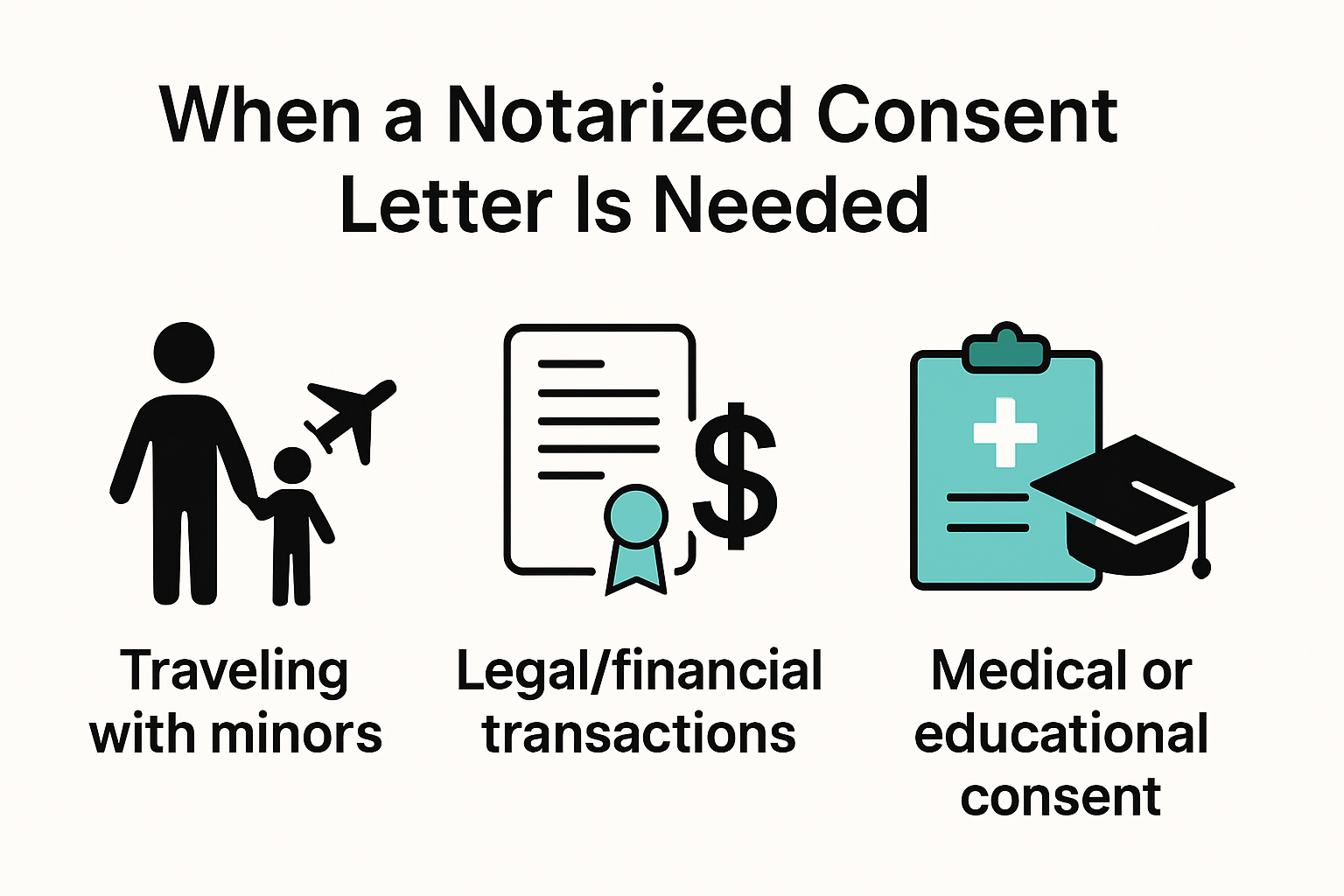
A notarized consent letter serves as a critical legal document that provides official authorization and verification in numerous important situations. Understanding when and why you might need such a document can save you significant time and potential legal complications.
Traveling with Minors
One of the most common scenarios requiring a notarized consent letter involves international or domestic travel with children. Passport Canada recommends that when a child travels with only one parent or with another guardian, a notarized consent letter becomes essential. This document proves parental permission and helps prevent potential accusations of child abduction. Single parents, divorced couples, or guardians traveling with children who do not share the same last name particularly benefit from this legal protection.
The consent letter typically needs to include specific details such as:
- Full legal names of the child and traveling adults
- Travel dates and destination
- Contact information for the non traveling parent or guardian
- Specific authorization for the trip
Legal and Financial Transactions
Beyond travel, notarized consent letters play a crucial role in various legal and financial contexts. Ontario Legal Resource Center highlights that these documents are frequently used in situations involving property transfers, financial agreements, and medical consent. For instance, if a property owner wants to grant someone else the authority to manage or sell their property, a notarized consent letter provides clear, legally recognized permission.
Business contexts also frequently require notarized consent letters. When representatives need to act on behalf of a company or an individual cannot be physically present for a transaction, a notarized consent letter becomes the bridge of legal authorization. This documentation ensures transparency and protects all parties involved by creating a clear record of consent.
Medical and Educational Consent
In healthcare and educational settings, notarized consent letters become critical instruments of legal permission. Parents or guardians might need to provide consent for medical procedures, especially for minors or individuals who cannot provide their own consent. Similarly, educational institutions often require notarized letters when a student needs representation or authorization from a parent or guardian.
The key distinction of a notarized consent letter is its legal weight. Unlike a simple signed document, notarization adds an official layer of verification. A notary public confirms the identity of the person signing and witnesses the document, which significantly increases its credibility and legal standing.
Explore our guide on navigating online notary services to understand how you can efficiently obtain a notarized consent letter that meets all legal requirements in Ontario. Whether you need authorization for travel, financial transactions, or medical consent, a properly notarized document ensures your intentions are clearly and legally communicated.
How to Prepare and Notarize Your Consent Letter
Preparing a legally valid notarized consent letter requires careful attention to detail and understanding of specific documentation requirements. The process involves more than simply writing a letter it demands precision and adherence to legal standards that ensure your document will be recognized and respected.

Essential Content and Formatting Requirements
A comprehensive consent letter must include specific elements to be considered legally valid. Law Society of Ontario recommends including the following critical details:
- Full legal names of all parties involved
- Specific purpose of the consent
- Clear and unambiguous authorization
- Date of the letter
- Contact information for involved parties
- Explicit signatures of consenting individuals
When drafting the letter, use clear and professional language. Avoid ambiguous statements or overly complex terminology. The goal is to create a document that communicates intent directly and unmistakably. Handwritten letters are acceptable but typed documents are preferred for clarity and professional appearance.
Documentation and Identification Process
Before notarization, you must prepare comprehensive documentation. Canadian Bar Association emphasizes the importance of bringing valid government issued identification. Acceptable forms of ID include:
- Current passport
- Drivers license
- Provincial health card
- Permanent resident card
The notary will carefully verify your identity and ensure you understand the contents of the document you are signing. As of October 2024, remote or virtual notarization is not permitted in Ontario which means you must appear in person with original documents.
To help you quickly review the required identification and documentation for notarizing a consent letter, see the table below.
| Acceptable ID for Notarization | Type |
|---|---|
| Current passport | Government-issued Photo ID |
| Driver’s license | Government-issued Photo ID |
| Provincial health card | Government-issued Photo ID |
| Permanent resident card | Government-issued Photo ID |
Notarization Process and Legal Verification
During the notarization appointment, a licensed notary public will perform several critical steps. They will:
- Confirm the identity of all signatories
- Witness the signing of the document
- Apply an official notarial seal
- Complete a notarial certificate verifying the authenticity of signatures
For a streamlined overview, the table below summarizes each step of the notarization process in Ontario for 2025.
| Step | Description |
|---|---|
| Identity Verification | Notary examines government-issued photo ID of signers |
| Document Review | Notary ensures letter content meets requirements |
| Signing & Witnessing | Notary witnesses signatories signing the document |
| Notarial Seal & Certificate | Notary applies official seal and completes certification |
Discover more about our comprehensive notary services to ensure your consent letter meets all legal requirements. Professional notarization transforms a simple letter into a legally recognized document with significant legal standing.
Remember that each notarized consent letter is unique. While templates can provide guidance, personalization and accuracy are key to creating a document that serves its intended legal purpose effectively.
Legal Requirements in Ontario for 2025
Navigating the legal landscape for notarized consent letters in Ontario requires a comprehensive understanding of current regulations and emerging legal standards. As of 2025, several key legal requirements shape the process of creating and validating these critical documents.
Authentication and Verification Standards
In 2025, Ontario maintains stringent requirements for document authentication. Ontario Ministry of Government Services highlights that Canada’s recent addition to the Hague Apostille Convention has streamlined international document verification. This means notarized consent letters now have improved recognition across participating countries.
Key authentication requirements include:
- Original signatures from all consenting parties
- Official notarial seal and certification
- Clear identification of all involved individuals
- Precise documentation of consent purpose
The legal framework demands absolute clarity and precision. Any ambiguity can potentially invalidate the entire document, making professional guidance crucial.
Jurisdictional Compliance and Restrictions
Law Society of Ontario emphasizes that physical presence remains mandatory for notarization in 2025. Remote or virtual notarization continues to be prohibited, requiring all parties to appear in person before a licensed notary public.
Specific legal restrictions include:
- Mandatory in person verification of identity
- Requirement for government issued photo identification
- Explicit consent from all parties
- Detailed documentation of authorization scope
Professional notaries must carefully verify each document meets these stringent legal standards. Failure to comply can result in document rejection or potential legal challenges.
International Document Recognition
With the implementation of the Hague Apostille Convention, Ontario has simplified the process of international document recognition. This means notarized consent letters prepared in Ontario now have enhanced credibility across multiple jurisdictions.
International recognition depends on:
- Precise adherence to formatting requirements
- Complete and unambiguous consent language
- Proper notarial certification
- Compliance with both provincial and international standards
Learn more about our comprehensive notary verification process to ensure your consent letter meets all legal requirements. Understanding these nuanced legal standards is crucial for creating a document that serves its intended purpose effectively and maintains legal integrity across different jurisdictions.
Frequently Asked Questions
What is a notarized consent letter used for in Ontario?
A notarized consent letter is used to provide legal authorization for various situations, including traveling with minors, conducting legal and financial transactions, and granting medical or educational consent.
How do I prepare a notarized consent letter?
To prepare a notarized consent letter, include the full names of all parties involved, the purpose of the consent, explicit authorization, contact information, and signatures. Ensure the letter is clear and professional.
What identification do I need for notarization in Ontario?
You must present valid government-issued identification, such as a current passport, driver’s license, provincial health card, or permanent resident card, when getting a document notarized in Ontario.
Can I get a notarized consent letter remotely in Ontario?
No, as of 2025, remote notarization is banned in Ontario. All parties involved must appear in person for the notarization process.
Trouble Navigating New Notarization Rules in Ontario?
Facing the stress of Ontario’s stricter in-person notarization laws for 2025 can feel overwhelming. If you are worried about missed documentation, last-minute travel hassles with minors, or the pressure of meeting detailed legal requirements for consent letters, you are not alone. Our team understands how crucial it is to have every signature and identity verified in person, and why it matters for your child’s travel, property agreements, or medical consent. The new ban on remote notarization means you want simple, reliable solutions you can trust, without risking a rejected document.

Take charge of your paperwork now to avoid avoidable travel disruptions or legal setbacks. At The Online Notary, we make every step of the notarization process clear, efficient, and compliant with Ontario’s 2025 standards. Learn how to get your consent letters, affidavits, or statutory declarations notarized with confidence by visiting our main website and discover how our trusted notary services can give you peace of mind and protect your interests right when you need it most.
Recommended
- Why Opt for an Online Notary in Ontario – The Online Notary CA
- The Complete Guide to Using an Online Notary Public for Affidavits and Declarations in Ontario (2025) – The Online Notary CA
- Everything You Need to Know About Online Notarization in Ontario: Fast, Legal, and Convenient for Affidavits and Declarations (2025) – The Online Notary CA
- Professional Online Notary Services in Canada – The Online Notary CA
- Travel Consent Letters for Minors with A Notary Near Me – My Mobile Notary