
Everyone knows certain paperwork can feel overwhelming, but declarations are different and carry surprising weight. A declaration is not just a document—it is an official legal statement that can have serious consequences for dishonesty, including prosecution for perjury. Most people expect to breeze through such forms without much thought, but courts and organizations actually treat these statements as powerful proof with real teeth. The biggest surprise is how a simple signed statement can transform into rock-solid evidence, impacting everything from business deals to government benefits.
Table of Contents
- Defining A Declaration: What Is It Really?
- The Importance Of Declares In Legal And Business Contexts
- How Declares Function: Mechanisms And Examples
- Key Concepts Associated With Declareations
- Real-World Applications Of Declareations In Ontario
Quick Summary
| Takeaway | Explanation |
|---|---|
| A declaration is a formal statement. | It serves as an official document expressing facts or intentions with legal significance. |
| Declarations require truthfulness. | Declarants face potential legal consequences, such as perjury, for providing false statements. |
| Legal and business integrity relies on declarations. | They create verifiable records that establish trust and accountability in professional interactions. |
| Mechanisms exist to authenticate declarations. | Processes like notarization and witness verification enhance the legal reliability of these documents. |
| Declarations are vital across various sectors. | They are used in legal proceedings, governmental processes, and business transactions for comprehensive documentation. |
Defining a Declaration: What is it Really?
A declaration represents an official, legally recognized statement of facts or intentions made by an individual or entity. At its core, a declaration serves as a powerful written document that communicates critical information with legal weight and personal accountability.
The Core Elements of a Declaration
When exploring what is a declaration, understanding its fundamental components becomes crucial. A declaration typically includes:
- A clear, precise statement of facts
- The full name and identification of the declarant
- A formal assertion of truthfulness
- Potential legal consequences for misrepresentation
The power of a declaration lies in its ability to provide an authoritative account of specific circumstances while holding the declarant legally responsible for the accuracy of their statements. Unlike casual verbal communication, a declaration carries significant legal implications.
Legal and Practical Implications
According to Cornell Law School, a declaration becomes legally binding when the person making the statement understands they could be prosecuted for perjury if the information is proven false. This means the declarant must provide truthful information under potential penalty of legal consequences.
Practical applications of declarative statements span numerous contexts including:
- Legal proceedings and court documentation
- Official government forms and immigration processes
- Business transactions and contractual agreements
- Personal affidavits and sworn testimonies
By requiring individuals to affirm the truthfulness of their statements, a declaration serves as a critical mechanism for maintaining integrity and accountability in various formal and legal interactions. The declarant essentially vouches for the authenticity of the information, understanding the potential repercussions of providing misleading or false information.
The Importance of Declares in Legal and Business Contexts
Declarations play a critical role in maintaining legal and business integrity, serving as foundational documents that establish trust, accountability, and formal communication across multiple professional domains. These statements provide a structured mechanism for individuals and organizations to communicate important information with significant legal implications.
Establishing Legal and Organizational Credibility
In legal and business environments, a declaration functions as more than just a simple statement. It represents a formal commitment to truthfulness that carries substantial weight in various contexts. According to OpenStax Business Resources, the legal system fundamentally depends on such mechanisms to maintain societal stability and regulate interactions between individuals and organizations.
Key reasons why declarative statements are crucial include:
- Providing verifiable documentation of facts
- Creating legally binding records
- Establishing personal and organizational accountability
- Facilitating transparent communication
Practical Applications Across Professional Domains
Declarations manifest in numerous professional scenarios, each with distinct purposes and implications. From notarized affidavits for legal proceedings to business contract verifications, these documents serve as essential instruments for maintaining organizational transparency and legal compliance.
Business and legal contexts where declarative statements are particularly critical encompass:
- Contractual agreements and negotiations
- Regulatory compliance reporting
- Financial and tax documentation
- Dispute resolution and evidence submission
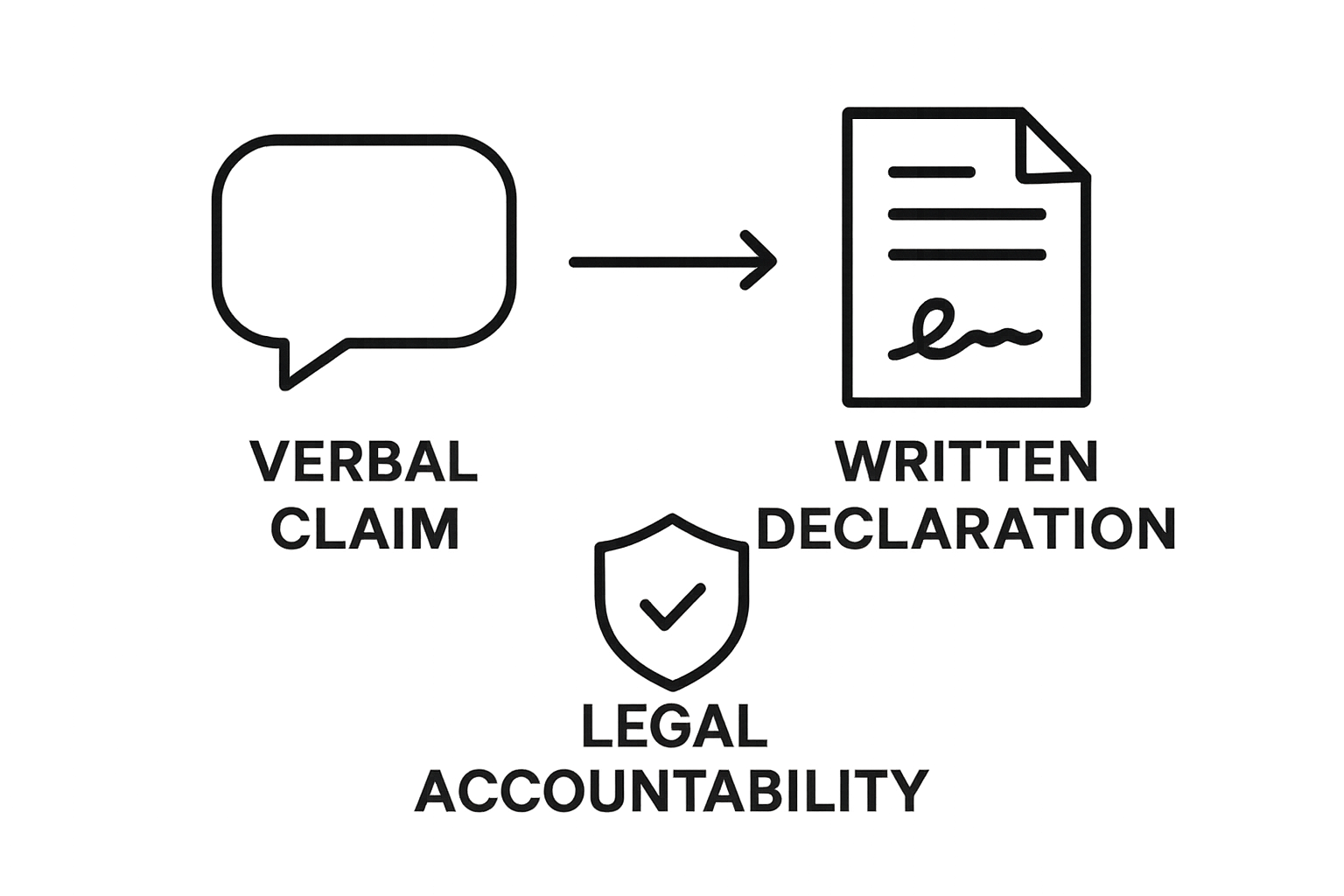
By requiring precise, truthful statements with potential legal consequences, declarative documents create a robust framework for accountability. They transform verbal claims into verifiable, enforceable records that can withstand legal scrutiny and provide clear evidence of intent, agreement, or factual representation.
To help clarify the similarities and differences, the following table compares declarations in legal, government, and business contexts as described in the article.
| Context | Purpose | Examples | Legal Significance |
|---|---|---|---|
| Legal | Provide formal written statements of fact | Affidavits, sworn testimonies, court documentation | Used as admissible evidence; prosecution for perjury applies |
| Government | Verify personal information, claims | Immigration, citizenship forms, tax filings | Authorizes actions; ensures accuracy in administrative records |
| Business | Establish contractual agreements, compliance | Contract negotiation, compliance reports, financial statements | Creates enforceable records; builds organizational accountability |
How Declares Function: Mechanisms and Examples
Declarations operate as precise communication tools that transform verbal statements into legally recognized, verifiable documents with specific structural requirements and functional mechanisms. Understanding how these documents work involves examining their core components and the intricate processes that validate their legal standing.
Structural Components and Validation
A declaration functions through a carefully designed framework that ensures authenticity and legal reliability. According to Computer Science Resources, these documents require specific structural elements that validate their credibility and legal weight.
Key structural components of a declaration include:
- Explicit identification of the declarant
- A clear, unambiguous statement of facts
- Date and location of declaration
- Formal attestation of truthfulness
- Potential legal consequences clause
Mechanisms of Legal Authentication
The authentication process transforms a simple statement into a legally binding document. Notarization services play a crucial role in this mechanism, providing an official verification that adds significant legal credibility to the declaration.
Primary mechanisms of declaration authentication involve:
- Witness verification
- Official signature documentation
- Comprehensive fact-checking
- Potential cross-referencing with external records
By integrating these rigorous verification processes, a declaration transcends a mere written statement.
The table below summarizes the essential components required for a declaration to be valid and legally reliable as highlighted in the guide.
| Component | Description |
|---|---|
| Declarant Identification | Full name and relevant identification of the person making the statement |
| Statement of Facts | Clear, specific description of relevant facts or intentions |
| Date and Location | When and where the declaration is made |
| Assertion of Truthfulness | Formal affirmation that the information is accurate to the best of their knowledge |
| Legal Consequence Clause | Notice of potential penalties (e.g., perjury) for false statements |
| Signature or Attestation | Official signing, possibly with witness or notary validation |
| It becomes a powerful legal instrument that can serve as evidence, establish formal agreements, and provide clear documentation of intent and factual circumstances across various professional and legal contexts. |
Key Concepts Associated with Declareations
Declaring a statement involves more than simply writing words on paper. It requires understanding a complex set of legal, ethical, and procedural principles that govern how formal statements are constructed, validated, and utilized across various professional and legal contexts.
Fundamental Principles of Declarative Communication
At the core of declarative communication lie several critical conceptual foundations that determine the document’s legal and practical effectiveness. According to National Archives Resources, these principles extend beyond mere documentation to represent fundamental expressions of intent and understanding.
Key conceptual principles include:
- Explicit statement of facts
- Unambiguous representation of intent
- Personal accountability for truthfulness
- Clear identification of the declarant
- Potential legal ramifications for misrepresentation
Legal and Ethical Dimensions
Declarations operate within a sophisticated framework of legal and ethical considerations. Learn more about notarization requirements that help validate these important documents and ensure their legal standing.
Ethical and legal dimensions of declarative statements encompass:
- Maintaining intellectual honesty
- Protecting individual and organizational integrity
- Establishing transparent communication channels
- Creating verifiable historical and legal records
- Supporting institutional accountability
By integrating these nuanced principles, a declaration transforms from a simple written statement into a powerful instrument of communication. It serves not just as a record of facts, but as a mechanism for establishing trust, resolving disputes, and maintaining the structural integrity of legal and professional interactions.
Real-World Applications of Declareations in Ontario
Declareations serve as critical instruments of legal and administrative communication throughout Ontario, facilitating essential processes across government, professional, and personal domains. Understanding their practical implementation reveals the profound impact these documents have on daily interactions and institutional operations.
Government and Administrative Contexts
In Ontario’s governmental landscape, declareations play a fundamental role in verifying information, establishing legal accountability, and maintaining transparent administrative processes. According to Ontario Government Forms Repository, various official forms require precise declarative statements to validate individual claims and authorize administrative actions.
Key governmental application areas include:
- Student financial assistance verification
- Immigration and citizenship documentation
- Tax and revenue reporting processes
- Professional licensing and credential confirmation
- Public service employment applications
Legal and Professional Verification
Online notary services provide critical support in authenticating these important documents across Ontario. Professional sectors rely extensively on carefully crafted declarative statements to establish legal compliance and personal accountability.
Professional domains utilizing declareations encompass:
- Real estate transactions
- Corporate legal documentation
- Academic credential verification
- Professional regulatory compliance
- Financial service agreements
By integrating rigorous verification processes, declareations transform from simple written statements into powerful legal instruments. They ensure transparency, provide clear documentation of intent, and create enforceable records that support Ontario’s complex administrative and legal frameworks.

Make Your Declaration Count with Trusted Online Notary Services
Are you feeling anxious about the legal consequences of your declaration or struggling with the uncertainty of whether your document will hold up in Ontario? Our article highlights the importance of statements that are clear, formally attested, and legally valid. When so much relies on accuracy and accountability, the risks of an improperly prepared declaration are just too high.

Take the next step for complete confidence. At The Online Notary, we make the process simple and secure for affidavits, statutory declarations, invitation letters, and solemn declarations. Every statement you prepare with us is verified for legal strength and ready for urgent needs or tight deadlines. Do not leave your professional or personal goals up to chance. Start your declaration now and experience online notary service trusted across Ontario.
Frequently Asked Questions
What is a declaration?
A declaration is an official, legally recognized statement of facts or intentions made by an individual or entity, which holds legal weight and personal accountability.
What are the key components of a declaration?
Key components of a declaration include a clear statement of facts, identification of the declarant, a formal assertion of truthfulness, and potential legal consequences for misrepresentation.
What are some practical applications of declarations?
Declarations are commonly used in legal proceedings, official government forms, business transactions, and personal affidavits, serving to document critical information with legal implications.
How does a declaration become legally binding?
A declaration becomes legally binding when the declarant understands the consequences of providing false information, such as the risk of perjury if the statements are proven false.