
People often scramble to find official papers to prove a family or partner connection, especially during stressful events like immigration or settling an inheritance. Surprisingly, when marriage certificates or birth records cannot be found, a simple sworn statement can carry just as much legal weight. An affidavit for proof of relationship turns a personal story into real evidence, and courts in the US accept these documents in thousands of cases every single year.
Table of Contents
- Defining The Affidavit For Proof Of Relationship
- The Importance Of Affidavits In Relationship Verification
- How Affidavits Support Legal And Financial Matters
- Understanding The Structure And Components Of An Affidavit
Quick Summary
| Takeaway | Explanation |
|---|---|
| Affidavits validate personal relationships legally | They provide official, sworn statements confirming the existence and nature of interpersonal connections in various contexts. |
| Key components ensure affidavit effectiveness | Essential elements include identification of parties, detailed facts, and declarations of truthfulness, enhancing the document’s legal standing. |
| Affidavits support immigration and legal scenarios | These documents are crucial for verifying family ties in immigration, inheritance claims, and social service applications. |
| Sworn statements require personal knowledge | Affiants must provide direct observations and detailed accounts to create credible affidavits that withstand legal scrutiny. |
| Affidavits can establish financial and legal accountability | They confirm financial responsibilities and relationships, making them essential in legal and financial matters where evidence may be lacking. |
Defining the Affidavit for Proof of Relationship
An affidavit for proof of relationship is a legal document that provides sworn testimony about the authenticity and nature of a personal connection between two individuals. This formal written statement serves as critical evidence in various legal and administrative contexts, particularly in immigration, family law, and social services proceedings.
Understanding the Legal Foundation
The affidavit for proof of relationship represents a legally binding declaration made under oath, confirming the existence and characteristics of a specific interpersonal connection. According to the U.S. Citizenship and Immigration Services, these documents play a crucial role in verifying familial or personal relationships.
Key elements typically documented in a relationship affidavit include:
- The specific type of relationship (spouse, partner, family member)
- Duration of the relationship
- Shared living arrangements
- Financial interdependence
- Emotional connection and mutual commitment
Purpose and Significance
Relationship affidavits serve multiple essential functions across different scenarios. They provide a credible mechanism for individuals to formally establish and validate their personal connections when official documentation might be limited or unavailable.
Common scenarios requiring an affidavit for proof of relationship include:
- Immigration applications demonstrating family ties
- Legal proceedings involving inheritance or guardianship
- Social services benefit determinations
- Establishing common law partnerships
- Verifying dependent status for insurance or employment purposes
By presenting a sworn statement from credible witnesses or directly involved parties, these documents offer a structured approach to confirming relationship details that might otherwise be challenging to substantiate through traditional documentation methods.
Below is a table summarizing common scenarios where affidavits for proof of relationship are used, along with their primary purpose in each situation for easier reference.
| Scenario | Primary Purpose |
|---|---|
| Immigration Applications | Demonstrate family or partner ties to authorities |
| Inheritance or Guardianship Proceedings | Establish legal rights based on relationship |
| Social Services Benefit Determinations | Verify dependents or qualified family members |
| Establishing Common Law Partnerships | Confirm partnership where marriage documentation is absent |
| Dependent Status for Insurance/Employment | Validate claims for dependent benefits |
The Importance of Affidavits in Relationship Verification
Affidavits play a critical role in legally validating personal relationships, providing an authoritative mechanism for individuals to establish and confirm their interpersonal connections across various legal and administrative domains. These sworn statements serve as powerful evidence when traditional documentation might be insufficient or unavailable.
Legal and Administrative Validation
In complex legal scenarios, relationship affidavits offer a structured approach to verifying personal connections. Whether for immigration proceedings, inheritance claims, or social service benefits, these documents provide a legally recognized method of confirming relationship details. Learn more about commissioning affidavits online to understand the formal process of creating these critical documents.
Key attributes that make relationship affidavits crucial include:
- Providing legally binding testimony
- Offering credible evidence where traditional documentation is limited
- Creating an official record of personal connections
- Supporting complex legal and administrative processes
- Establishing clear relationship narratives
Comprehensive Relationship Documentation
Relationship verification through affidavits goes beyond simple documentation. These sworn statements capture nuanced aspects of personal connections that standard forms cannot adequately represent. They enable individuals to present comprehensive narratives about their relationships, including emotional bonds, shared experiences, and mutual commitments.
Critical scenarios where relationship affidavits become indispensable involve:
- Demonstrating long term partnerships not formalized through marriage
- Establishing familial connections in international contexts
- Proving dependency for financial or legal purposes
- Supporting immigration and citizenship applications
- Resolving complex inheritance and guardianship matters
By providing a legally recognized platform for personal testimony, relationship affidavits bridge critical gaps in traditional documentation, offering a robust mechanism for verifying and validating interpersonal connections across diverse legal and administrative landscapes.

How Affidavits Support Legal and Financial Matters
Affidavits serve as powerful legal instruments that provide critical support across complex legal and financial landscapes, offering authoritative documentation and sworn testimony in scenarios where standard evidence might fall short. These legally binding documents play a fundamental role in establishing credibility and providing official verification of critical information.
Financial and Legal Verification Mechanisms
In financial and legal contexts, affidavits function as essential tools for confirming personal and economic details. According to the U.S. Citizenship and Immigration Services, these documents help establish official records and validate critical relationship and financial information. Learn more about online notarization services to understand how these documents can be efficiently processed.
Key financial and legal scenarios where affidavits become crucial include:
- Proving financial dependency
- Establishing financial responsibility
- Documenting inheritance claims
- Verifying financial support commitments
- Supporting immigration and citizenship applications
Comprehensive Legal Documentation
Affidavits transcend simple paperwork by providing sworn testimonial evidence that carries significant legal weight. They enable individuals and organizations to present comprehensive narratives about complex financial and interpersonal situations that standard forms cannot adequately capture.
Critical aspects of legal and financial affidavits encompass:
- Legally binding sworn statements
- Detailed personal and financial information
- Official documentation of relationships
- Transparent financial disclosures
- Comprehensive evidence for legal proceedings
By offering a structured, legally recognized platform for personal and financial testimony, affidavits bridge significant gaps in traditional documentation, providing robust mechanisms for verifying intricate legal and economic relationships across diverse administrative contexts.
Understanding the Structure and Components of an Affidavit
An affidavit is a structured legal document that requires precise organization and specific components to ensure its validity and legal effectiveness. Understanding its intricate framework helps individuals create comprehensive and credible sworn statements that can withstand legal scrutiny.
Essential Structural Elements
According to the U.S. Citizenship and Immigration Services, a well-constructed affidavit must include several critical components that establish its legal authenticity. Learn more about online notarization processes to understand how these documents are formally processed.
Key structural elements of a robust affidavit include:
- Clear identification of the affiant (document creator)
- Complete personal contact information
- Precise date and location of document creation
- Detailed narrative of facts
- Explicit statement of personal knowledge
- Formal declaration of truthfulness
Comprehensive Content Requirements
The content of an affidavit must go beyond mere factual reporting. Sworn statements demand meticulous detail and direct personal knowledge of the circumstances being described. This means the affiant must provide a comprehensive account that can be independently verified and demonstrates firsthand understanding.
Critical content considerations for affidavits encompass:
- Specific dates and timelines
- Direct personal observations
- Contextual background information
- Explanation of relationship to involved parties
- Clear and unambiguous language
- Avoidance of hearsay or speculative statements
By adhering to these structured guidelines, individuals can create legally robust affidavits that provide authoritative documentation across various personal, legal, and administrative contexts.
The following table organizes the essential structural elements and content requirements of a valid affidavit for proof of relationship, helping readers quickly identify what must be included and why it is important.
| Component | Purpose/Requirement |
|---|---|
| Affiant Identification | Clearly states who is making the sworn statement |
| Personal Contact Information | Provides verifiable details for legal correspondence |
| Date and Location of Creation | Establishes when and where the affidavit was made |
| Detailed Narrative of Facts | Describes the relationship in specific and comprehensive detail |
| Statement of Personal Knowledge | Confirms the affiant has direct knowledge of the facts presented |
| Declaration of Truthfulness | Legally binds the affiant to the veracity of the statement |
| Specific Dates and Timelines | Documents the chronology of the relationship |
| Direct Personal Observations | Ensures statements are based on firsthand evidence |
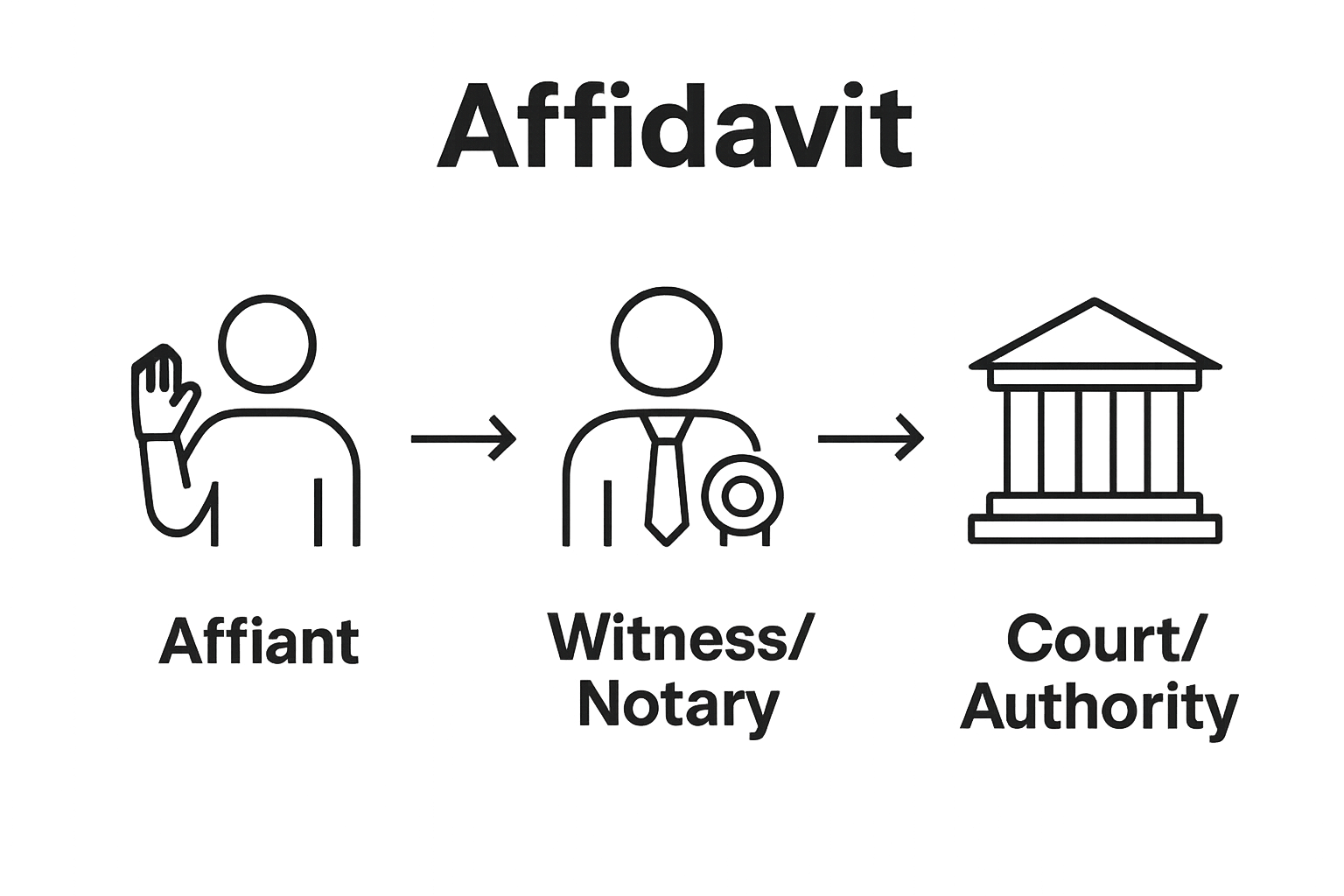
Make Relationship Proof Stress-Free with Reliable Online Notary Services
Struggling to prove your relationship in a legal or immigration process can be overwhelming. The article highlights how missing documentation, complex requirements, and strict affidavit structures can lead to delays or denied applications. If you need a valid affidavit for proof of relationship, you know how important it is to have a legally sound and properly commissioned document, especially when facing time-sensitive or high-stakes situations.

Take the uncertainty out of your affidavit process. TheOnlineNotary.ca provides fast, professional online notary services across Ontario for all types of affidavits and solemn declarations. Our secure platform lets you complete your documents from home and ensures your relationship affidavit meets every legal requirement. Do not risk delays or legal setbacks. Book your online notary session and get your proof of relationship affidavit commissioned today.
Frequently Asked Questions
What is an affidavit for proof of relationship?
An affidavit for proof of relationship is a legal document that provides sworn testimony regarding the nature and authenticity of a personal connection between two individuals.
When is an affidavit for proof of relationship commonly used?
These affidavits are often used in scenarios such as immigration applications to demonstrate familial ties, legal proceedings involving inheritance or guardianship, and establishing common law partnerships.
What are the key components of a valid affidavit for proof of relationship?
A valid affidavit typically includes the identification of the affiant, personal contact information, the date and location of creation, a detailed narrative of facts, an explicit statement of personal knowledge, and a formal declaration of truthfulness.
How can affidavits support legal and financial matters?
Affidavits serve as powerful legal instruments by providing sworn testimony and documentation that can validate claims regarding financial dependency, inheritance, and personal relationships, particularly where standard evidence is insufficient.