
Online notary services in Ontario are supposed to make life easier, right? The idea is simple and the technology exists, yet the legal system is still not fully on board. Remote notarization is technically not permitted in Ontario, despite 69 percent of buyers and sellers now preferring digital documents. So the real surprise is that until the rules change, you need to know why online notarization is anything but open and easy in this province.
Table of Contents
- How Online Notary Services Work In Ontario
- Key Benefits For Individuals And Businesses
- Legal Requirements And Accepted Documents
- Choosing The Right Online Notary Platform
Quick Summary
| Takeaway | Explanation |
|---|---|
| Online notarization has limited scope in Ontario | Remote notarization isn’t fully allowed; individuals must navigate existing legal restrictions carefully. |
| Document authentication involves strict identity verification | Notaries must confirm identities with government-issued IDs, ensuring document integrity against fraud. |
| Select online notary platforms with robust security features | Choose platforms that offer advanced identity verification and encryption to ensure secure transactions. |
| Stay informed about evolving regulations | Emerging technologies may influence changes in notarization laws, providing more flexible document management options. |
| Efficient processes save time and reduce costs | Businesses benefit from quicker notarizations and minimized administrative overhead, leading to greater operational efficiency. |
How Online Notary Services Work in Ontario
Online notary services in Ontario are a complex landscape of digital authentication that requires careful navigation. Currently, the legal framework for these services presents unique challenges and opportunities for individuals and businesses seeking document verification.
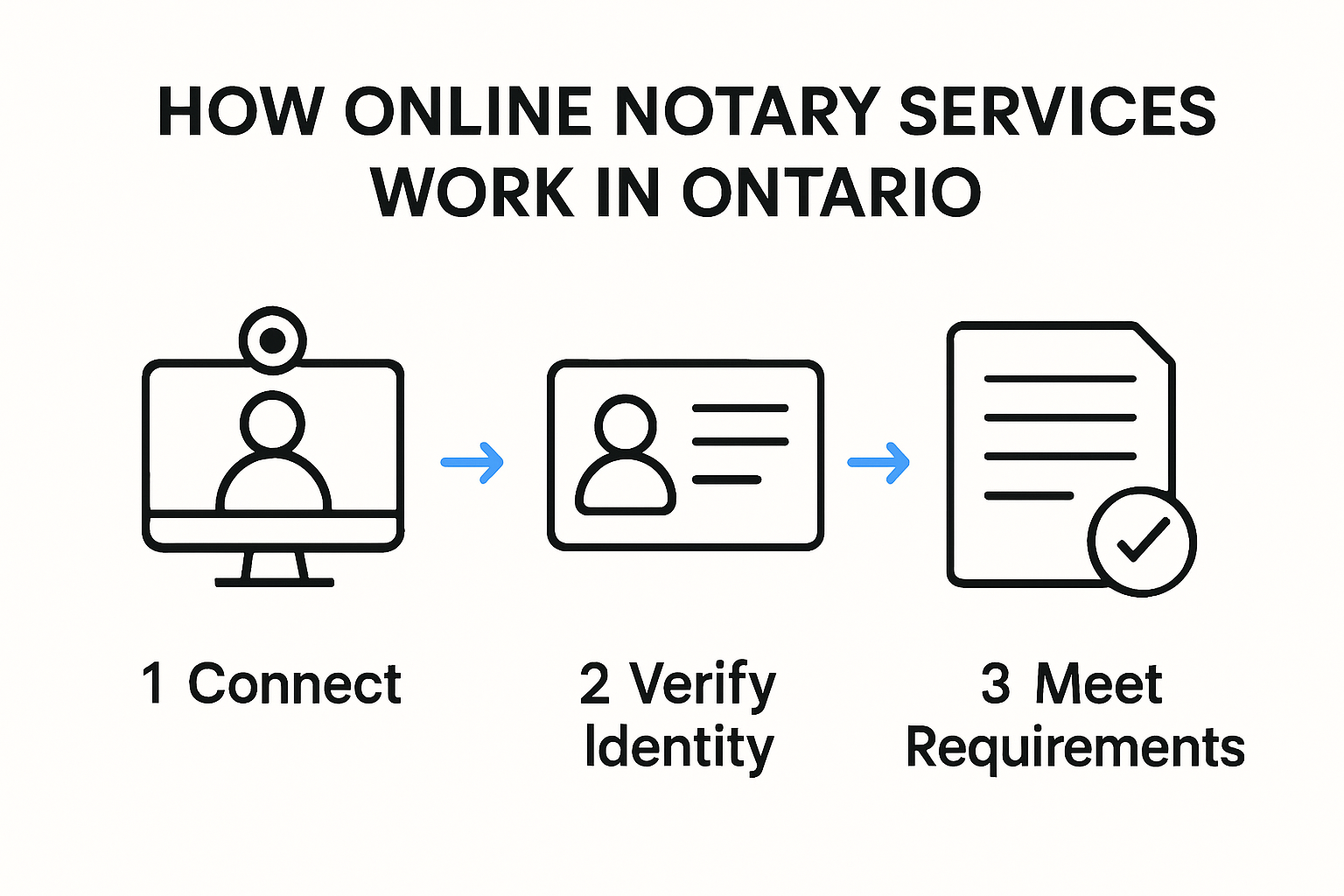
The Current Legal Landscape of Online Notarization
In Ontario, the process of online notarization is not straightforward. According to the Law Society of Ontario, remote or virtual notarization is technically not permitted under current regulations. While the Notaries Act allows for potential remote notarization through specific regulatory mechanisms, no such comprehensive regulation has been enacted to date.
Pravo Law explains that while remote commissioning of certain documents is allowed, full remote notarization remains prohibited. This means individuals seeking notary services must understand the nuanced restrictions that currently exist.
Document Authentication Methods
Despite the limitations, Ontario residents have several pathways for document authentication. Lawyers and paralegals appointed as notaries public can provide essential verification services. The authentication process typically involves several critical steps:
- Identity Verification: Confirming the identity of the document signer through government issued identification
- Document Review: Carefully examining the document for completeness and accuracy
- Witness Signature: Providing an official stamp and signature to validate the document
For those seeking more comprehensive information about online notary processes, understanding these intricate requirements is crucial.
Technology and Future Potential
While current regulations limit full online notarization, technological advancements are pushing the boundaries of how document authentication can occur. The Ontario legal system continues to evaluate methods that could potentially enable more flexible digital notary services.
Businesses and individuals must stay informed about potential regulatory changes. The transition to more digital authentication methods seems inevitable, but the precise timeline remains uncertain. Professionals in legal and administrative fields are closely monitoring potential updates that could streamline document verification processes.
Navigating online notary services in Ontario requires patience, understanding of current legal constraints, and a willingness to adapt to emerging technological solutions. As regulations evolve, individuals can expect more flexible and accessible document authentication methods in the future.
Key Benefits for Individuals and Businesses
Online notary services are transforming how individuals and businesses manage legal documentation, offering unprecedented convenience and efficiency in document authentication. While navigating the current regulatory landscape requires careful consideration, the potential benefits are significant and far-reaching.
Efficiency and Time Savings

According to research from legal technology experts, remote online notarization provides substantial time savings for both individuals and organizations. The National Association of Realtors reported that 69% of buyers and sellers now prefer digital document processing, highlighting the growing demand for streamlined legal transactions.
Businesses can dramatically reduce administrative overhead by eliminating traditional notarization barriers. Real estate transactions, estate planning, and business agreements can now be completed without the need for physical meetings. This translates to:
- Reduced Travel Costs: No more scheduling complicated in-person meetings
- Faster Processing: Documents can be authenticated quickly and securely
- Expanded Accessibility: Services available beyond traditional business hours
Below is a summary table organizing the key benefits of online notary services for individuals and businesses as discussed above:
| Benefit | Individuals | Businesses |
|---|---|---|
| Time Savings | Quick document authentication | Faster transaction processing |
| Reduced Travel Costs | Avoids in-person meetings | Minimizes travel expenses |
| Accessibility | Services beyond business hours, remote locations | Supports remote workforce, multiple regions |
| Administrative Efficiency | Easier document handling | Less paperwork, streamlined workflow |
| Convenience | Flexible scheduling | Reduced disruption to operations |
Enhanced Security and Compliance
Research from the American Judicial Society demonstrates that online notary services offer robust security features that often exceed traditional notarization methods. Advanced identity verification technologies ensure:
- Blockchain-anchored electronic signatures
- Comprehensive digital audit trails
- Strict identity proofing protocols
The Ontario Electronic Commerce Act supports these digital transformation efforts, establishing legal frameworks that recognize electronic signatures and remote document authentication. This regulatory support provides businesses and individuals with confidence in digital legal processes.
Accessibility and Flexibility
Online notary services break down traditional geographical and logistical barriers. Individuals with mobility challenges, those in remote locations, or professionals with demanding schedules can now access critical document authentication services without compromise. Learn more about digital notarization advantages and how they are reshaping legal document management.
For businesses, this means the ability to:
- Execute documents across multiple jurisdictions
- Support remote workforce documentation needs
- Reduce administrative complexity
While current Ontario regulations maintain certain restrictions, the trajectory toward more comprehensive digital notary services is clear. Businesses and individuals who stay informed and adaptable will be best positioned to leverage these emerging technological solutions.
Legal Requirements and Accepted Documents
Navigating the legal requirements for notarization in Ontario demands a comprehensive understanding of document authentication protocols and acceptable identification standards. Individuals and businesses must carefully adhere to specific regulatory guidelines to ensure their documents receive proper legal validation.
Identification and Verification Standards
According to the Ontario government, robust identity verification is the cornerstone of legitimate notarization. Acceptable identification documents must meet stringent criteria to confirm an individual’s legal identity. Primary government-issued photo identification typically includes:
- Driver’s License: Government-issued provincial identification
- Passport: International travel document with photo
- Permanent Resident Card: Official Canadian immigration document
- Ontario Photo Card: Provincial non-driver identification
Notaries public are required to meticulously examine these documents, confirming both the visual match and document authenticity. The Law Society of Ontario emphasizes the critical nature of this verification process, which serves as the fundamental protection against potential fraud.
The following table summarizes the primary forms of identification accepted for notarization in Ontario and their key characteristics:
| Identification Type | Description | Issued By |
|---|---|---|
| Driver’s License | Government-issued provincial ID | Province of Ontario |
| Passport | International travel document with photo | Government of Canada |
| Permanent Resident Card | Immigration document with photo | Government of Canada |
| Ontario Photo Card | Non-driver provincial identification | Province of Ontario |
Document Types and Notarization Eligibility
Not all documents qualify for standard notarization in Ontario. Legal professionals must carefully assess each document’s specific requirements. Common documents that frequently require notarization include:
- Affidavits
- Statutory declarations
- Power of attorney documents
- Real estate transaction paperwork
- Consent letters for minors
- Immigration and travel-related documentation
Learn more about comprehensive notarization guidelines to understand the nuanced requirements for different document types. Each category may have unique authentication protocols that demand precise attention to legal details.
Professional Qualification Requirements
The Ontario government outlines specific professional qualifications for individuals authorized to provide notary services. Currently, only specific legal professionals can serve as notaries public:
- Licensed lawyers in good standing with the Law Society of Ontario
- Paralegals registered with the Law Society
- Specific government officials designated with notarial powers
These professionals must undergo rigorous training and maintain strict ethical standards. They are responsible for ensuring document integrity, verifying identities, and maintaining comprehensive records of all notarization activities.
While current regulations present certain limitations on fully digital notarization, the legal landscape continues to evolve. Professionals and individuals must remain informed about potential regulatory changes that could expand online notary service capabilities in Ontario.
Choosing the Right Online Notary Platform
Selecting an appropriate online notary platform requires careful consideration of multiple factors, especially given the complex legal landscape in Ontario. While current regulations limit full digital notarization, understanding key platform selection criteria can help individuals and businesses navigate document authentication more effectively.
Security and Compliance Features
According to the National Association of Secretaries of State, robust online notary platforms must incorporate comprehensive security measures. Critical elements to evaluate include:
- Identity Verification: Advanced Knowledge-Based Authentication (KBA) protocols
- Credential Analysis: Sophisticated document verification technologies
- Encryption Standards: Secure data transmission mechanisms
- Audit Trail Capabilities: Comprehensive transaction logging
These features ensure that potential digital interactions meet stringent legal and security requirements. Learn more about secure online notarization processes to understand the intricate technical safeguards necessary for reliable document authentication.
Below is a checklist table outlining key security and compliance features to look for when selecting an online notary platform:
| Security Feature | Description | Recommended for Ontario? |
|---|---|---|
| Identity Verification (KBA) | Confirms identity using personal knowledge | Yes |
| Credential Analysis | Validates document authenticity electronically | Yes |
| Encryption Standards | Ensures data is securely transmitted | Yes |
| Audit Trail Capabilities | Provides comprehensive records and e-journals | Yes |
Technical Infrastructure and User Experience
Research from state-level electronic notarization guidelines highlights the importance of selecting platforms with robust technical infrastructure. Key considerations include:
- Compatibility with multiple devices
- Intuitive user interface
- Seamless document upload capabilities
- Real-time communication tools
- Secure video conferencing integration
User experience matters significantly. A platform that balances technical sophistication with ease of use can dramatically simplify the document authentication process for both individuals and businesses.
Compliance and Legal Alignment
Given Ontario’s specific regulatory environment, choosing a platform that demonstrates a clear understanding of provincial legal requirements is paramount. Potential users should investigate platforms that:
- Maintain transparency about current legal limitations
- Provide clear guidance on document types
- Offer expert support for navigating complex authentication processes
- Demonstrate ongoing commitment to regulatory compliance
While full digital notarization remains restricted in Ontario, platforms that proactively adapt to evolving legal frameworks provide the most value. Users should prioritize solutions that combine technological innovation with a deep understanding of local legal nuances.
The ideal online notary platform goes beyond mere technological capability. It represents a strategic partner in document authentication, offering guidance, security, and compliance in an increasingly complex digital landscape. As regulations continue to evolve, selecting a forward-thinking platform becomes crucial for individuals and businesses seeking efficient, secure document verification solutions.
Frequently Asked Questions
What are online notary services in Ontario?
Online notary services in Ontario involve document authentication performed by licensed notaries, but due to current regulations, full remote notarization is not allowed. Notaries must physically meet with clients for proper identity verification and document validation.
How does the identity verification process work for online notarizations?
The identity verification process for online notarizations in Ontario requires clients to present government-issued photo identification. This step ensures the legitimacy of the signer and helps prevent fraud in document authentication.
What types of documents can be notarized in Ontario?
Common documents that can be notarized in Ontario include affidavits, power of attorney documents, real estate transaction papers, and consent letters for minors. However, not all documents are eligible, so it is essential to consult with a notary for specific requirements.
Are there any legal restrictions on online notarization in Ontario?
Yes, Ontario currently has legal restrictions that prevent full remote notarization. While certain remote commissioning processes are permitted, individuals must adhere to existing laws that require physical presence for notarization services.
Simplify Notarization in Ontario with Trusted Online Solutions
Do you feel held back by Ontario’s strict rules on remote notarization? Many Ontarians want faster, safer ways to notarize documents such as affidavits, statutory declarations, or invitation letters. The law can be confusing and people worry about wasted time or rejected paperwork. You deserve an efficient way to get important documents validated without uncertainty.

Experience peace of mind and convenience by letting qualified professionals walk you through the right process for online notary services in Ontario. With The Online Notary, you get expert help from licenced notaries who understand the current regulations and requirements. Take the first step now so your affidavits, declarations, or consent letters are accepted the first time. Visit https://theonlinentoary.ca to book your secure and reliable notary service today.
Recommended
- Why Opt for an Online Notary in Ontario – The Online Notary CA
- The Complete Guide to Using an Online Notary Public for Affidavits and Declarations in Ontario (2025) – The Online Notary CA
- What is an Online Notary? – The Online Notary CA
- Professional Online Notary Services in Canada – The Online Notary CA