
Affidavits are everywhere in legal paperwork, from real estate deals to courtrooms and even immigration applications. The surprising part is just how much power these documents carry—a false statement in an affidavit can lead to perjury charges and criminal penalties. Most people think affidavits are just another boring form, but every signed affidavit is actually a sworn promise that could sway a judge, secure a business transaction, or change someone’s legal fate.
Table of Contents
- What Is An Affidavit? Definition And Purpose
- Why Types Of Affidavits Matter In Legal Contexts
- Key Types Of Affidavits: Overview And Distinctions
- Understanding The Role Of Affidavits In Business Transactions
- Real-World Applications Of Affidavits In Ontario
Quick Summary
| Takeaway | Explanation |
|---|---|
| Affidavits are sworn statements | An affidavit is a legal document in which an individual voluntarily swears to the truth of its contents under oath. |
| Legal consequences for false statements | Providing incorrect information can result in serious penalties, including perjury charges. |
| Different types serve unique purposes | Various affidavits cater to distinct legal scenarios, each with specific requirements and functions. |
| Affidavits are crucial in legal contexts | They are essential for evidentiary support in court, legal transactions, and regulatory compliance in Ontario. |
| Proper preparation is vital | Each affidavit must meet jurisdictional standards and be accurately crafted to avoid potential legal issues. |
What is an Affidavit? Definition and Purpose
An affidavit is a written legal document containing a sworn statement of facts made voluntarily by an individual under oath. These documents carry significant legal weight because the person signing declares the information to be true and accurate, understanding that intentionally providing false information could result in serious legal consequences.
Legal Standing and Importance
An affidavit serves as a critical legal instrument that provides a formalized method for individuals to declare facts in a manner recognized by courts and legal systems. Unlike verbal statements, an affidavit requires the person making the statement (known as the affiant) to sign the document in the presence of an authorized official, such as a notary public or commissioner for taking affidavits.
The primary characteristics that distinguish an affidavit include:
- Voluntary declaration: The statement must be made willingly without coercion
- Sworn testimony: The affiant confirms the truthfulness of the content
- Legal verification: Requires signature and official witnessing
- Potential legal consequences: False statements can lead to perjury charges
Practical Applications
Affidavits play a crucial role in various legal and administrative contexts. Learn more about online affidavit services that simplify the process of creating these important documents. These documents are commonly used in scenarios such as:
- Providing evidence in court proceedings
- Confirming personal identification details
- Supporting immigration applications
- Verifying property ownership transfers
- Documenting financial declarations
Understanding the serious nature and legal implications of an affidavit is essential. Each statement must be crafted with precision, honesty, and a clear understanding of its potential impact on legal proceedings. Whether used in personal, business, or governmental contexts, an affidavit represents a powerful tool for formally presenting verified information.
Use the following table to understand the core characteristics and requirements that define a valid affidavit in Ontario, ensuring legal compliance and proper documentation.
| Characteristic | Description |
|---|---|
| Voluntary Declaration | Must be made willingly by the affiant without any coercion |
| Sworn Testimony | Confirms that the information is truthful, with understanding of perjury |
| Legal Verification | Requires signature in the presence of a notary or commissioner |
| Specific Purpose | Crafted to meet unique legal, financial, or administrative needs |
| Jurisdictional Compliance | Must adhere to Ontario legal standards and formatting requirements |
| Evidentiary Weight | Used as formal legal evidence in court or administrative proceedings |
Why Types of Affidavits Matter in Legal Contexts
Understanding the various types of affidavits is crucial because each serves a specific legal purpose, with distinct requirements and implications for legal proceedings. The nuanced nature of these documents means that selecting the appropriate type of affidavit can significantly impact the effectiveness and validity of legal documentation.
Precision in Legal Documentation
Different legal scenarios demand specialized affidavits that capture specific details and serve unique functions. Explore our guide to online notarization to understand how modern technology supports these critical legal processes. The type of affidavit chosen must precisely match the legal context, ensuring that the document meets all procedural and evidentiary standards.
Key considerations in selecting the appropriate affidavit type include:
- Purpose of the document: Identifying the specific legal objective
- Jurisdictional requirements: Adhering to Ontario’s legal standards
- Evidentiary weight: Understanding how different affidavit types are evaluated
- Potential legal consequences: Recognizing the implications of incorrect documentation
Legal Implications and Procedural Significance
According to the Ontario Rules of Civil Procedure, the type of affidavit directly influences its admissibility and effectiveness in legal proceedings. Courts have strict requirements for how different types of affidavits must be prepared, sworn, and presented.
The most critical types of affidavits in legal contexts include:
- Sworn affidavits for court proceedings
- Affidavits of personal knowledge
- Financial disclosure affidavits
- Immigration and citizenship supporting documents
- Property transfer and ownership verification
Each type of affidavit carries unique legal weight and serves a specific purpose within the broader legal framework.
Below is a comparison table summarizing the main types of affidavits in Ontario and their key purposes to help distinguish their unique roles in legal contexts.
| Affidavit Type | Purpose/Context | Common Use Cases |
|---|---|---|
| Sworn Affidavit | Provides formal testimony in legal proceedings | Court cases, evidence submission |
| Personal/Identification | Confirms identity or personal circumstances | Name changes, residency, marital status |
| Financial Disclosure | Details financial status for legal or administrative review | Divorce, student loans, business deals |
| Property/Ownership | Verifies transfer or ownership status of assets | Real estate, inheritance, business assets |
| Immigration/Citizenship | Supports applications for status or documentation | Immigration, citizenship applications |
| Business/Corporate | Verifies business or transaction details | Mergers, acquisitions, compliance |
| Court Proceeding Evidence | Summarizes facts for submission in judicial settings | Civil litigation, family law disputes |
Professionals and individuals must exercise extreme care in selecting and preparing the appropriate affidavit to ensure legal compliance and effectiveness. The consequences of using an incorrect or improperly prepared affidavit can range from document rejection to potential legal challenges that could significantly impact the intended legal outcome.
Key Types of Affidavits: Overview and Distinctions
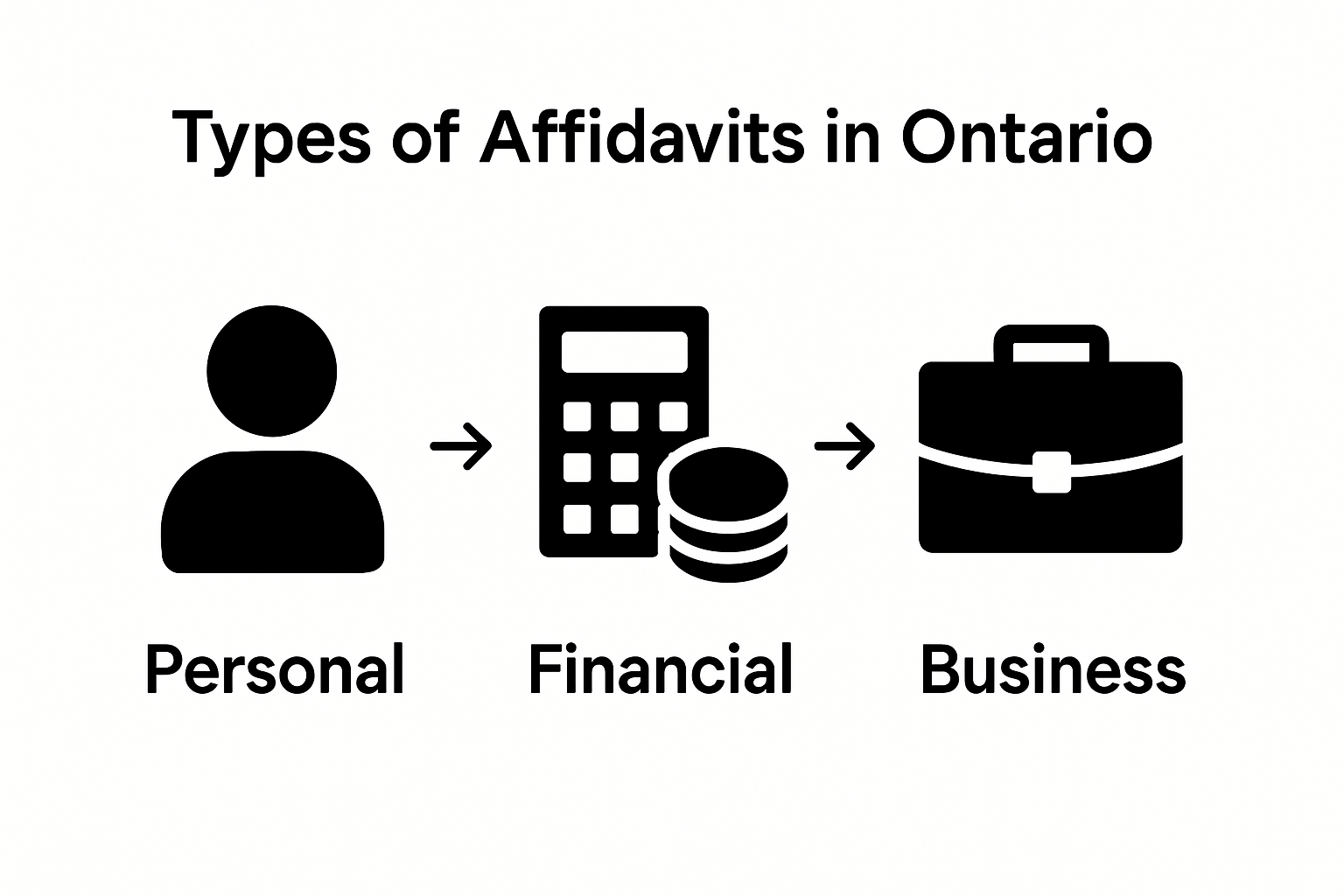
Affidavits are not a one-size-fits-all legal document. Ontario’s legal landscape requires specific types of affidavits tailored to different legal scenarios, each with unique characteristics and purposes. Learn how to obtain your affidavit online to streamline the process of creating these essential legal documents.
Personal and Identification Affidavits
Personal affidavits are sworn statements that provide crucial information about an individual’s identity, circumstances, or personal knowledge of specific events.
 These documents play a critical role in various legal and administrative processes.
Key types of personal and identification affidavits include:
- Identity verification affidavits
- Name change declarations
- Residency confirmation documents
- Marital status declarations
- Personal knowledge statements
Specialized Legal and Financial Affidavits
According to the Ontario Student Assistance Program, affidavits serve specific legal and financial purposes that require precise documentation and sworn testimony. These specialized documents address complex legal and financial scenarios.
Critical specialized affidavit types include:
- Financial disclosure statements
- Property transfer verification documents
- Inheritance and estate declarations
- Immigration supporting documents
- Court proceeding evidence submissions
- Business ownership confirmations
Contextual Considerations in Affidavit Selection
Choosing the appropriate affidavit type requires careful consideration of the specific legal context, jurisdictional requirements, and intended purpose. Each affidavit type carries unique legal implications and must be prepared with extreme precision.
Professionals and individuals must understand that the selection of an incorrect or improperly prepared affidavit can result in significant legal complications. The document must not only contain accurate information but also comply with specific formatting, witnessing, and submission requirements unique to its intended purpose.
Understanding the Role of Affidavits in Business Transactions
Affidavits serve as critical legal instruments in business environments, providing formal documentation and sworn verification of key financial, operational, and transactional details. Discover how to simplify your business documentation process with efficient online notarization services.
Financial Transparency and Legal Compliance
Businesses rely on affidavits to establish legal credibility and ensure transparent financial reporting. These sworn statements play a pivotal role in various business scenarios, offering a legally binding mechanism for confirming critical information.
Key business contexts requiring affidavits include:
- Corporate solvency declarations
- Asset ownership verification
- Partnership dissolution documentation
- Debt and liability confirmations
- Business transfer proceedings
Complex Business Transaction Documentation
According to the Ontario Co-operative Corporations Act, businesses must provide specific affidavits during significant corporate events. These documents serve as essential legal proof of an organization’s financial standing and operational integrity.
Complex business transactions frequently necessitate specialized affidavits such as:
- Merger and acquisition confirmations
- Shareholder agreement verifications
- Corporate restructuring declarations
- Intellectual property transfer documentation
- International business expansion statements
Risk Mitigation and Legal Protection
Affidavits function as powerful risk management tools, providing businesses with legally recognized documentation that can protect against potential disputes. By creating sworn statements that detail precise financial and operational circumstances, organizations establish a clear legal record that can be critical in potential litigation or regulatory investigations.
Professionals must understand that an improperly prepared affidavit can expose a business to significant legal vulnerabilities. Each document must be meticulously crafted to ensure complete accuracy, comprehensiveness, and compliance with Ontario’s specific legal requirements.
Real-World Applications of Affidavits in Ontario
Affidavits play a crucial role in numerous legal and administrative processes across Ontario, serving as authoritative documentation for various personal, professional, and governmental interactions. Learn how to streamline your document verification process through modern online notarization services.
Legal Proceedings and Judicial Contexts
In the Ontario judicial system, affidavits serve as critical instruments for presenting sworn testimony and providing verifiable evidence. Courts rely on these documents to establish facts, support legal arguments, and ensure the integrity of judicial proceedings.
Key legal scenarios requiring affidavits include:
- Criminal proceedings evidence submission
- Civil litigation supporting documentation
- Family law dispute resolution
- Small claims court claim verifications
- Appeal process supporting statements
Personal and Administrative Documentation
According to the Ontario Evidence Act, affidavits are essential for establishing personal identity, confirming legal status, and providing official declarations in various administrative contexts.
Common personal and administrative applications encompass:
- Immigration and citizenship verification
- Name change legal documentation
- Property ownership transfers
- Inheritance and estate claims
- Educational credential confirmations
- Insurance claim substantiations
Professional and Regulatory Compliance
Professional organizations and regulatory bodies in Ontario mandate affidavits as a means of ensuring transparency, accountability, and legal compliance across different sectors. These sworn statements help maintain professional standards and provide a mechanism for verifying critical information.
Affidavits are instrumental in scenarios such as:
- Professional licensing requirements
- Regulatory compliance declarations
- Professional conduct investigations
- Conflict of interest disclosures
- Ethical standard verifications
The versatility and legal weight of affidavits make them indispensable tools for individuals and organizations navigating Ontario’s complex legal and administrative landscape. Each affidavit must be meticulously prepared to ensure its validity, accuracy, and compliance with specific jurisdictional requirements.
Get the Right Affidavit Online – Fast and Legally Secure
Are you feeling overwhelmed by the complexity of choosing and preparing the correct type of affidavit in Ontario? This article highlighted the challenges you might face, such as strict legal requirements, matching the right affidavit to your situation, and ensuring validity in official matters. Errors or missing details can lead to rejection or serious legal consequences, making accuracy vital at every step.

Take control of your affidavit process today. At theonlinenotary.ca we help you complete and notarize your affidavit online quickly and securely, whether you need a sworn affidavit, invitation letter, statutory or solemn declaration. Our convenient services help you avoid costly mistakes and long waits. See how it works, or start your affidavit with confidence right now on our main site. Connect with a trusted Ontario notary and ensure your documents are accepted everywhere they are needed.
Frequently Asked Questions
What is the purpose of an affidavit in Ontario?
An affidavit is a sworn written statement used to declare facts voluntarily, providing legal credibility in various legal contexts, including court proceedings and administrative processes.
What are the main types of affidavits used in Ontario?
The main types of affidavits include sworn affidavits for court proceedings, personal and identification affidavits, financial disclosure affidavits, and immigration supporting documents, each serving unique legal functions.
How do I ensure my affidavit meets legal standards in Ontario?
To ensure your affidavit meets legal standards, it should be prepared following jurisdictional requirements, contain accurate information, be signed in the presence of an authorized official, and comply with specific evidentiary conditions.
Can affidavits be used in business transactions in Ontario?
Yes, affidavits are commonly used in business transactions in Ontario to provide formal documentation of financial, operational, and transactional details, helping to establish legal credibility and ensure transparent reporting.