
Notarizing a document in Ontario might sound old-school, like stamping paper just for formality. But guess what. Notarized documents are up to 10 times more likely to be accepted by courts and international agencies than unsigned, unverified paperwork. That means skipping it could leave you wide open to rejection, disputes, and extra hassles you never saw coming.
Table of Contents
- Legal Reasons To Notarize Documents
- Protecting Your Business And Personal Interests
- Ontario Notarization Process Explained
- Common Documents That Need Notarization
Quick Summary
| Takeaway | Explanation |
|---|---|
| Notarization ensures document authenticity | Notarization legally validates documents and signatures, establishing their authenticity and credibility, critical in legal contexts. |
| Prevents potential legal disputes | Notarized documents provide clear evidence of agreement and intent, reducing ambiguity and potential conflicts over document validity. |
| Mitigates legal and financial risks | Proper notarization creates a verified record that protects against legal uncertainties and liabilities in personal and business matters. |
| Identifying qualified notaries is essential | Only licensed professionals, such as lawyers and paralegals, can notarize documents in Ontario, ensuring proper legal authority. |
| Digital notarization options are available | Ontario permits both in-person and secure digital notarization, offering flexibility in how documents are authenticated and processed. |
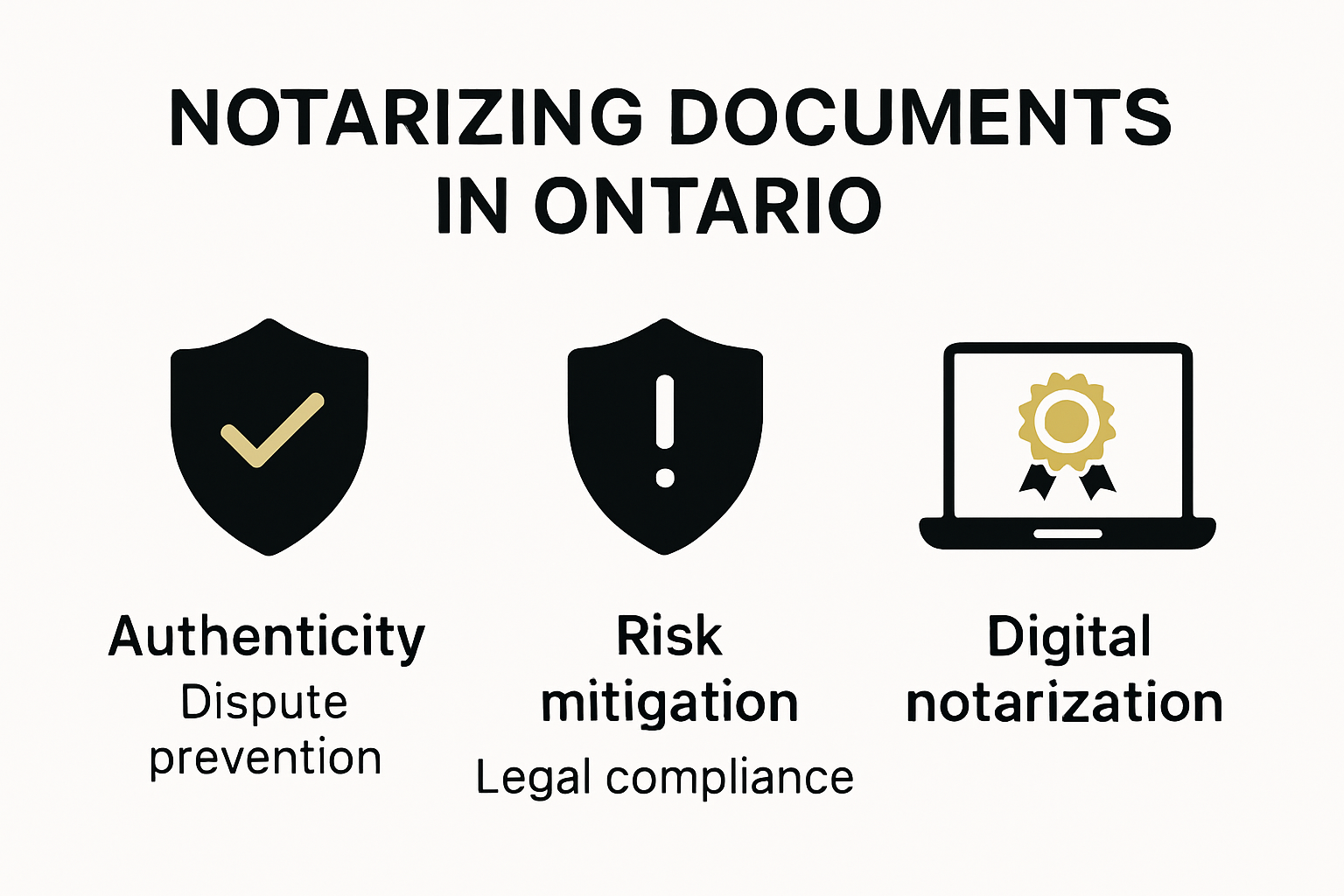
Legal Reasons to Notarize Documents
Notarization serves as a critical legal safeguard that transforms ordinary documents into legally recognized instruments with significant protective power. Understanding the legal implications of notarization helps individuals and businesses protect their interests and ensure document validity.
Establishing Document Authenticity and Credibility
The primary legal reason for notarizing documents centers on establishing irrefutable authenticity. According to the Department of Justice Canada, notarization provides legal validation that ensures documents are genuine, signatures are legitimate, and parties have willingly entered into agreements. This process creates a legal record that can withstand scrutiny in governmental, judicial, and administrative proceedings.
When a document is notarized, a licensed professional confirms the identity of signatories, verifies their willingness to sign, and adds an official seal. This process creates a layer of legal protection that significantly reduces the potential for fraud or disputed signatures. Businesses and individuals rely on this validation to protect their legal interests in contracts, property transfers, affidavits, and other critical documentation.

Preventing Potential Legal Disputes
Notarization serves as a powerful preventative mechanism against potential legal conflicts. By creating an official, third-party verified record, notarized documents provide clear evidence of agreement and intent. Research from the Canadian Bar Association highlights that notarized documents significantly reduce ambiguity in legal transactions, offering a standardized method of confirming the authenticity of signatures and the voluntary nature of agreements.
In legal proceedings, notarized documents carry substantial weight. Courts and government agencies recognize these documents as more reliable and credible compared to unnotarized counterparts. This recognition can be crucial in scenarios involving property transfers, power of attorney declarations, statutory declarations, and other legally sensitive documents where precise documentation is paramount.
Legal Compliance and International Recognition
Many legal processes and international transactions require notarized documents as a standard compliance mechanism. Certain legal documents, such as affidavits, sworn statements, and international business contracts, demand notarization to be considered valid. This requirement ensures that documents meet specific legal standards and can be recognized across different jurisdictions.
For individuals and businesses operating in Ontario, notarization provides a standardized method of ensuring document integrity. Whether you are executing a real estate transaction, creating a legal declaration, or preparing documentation for international use, notarization offers a universally recognized method of verifying document authenticity. Learn more about our comprehensive online notary services that make this critical legal process seamless and accessible.
By understanding these legal reasons, individuals and organizations can make informed decisions about when and why to notarize their important documents, ultimately protecting their legal interests and ensuring clear, undisputed documentation.
Protecting Your Business and Personal Interests
In an increasingly complex legal and business environment, protecting personal and professional interests requires strategic documentation and verification. Notarization emerges as a powerful tool for individuals and businesses seeking comprehensive protection against potential risks and legal vulnerabilities.
Identity Verification and Fraud Prevention
According to the Department of Justice Canada, notaries play a critical role in verifying identities and preventing fraudulent activities. The rigorous identity confirmation process during notarization creates a robust defense mechanism against potential impersonation and document tampering. When a notary validates a document, they meticulously examine government-issued identification, confirm the signatory’s willingness, and create an official record that significantly reduces the risk of unauthorized document execution.
Businesses face substantial financial risks from fraudulent transactions. A notarized document provides an additional layer of security by ensuring that all parties are who they claim to be and that signatures are genuine. This protection extends across various scenarios including contract negotiations, property transfers, financial agreements, and critical business transactions.
Mitigating Legal and Financial Risks
Notarization serves as a strategic risk management tool for both personal and professional contexts. Research from the Canadian Bar Association indicates that properly notarized documents can substantially reduce legal uncertainties and potential litigation risks. By creating an official, third-party verified record, individuals and businesses establish a clear evidentiary trail that can withstand potential legal challenges.
For businesses, this means protecting intellectual property, ensuring contract validity, and maintaining clear documentation of critical agreements. Personal interests are similarly safeguarded through notarization of wills, power of attorney documents, inheritance agreements, and other sensitive personal legal instruments. The official verification process creates a reliable record that can protect individual rights and intentions.
Protecting Confidential and Sensitive Information
In an era of increasing digital risks and information vulnerabilities, notarization provides a structured approach to protecting confidential information. Professional notaries follow strict protocols to ensure document integrity and maintain confidentiality. This is particularly crucial for documents containing sensitive personal or business information, such as financial statements, proprietary business plans, and personal legal declarations.
The notarization process includes multiple safeguards: confirming participant identities, documenting the signing context, and creating an official record that cannot be easily disputed. Learn more about our secure online notary services that offer comprehensive protection for your most important documents.
By understanding and leveraging notarization, individuals and businesses can create a robust defense against potential legal, financial, and personal risks. The small investment in notarization can provide significant long-term protection and peace of mind in an increasingly complex legal landscape.
Ontario Notarization Process Explained
Navigating the notarization process in Ontario requires understanding specific legal requirements and procedural steps. This comprehensive guide breaks down the essential components of document notarization, helping individuals and businesses ensure their documents are properly authenticated.
Identifying Qualified Notary Professionals
According to the Law Society of Ontario, not everyone can perform notarization. In Ontario, only specific professionals are authorized to notarize documents, including lawyers, paralegals, and commissioned notary publics. The Ontario government guidelines outline strict qualification criteria for these professionals, ensuring they have the legal authority and professional credentials to validate documents.
When seeking notarization, individuals must verify the credentials of the notary. This involves checking their professional status, understanding their specific authorization, and confirming they are registered with the appropriate regulatory bodies. Some key professionals authorized to notarize documents include licensed lawyers, paralegals, and specific government-appointed commissioners for taking affidavits.
Document Preparation and Verification
The notarization process requires meticulous document preparation and personal verification. Individuals must bring original documents and valid government-issued photo identification. The notary will carefully examine these documents to confirm the identity of the signatories and ensure the documents meet legal standards.
Typical steps in the document verification process include:
- Confirming the identity of all signatories
- Verifying the completeness and integrity of the document
- Ensuring all parties are signing voluntarily and without coercion
- Checking that the document does not contain any obvious alterations or inconsistencies
Professional notaries follow a standardized process to maintain the legal integrity of the documents. Learn more about our comprehensive online notary verification methods that streamline this critical authentication process.
Below is a summary table outlining the main steps in the Ontario notarization process for easy reference:
| Step | Description |
|---|---|
| 1. Identify Qualified Notary | Confirm notary is licensed (lawyer, paralegal, or appointed commissioner). |
| 2. Prepare Your Documents | Gather all original documents required for notarization. |
| 3. Present Valid Identification | Bring government-issued photo ID for all signatories. |
| 4. Notary Verifies Information | Notary checks signatories’ identity and document integrity. |
| 5. Sign in Presence of Notary | All parties sign documents in front of the notary (or during an online session). |
| 6. Notary Applies Seal | Notary adds official seal or electronic signature, completing the notarization process. |
Digital and In-Person Notarization Options
Ontario now recognizes both traditional in-person and modern digital notarization methods. According to Ontario’s official resources, individuals can choose between face-to-face notarization or utilize secure online platforms that meet provincial legal standards.
In-person notarization involves physically meeting with a notary, presenting documents, and signing in their presence. Digital notarization offers a convenient alternative, allowing document authentication through secure online platforms. These digital solutions provide robust identity verification, document encryption, and official electronic sealing.
Key considerations for digital notarization include ensuring the platform complies with provincial legal requirements, maintains document security, and provides a verifiable authentication trail. Individuals should select reputable online notary services that offer comprehensive security protocols and legally recognized verification methods.
Below is a comparison table highlighting the features of in-person versus digital notarization options available in Ontario:
| Feature | In-Person Notarization | Digital Notarization |
|---|---|---|
| Location | Physical office/meeting place | Online via secure platform |
| Identity Verification | In-person ID check | Remote ID check using technology |
| Document Handling | Physical documents | Electronic documents (uploads) |
| Notary Seal | Physical stamp/seal | Electronic signature/seal |
| Convenience | Appointment-based, limited hours | Remote access, flexible scheduling |
| Legal Acceptance in Ontario | Yes | Yes (must meet legal requirements) |
Understanding the notarization process empowers individuals and businesses to navigate document authentication with confidence. By following these structured steps and working with qualified professionals, you can ensure your documents meet the highest standards of legal validity in Ontario.
Common Documents That Need Notarization
Notarization is a critical process for validating numerous important documents across personal, professional, and legal domains. Understanding which documents require notarization helps individuals and businesses ensure their paperwork remains legally robust and universally recognized.
Personal and Family Legal Documents
According to Axess Law, several personal documents demand notarization to maintain legal integrity. Travel consent letters for minors represent a prime example, where notarization provides official permission for children to travel internationally with one parent or guardian. Affidavits of divorce and separation agreements also require notarization to ensure their legal validity and enforceability.
Additionally, important family-related documents such as guardianship declarations, name change certificates, and inheritance documents benefit significantly from notarization. These documents often need to be legally recognized across different jurisdictions, making notarization a crucial step in establishing their authenticity and credibility.
Business and Financial Documentation
De Palma Paralegal highlights that numerous business and financial documents require notarization to be legally enforceable. Promissory notes, loan agreements, and property transfer documents are prime examples where notarization provides an additional layer of legal protection. Affidavits of execution for wills and business contracts ensure that these critical documents cannot be easily disputed.
Business professionals frequently need notarization for articles of incorporation, partnership agreements, power of attorney documents, and statutory declarations related to business operations. Learn more about our specialized online notary services for business documents that streamline this essential legal process.
International and Official Documentation
The Ontario government guidelines emphasize the importance of notarization for documents intended for international use. Academic credentials such as university degrees, diplomas, and transcripts often require notarization to be recognized globally. Similarly, vital statistics documents, including birth certificates, marriage certificates, and death certificates, need notarization when being used for international purposes.
Other critical documents requiring notarization include immigration documents, visa applications, international business contracts, and legal affidavits intended for use in multiple jurisdictions. The notarization process ensures these documents meet international legal standards and can be confidently presented in various official contexts.
Navigating the complex landscape of document notarization requires careful attention to detail and understanding of legal requirements. By recognizing which documents need notarization, individuals and businesses can protect their interests, ensure legal compliance, and maintain the highest standards of document authenticity.
Frequently Asked Questions
What are the benefits of notarizing documents in Ontario?
Notarizing documents in Ontario provides legal validation and authenticity, significantly enhancing their credibility and acceptance in courts and international agencies. It reduces the risk of legal disputes and ensures compliance with legal standards.
Who can notarize documents in Ontario?
In Ontario, only licensed professionals such as lawyers, paralegals, and commissioned notaries can notarize documents, ensuring they have the legal authority and professional credentials to do so.
What types of documents typically require notarization?
Common documents that require notarization include personal legal documents like affidavits and travel consent letters for minors, business documentation such as loan agreements and property transfers, and international documents like diplomas and immigration paperwork.
How does the notarization process work in Ontario?
The notarization process in Ontario involves identifying a qualified notary, preparing documents, verifying identities with valid ID, and having all parties sign in the presence of the notary, who then applies their official seal to complete the process.
Ready to Protect Your Most Important Documents in Ontario?
Have you felt the stress of wondering if your documents will hold up when it matters most? The article explained that missing notarization can leave your paperwork open to rejection and costly disputes. Whether you are dealing with affidavits, statutory declarations, or travel letters, the need for proven authenticity and legal compliance in Ontario has never been clearer. Your signature means little if it is not backed by a trusted notary. Why risk rejection, delays, or costly do-overs?

Take control of your peace of mind with fully recognized online notarization. Get started today by visiting The Online Notary in Ontario for secure, fast service from your home or office. Discover how simple it is to notarize affidavits and statutory declarations online. Your vital documents deserve nothing less. Choose confidence. Choose a provider trusted across Ontario now.
Recommended
- Why Opt for an Online Notary in Ontario – The Online Notary CA
- Notarize Online in Canada – The Online Notary CA
- The Complete Guide to Using an Online Notary Public for Affidavits and Declarations in Ontario (2025) – The Online Notary CA
- Everything You Need to Know About Online Notarization in Ontario: Fast, Legal, and Convenient for Affidavits and Declarations (2025) – The Online Notary CA
- California Trust Certification: Secure Your Family’s Future in 2025 – Law Office of Eric Ridley
- Food Safety Certificate Ontario: Why Getting Certified with Probeit Is a Game-Changer – Probe IT