
TL;DR:
- Remote online notarization has become mainstream, with platforms integrating AI-driven identity verification and advanced security measures. Legislation varies by state, requiring careful compliance monitoring, while security architecture now relies on expiring links and token-based access controls to reduce risk. AI automates identity checks and fraud detection, transforming notarization workflows for legal professionals and businesses in 2025.
Remote online notarization is no longer an experiment. Digital notary trends 2025 mark the point where RON platforms, AI-driven identity verification, and state-level legislative reform converged into a mature, high-stakes infrastructure for legal professionals and business owners. Platforms like NotaryCentral and Namirial are processing transactions at scale, state legislatures from California to Rhode Island are codifying new rules, and security architectures have moved well beyond basic password protection. If you work in law or run a business that depends on authenticated documents, the shifts happening right now will directly affect how you operate.
How are remote online notarization platforms evolving in 2025?
Remote online notarization has crossed from early adoption into mainstream legal infrastructure. The numbers confirm it. Namirial reported a 23% increase in electronic signatures in 2025, processing over 113 million digital operations. That volume signals that the market for integrated digital trust, including notarization, has reached a tipping point where businesses can no longer treat it as optional.
RON platforms in 2025 are defined by several concrete capabilities that distinguish them from earlier video-call workarounds:
- Legally compliant audio-video sessions with tamper-evident recording and audit trails
- Encrypted document storage in private cloud environments, not shared or public buckets
- Signer identity verification layered with knowledge-based authentication and biometric checks
- State-specific compliance modules that adjust workflows based on the notary’s jurisdiction
- Session management controls that allow notaries to terminate sessions and document the reason
The state-by-state approval picture is also expanding. Secured Signing received approval for RON and IPEN in both Rhode Island and South Carolina, adding to a growing list of jurisdictions where remote notarization carries full legal weight. Each new approval reduces the friction for businesses operating across state lines.
Pro Tip: Before selecting a RON platform, verify that it holds active approvals in every state where your signers are located. A platform approved in one state may not satisfy the legal requirements of another, and a notarization completed under the wrong framework can be challenged.
The growth of active electronic signature users signals cross-market demand for integrated digital trust solutions that encompass notarization, not just signing. Legal professionals who treat RON as a standalone tool are missing the broader workflow integration that 2025 platforms now offer.
What security advancements define digital notary technology in 2025?
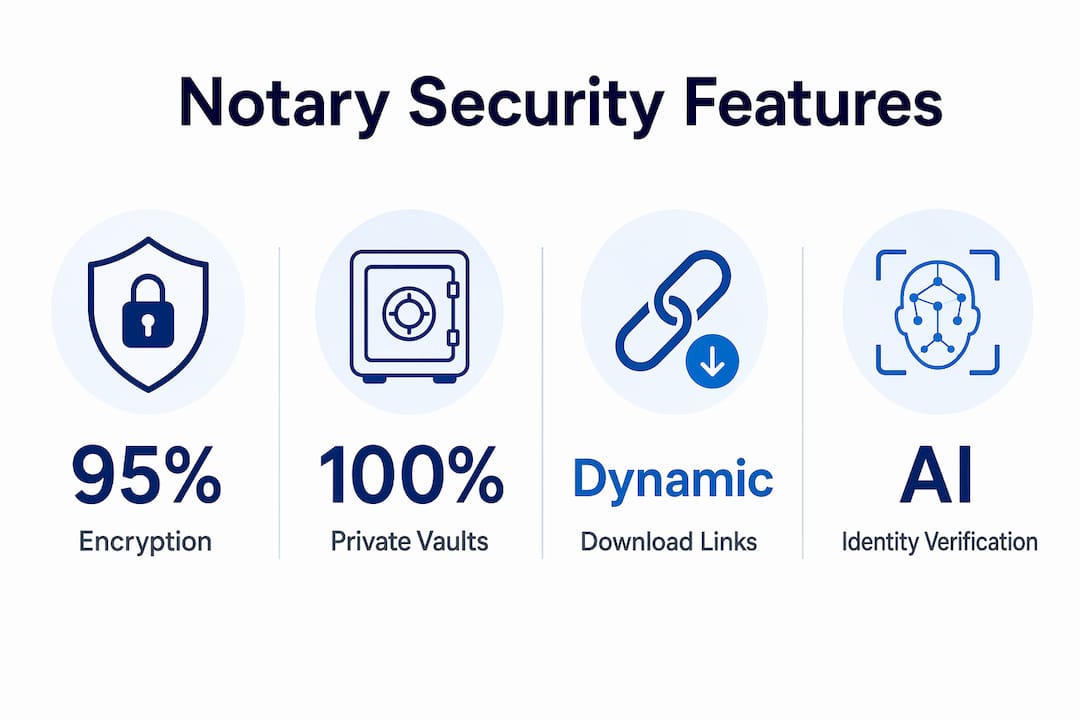
Security architecture is where 2025 RON platforms separate themselves most clearly from earlier generations. The standard has shifted from “encrypted in transit” to a multi-layer model that controls access at every point in the document lifecycle.

NotaryCentral stores notarized documents in encrypted private vaults using AWS S3 private buckets. No permanent public URL exists for any document. Instead, the platform generates time-limited pre-signed URLs dynamically each time a download is requested. By default, those links expire after 15 minutes. This design means a forwarded or leaked link becomes useless almost immediately, which is a meaningful reduction in exposure compared to static download links.
| Security feature | How it works | Why it matters |
|---|---|---|
| Encrypted private vaults | AWS S3 private buckets, no public URLs | Documents are inaccessible without an active, authorized request |
| Expiring download links | 15-minute pre-signed URLs generated on demand | Leaked or forwarded links expire before they can be misused |
| Signer portal access tokens | High-entropy tokens with 30-day expiry | Reduces long-term exposure from user handling errors |
| Cryptographic integrity metadata | Embedded in archived documents | Confirms document has not been altered after notarization |
The signer portal access model is particularly worth understanding. Rather than sending a static link that remains valid indefinitely, platforms like NotaryCentral issue renewable access tokens that expire on a defined schedule. This approach directly addresses one of the most common failure points in document security: users forwarding access links to unintended recipients.
For legal professionals handling sensitive documents such as affidavits, statutory declarations, or power of attorney instruments, these controls are not optional extras. They are the baseline you should require from any platform you use or recommend to clients. You can review how Ontario-specific digital notary security standards apply to these frameworks in practice.
Pro Tip: Ask any RON vendor whether their download links are static or dynamically generated. Static links that never expire are a security liability regardless of how strong the underlying encryption is.
What are the key legislative and regulatory trends impacting digital notarization in 2025?
Legislation is the variable that most directly affects whether your digital notarization workflow is legally defensible. Three developments in 2025 stand out for legal professionals and business owners.
California AB 1977 establishes a mandatory secure electronic journal for all online notarial acts performed in California. The bill requires platform registration with the state and mandates 30 days’ notice before any material platform changes or termination. Implementation is scheduled no later than January 1, 2030, but the regulatory framework is already shaping how platforms build their compliance architecture today.
Fee recovery clarification under AB 1977 addresses a practical problem that notaries have faced since RON became widespread. The legislation clarifies that notaries may recover reasonable technology costs for failed sessions but cannot charge for incomplete notarial acts. This distinction matters for any notary pricing their services or any business budgeting for notarization costs.
Ongoing state approvals continue to expand the geographic reach of legally valid RON. Rhode Island and South Carolina joining the list of approved jurisdictions reflects a broader national trend toward harmonization, even if the process remains state by state. For businesses operating across multiple states, this patchwork reality requires active monitoring rather than a set-and-forget approach.
The contrast between states is instructive. California is building a detailed regulatory infrastructure with registration requirements and journal mandates. Other states are approving platforms with lighter-touch frameworks. Neither approach is inherently better, but they create different compliance obligations depending on where your notary and your signers are located. Understanding whether online notarization is legal in your specific jurisdiction is the first step before committing to any platform.
For businesses with operations in multiple jurisdictions, the practical implication is clear. You need a compliance calendar that tracks state-level RON legislation, not just a one-time platform evaluation.
How does AI impact the future of digital notarization?
Artificial intelligence is now embedded in the identity verification layer of most serious RON platforms, and its role is expanding. The impact is not theoretical. Namirial recorded 1.8 million digital onboarding registrations in late 2025, a volume that would be operationally impossible to process with manual identity checks alone.
The specific ways AI is reshaping notarization workflows include:
- Automated document validation that checks for tampering, formatting anomalies, and signature placement before a notary reviews the file
- Biometric identity matching that compares a signer’s live video feed against government-issued ID in real time
- Fraud pattern detection that flags sessions with behavioral anomalies, such as unusual typing patterns or inconsistent geolocation data
- Onboarding acceleration that reduces the time from signer invitation to completed notarization by automating credential checks
The synergy between AI identity verification and electronic signature ecosystems is particularly significant. Platforms that combine both functions create a single chain of custody from identity confirmation through document signing and notarization. This integration reduces the number of handoffs where fraud or error can occur. For legal professionals, it also simplifies the audit trail that may need to be produced in litigation.
The impact of AI on notarization extends to user experience as well. Signers who previously needed to appear in person or navigate complex video verification steps now complete the process in minutes. That efficiency gain translates directly into faster transaction cycles for businesses and reduced friction for clients. Digital estate planning, for example, is one area where integrated digital trust and AI-assisted notarization are beginning to intersect in meaningful ways.
Key takeaways
Digital notarization in 2025 is defined by three converging forces: expanding RON legislation, AI-powered identity verification, and security architectures built around expiring access controls rather than static credentials.
| Point | Details |
|---|---|
| RON adoption is accelerating | Namirial processed 113 million digital operations in 2025, confirming mainstream demand for remote notarization. |
| Security requires expiring access | Platforms using 15-minute download links and renewable tokens reduce unauthorized access more effectively than encryption alone. |
| Legislation varies by state | California AB 1977 and approvals in Rhode Island and South Carolina show that compliance obligations differ significantly by jurisdiction. |
| AI is now core infrastructure | Automated identity verification and fraud detection are standard features in leading RON platforms, not premium add-ons. |
| Fee recovery rules matter | California law clarifies notaries can recover technology costs for failed sessions but cannot charge for incomplete acts. |
Why the security conversation matters more than most practitioners realize
I have watched legal professionals evaluate RON platforms almost entirely on price and ease of use, and I understand why. Those factors are real. But the security architecture question is where I see the most consequential gaps in how practitioners make decisions.
The shift to digital notary best practices is not just about adopting new tools. It is about understanding that a notarized document stored behind a static, permanent download link carries a fundamentally different risk profile than one protected by expiring pre-signed URLs and token-based signer portals. Most clients will never ask about this distinction. That does not mean it is unimportant. It means you carry the responsibility for knowing it.
On the legislative side, I would caution against assuming that a platform’s approval in one state covers your obligations in another. The patchwork of state RON laws is genuinely complex, and the consequences of a notarization completed under the wrong framework can range from a rejected document to a challenged transaction. Build a habit of verifying jurisdiction-specific compliance before every new client engagement, not just when you onboard a new platform.
The AI identity verification trend is the one I find most genuinely transformative. Not because it replaces the notary’s judgment, but because it shifts the notary’s role toward higher-value oversight and away from manual credential checking. That is a good trade for any professional who wants to handle more volume without compromising quality.
— Ken
How Theonlinenotary supports your 2025 notarization needs
Legal professionals and business owners in Ontario need a notarization partner that keeps pace with the security standards and regulatory expectations described in this article.

Theonlinenotary provides trusted online notary services for affidavits, invitation letters, statutory declarations, solemn declarations, and more, available 24/7 for clients across Ontario. If you are evaluating your options, the best online notary solutions comparison breaks down leading platforms against the criteria that matter most for compliance and security. Whether you need a single document notarized or a recurring workflow for your business, Theonlinenotary delivers the expertise and availability the current regulatory environment demands.
FAQ
What is remote online notarization (RON)?
Remote online notarization is the process of completing a notarial act through an audio-video session rather than an in-person meeting. The notary and signer connect digitally, with identity verification and document signing handled through a compliant platform.
Which states approved RON in 2025?
Secured Signing received approval for RON and IPEN in Rhode Island and South Carolina in 2025, adding to the growing number of states where remote notarization carries full legal validity. State approvals continue to expand, though requirements vary by jurisdiction.
How do RON platforms protect notarized documents?
Platforms like NotaryCentral store documents in encrypted private vaults using AWS S3 private buckets, with download links that expire after 15 minutes by default. Signer portal access tokens also carry expiry dates, typically 30 days, to limit long-term exposure.
What does California AB 1977 require from notaries?
California AB 1977 mandates a secure electronic journal for online notarial acts and requires platform registration with the state. Notaries may recover reasonable technology costs for failed sessions but cannot charge for incomplete notarial acts.
How is AI changing identity verification in digital notarization?
AI-assisted identity verification automates biometric matching, document validation, and fraud detection within RON platforms. Namirial processed 1.8 million digital onboarding registrations in late 2025, demonstrating the scale at which AI-powered verification now operates.