
TL;DR:
- Online notarization in Ontario involves remote execution of notarial acts via audio-visual technology, but it excludes certain documents like wills and powers of attorney from eligibility. Proper compliance requires live sessions with verified identity, recording, and a secure platform, making the process legally valid yet institution-dependent for acceptance. To ensure legality, verifying document eligibility, platform standards, and recipient acceptance is essential before conducting remote notarizations.
Online notarization in Ontario is defined as the remote execution of notarial acts using audio-visual technology, governed primarily by the Ontario Electronic Commerce Act (ECA). The legal implications of online notary services hinge on three factors: which documents qualify, how identity is verified, and whether the platform meets provincial compliance standards. Ontario residents and businesses increasingly turn to services like Theonlinenotary for affidavits, statutory declarations, and invitation letters. But the legal framework contains specific exclusions and requirements that, if ignored, can invalidate a document entirely. Knowing those boundaries before you sign anything remotely is not optional. It is the starting point.
What are the legal requirements and limitations for online notarization in Ontario?
Ontario’s ECA provides the foundational authority for electronic transactions, but it explicitly carves out several document categories. Wills, powers of attorney, and negotiable instruments are excluded from online notarization applicability. This means any estate planning document, such as a will or a power of attorney for personal care, must still go through traditional in-person notarization. The exclusion is not a technicality. It reflects the legislature’s judgment that certain documents carry too much legal weight to rely on remote verification alone.
For documents that do qualify, electronic signatures are legally valid under Section 11 of the ECA, provided they are executed with the signer’s consent and supported by appropriate verification. This is the legal backbone of online notary laws in Ontario. The signature must be linked to the signer in a way that makes any subsequent tampering detectable.
Online notary requirements in Ontario also mandate that the notary and signer interact through a live, synchronous audio-visual session. Pre-recorded video does not satisfy this requirement. The notary must observe the signer in real time, confirm their identity, and witness the act of signing. Notaries must also record these sessions and maintain a notarial journal, creating an auditable trail that supports legal defensibility if the document is ever challenged.
Key compliance requirements include:
- Government-issued photo ID presented clearly on camera during the session
- Live audio-visual connection with no interruptions or pre-recorded segments
- Secure platform that meets Ontario’s standards for encryption and data storage
- Notarial journal entry for every session, including signer details and document description
- Electronic seal that is tamper-evident and uniquely tied to the notary’s credentials
Pro Tip: Before scheduling any online notarization session, confirm with the receiving institution, such as a bank, court, or government agency, that they accept electronically notarized documents. Not every institution has updated its internal policies to match Ontario’s legal framework.
How does online notarization compare to traditional notarization?
The most persistent misconception about online notarization is that it is a lesser or provisional form of the real thing. Remote online notarization can actually be more secure than traditional notarization because it incorporates technology-enabled identity proofing and tamper-evident records that paper-based processes cannot match. A notary stamp on a paper document can be forged. A cryptographically sealed electronic document with a recorded session and audit log is significantly harder to falsify.
That said, legal validity and practical acceptance are two different things. A document can be legally valid under Ontario law and still be rejected by a foreign government, a financial institution, or a court that has not updated its acceptance criteria. This gap between legal validity and institutional acceptance is one of the most underappreciated risks of online notarization.
| Factor | Online notarization | Traditional notarization |
|---|---|---|
| Legal validity in Ontario | Valid for eligible document types | Valid for all document types |
| Identity verification | Multifactor authentication, biometrics | In-person ID check |
| Fraud resistance | Tamper-evident records, session recording | Physical presence, manual review |
| Convenience | Available remotely, often 24/7 | Requires in-person appointment |
| Document scope | Excludes wills, POAs, negotiable instruments | No statutory exclusions |
| Audit trail | Digital session recording and journal | Paper journal only |
For businesses processing high volumes of affidavits or statutory declarations, online notarization offers a clear operational advantage. For individuals dealing with estate planning or sensitive financial instruments, traditional notarization remains the only legally compliant path under Ontario law.
What practical steps are required to complete a legal online notarization?
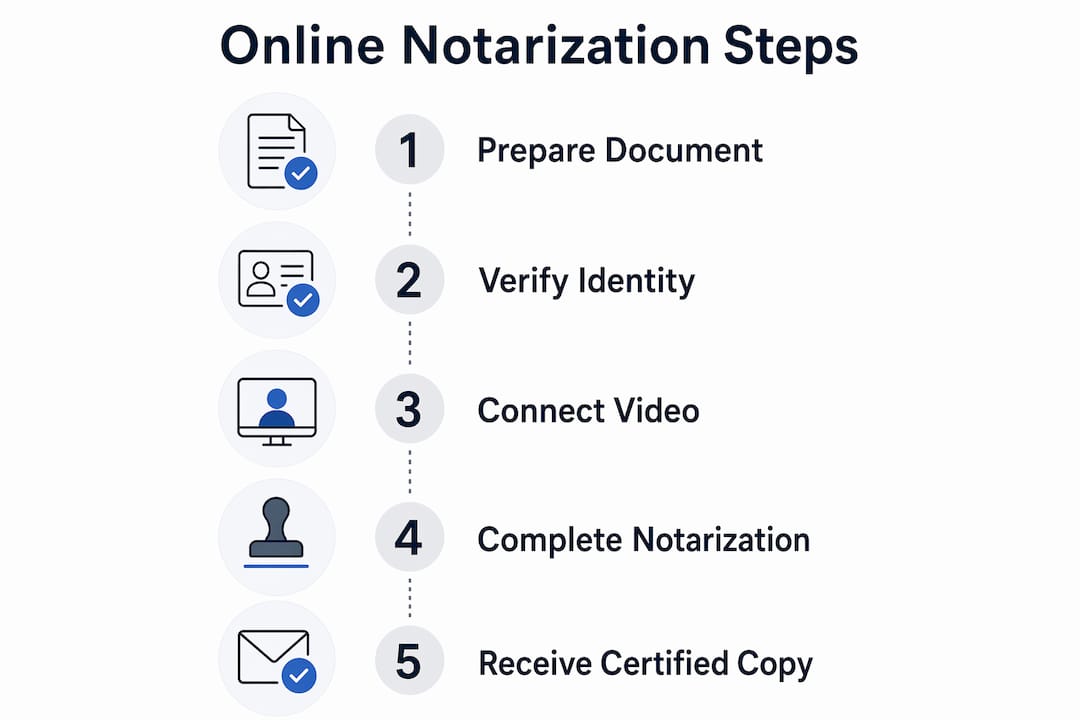
Completing a legally valid online notarization in Ontario requires preparation on both the technical and documentary sides. Showing up to a video session without the right ID or on an unsupported device is one of the most common reasons sessions fail or produce documents that cannot be used.
Follow these steps to prepare correctly:
- Confirm document eligibility. Check whether your document falls within the ECA’s excluded categories. Wills and powers of attorney require in-person notarization regardless of your preference for remote services.
- Prepare valid government-issued ID. A Canadian passport, driver’s license, or permanent resident card are standard. The ID must be current, undamaged, and legible on camera.
- Test your device and connection. You need a device with a functioning camera and microphone, a stable internet connection, and a supported browser. Most platforms specify Chrome or Firefox. Test these at least 30 minutes before your session.
- Choose a compliant platform. Platforms must meet Ontario’s standards for security, identification, and recordkeeping. Theonlinenotary operates within these requirements for Ontario residents.
- Attend the live session. Join the audio-visual call, present your ID on camera, and follow the notary’s instructions for signing. Do not sign before the session begins.
- Receive and verify your notarized document. After the session, you will receive a digitally sealed document. Confirm the electronic seal is intact before submitting it to any institution.
Pro Tip: If you are submitting a notarized document to a foreign authority, ask whether they require an apostille or additional authentication. Online notarization does not automatically satisfy international document requirements, and you may need additional steps through Global Affairs Canada.
Identity verification in remote notarization includes multifactor authentication and knowledge-based questions or biometric checks. These measures reduce fraud and confirm signer presence despite the physical distance. This level of verification often exceeds what a traditional notary can realistically perform during a brief in-person appointment.

What are the common legal issues and risks of online notarization?
The legal issues in online notarization cluster around three failure points: improper identity verification, document ineligibility, and platform non-compliance. Each one can result in a document being declared invalid, which carries real consequences for contracts, immigration applications, and legal proceedings.
Failure to verify signer presence is the most common notary misconduct leading to legal invalidation. In an online context, this means a notary who allows a pre-recorded video, accepts a photo instead of a live feed, or fails to confirm the signer’s identity through proper channels. The document produced in such a session has no legal standing.
The risks of online notarization that Ontario residents and businesses face most frequently include:
- Using an ineligible document type. Attempting to notarize a will or power of attorney online creates a document that appears valid but is legally unenforceable.
- Choosing a non-compliant platform. Not every video conferencing tool meets Ontario’s security and recordkeeping standards. Using Zoom or Google Meet without a purpose-built notarization layer does not satisfy the legal requirements.
- Incomplete identity verification. Presenting an expired ID or one that is not clearly visible on camera can invalidate the session.
- Institutional non-acceptance. Even a legally valid online notarization may be rejected by a bank, court, or foreign government that has not updated its policies.
- Notary jurisdiction issues. A notary licensed in another province or country cannot legally notarize Ontario documents unless they hold the appropriate Ontario credentials.
Not all documents are suitable for online notary services. High-stakes or sensitive documents may require in-person notarization to meet legal standards, and assuming otherwise is the most expensive mistake you can make. The biggest misconception in this space is that online notarization covers everything traditional notarization does. It does not, and planning must start with the document category, not the convenience of the format.
Key takeaways
Online notarization in Ontario is legally valid for eligible document types under the Electronic Commerce Act, but wills, powers of attorney, and negotiable instruments require traditional in-person notarization without exception.
| Point | Details |
|---|---|
| ECA exclusions are absolute | Wills, powers of attorney, and negotiable instruments cannot be notarized online under Ontario law. |
| Electronic signatures are valid | Section 11 of the ECA confirms validity when consent and verification conditions are met. |
| Session recording is mandatory | Notaries must record audio-visual sessions and maintain a notarial journal for every online notarization. |
| Platform compliance matters | Only platforms meeting Ontario’s security and recordkeeping standards produce legally defensible documents. |
| Institutional acceptance varies | A legally valid online notarization may still be rejected by banks, courts, or foreign authorities. |
Ontario’s online notarization laws are still catching up to practice
I have worked with enough Ontario residents and businesses to know that the gap between what the law permits and what institutions actually accept is the real friction point in online notarization. The ECA is clear. The technology is reliable. But the adoption curve among receiving institutions, particularly banks and foreign consulates, is uneven at best.
What I find most telling is how often clients come to Theonlinenotary after a failed attempt with a non-compliant platform. They assumed any video call with a notary would satisfy the legal requirements. It does not. The platform itself must meet specific standards for encryption, identity proofing, and session recording. That distinction is rarely explained clearly anywhere outside of legal circles.
My honest observation is that Ontario’s legislative framework for online notarization is sound but incomplete. The ECA exclusions make sense for high-stakes documents. What is missing is clearer guidance for institutions on how to evaluate and accept electronically notarized documents. Until that guidance exists, the safest approach is to confirm acceptance with the receiving party before you notarize, not after. Businesses that build this confirmation step into their document workflows avoid the most costly delays. Individuals who skip it often find themselves starting over with an in-person appointment anyway.
The common myths about online notarization in Ontario, particularly around document scope and platform requirements, are worth understanding before you commit to any method. The law gives you a workable tool. Using it correctly is the part that requires attention.
— Ken
Get legally compliant online notarization through Theonlinenotary
If you need to notarize an affidavit, statutory declaration, invitation letter, or solemn declaration in Ontario, Theonlinenotary provides fully compliant online notary services built around provincial legal requirements.

Theonlinenotary operates 24/7, uses secure audio-visual technology that meets Ontario’s ECA standards, and maintains the notarial records required for legal defensibility. Every session includes proper identity verification and a tamper-evident electronic seal. You do not need to leave your home or office. You do need a compliant provider. Explore the full range of Ontario notary services available through Theonlinenotary and book a session that fits your schedule.
FAQ
What documents cannot be notarized online in Ontario?
Wills, codicils, powers of attorney for personal care or financial affairs, and negotiable instruments are excluded from online notarization under Ontario’s Electronic Commerce Act. These documents require traditional in-person notarization.
Are electronic signatures legally binding in Ontario?
Yes. Under Section 11 of the Ontario Electronic Commerce Act, electronic signatures are legally valid when executed with the signer’s consent and supported by appropriate identity verification. The signature must be linked to the signer in a tamper-detectable way.
Is online notarization more secure than in-person notarization?
Remote online notarization incorporates multifactor authentication, biometric checks, and tamper-evident session recordings that traditional notarization cannot replicate. These protocols make fraudulent notarization significantly harder to execute undetected.
What ID do I need for an online notarization session in Ontario?
You need a current, government-issued photo ID such as a Canadian passport, driver’s license, or permanent resident card. The ID must be clearly visible on camera during the live audio-visual session.
Can a notary from another province notarize Ontario documents online?
No. A notary must hold valid Ontario credentials to legally notarize documents intended for use under Ontario law. Provincial licensing does not transfer automatically, and using an out-of-province notary for Ontario documents creates a compliance risk.