
Every year, countless Canadians rely on statutory declarations to resolve critical legal matters when evidence is hard to provide. A single false statement in these documents can lead to perjury charges, making accuracy and honesty absolutely vital. Statutory declarations help bridge gaps in documentation for everything from immigration to property transfers, so understanding the rules and risks can make a real difference in protecting your rights.
Key Takeaways
| Point | Details |
|---|---|
| Statutory Declaration Definition | A statutory declaration is a legal document that confirms facts under legal obligation, often used when traditional evidence is unavailable. |
| Legal Framework | These declarations must be signed before a notary public or commissioner of oaths, and false statements can lead to serious legal penalties, including perjury. |
| Common Uses | In Ontario, statutory declarations are used for identity verification, employment and immigration documentation, property transactions, and personal status changes. |
| Risk Management | Knowingly providing false information or procedural errors can result in criminal prosecution, financial penalties, and professional repercussions, necessitating diligence in the preparation process. |
Table of Contents
- Statutory Declarations In Canada Explained
- Types And Common Uses In Ontario
- Legal Requirements And Validity Criteria
- Step-By-Step Process To Create A Statutory Declaration
- Risks, Liabilities, And Common Pitfalls
Statutory Declarations in Canada Explained
A statutory declaration is a powerful legal document that allows individuals to formally confirm facts or circumstances under legal obligation. According to NotaryPro, these declarations are used when traditional evidence isn’t readily available and carry substantial legal significance.
Statutory declarations serve multiple critical purposes across personal and professional landscapes:
- Confirming personal information
- Providing statements in legal proceedings
- Verifying identity or relationship status

- Supporting immigration or government applications
Learn more about who can sign statutory declarations to understand the specific requirements and authorized representatives.
The legal framework surrounding statutory declarations is stringent. As outlined by Wikipedia, these documents must be attested to by an authorized official like a notary public or commissioner of oaths. False statements can result in serious legal consequences, including potential perjury charges. This means when you sign a statutory declaration, you’re making a solemn commitment to truthfulness that carries significant legal weight.
Essentially, a statutory declaration bridges gaps where standard documentation falls short, providing a legally recognized method for individuals to assert facts when conventional proof is challenging to obtain.
Types and Common Uses in Ontario
Statutory declarations in Ontario play a crucial role across various administrative and legal contexts. According to the Ontario Works Policy Directives, these documents are governed by the Canada Evidence Act and Ontario Evidence Act, serving as powerful tools for asserting legal truth.
Common Uses in Ontario
Ontario residents utilize statutory declarations in numerous scenarios:
- Identity Verification: Confirming personal details for government services
- Employment Verification: Documenting work history or professional credentials
- Property Transactions: Establishing ownership or transfer details
- Immigration Processes: Supporting documentation for residency applications
- Personal Status Changes: Declaring name changes, marital status, or other significant life events
Discover who can officially sign statutory declarations to understand the specific authorization requirements.
The legal framework is strict: these declarations must be signed before an authorized official such as a notary public or commissioner of oaths. False statements aren’t just discouraged—they carry serious legal consequences. As research from The Online Notary indicates, making an intentionally false declaration can result in significant legal penalties.
While similar to affidavits, statutory declarations offer more flexibility in administrative contexts, making them a preferred method for documenting complex personal and professional situations in Ontario.
Here’s a comparison of statutory declarations and affidavits in Ontario:
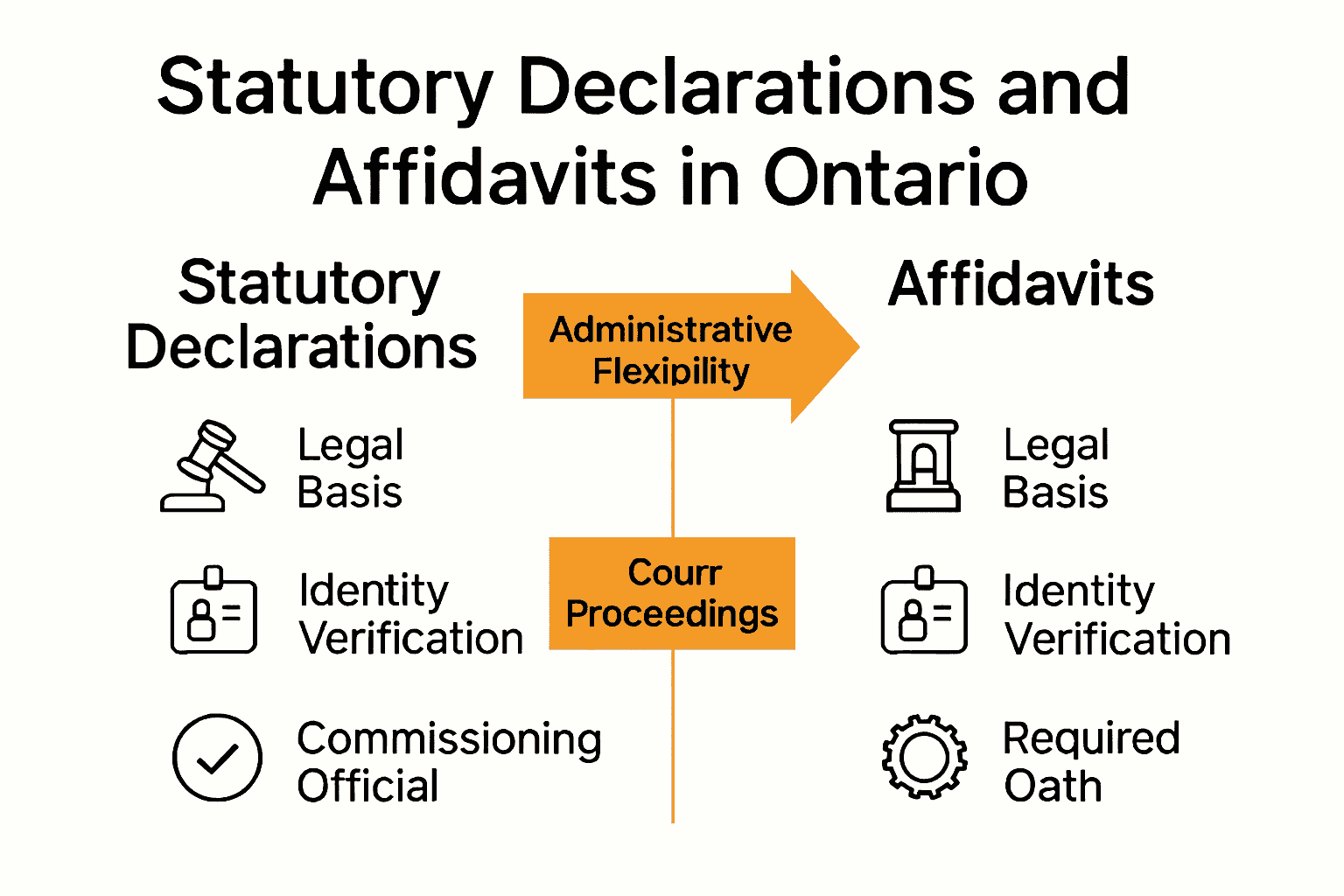
| Feature | Statutory Declaration | Affidavit |
|---|---|---|
| Legal Basis | Canada/Ontario Evidence Act | Same as statutory declaration |
| Common Uses | Identity verification Employment history Property transactions Immigration processes | Court proceedings Sworn evidence in trials |
| Commissioning Official | Notary public Commissioner of oaths | Notary public Commissioner of oaths |
| Required Oath | Solemn declaration | Formal sworn oath |
| Administrative Flexibility | High Widely used for official documents | Lower Primarily for court use |
Legal Requirements and Validity Criteria
Statutory declarations in Canada come with stringent legal requirements designed to ensure their authenticity and reliability. According to NotaryPro, these requirements involve multiple critical steps to maintain legal integrity.
Key Legal Validation Steps
The process of creating a valid statutory declaration involves several crucial elements:
- Identity Verification: Confirming the declarant’s true identity through government-issued documentation
- Official Presence: Signing the document in front of an authorized official
- Solemn Declaration: Affirming the truthfulness of the document’s contents
- Location Documentation: Recording the specific date and location of signing
Learn more about document validity standards to understand the nuanced legal requirements.
As outlined by the Canadian Defence Administrative Orders, the procedural criteria are comprehensive. Any alterations must be initialed, the declarant must fully understand the document’s contents, and the official must properly complete the jurat (the certification section).
False declarations are not taken lightly. Making a knowingly false statutory declaration can result in serious legal consequences, potentially constituting perjury. This underscores the profound legal weight these documents carry in administrative, personal, and professional contexts.
Step-By-Step Process to Create a Statutory Declaration
Creating a statutory declaration requires careful attention to detail and adherence to legal protocols. According to Notariz, the process involves several critical steps to ensure legal validity.
Preparing Your Statutory Declaration
Here’s a comprehensive roadmap for drafting and finalizing your declaration:
- Document Preparation
- Draft a clear, factual statement
- Include precise personal details
- Outline the specific purpose of the declaration
- Document Structure
- Create a title indicating the declaration’s nature
- Include full declarant information
- Write a concise statement of facts
Learn more about completing statutory declarations online for additional digital guidance.
Commissioning Process
As outlined by NotaryPro, the commissioning stage is crucial. You’ll need to:
- Book an appointment with a notary or commissioner
- Bring valid government-issued photo identification
- Sign the document in the official’s presence
- Have the document sealed and signed by the authorized official
The final step transforms your document from a simple written statement into a legally recognized statutory declaration. Each signature, date, and seal represents a critical link in establishing the document’s legal authenticity.
Risks, Liabilities, and Common Pitfalls
Statutory declarations carry significant legal weight and potential risks that can dramatically impact an individual’s legal standing. According to NotaryPro, knowingly providing false information constitutes perjury, a serious criminal offence with substantial consequences.
Primary Legal Risks
The potential risks associated with statutory declarations include:
- Criminal Prosecution: Potential charges under the Criminal Code
- Financial Penalties: Significant fines and legal expenses
- Professional Repercussions: Potential loss of professional credentials
- Legal Invalidation: Complete nullification of related legal processes
Understand who can officially sign these critical documents to minimize procedural errors.
Common Procedural Pitfalls
As outlined by Canadian Defence Administrative Orders, critical errors can invalidate your declaration:
- Incorrect jurat formatting
- Missing initials on document alterations
- Signing before an unauthorized official
- Incomplete or ambiguous factual statements
The consequences extend beyond mere document rejection. Improper statutory declarations can trigger legal investigations, potentially resulting in criminal charges. Precision, honesty, and strict adherence to procedural requirements are not just recommended—they’re absolutely essential.
Make Statutory Declarations Simple with The Online Notary
Getting a statutory declaration right in Canada can feel overwhelming and stressful. You might worry about making legal mistakes or not meeting strict requirements like official witnessing and document formatting. If you are looking for peace of mind and reliable guidance, you are not alone. Our Uncategorized – The Online Notary section has practical resources to answer your questions and show real solutions for challenges discussed in this guide.

Let us help you complete your statutory declaration smoothly. Visit The Online Notary to book your secure online notary appointment today. Experience fast turnaround, expert guidance, and confidence every step of the way. Do not wait until paperwork errors cause stress or delays. Start now and feel the relief of having your documents handled by experienced Ontario notaries.
Frequently Asked Questions
What is a statutory declaration?
A statutory declaration is a legal document used to assert facts or circumstances that can be officially recognized in legal contexts. It is often employed when traditional evidence is not available.
Who can sign a statutory declaration?
A statutory declaration must be signed in front of an authorized official, such as a notary public or a commissioner of oaths, who can attest to the identity of the declarant and the authenticity of the document.
What are the common uses of statutory declarations?
Statutory declarations are commonly used for various purposes, including confirming identity, providing employment verification, supporting immigration applications, and documenting personal status changes such as name changes or marital status.
What are the legal consequences of making a false statutory declaration?
Making a false statutory declaration can lead to serious legal consequences, including charges for perjury, financial penalties, and potential criminal prosecution. It is crucial to provide truthful and accurate information when completing this document.
Recommended
- How to Complete a Statutory Declaration Online in Ontario – The Online Notary
- Understanding Who Signs Statutory Declarations in Ontario – The Online Notary
- Understanding Who Signs Statutory Declarations in Ontario – The Online Notary
- Understanding Solemn Declaration Sample for Ontario Residents – The Online Notary