
Did you know that thousands of people in Ontario each year face challenges because their official birth certificates are lost, destroyed, or simply unavailable? This missing piece of documentation can hold up everything from getting a driver’s license to enrolling in school. When original records cannot be found, knowing how to use a proof of birth affidavit can make the difference between stalled plans and smooth progress through legal and administrative steps.
Key Takeaways
| Point | Details |
|---|---|
| Proof of Birth Affidavit Defined | A legal document serving as a temporary alternative when standard birth certificates are unavailable, requiring commissioning by an authorized official. |
| Key Uses | Commonly utilized for obtaining government-issued IDs, passports, and enrolling in schools when original documentation is missing. |
| Essential Components | Must include personal information, a sworn statement, and at least two supporting documents to verify birth details. |
| Common Pitfalls | Avoid incomplete information, lack of authorization, and insufficient supporting evidence to ensure acceptance of the affidavit. |
Table of Contents
- What Is A Proof Of Birth Affidavit?
- Types And Key Uses In Ontario
- Essential Requirements And Documentation
- Legal Status And Governing Rules
- Common Mistakes And How To Avoid Them
What Is a Proof of Birth Affidavit?
A proof of birth affidavit is a powerful legal document used when standard birth certificates become unavailable or difficult to obtain. According to research from NotaryPro, this affidavit serves as a temporary alternative for legal processes and official applications when original documentation cannot be quickly accessed.
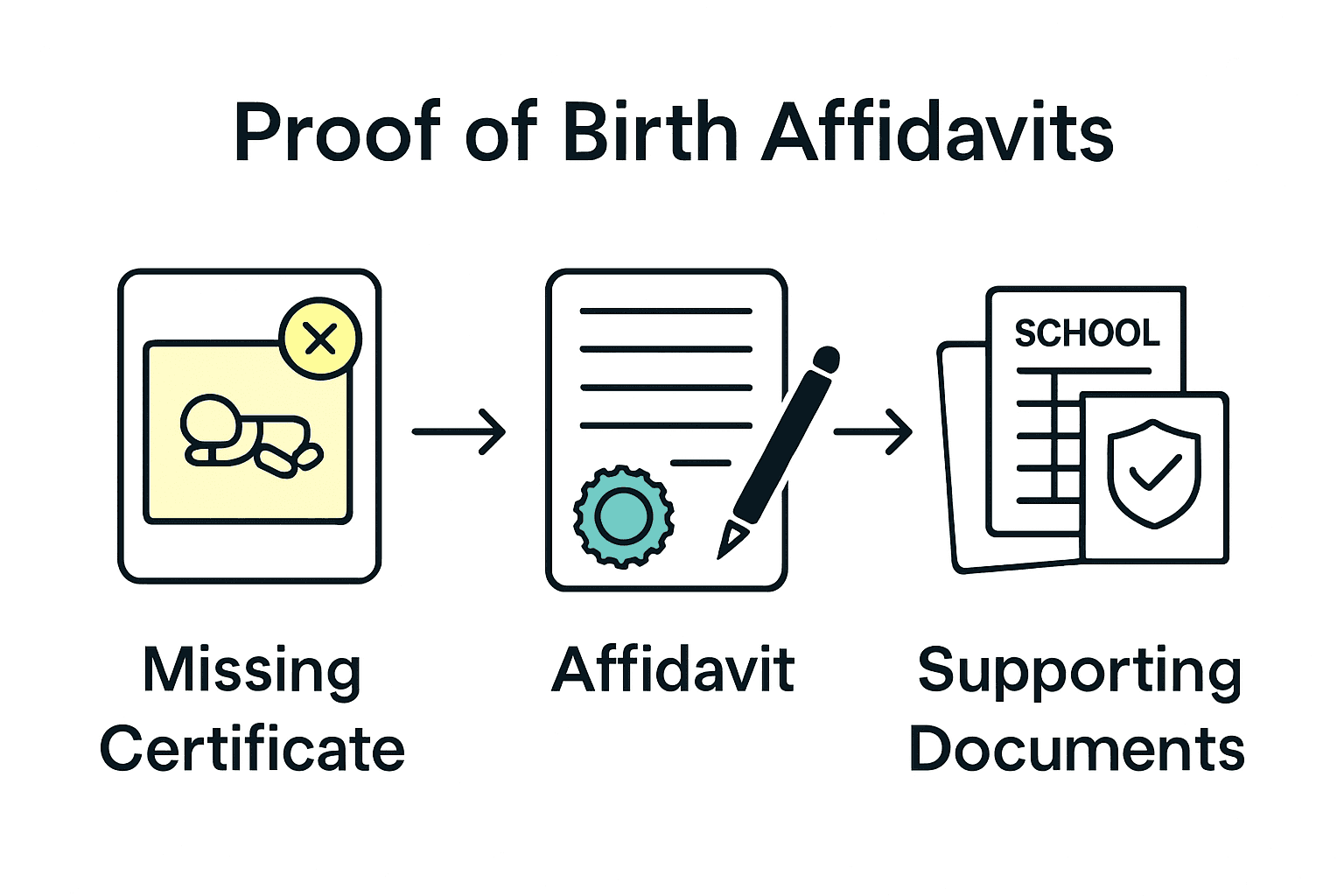
Essentially, a proof of birth affidavit is a sworn statement that provides critical information about an individual’s birth. Learn more about official affidavit processes in our comprehensive guide. The document must be officially commissioned by an authorized professional like a notary public or commissioner of oaths, which ensures its legal validity and credibility.
Key characteristics of a proof of birth affidavit include:
- A written declaration made under oath
- Legally admissible evidence of birth details
- Typically includes personal information like full name, date of birth, place of birth
- Requires signature and seal from an authorized official
While not a permanent replacement for an official birth certificate, this document provides a critical legal mechanism for individuals who need to verify their birth information quickly and formally. The affidavit bridges documentation gaps and helps individuals proceed with essential legal, administrative, and personal processes when standard documentation is temporarily unavailable.
Types and Key Uses in Ontario
In Ontario, proof of birth affidavits play a crucial role in various legal and administrative processes when standard documentation is unavailable. According to Ontario Regulation 1094, when primary evidence of birth cannot be obtained, individuals may submit an affidavit describing their attempts to secure such documentation, accompanied by alternative supporting evidence.
Common Uses for Proof of Birth Affidavits
The most frequent applications for proof of birth affidavits in Ontario include:
- Obtaining a driver’s licence
- Passport applications
- Government identification registration
- School enrollment
- Healthcare documentation
Learn about other essential notarized documents in Ontario to understand the broader context of legal documentation. As specified by DriveTest regulations, when official records are missing or incomplete, an affidavit sworn before a commissioner of oaths or notary can serve as a valid method of birth verification.
For most governmental and administrative purposes, a proof of birth affidavit must include specific components to be considered valid:
- Detailed personal information
- Sworn statement describing attempts to obtain original documentation
- Minimum of two supporting Class B evidence documents
- Official commissioning by a recognized legal authority
Understanding these nuanced requirements ensures individuals can navigate documentation challenges effectively, providing a legal pathway to verify their birth information when traditional records are unavailable.
Essential Requirements and Documentation
When preparing a proof of birth affidavit in Ontario, specific documentation and requirements must be carefully followed. According to research from DriveTest, the affidavit must be officially commissioned by a notary public or commissioner of oaths, and include crucial personal information explaining the absence of standard birth documentation.
Key Documentation Components
Here’s a structured overview of essential documentation for a proof of birth affidavit:
| Required Information | Example Details | Notes |
|---|---|---|
| Full Legal Name | John Alexander Doe | As shown on supporting ID |
| Complete Date of Birth | January 15, 1990 | Include day, month, and year |
| Place of Birth | Toronto, Ontario | Specify city/town and province |
| Parents’ Full Names | Jane Doe Richard Doe | Both parents as per records |
| Reason for Missing Certificate | Lost during move Unavailable from country | Detailed explanation is required |
| Supporting Documents | School records Insurance policies Medical records | Include at least 2 supporting documents |
| Official Commissioning | Notary Public Commissioner of Oaths | Must include signature and official seal |
The comprehensive proof of birth affidavit should include:
- Full legal name
- Complete date of birth
- Place of birth
- Parents’ full names
- Detailed explanation why original birth certificate is unavailable
Learn more about the nuances of official documentation in Ontario. As specified by NotaryPro, acceptable supporting documents can include:
- School records
- Insurance policies
- Adoption documentation
- Medical records
- Religious baptismal certificates
The affidavit must be sworn under oath, which means the individual must affirm the truthfulness of all statements in the presence of an authorized official. This process ensures the document’s legal validity and credibility, transforming it from a simple written statement into a legally recognized verification of birth information.
Legal Status and Governing Rules
Proof of birth affidavits in Ontario are governed by specific legal frameworks that ensure their validity and reliability. According to Ontario Regulation 1094, these documents serve as crucial legal alternatives when primary birth documentation cannot be obtained, providing a structured mechanism for individuals to verify their birth information.
Legal Recognition and Validity
The legal standing of a proof of birth affidavit is rooted in its formal commissioning process. As defined in standard legal documentation, affidavits are legally binding sworn statements that are admissible in court and official procedures. This means that when properly executed, a proof of birth affidavit carries significant legal weight.
Key legal principles governing these affidavits include:
- Must be sworn under oath
- Requires signature of an authorized official
- Provides legally recognized evidence of birth details
- Acceptable when primary documentation is unavailable
- Follows strict documentation standards set by provincial regulations
Explore more about official notarization processes in Ontario. The regulatory framework ensures that these affidavits are not simply informal documents, but robust legal instruments that can be used for critical administrative and personal processes, from obtaining identification to registering significant life events.
Common Mistakes and How to Avoid Them
Preparing a proof of birth affidavit requires meticulous attention to detail, as even minor errors can result in document rejection. According to DriveTest regulations, the most frequent mistakes involve improper documentation and insufficient supporting evidence.
Critical Errors to Prevent
Common mistakes applicants make include:
- Failing to have the document commissioned by an authorized official
- Omitting detailed personal information
- Not explaining why the original birth certificate is unavailable
- Insufficient supporting documentation
- Incomplete record of attempts to obtain primary evidence
Learn more about official notarization processes in Ontario. As specified by Ontario Regulation 1094, applicants must provide a comprehensive explanation of their efforts to obtain Class A evidence, accompanied by a minimum of two or three Class B supporting documents.
To ensure your proof of birth affidavit is accepted, follow these key recommendations:

- Always use an authorized notary or commissioner of oaths
- Include comprehensive personal details
- Provide a clear, detailed explanation for missing documentation
- Gather multiple supporting documents
- Double-check all information for accuracy before submission
By understanding and avoiding these common pitfalls, you can significantly increase the likelihood of your proof of birth affidavit being accepted on the first submission.
Experience Hassle-Free Proof of Birth Affidavits in Ontario
Have you struggled with missing or hard-to-find birth documentation, only to discover that legal and administrative offices require official verification? Navigating proof of birth affidavit requirements can be stressful and time-consuming. You deserve a solution that makes the process simple and fully valid for Ontario regulations. For more about what we offer, visit our Uncategorized resource page.

Do not risk rejection or wasted time. Choose our trusted online notary services for fully commissioned affidavits, verified by authorized professionals who understand every legal detail. Act now to secure your legally recognized proof of birth affidavit, ready for government IDs, passports, and more. Take advantage of fast, secure service at The Online Notary and move forward with confidence today.
Frequently Asked Questions
What is a proof of birth affidavit?
A proof of birth affidavit is a sworn statement that provides essential details about an individual’s birth, serving as a temporary alternative when a standard birth certificate is unavailable.
What information is required in a proof of birth affidavit?
The affidavit must include personal details such as full legal name, date of birth, place of birth, parents’ names, the reason for the absence of the original birth certificate, and at least two supporting documents.
How is a proof of birth affidavit made valid?
To be valid, a proof of birth affidavit must be officially commissioned by an authorized notary public or commissioner of oaths, including their signature and official seal, affirming the document’s credibility.
What common mistakes should be avoided when preparing a proof of birth affidavit?
Common mistakes include failing to commission the document correctly, omitting key personal information, not providing a clear explanation for the missing original birth certificate, and insufficient supporting documents.