
Booking a notary online seems convenient, but Ontario law requires notaries to be physically present for your documents to be valid. This is a real challenge for small business owners and individuals who need legal paperwork certified quickly and affordably. Understanding the difference between remote commissioning and notary services helps you avoid costly mistakes and ensures your affidavits and statutory declarations are accepted by banks, government offices, and legal representatives.
Table of Contents
- Understanding Online Notary Accessibility in Ontario
- Types of Online Notarial Services Available
- Key Legal Requirements and Restrictions
- Remote Commissioning Process and Security Measures
- Risks, Limitations, and Common Pitfalls
Key Takeaways
| Point | Details |
|---|---|
| In-Person Notarization Required | Online notarization is not permitted in Ontario; physical presence with a notary is mandatory for valid documentation. |
| Commissioners Offer Remote Services | Remote commissioning via video is legal for certain documents, such as affidavits, but not for full notarization. |
| Risk of Invalid Documents | Using unauthorized online notary services can result in documents being rejected by institutions, creating legal complications. |
| Plan Appointments Ahead | Schedule in-person or remote commissioning appointments early to ensure availability and compliance with legal requirements. |
Understanding Online Notary Accessibility in Ontario
Accessibility to notary services in Ontario hinges on a critical legal reality: online notary services are not currently permitted under the Notaries Act without physical presence. This distinction shapes everything about what you can and cannot do when seeking document certification.
The Law Society of Ontario has been clear about this restriction. The Notaries Act requires notaries to be physically present with individuals during the notarization process. Until regulations change this requirement, online notarization remains unavailable for most documents in the province.
What This Means for Your Documents
If you need documents notarized in Ontario, you’re working within specific constraints:
- Affidavits require in-person notarization with a licensed notary present
- Statutory declarations follow the same physical presence requirement
- Solemn declarations must be completed face-to-face
- Invitation letters need direct notary verification
Documents notarized through unauthorized online services risk being deemed invalid. This creates real problems when you submit them to government agencies, financial institutions, or legal representatives.
Why Physical Presence Matters
The requirement exists for verification purposes. A notary must confirm your identity, witness your signature, and ensure you’re signing willingly and without duress. These protections cannot be replicated through a screen, according to current Ontario regulations.

Some remote witnessing is permitted under specific acts for limited purposes. However, this is not the same as full online notarization, and the scope remains narrow.
Understanding Your Actual Options
You have realistic alternatives that work within Ontario’s legal framework:
- Schedule in-person appointments with licensed notaries
- Use mobile notary services that come to your location
- Complete notarization at law offices or service providers
- Plan ahead to avoid rushed appointments
These options provide legitimate certification for your documents without legal risk.
Know the difference between remote witnessing and online notarization. Some acts permit remote witnessing under specific conditions, but this doesn’t mean full online notarization is legal for your documents.
Accessibility in Ontario currently means accessing available in-person services, not digital alternatives. Small business owners and individuals need reliable, affordable notarization—and working with compliant providers ensures your documents hold up when they matter most.
Pro tip: Contact licensed notaries early to schedule appointments rather than rushing at the last minute, as availability varies and some providers offer flexible hours or mobile services to fit your schedule.
Types of Online Notarial Services Available
Ontario distinguishes between two separate services that sound similar but operate under completely different rules. Understanding this distinction is critical because one is legally available online, while the other is not.
Commissioners of Oaths and Remote Commissioning
Commissioners of oaths can legally perform remote commissioning through video conferencing. This means you can have documents commissioned online if a commissioner witnesses your signature through a real-time video connection where both parties can see and communicate clearly.
Remote commissioning works for:
- Affidavits requiring sworn statements
- Statutory declarations confirming facts under oath
- Solemn declarations where testimony is necessary
- Invitation letters needing commissioner verification
The commissioner must see you sign the document and confirm your identity during the video call. This provides the legal verification needed for these documents to be valid.
Notaries Public and In-Person Requirements
Notaries public operate differently and cannot perform their services online. Notary public functions like certifying true copies and verifying original documents require physical presence by law.
Notary services that demand in-person attendance include:
- Certifying copies as true copies of originals
- Verifying document authenticity
- Witnessing signatures for property transfers
- Authenticating legal instruments
These cannot happen through a screen because the notary must physically examine original documents and confirm signatures in person.
Key Differences at a Glance
| Service | Remote Available | Requirements |
|---|---|---|
| Commissioner of oaths | Yes | Real-time video, clear communication |
| Notary public | No | Must be in-person |
The critical distinction matters for your documents. Commissioners of oaths can serve you remotely, but notaries public cannot—know which service your document requires before booking.
Small business owners often need commissioners for affidavits and statutory declarations. These remote services save time and eliminate travel, making accessibility genuinely improved for certain document types. However, other legal documents still require traditional in-person notarization.
Pro tip: Confirm whether your document needs a commissioner of oath or a notary public before scheduling, as this determines whether remote service is an option and saves you time during the booking process.
To clarify the roles and impacts of different document certification services in Ontario, see the comparison below:
| Document Type | Commissioner of Oaths | Notary Public | Business Impact |
|---|---|---|---|
| Affidavits | Can commission remotely | Requires in-person presence | Remote saves time; in-person ensures legal compliance |
| Statutory Declarations | Remote commissioning allowed | Physical presence required | Remote offers flexibility; in-person avoids rejection |
| Solemn Declarations | Can be done online, commissioner only | Must be face-to-face | Remote increases accessibility; in-person needed for validity |
| True Copies & Authenticity | Not permitted remotely | Certified in person | Remote not possible; in-person avoids application delays |
Key Legal Requirements and Restrictions
Ontario’s legal framework around notarization is strict and unambiguous. The Notaries Act sets clear boundaries about what can and cannot happen remotely, and understanding these rules protects you from invalid documents and wasted time.
The Physical Presence Requirement
The Notaries Act requires physical presence for notarization to be valid. This is not a suggestion or a guideline—it’s a legal mandate that applies to all notary services in Ontario.
What this means in practice:
- You must be physically present with the notary
- The notary must see you sign the document in real time
- Identity verification happens face-to-face
- No exceptions exist unless regulations change
Documents signed through unauthorized online services are not legally valid. When you submit them to government agencies or financial institutions, they will be rejected.
Current Regulatory Status
No regulations currently exist permitting remote notarization in Ontario. While the Notaries Act contemplates the possibility of future regulations enabling virtual notarization, those rules have not been enacted.
This creates a clear legal reality: online notary services advertising full notarization are operating illegally. The Law Society of Ontario warns that providers offering these services face regulatory penalties.
What About Remote Witnessing?
Some statutes in Ontario do permit limited remote witnessing under specific circumstances. This is different from full online notarization and applies only to particular document types and situations.
Remote witnessing:
- Works for affidavits through commissioners of oaths
- Requires real-time video communication
- Must meet specific statutory requirements
- Cannot substitute for notary public functions
This distinction matters. Remote witnessing is legal and accessible. Full online notarization is not—yet.
Consequences of Non-Compliance
Using unauthorized online notary services creates real problems:
- Documents become legally invalid
- Government agencies reject them
- Banks and financial institutions deny processing
- You may need to restart applications entirely
- Costs increase through delays and rework
Non-compliance carries penalties beyond invalid documents. The Law Society of Ontario takes regulatory action against providers offering illegal services, and your documents may be rejected by institutions that verify legitimacy.
Small business owners cannot afford these delays. Working with compliant providers ensures your affidavits, statutory declarations, and other documents hold up under scrutiny.
Pro tip: Verify that any notary service you use is licensed by the Law Society of Ontario and confirm whether your document requires a commissioner of oath or in-person notary public service before paying for anything.
Remote Commissioning Process and Security Measures
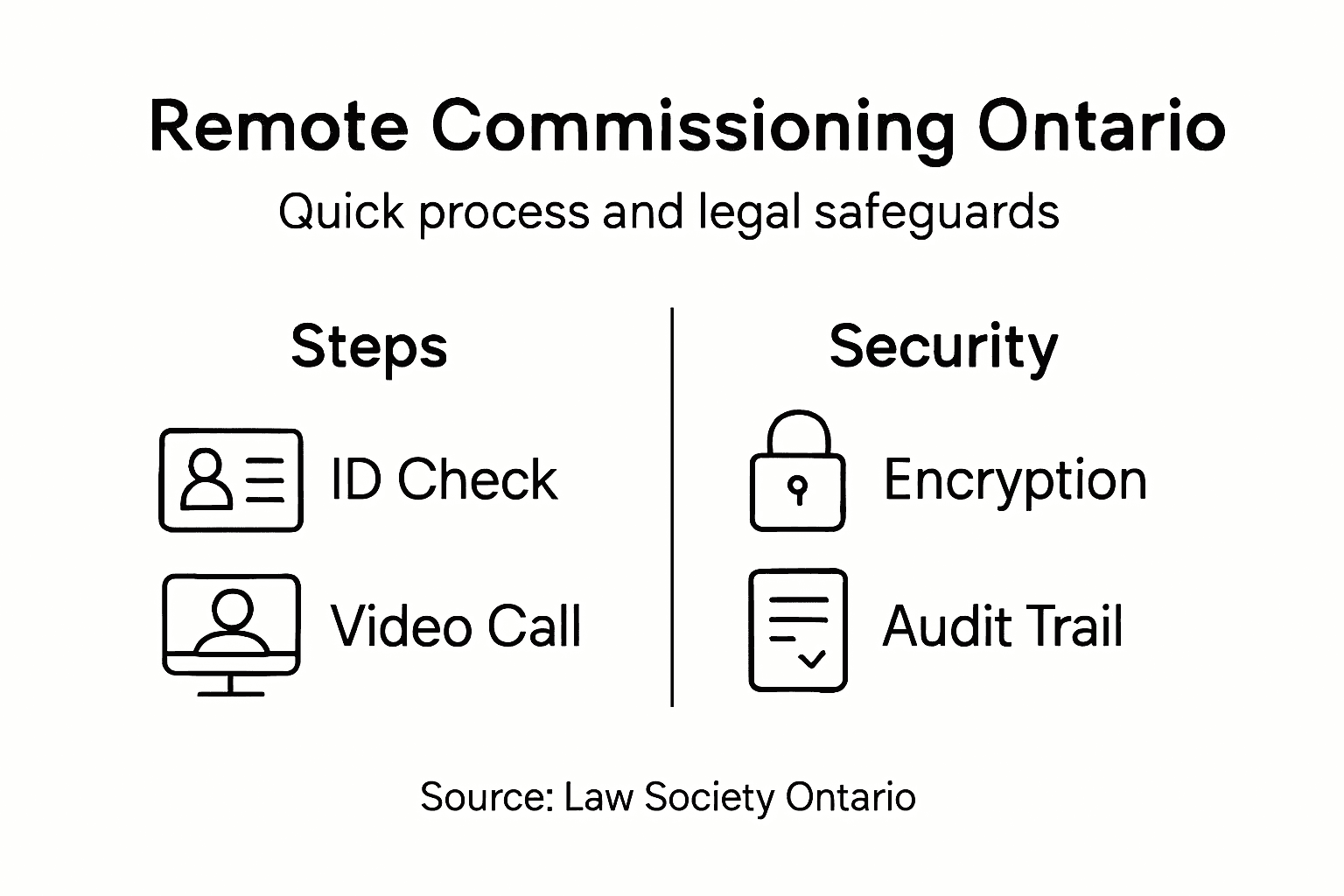
Remote commissioning through video creates legitimate accessibility for affidavits and statutory declarations. The process works because strict security protocols ensure the document holds up legally when institutions examine it later.
How Remote Commissioning Works
Remote commissioning happens through secure video conferencing with real-time interaction between you and the commissioner. Both parties must remain visible and audible throughout the entire session, ensuring nothing happens off-camera.
The session flow looks like this:
- Schedule your appointment with a licensed commissioner
- Prepare your document and government-issued ID
- Join the secure video call at the scheduled time
- Commissioner verifies your identity from the ID
- You sign the document while the commissioner watches
- Commissioner records the session and creates documentation
This straightforward process takes minutes and produces legally valid documents.
Identity Verification Requirements
Government-issued identification is non-negotiable. The commissioner must see your valid ID and confirm it matches your appearance before proceeding with commissioning.
Acceptable forms include:
- Driver’s license
- Passport
- Provincial health card (with photo)
- Government-issued identification card
Have your ID ready and visible on camera. This verification step protects both you and the commissioner by confirming you are who you claim to be.
Security Protocols and Encryption
Platforms used for remote commissioning implement robust security measures that protect your information and document. Encryption ensures your video session remains private and cannot be intercepted.
Standard security features include:
- End-to-end encrypted video connections
- Session recording for compliance and proof
- Secure document upload and storage
- Access controls limiting who can view records
- Compliance with Ontario privacy regulations
These protocols create an audit trail proving the commissioning happened legitimately. This documentation becomes valuable if anyone questions the document’s validity later.
What Gets Recorded and Stored
Commissioners maintain records of each remote session. These records document that you appeared, signed the document, and the commissioner witnessed it. Institutions can verify this documentation if needed.
Session recording provides legal proof. The encrypted recording and documentation create an audit trail that protects your document’s validity and proves compliance with commissioning requirements.
Small business owners benefit from this transparency. Your affidavits and statutory declarations become defensible documents institutions will accept without hesitation.
Pro tip: Test your internet connection and camera before your appointment, ensure your space is quiet and well-lit, and have your ID and document ready on screen to keep the session brief and professional.
For easy reference, here’s a summary of recommended security measures for remote commissioning:
| Security Feature | Why It Matters | Result |
|---|---|---|
| End-to-end encryption | Protects video session privacy | Prevents unauthorized access |
| Session recording | Provides compliance documentation | Creates legal audit trail |
| Secure document storage | Safeguards uploaded documents | Ensures confidentiality |
| Platform privacy compliance | Meets Ontario legal standards | Boosts institutional trust |
Risks, Limitations, and Common Pitfalls
Remote commissioning works well for specific document types, but it has hard boundaries. Crossing those boundaries creates legal problems that cost time and money to fix.
What Remote Commissioning Cannot Do
Notaries cannot certify true copies or verify document authenticity remotely. This is a critical limitation because some documents require exactly these services.
Tasks that require in-person notarization:
- Certifying copies as true copies of originals
- Verifying the authenticity of original documents
- Witnessing signatures on property transfers
- Authenticating legal instruments requiring physical inspection
Attempting these remotely produces invalid documents. You cannot see the original document through a screen well enough to certify it accurately.
The Commissioning vs. Notarization Confusion
Many people mistakenly treat remote commissioning as equivalent to full online notarization. This misunderstanding leads to ordering the wrong service and receiving documents that do not meet requirements.
The distinction matters:
- Remote commissioning works for affidavits and statutory declarations
- Notarization requires in-person services and cannot happen online
Confusing these creates expensive problems when institutions reject your documents.
Identity Verification Failures
Adequate identity verification is non-negotiable. If the commissioner skips proper ID verification or accepts unclear identification, the entire document becomes questionable.
Risks from weak verification:
- Documents get rejected by institutions
- Institutions question the signature’s legitimacy
- You cannot quickly fix this without re-commissioning
- Delays compound through applications and processes
Always use licensed commissioners who take verification seriously.
Platform Security Vulnerabilities
Using non-compliant platforms compromises document integrity. If the video conferencing platform lacks proper encryption or security protocols, your session becomes vulnerable.
Security problems create cascading issues. Institutions may refuse documents processed through questionable platforms because they cannot verify legitimacy.
Use only compliant platforms with proper encryption. Security vulnerabilities compromise your document’s legal standing and can result in institutions rejecting it entirely.
Small business owners cannot afford to gamble on platforms. Working with established, compliant commissioners ensures your documents hold up under scrutiny.
Pro tip: Before scheduling, ask the commissioner whether they use encrypted video conferencing, maintain session recordings, and comply with Ontario privacy regulations—legitimate providers answer these questions immediately.
Unlock Reliable Document Certification Services in Ontario
Navigating Ontario’s strict regulations around online notary accessibility can be frustrating. The article highlights key challenges such as the legal requirement for physical presence with notaries public and the limited scope of remote commissioning by commissioners of oaths. If you need affidavits, statutory declarations, or invitation letters commissioned with full legal compliance, understanding these distinctions is essential to avoid costly delays and invalid documents.
At The Online Notary, we specialize in providing secure and fully compliant online services for affidavits, statutory declarations, solemn declarations, and invitation letters allowed under Ontario law. Our licensed commissioners of oaths use encrypted video conferencing to verify your identity and witness your signature in real time, ensuring your documents hold up with government agencies and institutions.

Discover how our tailored services simplify your document commissioning needs while respecting Ontario’s legal requirements. Visit our Uncategorized – The Online Notary page to explore detailed explanations and see how we can support your situation. Get started today with The Online Notary and experience trustworthy notarization with confidence. Do not wait until last-minute complications arise. Secure your appointment now and ensure your documents are legally valid and accepted.
Frequently Asked Questions
What is the main restriction on online notary services in Ontario?
Currently, online notary services are not permitted under the Notaries Act unless the notary is physically present with the individual during the notarization process.
Can I use online notary services for document notarization in Ontario?
No, full online notarization is not legal for most documents in Ontario. Individuals must schedule in-person appointments with licensed notaries to ensure the legality of their documents.
What is the difference between a commissioner of oaths and a notary public?
A commissioner of oaths can perform remote commissioning through video conferencing, while a notary public requires in-person service and cannot operate online due to legal restrictions.
What documents can be remotely commissioned in Ontario?
Remote commissioning is allowed for affidavits, statutory declarations, and solemn declarations if the commissioner witnesses your signature via a real-time video connection.
Recommended
- Online Notary Public in Ontario: Services and Benefits 2025 – The Online Notary
- Are Online Notaries Legal in Ontario? What You Need to Know – The Online Notary
- Understanding Online Notary Requirements in Ontario – The Online Notary
- Online Notary in Ontario: Fast, Legal, and Secure Services 2025 – The Online Notary