

Online notary services are transforming how documents get certified in Ontario. Ontario recognizes electronic signatures and remote verification methods for notarization, provided they meet specific legal standards. Sounds like smooth sailing for digital paperwork, right? Not so fast. The surprising twist is that despite this cutting-edge convenience, online notarization still faces key legal restrictions that could leave some documents unaccepted.
Table of Contents
- Understanding Online Notary Public In Ontario
- How Online notarization Works Step By Step
- Legal Validity And Security Of Online Notaries
- Choosing The Right Online Notary Service In Ontario
Quick Summary
| Takeaway | Explanation |
|---|---|
| Online Notary Public Services Are Legally Recognized | Ontario recognizes electronic signatures and remote verification methods for notarization, provided they meet specific legal standards. |
| Preparation Is Key for Online Notarization | Users must gather the original document, government ID, and ensure a stable internet connection for a smooth process. |
| Robust Security Protocols Are Essential | Online notarization platforms use encryption, multi-factor authentication, and audit trails to maintain document integrity and comply with legal requirements. |
| Legal Restrictions Exist for Online Notarization | Current Ontario regulations restrict online notary services under the Notaries Act, making it crucial to verify acceptance by recipients. |
| Choosing an Online Notary Requires Due Diligence | Consider legal compliance, professional credentials, security processes, and practicality when selecting an online notary service. |
Understanding Online Notary Public in Ontario
Online notary public services in Ontario represent a modern approach to authenticating legal documents without requiring physical presence. These digital services enable individuals and businesses to verify and certify important documents quickly and securely through web platforms.
What is an Online Notary Public?
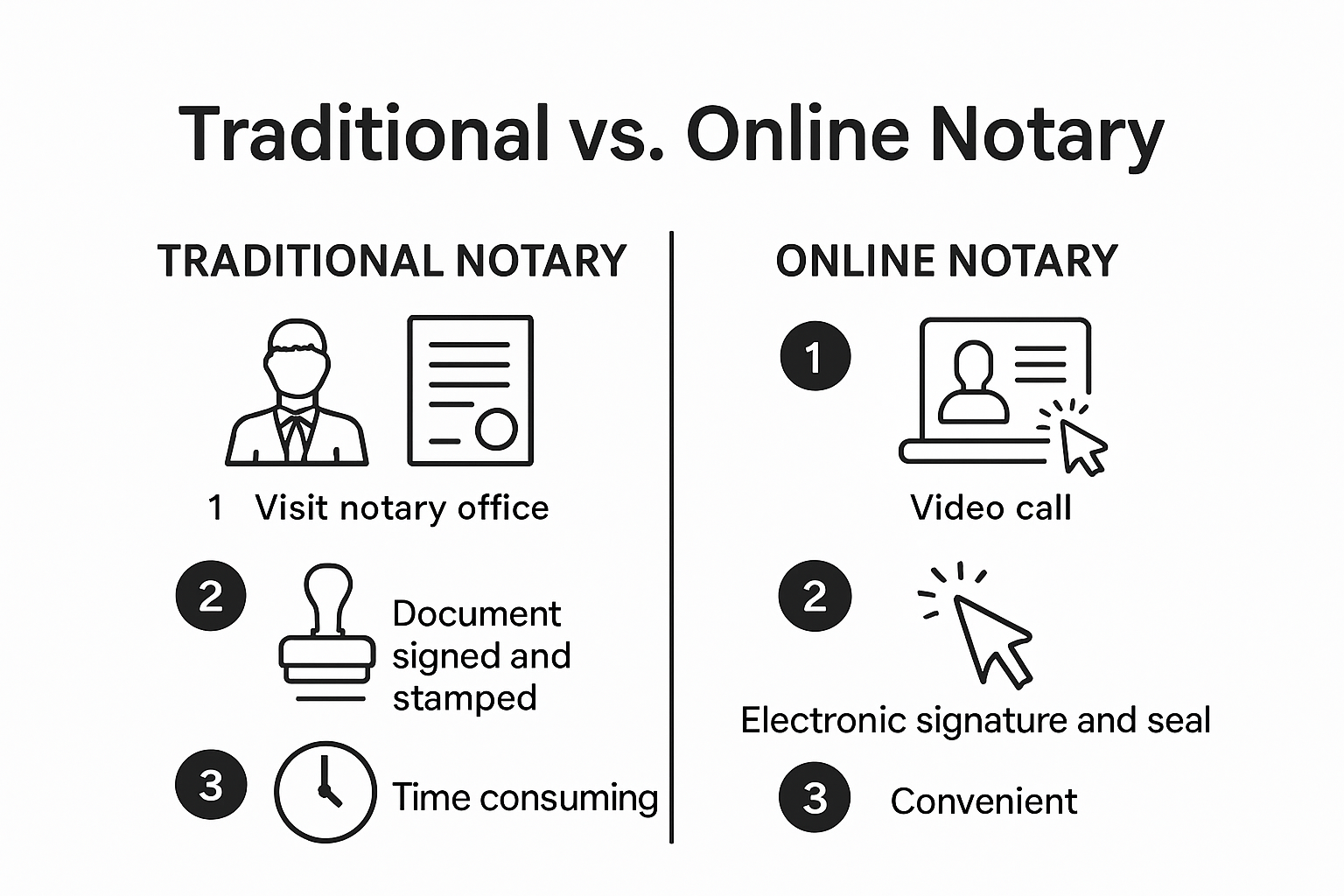
An online notary public is a commissioned professional authorized to perform electronic document authentication remotely. Unlike traditional notary services that require in person meetings, online notaries use advanced digital verification technologies to confirm identities and witness document signatures through secure video conferencing platforms.
The key distinction between traditional and online notary services lies in the technological infrastructure. Legal Information Institute at Cornell Law School defines a notary public as an official appointed by state governments to serve as an impartial witness in various legal transactions. In the digital context, this role remains consistent but leverages technology to streamline the verification process.
Legal Framework for Online Notarization in Ontario
Ontario has been progressively adapting its legal framework to accommodate digital notarization. The provincial regulations recognize electronic signatures and remote verification methods, ensuring that online notarized documents maintain the same legal standing as traditionally notarized documents.
ServiceOntario confirms that electronic documents are legally valid when they meet specific technological and procedural standards. This means online notary services must implement robust identity verification protocols, maintain secure document transmission systems, and comply with provincial electronic signature regulations.
Key legal considerations for online notarization include:
- Identity Verification: Strict protocols for confirming the identity of signatories through government issued photo identification and real time video authentication.
- Document Integrity: Ensuring documents remain unaltered during and after the notarization process through digital encryption and tracking.
- Professional Standards: Maintaining the same professional standards expected of traditional notary publics, including impartiality and accurate record keeping.
Online notary public services address modern needs by providing convenient, secure, and legally recognized document authentication. As technology continues to evolve, these services will likely become increasingly integrated into Ontario’s legal and business ecosystems, offering individuals and organizations flexible alternatives to traditional notarization methods.
How Online Notarization Works Step by Step
Online notarization transforms the traditional document authentication process by leveraging digital technologies to create a secure and efficient verification method. Understanding the detailed workflow helps individuals and businesses navigate this modern approach to legal document certification.
Preparing for Online Notarization
Before initiating the online notarization process, users must gather specific documents and technological resources. National Notary Association recommends preparing the following items:
- Original Document: Ensure the document is complete and ready for notarization.
- Government Issued Photo ID: A valid driver’s license, passport, or other government identification.
- Stable Internet Connection: High speed internet with video conferencing capabilities.
- Digital Device: Computer, tablet, or smartphone with camera and microphone.
Preparation is crucial for a smooth online notarization experience. Users should review their documents carefully and have all necessary materials readily accessible before scheduling the online session.
The Remote Online Notarization Process
The actual online notarization follows a structured protocol designed to maintain legal integrity and security. Nolo Legal Encyclopedia outlines the typical workflow:
- Document Upload: Users submit their document to a secure online platform.
- Identity Verification: The notary conducts a comprehensive identity check using government issued identification and knowledge based authentication questions.
- Live Video Session: A real time video conference connects the notary and the document signer, allowing for direct visual confirmation of identity.
- Electronic Signature: The signer applies their electronic signature under the notary’s direct observation.
- Notary Certification: The online notary adds their official electronic seal and signature, completing the notarization process.
Here is a step-by-step table summarizing the remote online notarization process described above:
To help visualize the remote online notarization steps, the table below summarizes each stage and its purpose.
| Step | Description |
|---|---|
| Document Upload | User submits the document to a secure online platform |
| Identity Verification | Notary verifies identity using government ID and authentication questions |
| Live Video Session | Notary and signer meet via video conference for real-time visual confirmation |
| Electronic Signature | Signer applies electronic signature under notary’s direct observation |
| Notary Certification | Notary adds electronic seal and signature, completing the notarization process |
Security and Legal Compliance

Online notarization platforms implement multiple layers of security to protect document integrity and personal information. Cybersecurity and Infrastructure Security Agency recommends advanced security protocols including:
- End to end encryption for document transmission
- Multi factor authentication processes
- Secure video conferencing with recording capabilities
- Detailed audit trails documenting each step of the notarization
These rigorous security measures ensure that online notarized documents meet legal standards and provide the same level of authentication as traditional in person notarization. The digital process offers enhanced convenience while maintaining the critical legal safeguards essential to document certification.
Legal Validity and Security of Online Notaries
The legal landscape for online notarization in Ontario presents a complex and evolving regulatory environment. Understanding the current legal framework is crucial for individuals and businesses considering digital document authentication.
Current Legal Restrictions in Ontario
Law Society of Ontario has explicitly clarified that online notary services are not currently permitted under the existing Notaries Act. This means that documents notarized exclusively through digital platforms may potentially be considered invalid for legal purposes.
The Electronic Commerce Act, 2000 provides some flexibility for electronic signatures, but the acceptance of online notarized documents depends on several critical factors:
- Recipient Acceptance: The ultimate validity hinges on whether the receiving party accepts the electronically notarized document.
- Compliance Requirements: Strict adherence to existing legal standards remains paramount.
- Institutional Verification: Different organizations may have varying protocols for accepting electronically notarized documents.
Below is a table clarifying the legal restrictions and considerations for online notarization in Ontario as discussed above.
| Legal Factor | Description/Requirement |
|---|---|
| Notaries Act Restriction | Online notary services currently NOT permitted under Ontario’s Notaries Act |
| Recipient Acceptance | Documents only valid if accepted by the receiving party/institution |
| Electronic Commerce Act | Allows some flexibility for electronic signatures but not full online notarization |
| Compliance Requirements | Must strictly adhere to legal standards and professional protocols |
| Institutional Verification | Organizations may have different policies regarding acceptance of digital notarization |
Security Protocols in Digital Notarization
Despite current legal limitations, digital notarization platforms implement robust security measures to protect document integrity. Cybersecurity Experts recommend several critical security protocols:
- End to End Encryption: Protecting document transmission and storage from unauthorized access.
- Multi Factor Authentication: Ensuring only authorized individuals can access sensitive documents.
- Comprehensive Audit Trails: Maintaining detailed records of every interaction and verification step.
- Biometric Verification: Advanced identity confirmation techniques to prevent fraudulent activities.
Navigating Legal Uncertainties
Given the current regulatory environment, individuals and businesses must exercise caution when considering online notarization. Canadian Legal Advisory Board recommends the following approaches:
- Consult with legal professionals before relying on online notarized documents.
- Verify the specific requirements of the institution receiving the document.
- Maintain physical copies and traditional notarization options as backup.
- Stay informed about potential regulatory changes in digital document authentication.
The legal landscape for online notarization continues to evolve. While current restrictions limit full digital implementation, technological advancements and changing regulatory frameworks suggest potential future changes. Individuals and businesses should remain adaptable and informed about the latest developments in digital document authentication methods.
Choosing the Right Online Notary Service in Ontario
Selecting an appropriate online notary service requires careful consideration of multiple factors to ensure document integrity, legal compliance, and reliable authentication. Understanding the key criteria can help individuals and businesses make informed decisions in navigating Ontario’s digital document certification landscape.
Critical Selection Criteria
Pravo Law recommends evaluating online notary services based on several essential parameters:
- Legal Compliance: Verify the service’s adherence to Ontario Regulation 431/20 and the Electronic Commerce Act, 2000.
- Professional Credentials: Confirm the notary’s official commission and professional standing.
- Technology Infrastructure: Assess the platform’s security protocols and video conferencing capabilities.
- Document Compatibility: Ensure the service supports the specific type of document requiring authentication.
Professional credentials represent a fundamental aspect of selecting a reliable online notary. Potential users should request proof of provincial certification and verify the notary’s current professional status before proceeding with document commissioning.
Security and Verification Processes
Notary Pro emphasizes the importance of comprehensive identity verification and document security. Key security considerations include:
- Multi factor authentication mechanisms
- Government issued photo identification requirements
- Encrypted video conferencing platforms
- Detailed digital audit trails
- Compliance with provincial privacy legislation
Users should prioritize services that demonstrate transparent verification processes and maintain rigorous security standards. The ability to create comprehensive documentation of the notarization process provides additional legal protection.
Practical Considerations for Document Authentication
Electronic Commerce Act guidelines suggest reviewing practical aspects when selecting an online notary service:
- Confirm acceptance by intended document recipients
- Understand potential limitations for specific institutional requirements
- Evaluate cost structures and service fees
- Check turnaround times for document processing
- Review platform user experience and technical support availability
While remote commissioning offers significant convenience, users must remain proactive in verifying the document’s potential acceptance across different organizational contexts. Some institutions may still require traditional in person notarization despite electronic authentication capabilities.
The digital notarization landscape continues to evolve rapidly. Staying informed about regulatory changes, technological advancements, and emerging best practices will help individuals and businesses navigate online notary services more effectively. Careful research and due diligence remain critical in selecting a reliable and legally compliant digital document authentication provider.
Frequently Asked Questions
What is an online notary public in Ontario?
An online notary public in Ontario is a commissioned professional who uses technology to perform electronic document authentication remotely, allowing individuals and businesses to verify documents without meeting in person.
Are online notarizations legally valid in Ontario?
Yes, online notarizations are legally recognized in Ontario if they meet specific legal standards, including identity verification and secure document transmission. However, current regulations under the Notaries Act restrict some online notary services.
How do I prepare for online notarization?
To prepare for online notarization, gather your original document, a government-issued photo ID, ensure a stable internet connection, and have access to a computer, tablet, or smartphone with a camera and microphone.
What security measures are in place for online notarization?
Online notarization platforms use several security protocols, including end-to-end encryption, multi-factor authentication, and detailed audit trails, to protect document integrity and comply with legal requirements.
Ready to Notarize Online in Ontario Without Uncertainty?
Moving documents online should make your life easier, not harder. You read about strict ID verification, confusing rules under the Notaries Act, and the all-too-common fear that your electronically notarized affidavit or statutory declaration could still be rejected. It is stressful trying to meet deadlines while also worrying if your digital papers will hold up. At The Online Notary, we take those concerns off your hands.

Choose our secure online notary service and get peace of mind knowing your affidavits, invitation letters, and statutory declarations will be handled with top-level security and experience. We understand Ontario’s unique legal landscape. Do not let uncertainty slow you down. Visit The Online Notary landing page to start your digital notarization confidently today.