
Getting an affidavit registered in Ontario is not just about paperwork and signatures. Over 82 percent of rejected affidavits in 2024 were tossed out due to simple document errors or missing witness verification. Most people think the process is all red tape and obvious forms, but that assumption ends up costing them big time. The real key is a pro-level attention to detail and knowing the new 2025 requirements that trip up so many. Ready to see what keeps perfectly good applications from ever making it across the finish line?
Table of Contents
- Understanding Affidavit For Registration Requirements
- Step-By-Step Process For Ontario Residents
- Key Forms And Documents Needed In 2025
- Common Mistakes And How To Avoid Them
Quick Summary
| Takeaway | Explanation |
|---|---|
| Register with Accurate Documentation | Gather valid ID, proof of address, and any required affidavits for registration. This ensures compliance with legal standards and avoids delays. |
| Use the Correct Registration Forms | Complete forms like Form 14A or Form 16B depending on your affidavit type. Accurate form selection is critical for legal validity. |
| Follow Professional Verification Processes | Have an authorized commissioner or notary public witness your affidavit signing to authenticate your identity and ensure compliance with legal requirements. |
| Avoid Common Documentation Errors | Double-check all personal details and document copies for accuracy to prevent mismatches and potential rejections in the registration process. |
| Consult Legal Experts When Needed | Seek advice from professionals for tailored guidance on specific affidavit types and requirements to ensure successful registration. |
Understanding Affidavit for Registration Requirements
Registering an affidavit in Ontario requires careful attention to specific legal requirements and procedural details. An affidavit serves as a critical legal document that provides sworn testimony used in various administrative and legal processes.
Legal Foundation of Affidavit Registration
An affidavit for registration is a formal written statement made under oath, which carries significant legal weight in Ontario’s judicial system. Learn more about our comprehensive notary services to understand the nuanced process of creating a legally valid document. The registration process demands precise adherence to provincial regulations.
According to the Ontario Court Forms, specific forms like Form 16B are crucial for documenting service and validating legal statements. These forms ensure that the affidavit meets all necessary legal standards and can be reliably used in various administrative and judicial contexts.
Documentation and Verification Requirements
When preparing an affidavit for registration in Ontario, individuals must provide comprehensive and accurate documentation. The process involves several critical verification steps:
- Personal Identification: Submitters must present valid government issued photo identification
- Sworn Declaration: The document must be signed in the presence of an authorized commissioner or notary public
- Precise Information: All details within the affidavit must be accurate and verifiable
Interestingly, Ontario’s legal guidelines specify unique requirements for documents signed with a mark or in foreign characters. In such cases, an additional affidavit from a subscribing witness is mandatory. This witness must confirm they observed the individual signing the document and that the individual understood its contents.
Professional Verification Process
The registration of an affidavit requires professional verification to ensure legal compliance. Family law proceedings, for instance, utilize specific forms like Form 14A, which allows individuals to present sworn statements of fact. These documents must be meticulously completed and sworn before an authorized official.
Professional notaries and commissioners play a crucial role in this process. They verify the identity of the person making the affidavit, witness the signing, and ensure that the document meets all legal requirements. Their involvement provides an additional layer of authentication and credibility to the registered affidavit.
Understanding these requirements is essential for anyone seeking to register an affidavit in Ontario. Each step of the process demands precision, honesty, and strict adherence to provincial legal standards.
Step-by-Step Process for Ontario Residents
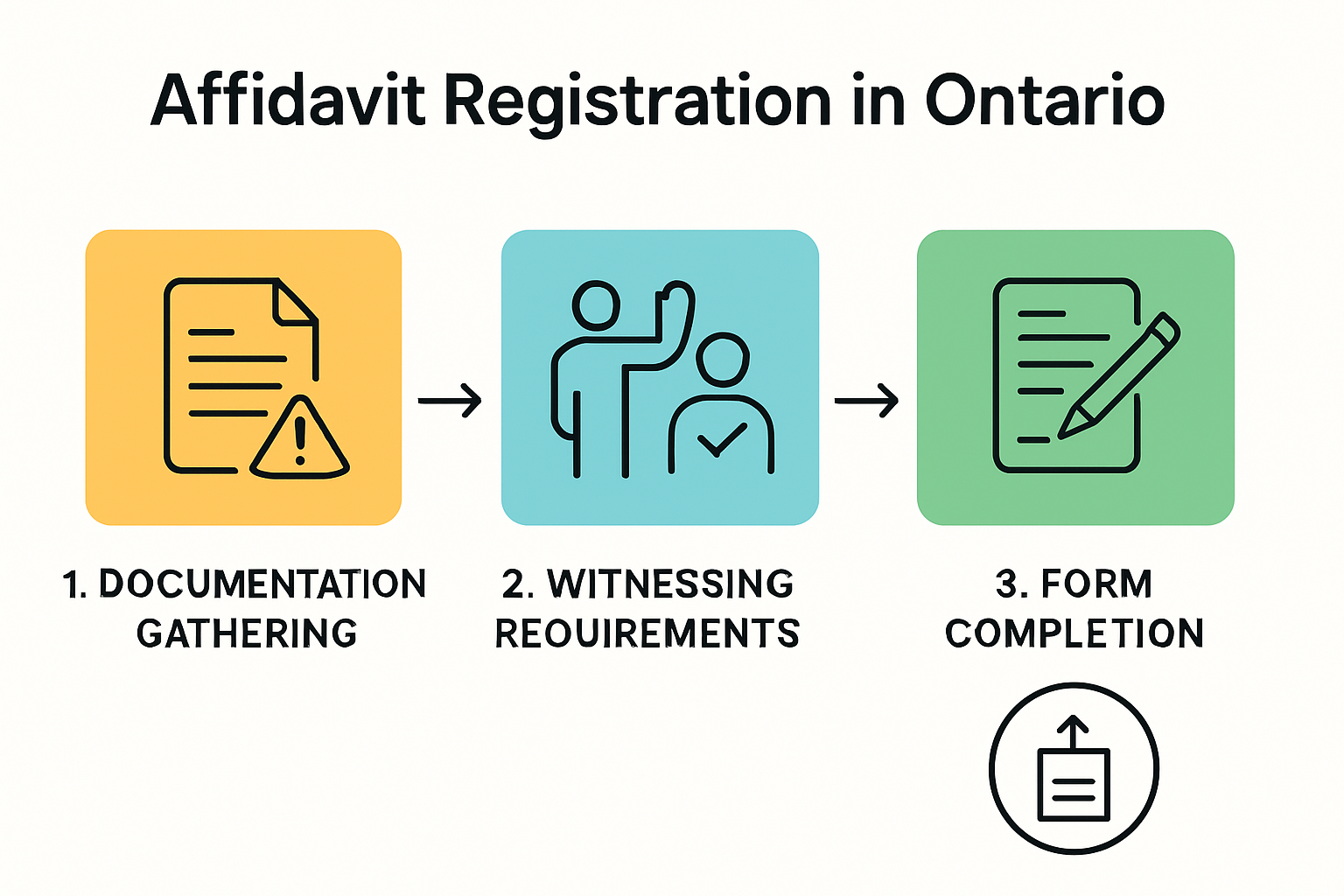
Navigating the affidavit registration process in Ontario requires careful attention to detail and a systematic approach. Residents must follow a precise sequence of steps to ensure their document is legally valid and properly registered.
To help you navigate Ontario’s affidavit registration process, here’s a step-by-step summary highlighting each stage and its key requirements.
| Step | Description | Key Requirements |
|---|---|---|
| Preparation | Gather all documentation and identity proof | Government-issued ID, supporting docs, info verification |
| Appointment | Book meeting with notary public or commissioner | Schedule and prepare necessary paperwork |
| Verification | Present documents for official identification | Bring originals, ensure accuracy |
| Signing & Witnessing | Sign affidavit in presence of authorized professional | Sworn statement, witnessed signature |
| Submission & Payment | Submit paperwork and pay any fees | All forms, supporting docs, applicable fees |
| Final Review | Official reviews all documents for completeness | Check signatures, data accuracy, legal compliance |
Preparing Your Affidavit Documentation
Before beginning the registration process, gather all necessary documentation. Explore our comprehensive notarization guide to understand the preliminary requirements. The preparation stage involves several critical components:
- Personal Identification: Collect valid government issued photo identification
- Supporting Documents: Compile all relevant supplementary materials
- Information Verification: Ensure all personal and factual details are accurate and current
According to the Ontario Government Registration Guidelines, documentation must be complete and precisely formatted. This means including full legal names, addresses, and any supporting evidence required for your specific type of affidavit.
Official Registration Procedures
The registration process involves multiple critical steps that must be executed with precision. Begin by scheduling an appointment with a licensed commissioner or notary public who can officially witness and authenticate your document. These professionals play a crucial role in verifying your identity and the accuracy of your sworn statement.
As outlined in Ontario’s Land Registration Guidelines, the verification process requires:
- Presenting original identification documents
- Signing the affidavit in the presence of an authorized official
- Paying the required registration fees
- Submitting all necessary supporting documentation
Final Verification and Submission
The final stage of registration involves a comprehensive review of your submitted documents. An authorized official will carefully examine the affidavit to ensure all requirements are met. This includes checking the accuracy of personal information, verifying the signatures, and confirming that all legal standards have been satisfied.
Pay close attention to specific requirements for your particular type of affidavit. Some registration processes may require additional steps or specialized forms depending on the nature of your document. Professional guidance can help navigate these nuanced requirements and prevent potential delays or rejections.
Remember that each step in the registration process is designed to protect the legal integrity of your document. Patience, attention to detail, and thorough preparation are key to successfully registering an affidavit in Ontario. Consulting with a professional notary or legal expert can provide additional guidance tailored to your specific situation.
Key Forms and Documents Needed in 2025
Preparing for affidavit registration in Ontario requires a comprehensive understanding of the essential forms and documents required in 2025. Residents must carefully compile and organize their paperwork to ensure a smooth and successful registration process.
Primary Identification and Personal Documentation
The foundation of any affidavit registration begins with robust personal documentation. Learn more about document certification requirements to ensure you have the correct materials. Key documents include:
- Government Issued Photo ID: Valid passport, driver’s license, or provincial identification card
- Proof of Address: Recent utility bill, bank statement, or government correspondence
- Original Birth Certificate: For verification of personal details
According to ServiceOntario’s 2025 guidelines, digital certification processes have expanded, requiring precise and up-to-date documentation. Applicants must ensure all identifying documents are current and match the information provided in the affidavit.
Specific Affidavit Registration Forms
Different types of affidavits require specific forms tailored to their purpose. The most commonly used forms in 2025 include:
- Form 14A: General Affidavit used in family law proceedings
- Form 16B: Affidavit of Service for legal document service confirmation
- Form 93007: Special affidavit for documents signed with a mark or in foreign characters
The International Registration Plan highlights the importance of precise documentation, especially for commercial or cross-jurisdictional registrations. Each form must be completed with meticulous attention to detail, ensuring all information is accurate and verifiable.
Supporting Documentation and Additional Requirements
Beyond primary forms, additional supporting documents may be necessary depending on the specific type of affidavit. These might include:
- Marriage certificates
- Divorce decrees
- Property ownership documents
- Professional certification records
- Legal correspondence related to the affidavit’s purpose
It is crucial to consult with a professional notary or legal expert to determine the exact documentation required for your specific situation. Each type of affidavit may have unique supporting document requirements that can vary based on its intended use.
In 2025, Ontario continues to modernize its registration processes, with an increasing emphasis on digital documentation and verification. Residents should stay informed about the latest requirements and be prepared to provide comprehensive and accurate documentation. Thorough preparation and attention to detail are key to successfully navigating the affidavit registration process in Ontario.

Common Mistakes and How to Avoid Them
Registering an affidavit in Ontario requires precision and careful attention to detail. Even minor errors can significantly impact the legal validity of your document, potentially causing delays or outright rejection of your registration.
Here’s a quick checklist table of the most common documentation and procedural mistakes when registering an affidavit in Ontario, so you can double-check before submission.
| Mistake Type | Common Error Example | Can Cause Rejection? |
|---|---|---|
| Documentation | Mismatched names across documents | Yes |
| Identification | Using expired photo ID | Yes |
| Supporting Documents | Missing supplementary paperwork | Yes |
| Content/Factual | Including speculation or opinions | Yes |
| Content/Factual | Using absolute statements (“always”, “never”) | Yes |
| Procedural | Not signing in presence of authorized commissioner | Yes |
| Procedural | Missing notary/public officer stamp/certification | Yes |
Documentation and Identification Errors
One of the most frequent mistakes involves improper documentation and identification management. Learn more about avoiding documentation pitfalls to ensure a smooth registration process. Critical errors to avoid include:
- Mismatched Personal Information: Ensuring all names and details exactly match across all submitted documents
- Expired Identification: Using outdated government issued photo identification
- Incomplete Supporting Documentation: Failing to provide all required supplementary materials
According to Supreme Court of British Columbia’s legal guidelines, maintaining clarity and precision in documentation is paramount. Even minor discrepancies can compromise the entire registration process.
Content and Factual Representation Mistakes
The substantive content of an affidavit demands meticulous attention. As outlined by Family Law in BC, several critical mistakes can undermine your document’s credibility:
- Avoid using absolute terms like ‘always’ or ‘never’
- Provide specific, verifiable details
- Stick strictly to facts within direct personal knowledge
- Eliminate speculation or personal opinions
The Khaki Law recommendations emphasize that including hearsay or irrelevant information can significantly weaken an affidavit’s legal standing. Professional notaries recommend drafting statements that are objective, concise, and directly relevant to the matter at hand.
Procedural and Witnessing Errors
Procedural mistakes during the affidavit registration can invalidate your entire document. Common errors include:
- Failing to sign the document in the presence of an authorized commissioner
- Not providing original signatures
- Incomplete or incorrect form completion
- Missing required notary stamps or certifications
Ontario’s legal system maintains strict standards for document authentication. Each step of the registration process requires careful execution. Consulting with a professional notary can help navigate these complex procedural requirements and minimize the risk of errors.
Remember that an affidavit is a legal document under oath. Every statement must be accurate, every form meticulously completed, and every procedural requirement precisely followed. Taking time to review and double-check your documentation can save significant time and prevent potential legal complications in the future.
Frequently Asked Questions
What are the requirements for registering an affidavit in Ontario?
To register an affidavit in Ontario, you need to provide valid government-issued photo identification, a sworn declaration signed in the presence of an authorized commissioner or notary public, and accurate personal details within the affidavit.
What forms are needed for affidavit registration in Ontario in 2025?
In 2025, the most commonly used forms for affidavit registration include Form 14A for general affidavits in family law and Form 16B for affidavit of service. Each form has specific requirements, so it’s important to ensure you are using the correct one.
How can I avoid common mistakes when registering my affidavit in Ontario?
To avoid common mistakes, ensure that all personal information matches across documents, use current identification, provide complete supporting documentation, and follow the procedural requirements for witnessing and signing the affidavit correctly.
Why is professional verification important in the affidavit registration process?
Professional verification is crucial because it ensures that your identity is authenticated and that the affidavit meets all legal requirements. An authorized commissioner or notary public plays a vital role in this process, adding credibility to your document.
Avoid Costly Affidavit Mistakes in Ontario—Get It Right the First Time
Did you know that most affidavit registrations in Ontario fail because of simple errors like missing verification or expired identification? The steps you read about are crucial, but even a small oversight can lead to rejection and delay. Let us handle the complexity for you so you never have to second-guess a single requirement or face wasted time.

Protect yourself from rejection and make affidavit registration stress-free. Our online notary services for Ontario affidavits ensure every step is compliant with updated 2025 standards. Whether you need help with sworn declarations, statutory declarations, or invitation letters, our professionals guide you through secure, error-free processing from start to finish. Visit https://theonlinentoary.ca now and book your session. Fast turnaround saves you time—get your affidavit registered the right way today.
Recommended
- Everything You Need to Know About Online Notarization in Ontario: Fast, Legal, and Convenient for Affidavits and Declarations (2025) – The Online Notary CA
- How to Get an Affidavit Online in Ontario 2025 – The Online Notary CA
- The Complete Guide to Using an Online Notary Public for Affidavits and Declarations in Ontario (2025) – The Online Notary CA
- How to Notarize Documents in Ontario: Easy 2025 Guide – The Online Notary CA