
Trying to get your paperwork notarized in Ontario can feel confusing. Nearly 80 percent of legal documents rejected for international use are due to improper notary selection. You might assume all notaries are basically the same and only stamp your documents, right? Actually, picking the wrong type of notary could mean your most critical documents become legally useless—and that surprise is what trips up so many people in Ontario.
Table of Contents
- Understanding Public Vs Private Notaries
- How Notary Services Work In Ontario
- When To Choose A Public Or Private Notary
- Costs And Legal Validity For Ontario Residents
Quick Summary
| Takeaway | Explanation |
|---|---|
| Public notaries have broader powers | They can authenticate documents for both domestic and international use and perform complex legal tasks beyond mere verification. |
| Private notaries have limited authority | They primarily witness sworn statements within a restricted legal context, making them suitable for routine documentation. |
| Choose a public notary for complex documents | For international transactions or significant legal documentation, public notaries provide higher legal credibility and assurance of acceptance. |
| Cost differences vary by notary type | Public notaries typically charge more due to their extensive legal authority, whereas private notaries are often more affordable. |
| Legal validity hinges on document type | For critical legal papers, ensure to select a notary that meets the specific authentication requirements of the document. |
Understanding Public vs Private Notaries
Navigating the legal landscape of document authentication in Ontario requires a clear understanding of notarial services. Public and private notaries play distinct roles in certifying documents, each with unique responsibilities and legal authorities.
The Legal Framework of Notarial Services
In Ontario, the distinction between public and private notaries is more than just a bureaucratic technicality. According to the Ontario Ministry of the Attorney General, a public notary is an official appointed with specific legal powers to witness and authenticate documents. These professionals are granted authority by the provincial government to perform crucial legal functions that extend beyond simple document verification.
Public notaries have broader certification powers compared to private notaries. They can witness signatures, administer oaths, and certify true copies of original documents for use both within and outside Ontario. This makes them essential for individuals and businesses requiring official document authentication for legal, governmental, or international purposes.
Differences in Scope and Authority
Private notaries, in contrast, have more limited capabilities. While they can witness certain documents, their legal authority is significantly more restricted. Most private notaries are commissioners for taking affidavits, which means they can primarily witness sworn statements and declarations within a more confined legal framework.
The key differentiator lies in the official appointment and recognition. Public notaries undergo rigorous training and background checks to ensure they can handle sensitive legal documentation with the highest level of professionalism. Experts in legal documentation emphasize that the public notary’s seal carries significant weight in legal and administrative contexts.
Practical Implications for Ontario Residents
For Ontario residents, understanding these differences is crucial when seeking document authentication. Certain critical documents such as international travel documents, property transfers, and legal affidavits often require the specific expertise of a public notary. Check out our guide on understanding notarial services to learn more about when you might need a public versus a private notary.
Businesses and individuals must carefully consider their specific documentation needs. A public notary provides a higher level of legal assurance and wider recognition, making them the preferred choice for complex or internationally relevant documents. Private notaries remain valuable for more routine local documentation requirements.
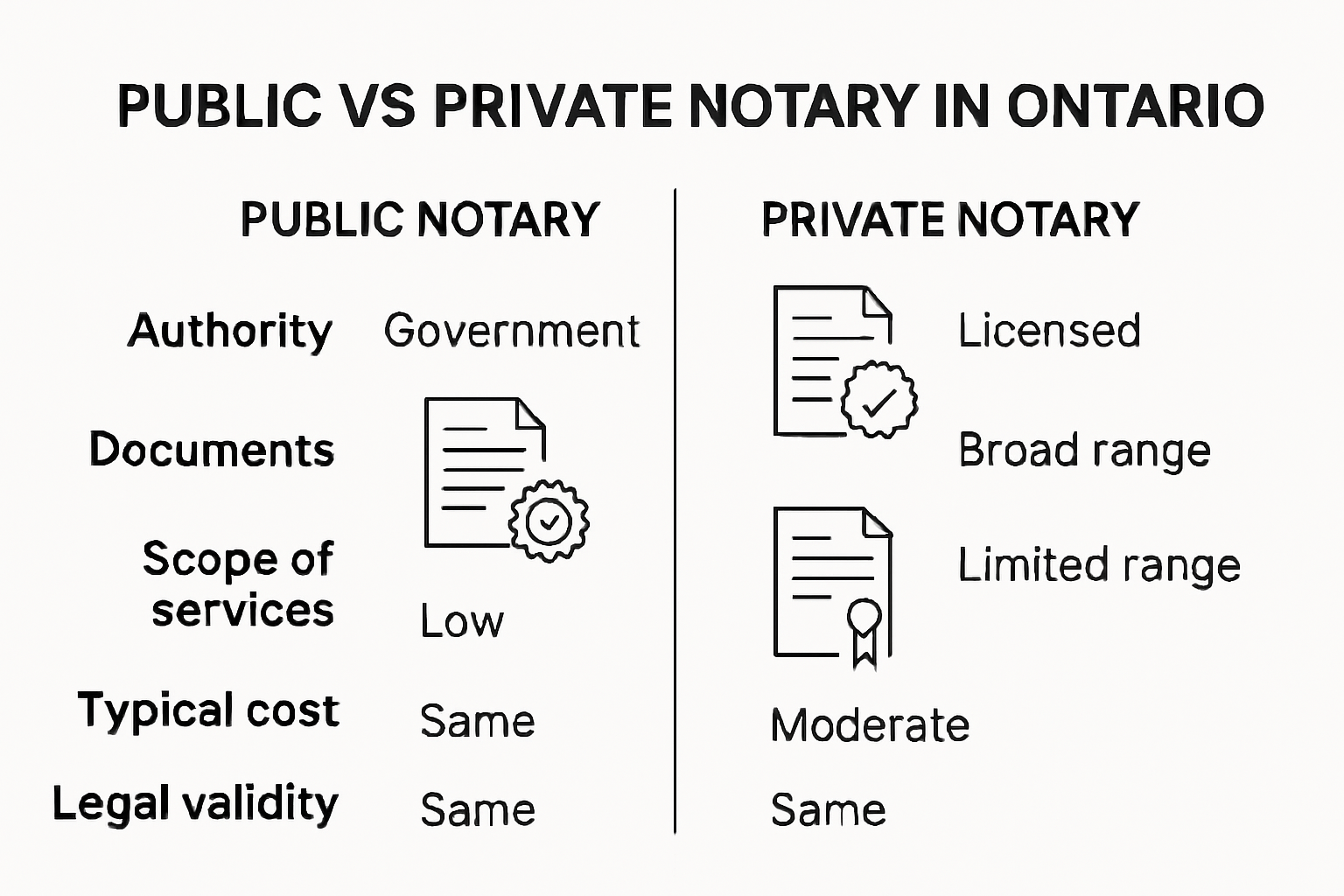
To help clarify the major differences between public and private notaries in Ontario, the following comparison table highlights their respective roles, authority, recommended use cases, and general cost range.
| Feature / Aspect | Public Notary | Private Notary |
|---|---|---|
| Scope of Authority | Broad (domestic & international) | Limited (mainly local) |
| Typical Use Cases | Complex, international, legal documents | Routine, domestic documentation |
| Legal Authorization | Appointed by provincial government; typically lawyers/paralegals | Often commissioners for taking affidavits |
| Recognition | High (widely accepted, incl. international) | Limited (primarily local/legal context) |
| Service Pricing | $50 – $150 per document; higher for complex | $25 – $75 per document |
| Examples of Documents | Immigration, cross-border real estate, international contracts | Affidavits, statutory declarations, domestic powers of attorney |
Ultimately, the choice between a public and private notary depends on the specific legal context, the document type, and the intended use. By understanding these nuanced differences, Ontario residents can make informed decisions about their document authentication needs.
How Notary Services Work in Ontario
Notary services in Ontario operate within a structured legal framework designed to ensure document authenticity and legal compliance. Understanding the intricacies of these services is crucial for individuals and businesses seeking reliable document certification.
Legal Authorization and Appointment Process
According to the Ontario Ministry of the Attorney General, notaries public in Ontario are officially appointed professionals with specific legal mandates. The appointment process involves rigorous screening and requires individuals to meet stringent professional standards. The Law Society of Ontario oversees the licensing and professional conduct of notaries, ensuring that only qualified professionals can provide these critical legal services.
To become a notary public in Ontario, candidates must typically be lawyers or paralegals with good standing in the legal community. This requirement guarantees that notaries possess comprehensive legal knowledge and understand the nuanced responsibilities associated with document authentication. The appointment process includes background checks, professional references, and a thorough review of the candidate’s legal expertise.
Document Authentication Procedures
The core function of notary services involves verifying the identity of document signers and confirming the authenticity of signatures. Notaries follow a systematic approach to document certification. This process typically includes:
Below is a summary table outlining the typical notary process in Ontario, showing the main steps involved in document authentication for better understanding.
| Step | Description |
|---|---|
| Identity Verification | Checking government-issued photo ID |
| Signature Witnessing | Observing the actual signing of documents |
| Certificate of Authentication | Applying official seal and notary signature |
| Recordkeeping | Maintaining transaction logs for legal audit trail |
- Identity Verification: Examining government issued photo identification
- Signature Witnessing: Observing the actual signing of documents
- Certificate of Authentication: Applying an official seal and signature to validate the document
Notaries must maintain meticulous records of each transaction, ensuring a clear audit trail for legal purposes. Learn more about the detailed process of document notarization, which provides comprehensive insights into the steps involved.
Specialized Notarial Services
Ontario notaries offer specialized services beyond standard document authentication. These include administering oaths, certifying true copies of original documents, and providing legal attestations for various purposes such as international travel documents, property transfers, and business agreements.
The complexity of notarial services requires professionals to stay updated on legal requirements and maintain a high standard of professional conduct. Notaries must be impartial witnesses, ensuring the integrity of the documents they handle. Their role extends beyond mere signature witnessing to providing a critical layer of legal verification that helps prevent fraud and ensures document reliability.
Businesses and individuals rely on notary services for critical legal documentation, making the profession an essential component of Ontario’s legal infrastructure. From real estate transactions to immigration documents, notaries play a pivotal role in authenticating important legal paperwork, providing peace of mind and legal certainty in an increasingly complex documentation landscape.
When to Choose a Public or Private Notary
Choosing between a public and private notary in Ontario depends on specific document requirements, legal context, and intended use. Understanding the nuanced scenarios where each type of notary is most appropriate can save time, prevent legal complications, and ensure document authenticity.
International and Complex Legal Documents
According to Canadian legal resources, public notaries are recommended for documents requiring international recognition or complex legal authentication. These professionals possess broader certification powers critical for scenarios such as:
- Immigration paperwork
- International business contracts
- Real estate transactions involving cross-border elements
- Academic credential verifications
Public notaries provide a higher level of legal credibility, making their certification particularly valuable when documents must be recognized across different jurisdictions. Their official seal and comprehensive training ensure that international entities will accept the documentation without additional verification.
Domestic and Routine Documentation
For local, routine documentation, private notaries often suffice. Explore our comprehensive guide on notary verification to understand the nuanced differences in document authentication. Private notaries are suitable for:
- Local affidavits
- Statutory declarations
- Power of attorney documents for domestic purposes
- Simple contract witnessing
In Ontario, power of attorney documents represent a classic example where a private notary can effectively manage authentication. These documents typically require local legal recognition and do not necessitate the extensive certification a public notary provides.
Specialized Scenarios and Professional Recommendations
Certain professional environments demand specific notarial approaches. Government agencies, international corporations, and legal institutions often have precise requirements for document authentication. Professionals in these sectors should consider:
- Consulting with their organizational legal department
- Verifying specific documentation requirements
- Understanding jurisdiction-specific authentication protocols
Individuals working in sectors like international trade, immigration, or legal services should prioritize public notaries. Their comprehensive training and broader legal authorization ensure that critical documents meet the most stringent verification standards.
Ultimately, the choice between a public and private notary hinges on the document’s purpose, intended use, and required level of legal authentication. While public notaries offer more comprehensive certification, private notaries remain valuable for routine, locally focused documentation needs. Carefully evaluating the specific requirements of your document will guide you toward the most appropriate notarial service in Ontario.
Costs and Legal Validity for Ontario Residents
Understanding the financial implications and legal standing of notarial services is crucial for Ontario residents seeking document authentication. The costs and legal validity of notary services vary significantly between public and private notaries, impacting both individual and business document certification needs.
Pricing Structure and Cost Considerations
According to official Ontario government resources, notary service pricing is not standardized, creating variation in costs across different providers. Public notaries typically charge higher rates due to their extensive legal authorization and comprehensive authentication processes. These fees reflect the professional expertise and broader legal recognition they provide.
Explore affordable online notary options to understand the range of pricing available. Private notaries often offer more budget-friendly rates, making them attractive for routine, local documentation. The cost difference stems from the varying levels of legal complexity and certification required for different document types.
Typical cost ranges include:
- Public Notary: $50 – $150 per document
- Private Notary: $25 – $75 per document
- Complex International Documents: $100 – $250
Legal Validity and Authentication Standards
The Canada Revenue Agency emphasizes the critical importance of proper document authentication. Public notaries provide the highest level of legal validity, with their certification carrying significant weight in legal, governmental, and international contexts.
Legal validity depends on several factors:
- Professional credentials of the notary
- Specific authentication requirements
- Intended use of the document
- Jurisdictional recognition standards
Public notaries offer a more comprehensive authentication process, ensuring documents meet stringent legal standards. Their official seal and comprehensive verification provide an additional layer of legal protection that private notaries cannot match.
Strategic Considerations for Document Certification
Ontario residents must carefully evaluate their specific documentation needs. While cost is an important factor, the legal validity of the document should be the primary consideration. International documents, legal agreements, and official government paperwork typically require the more robust certification provided by public notaries.
Historically, notarial services trace back to ancient Roman practices, highlighting the long-standing importance of document authentication. Modern Ontario residents benefit from a sophisticated notarial system that balances accessibility with legal rigor.
Businesses and individuals should consider:
- The document’s intended use
- Jurisdictional requirements
- Long-term legal implications
- Potential future verification needs
Ultimately, choosing between a public and private notary involves balancing cost, legal validity, and specific documentation requirements. While public notaries offer more comprehensive certification, the additional expense may not be necessary for all document types. Careful assessment of individual needs will guide the most cost-effective and legally sound approach to document authentication in Ontario.

Frequently Asked Questions
What is the difference between a public and private notary in Ontario?
Public notaries have broader legal authority and can authenticate documents for both domestic and international use, while private notaries are limited to witnessing local affidavits and declarations.
When should I choose a public notary instead of a private notary?
You should choose a public notary for complex or international legal documents, such as immigration papers, real estate transactions involving cross-border elements, and international business contracts.
How much does it typically cost to hire a public or private notary in Ontario?
Public notaries generally charge between $50 to $150 per document, while private notaries charge between $25 to $75 for routine documentation.
What types of documents require the services of a public notary?
Documents that typically require a public notary include immigration paperwork, international contracts, property transfers, and legal affidavits that necessitate broader legal recognition.
Simplify Document Notarization With Trusted Online Solutions
Are you worried about choosing the right notary service in Ontario? Many people face the same challenge. Selecting between a public and private notary for critical documents can leave you stressed about legal validity and unexpected costs. If you are dealing with affidavits, statutory declarations, or invitation letters, clarity and confidence are essential. That is why our online platform bridges this gap by ensuring you get the correct notarial authority for your situation—all from the comfort of your home.

Take the uncertainty out of your next notarization. Our team provides reliable and fully recognized online notary services for Ontario. Whether you need help with affidavits or complex statutory declarations, we are ready to guide you through the authentication process quickly and securely. Do not risk costly rejection or delays—get your documents notarized online today and move forward with confidence.
Recommended
- Notary Public vs Lawyer in Ontario: Key Differences for 2025 – The Online Notary CA
- How to Verify Notary in Ontario: Step-by-Step Guide 2025 – The Online Notary CA
- Understanding the Notary Public Role in Ontario 2025 – The Online Notary CA
- What Does a Notary Do in Ontario? 2025 Guide – The Online Notary CA