
Affidavits and statutory declarations sound like dry paperwork, but they shape real decisions in courtrooms, banks, and government offices every day. People are often surprised to learn that providing false information in an affidavit or statutory declaration can actually lead to criminal charges for perjury and even imprisonment. Many assume these documents are mere formalities, yet they carry legal power that can change lives—one sentence at a time.
Table of Contents
- Defining Affidavit And Statutory Declaration
- The Importance Of Affidavits And Statutory Declarations
- Key Differences Between Affidavits And Statutory Declarations
- Common Uses And Applications In Ontario
- Legal Implications And Enforcements
Quick Summary
| Takeaway | Explanation |
|---|---|
| Affidavits require sworn oaths. | Affidavits are legally binding declarations made under oath, ensuring the truthfulness of statements. |
| Statutory declarations lack religious oaths. | Unlike affidavits, statutory declarations affirm truthfulness without a sworn oath, often used in administrative contexts. |
| Legal consequences for falsehoods exist. | Providing false information in either document can lead to serious penalties, including charges for perjury. |
| Affidavits are preferred in court. | Affidavits carry more legal weight in judicial settings compared to statutory declarations, which are used in less formal situations. |
| Use for identity and verification. | These documents are essential for proving identity, verifying credentials, and facilitating various administrative processes. |
Defining Affidavit and Statutory Declaration
In legal and administrative contexts, affidavits and statutory declarations serve critical roles as written statements that communicate important information. While they might seem similar, these documents have distinct characteristics, purposes, and legal implications that set them apart.
What is an Affidavit?
An affidavit is a formal written statement of facts voluntarily made under an oath or solemn affirmation, typically signed in the presence of an authorized official such as a notary public, commissioner for oaths, or lawyer. The key distinguishing feature of an affidavit is that the person making the statement swears or affirms its truthfulness, understanding that providing false information could result in legal penalties for perjury.
Key characteristics of an affidavit include:
- Sworn under oath or affirmation
- Legally binding document
- Used in court proceedings and legal contexts
- Requires signature of the declarant and witnessing by an authorized official
What is a Statutory Declaration?
A statutory declaration is a formal statement made in writing, typically used in non-court settings, where the declarant affirms the truthfulness of the information without taking a religious oath. This document is declared before an authorized person such as a lawyer, notary, or commissioner, but does not involve the same level of sworn testimony as an affidavit.
Unique aspects of a statutory declaration include:
- Declared as true without religious oath
- Often used for administrative or bureaucratic purposes
- Carries legal weight through statutory authority
- Provides a formal method of confirming information
If you want to learn more about legal document verification in Ontario, our comprehensive guide offers additional insights into the notarization process.
The Importance of Affidavits and Statutory Declarations
Affidavits and statutory declarations play pivotal roles in legal, administrative, and personal documentation processes. These formal written statements provide critical mechanisms for individuals and organizations to communicate verified information with legal credibility and official recognition.
Legal Verification and Credibility
Both affidavits and statutory declarations serve as powerful tools for establishing the authenticity of information. Legal systems rely on these documents to create a verifiable record of facts, ensuring that statements can be trusted and potentially used as evidence in various contexts. Unlike verbal statements, these written documents carry significant weight because they require the declarant to confirm the truthfulness of their statements under potential legal consequences.

Key legal advantages include:
- Creating an official record of facts
- Providing a legally recognized method of communication
- Establishing personal accountability for information
- Reducing potential disputes through formal documentation
Practical Applications in Different Contexts
The utility of affidavits and statutory declarations extends across numerous professional and personal scenarios. From immigration processes and property transactions to employment verifications and personal identity confirmations, these documents offer a standardized method of communicating critical information.
Common scenarios where these documents are essential include:
- Proving identity and personal circumstances
- Supporting legal proceedings
- Verifying educational or professional credentials
- Facilitating administrative processes
If you are interested in understanding the process of commissioning legal documents online, our comprehensive guide provides detailed insights into modern documentation practices.
According to the European Patent Office, these documents are recognized as admissible forms of evidence, highlighting their importance in formal and legal contexts. By providing a structured and accountable method of declaring information, affidavits and statutory declarations continue to be essential tools in maintaining legal and administrative integrity.
Key Differences Between Affidavits and Statutory Declarations
While affidavits and statutory declarations might appear similar at first glance, they possess distinct characteristics that significantly impact their legal application, preparation, and use across various contexts. Understanding these nuanced differences is crucial for selecting the appropriate document for specific legal and administrative requirements.
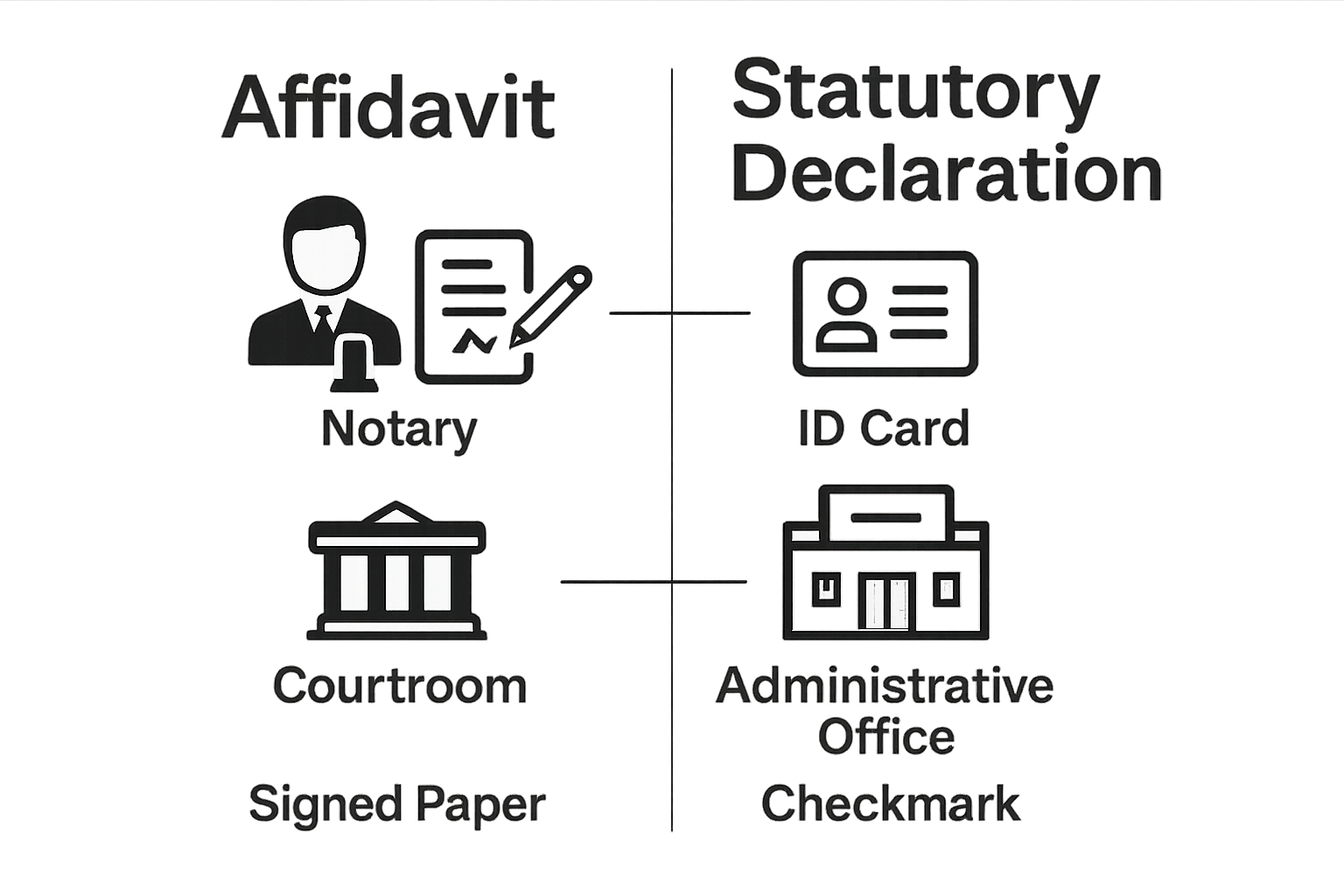
Legal Formality and Oath Requirements
The primary distinction between affidavits and statutory declarations lies in their method of validation. An affidavit requires a formal oath or solemn affirmation, typically administered by an authorized official such as a notary public or commissioner for oaths. The deponent swears to the truthfulness of the statement, understanding that providing false information could result in legal penalties for perjury.
Key differences in legal formality include:
- Affidavits involve a sworn oath or affirmation
- Statutory declarations are simply declared as true
- Affidavits carry higher legal weight in court proceedings
- Statutory declarations are more flexible in administrative contexts
Scope and Application
The usage of these documents varies significantly across different legal and administrative domains. Affidavits are predominantly used in court proceedings, legal investigations, and formal legal documentation where a high level of verifiable truth is required. Statutory declarations, by contrast, are more commonly employed in administrative, bureaucratic, and personal documentation scenarios that do not necessarily demand the same level of judicial scrutiny.
To help clarify the core distinctions and proper use of each document, the following table compares key aspects of affidavits and statutory declarations as detailed in the article.
| Aspect | Affidavit | Statutory Declaration |
|---|---|---|
| Definition | Formal written statement made under oath or affirmation | Formal written statement declared true without a religious oath |
| Oath Requirement | Requires a sworn oath or affirmation | No oath; only a formal declaration of truth |
| Legal Weight | Higher, preferred in court proceedings | Lower, mainly for administrative uses |
| Common Uses | Court evidence, legal investigations, judicial proceedings | Identity verification, administrative processes, personal docs |
| Witnessing Official | Notary public, commissioner for oaths, or lawyer | Commissioner, lawyer, or notary public |
| Legal Consequences | False statements can lead to perjury charges and imprisonment | False statements can lead to criminal charges and penalties |
| Jurisdictional Preference | Frequently used in courts and legal settings | Mostly used in non-court and administrative contexts |
Typical application scenarios differ as follows:
- Affidavits: Court evidence, legal testimonies, complex legal matters
- Statutory declarations: Identity verification, administrative processes, personal documentation
- Affidavits require more rigorous authentication
- Statutory declarations offer more administrative flexibility
According to United States Department of State documentation, an affidavit represents a written declaration confirmed by the oath or affirmation of the party making it, underscoring its critical role in legal documentation.
If you want to explore online notarization options for these documents, our comprehensive guide provides detailed insights into modern legal documentation practices.
Common Uses and Applications in Ontario
In Ontario, affidavits and statutory declarations play crucial roles across various personal, professional, and legal domains. These documents provide essential mechanisms for individuals and organizations to communicate verified information with legal credibility and official recognition.
Legal and Administrative Contexts
Affidavits and statutory declarations are fundamental tools in Ontario’s legal and administrative landscape, serving multiple critical functions. From court proceedings to government applications, these documents offer a structured approach to providing verifiable information. Legal professionals and government agencies rely on these documents to establish facts, verify identities, and support various administrative processes.
Key legal and administrative applications include:
- Immigration and citizenship documentation
- Property transfer and real estate transactions
- Court evidence and legal testimonies
- Government benefit applications
- Professional credential verifications
Personal and Professional Scenarios
Beyond formal legal contexts, these documents are extensively used in personal and professional scenarios across Ontario. Individuals might require affidavits or statutory declarations for various life events and administrative needs, such as name changes, proving marital status, or verifying educational qualifications.
The following table summarizes the main areas where affidavits and statutory declarations are utilized in Ontario, organized by legal, administrative, personal, and professional contexts for easier reference.
| Application Context | Examples of Use |
|---|---|
| Legal/Judicial | Court evidence, legal testimonies, property transfer |
| Government/Administrative | Immigration, citizenship, benefit applications, real estate |
| Professional/Employment | Verifying credentials, employment background checks |
| Personal/Individual | Name changes, proving marital status, verifying education |
| Financial/Insurance | Facilitating transactions, verifying claims or personal details |
| Legal Self-Representation | Supporting documents in small claims, notarized statements |
| Online/Remote Services | Using online notary services for documentation |
Common personal and professional use cases involve:
- Confirming personal identity and circumstances
- Supporting employment background checks
- Verifying educational credentials
- Facilitating financial and insurance processes
- Resolving personal legal matters
According to the Canada Defence Department, these documents serve as critical tools for establishing and confirming factual information across various administrative contexts.
If you are interested in exploring professional online notary services, our comprehensive guide provides detailed insights into modern documentation practices in Ontario.
Legal Implications and Enforcements
The legal framework surrounding affidavits and statutory declarations involves complex mechanisms of accountability, verification, and potential consequences for misrepresentation. Understanding these implications is crucial for anyone preparing or relying on these critical legal documents.
Penalties for False Statements
Legal systems impose significant penalties for providing false information in affidavits and statutory declarations. The consequences extend beyond simple administrative rejection, potentially involving criminal charges for intentional misrepresentation. The severity of these penalties underscores the importance of absolute truthfulness when creating these documents.
Key legal consequences include:
- Criminal charges for perjury
- Potential imprisonment for deliberate false statements
- Substantial financial penalties
- Potential loss of professional credentials
- Invalidation of related legal proceedings
Evidentiary Weight and Legal Recognition
Affidavits and statutory declarations carry different levels of evidentiary weight in legal proceedings. An affidavit, being sworn under oath, typically holds more legal significance compared to a statutory declaration. Courts and legal institutions carefully evaluate these documents, considering factors such as the credibility of the declarant, the specificity of statements, and the context of the declaration.
Important considerations for legal recognition involve:
- Verification of the declarant’s identity
- Consistency and specificity of statements
- Professional credentials of the witnessing official
- Compliance with jurisdictional legal requirements
- Potential cross examination in legal proceedings
According to the Supreme Court of Canada, these documents represent critical mechanisms for establishing factual information with potential legal ramifications.
If you want to explore professional online notary services that ensure legal compliance, our comprehensive guide provides detailed insights into modern documentation practices.
Make Your Next Affidavit or Statutory Declaration Simple and Secure in Ontario
If you are feeling overwhelmed by the differences between an affidavit and a statutory declaration, you are not alone. The article highlighted how confusing and stressful it can be to navigate legal documents, make sure your statements are correctly verified, and ensure you avoid costly mistakes or delays. Whether you are dealing with legal proceedings, immigration, or personal matters, accuracy and proper validation matter. That is why having a trusted professional notary who understands Ontario regulations can make all the difference.

You do not need to travel or wait in line to get documents notarized. With The Online Notary, you can access fast and secure online services for affidavits, statutory declarations, solemn declarations, and more. Our certified notaries guide you through each step, helping you avoid common errors and meet legal standards. Take action today by learning more about our online notary solutions in Ontario and ensure your paperwork is completed with confidence. Do not let uncertainty slow you down. Get your legal documents right the first time.
Frequently Asked Questions
What is the main difference between an affidavit and a statutory declaration?
An affidavit is a sworn statement made under oath, while a statutory declaration is a written statement declared as true without the need for a religious oath. Affidavits carry higher legal weight in court proceedings compared to statutory declarations.
When should I use an affidavit instead of a statutory declaration?
You should use an affidavit when you need to provide a sworn statement for court evidence, legal investigations, or situations where formal authentication is required. Statutory declarations are more appropriate for administrative purposes or non-court related documentation.
Are there legal consequences for false statements in affidavits and statutory declarations?
Yes, providing false information in either document can result in severe legal repercussions, including criminal charges for perjury, potential imprisonment, and financial penalties, depending on the jurisdiction and severity of the misrepresentation.
Do both affidavits and statutory declarations need to be witnessed?
Yes, both documents must be signed in the presence of an authorized official, such as a notary public or commissioner for oaths, to verify the identity of the declarant and to authenticate the document.