
Starting a business in Ontario sounds pretty straightforward. You just register a name and you are good to go, right? Not so fast. Every year, thousands of new Ontario businesses fail to get off the ground simply because they missed one of the required registration steps or misunderstood the rules. What might surprise you is that even something as basic as picking your business structure can change your tax obligations, legal protections, and the entire growth path of your company. There is way more to registration than most people realize and missing even a small detail could cost you time, money, or worse, your new business dream.
Table of Contents
- Step 1: Choose A Business Structure
- Step 2: Select A Unique Business Name
- Step 3: Register Your Business Name
- Step 4: Obtain Necessary Permits And Licenses
- Step 5: Register For Taxes And Get An Ein
Quick Summary
| Key Point | Explanation |
|---|---|
| 1. Choose an appropriate business structure | Your business structure determines legal responsibilities and financial obligations; evaluate sole proprietorships, partnerships, or corporations based on risk and goals. |
| 2. Ensure your business name is unique | A memorable and legally distinct name differentiates your brand; conduct thorough searches to avoid conflicts with existing businesses. |
| 3. Register your business properly | Complete the registration process through ServiceOntario with required documentation to establish your business legally and protect its name. |
| 4. Obtain necessary permits and licenses | Research and acquire required licenses relevant to your specific industry to comply with regulations and avoid legal issues. |
| 5. Register for taxes and obtain an EIN | Register with the Canada Revenue Agency for your Business Number and tax accounts, ensuring compliance with federal and provincial tax obligations. |
Step 1: Choose a Business Structure
Selecting the right business structure is a foundational decision that will impact your legal responsibilities, tax obligations, and operational flexibility when registering a business in Ontario. Your chosen structure determines how you manage personal liability, reporting requirements, and potential business growth strategies.
The primary business structures available in Ontario include sole proprietorship, partnership, and corporation. Each structure offers unique advantages and challenges that align differently with your entrepreneurial goals. Sole proprietorships represent the simplest option for individual entrepreneurs, providing complete control but exposing personal assets to potential business risks. This structure works best for small, low-risk businesses with minimal startup capital.
Partnerships offer an alternative for multiple individuals wanting to combine resources and expertise. In Ontario, you can establish general partnerships, where all partners share equal responsibility and liability, or limited partnerships, which provide more protective frameworks for some participants. Corporations stand as the most complex structure, offering the strongest personal liability protection. They exist as separate legal entities, which means the business can own property, enter contracts, and be sued independently of its owners.
When evaluating your business structure, consider several critical factors. Your potential business risk level plays a significant role in determining the most appropriate approach. High-risk ventures typically benefit from corporate structures that shield personal assets. Professional service providers like consultants, lawyers, or healthcare practitioners might prefer professional corporation formats that offer specialized legal protections.
Financial considerations are equally important. Sole proprietorships and partnerships generally have lower startup and maintenance costs, while corporations involve more complex registration processes and ongoing compliance expenses. Tax implications vary substantially between structures, with corporations potentially offering more strategic tax planning opportunities.
To make an informed decision, research each structure thoroughly and potentially consult with a local business advisor or lawyer who understands Ontario’s specific regulatory landscape. Verify your choice by confirming you understand the legal and financial implications, ensuring your selected structure aligns with your short and long-term business objectives.
Remember, your initial business structure is not permanently fixed. As your business evolves, you can transition between structures to accommodate changing needs and growth strategies. The key is selecting a foundation that provides the most appropriate balance of protection, flexibility, and operational efficiency for your specific entrepreneurial vision.
Below is a comparison of the primary business structures available in Ontario, outlining key features to help you decide which may be right for your business.
| Business Structure | Liability Protection | Startup/Compliance Cost | Tax Implications | Best For |
|---|---|---|---|---|
| Sole Proprietorship | Low | Low | Personal income tax | Individuals, small low-risk businesses |
| General Partnership | Low (shared) | Low | Personal income tax | Multiple owners sharing resources/skills |
| Limited Partnership | Varies | Moderate | Personal income tax | Investors seeking limited liability |
| Corporation | High | High | Corporate tax rates, more planning options | High-growth, higher-risk, or investor-backed businesses |
| Professional Corporation | High (specialized) | High | Corporate tax rates, special rules | Regulated professionals (law, health, etc) |
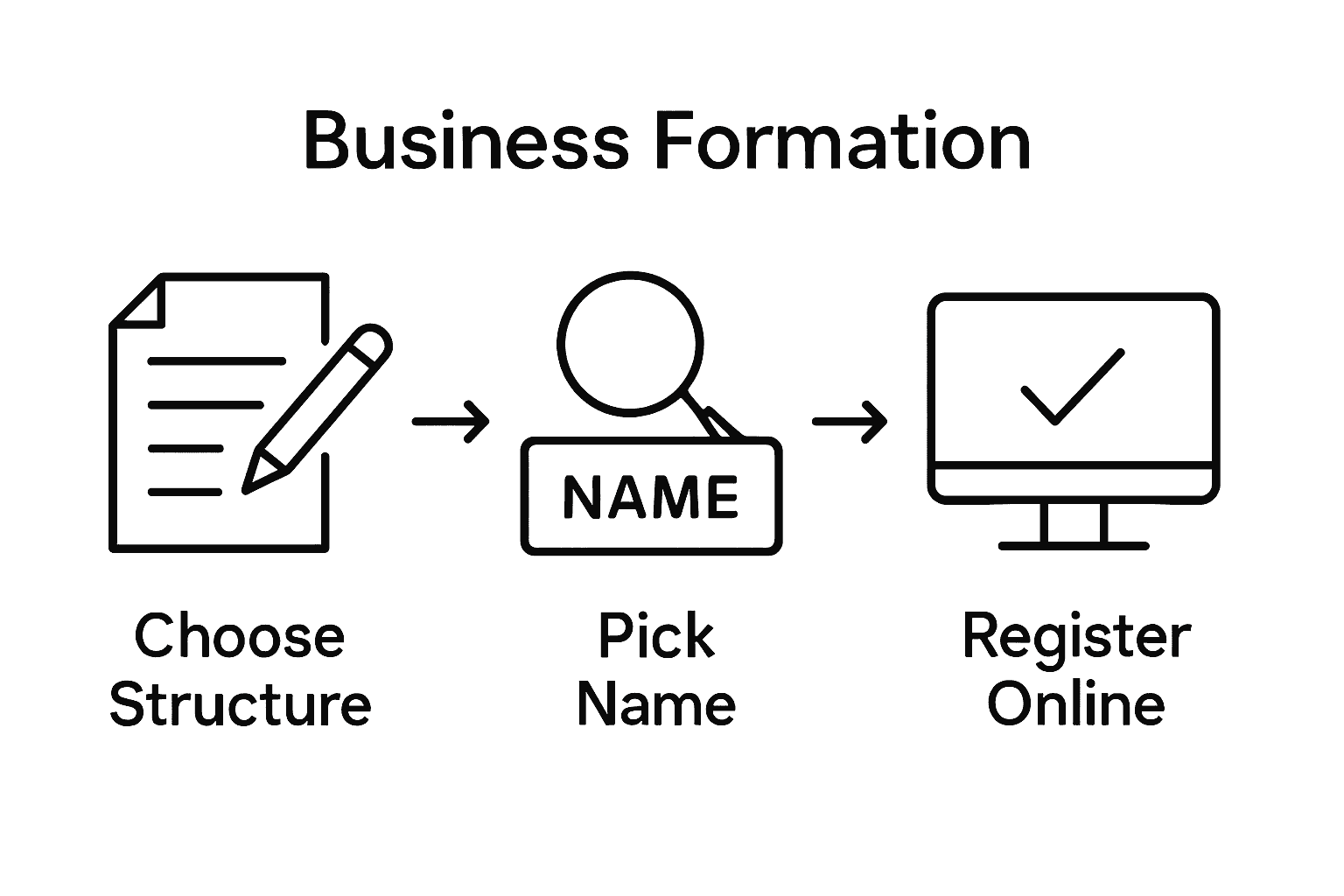
Step 2: Select a Unique Business Name
Choosing a unique business name represents a critical step in establishing your brand identity and legal presence in Ontario. Your business name serves as more than just an identifier it communicates your professional essence and differentiates you in the marketplace. The process requires careful consideration, creativity, and strategic thinking to ensure legal compliance and market appeal.
Begin by brainstorming names that reflect your business purpose, values, and target audience. Avoid generic or overly complicated names that might confuse potential customers. Your business name should be memorable, pronounceable, and aligned with your industry. Consider how the name sounds when spoken aloud, its potential abbreviations, and its visual representation on marketing materials.
Before finalizing your selection, conduct a comprehensive search to verify name availability. According to the Ontario business registration guidelines, you must ensure your proposed name is not already registered or too similar to existing business names. The NUANS (Newly Updated Automated Name Search) system provides an official database for checking name uniqueness. This search helps prevent potential legal conflicts and trademark disputes that could arise from inadvertently selecting a name already in use.
When evaluating potential names, consider several strategic factors. Linguistic clarity matters your name should translate well across different contexts and potentially avoid unintended meanings in multiple languages. Regional sensitivities and cultural appropriateness also play significant roles in name selection. Conduct informal focus groups or seek feedback from potential customers to gauge the name’s reception.
Once you have a shortlist of potential names, verify their domain name availability. In today’s digital landscape, having a matching web domain strengthens your brand consistency. Check domain registration platforms to confirm your preferred business name has an available corresponding website address. Some entrepreneurs opt to purchase similar domain variations to protect their brand and prevent potential confusion.
The final verification involves registering your chosen name with appropriate provincial authorities. In Ontario, this typically means submitting your selected name through official business registration channels. Be prepared to provide supporting documentation and potentially pay registration fees. Maintain copies of all name search and registration documents for your business records.
Remember that your business name is an investment in your brand’s future. Take time to select a name that not only meets legal requirements but also resonates with your target market and reflects your business’s unique value proposition.
Step 3: Register Your Business Name
Registering your business name represents a critical legal step that establishes your official business identity in Ontario. This process transforms your business concept from an idea into a recognized legal entity, providing essential protection and credibility for your entrepreneurial venture.
According to Ontario’s business registration guidelines, the registration process varies depending on your chosen business structure. Sole proprietorships and partnerships require different registration approaches compared to incorporated businesses. Your registration method directly impacts your legal and financial responsibilities.
For most small businesses in Ontario, the registration process begins with ServiceOntario, the provincial government’s online service platform. You will need to prepare several key documents before initiating the registration. These typically include your selected business name, proof of identity, business structure details, and potentially additional documentation specific to your industry or business type.
Gather essential documentation before starting your registration. This includes valid government issued photo identification, your comprehensive business plan, and any supporting financial records. Personal identification must match the name under which you plan to register the business. If you are registering a partnership, ensure all partners are prepared to provide their identification and consent.
The online registration process involves completing a series of detailed forms that capture your business’s fundamental information. You will be required to provide precise details about your business structure, ownership, contact information, and operational intent. Accuracy is paramount during this stage, as any inconsistencies could delay your registration or create future legal complications.
Financial preparation is crucial. Registration typically involves paying a processing fee, which varies based on your business structure and registration method. Some entrepreneurs opt for expedited processing, which comes with additional costs but can accelerate your business establishment timeline. Budget for these expenses and consider them as investments in your business’s legal foundation.
After submitting your registration, expect a processing period where provincial authorities review your application. Keep copies of all submitted documentation and your registration confirmation. This paperwork serves as critical evidence of your business’s legal status and may be required for future banking, taxation, and regulatory purposes.
Once registered, your business name receives legal protection within Ontario. This registration prevents other businesses from using an identical or confusingly similar name, providing a layer of brand security. Treat your registration certificate as a valuable document, storing it safely with your other critical business records.
Use this checklist to prepare all necessary documents and information before registering your business in Ontario to ensure a smooth and efficient process.
| Requirement | Description | When Needed |
|---|---|---|
| Chosen Business Name | Unique name confirmed via NUANS search | Before registration begins |
| Proof of Identity | Valid government-issued photo identification | All business structures |
| Business Structure Details | Outline of ownership, type, and structure | Before registration begins |
| Comprehensive Business Plan | Overview of business goals and operations | Recommended but optional |
| Supporting Financial Records | Proof of funds or statements (as applicable) | Sometimes required |
| Partner Identification and Consent | IDs and written consent for all partners | Partnerships only |
| Registration Fee | Payment method for ServiceOntario fees | During registration |
Step 4: Obtain Necessary Permits and Licenses
Obtaining the appropriate permits and licenses represents a crucial step in legally establishing your business in Ontario. This process ensures your business operates within regulatory frameworks, avoiding potential legal complications and demonstrating professional compliance. Different industries and business types require specific documentation, making thorough research essential.
According to the Ontario government’s business resources, permit requirements vary significantly across different sectors and municipal jurisdictions. Professional service providers, retail establishments, food service businesses, and construction companies each face unique licensing requirements. Your specific business type determines the complexity and number of permits you will need to acquire.
Begin by conducting comprehensive research specific to your industry and local municipality. Contact your local city or regional government offices to understand precise licensing requirements. Some businesses might require multiple permits from different government levels provincial, municipal, and federal. Professional consultation with a local business advisor can help navigate these intricate regulatory landscapes.
Financial and operational planning must account for permit acquisition costs. Licensing fees range from modest to substantial, depending on your business type and scale. Budget for both initial permit expenses and potential renewal costs. Some permits require annual renewal, while others might be one time investments. Maintain organized financial records documenting all permit related expenditures.
The permit application process typically involves submitting detailed business documentation, including your business registration papers, professional certifications, and potentially health and safety compliance documents. Prepare comprehensive application packages that demonstrate your business’s legitimacy and commitment to regulatory standards. Some industries might require additional background checks or specialized training certificates.
Critical documents you will likely need include your business registration certificate, tax identification numbers, professional licenses specific to your field, and potentially zoning compliance documentation. Some businesses require specialized permits related to health regulations, environmental standards, or professional practice guidelines. Municipalities often have specific requirements for home based businesses, retail locations, and commercial operations.
Once you have gathered and submitted all required documentation, anticipate a processing period. Follow up regularly with permitting authorities to track your application status. Retain copies of all submitted materials and correspondence. After receiving your permits, display them prominently in your business location as required by local regulations. This demonstrates transparency and commitment to legal compliance.
Remember that permit requirements can change. Establish a system for tracking renewal dates and staying informed about regulatory updates in your specific industry. Proactive compliance protects your business from potential fines, legal challenges, and operational disruptions.
This table summarizes common types of permits and licenses you may need, their purposes, and the level of government involved in Ontario business registration.
| Permit/License Type | Purpose | Level of Government |
|---|---|---|
| Business License | Required for operating certain business types | Municipal or Provincial |
| Zoning Permit | Ensures business complies with local zoning | Municipal |
| Health/Safety Permit | Certifies compliance with health regulations | Municipal or Provincial |
| Professional License | Legally required to practice certain fields | Provincial |
| Environmental Permit | Required for activities impacting environment | Provincial or Federal |
| Sign Permit | Approves exterior business signage | Municipal |
Step 5: Register for Taxes and Get an EIN
Registering for taxes and obtaining an Employer Identification Number (EIN) represents a critical financial and legal milestone in establishing your business infrastructure. This process connects your business to Canada’s taxation system, enabling legal financial operations and ensuring compliance with federal and provincial regulations.
According to the Canada Revenue Agency guidelines, businesses must secure a Business Number (BN) that serves as a comprehensive identification for various tax related accounts. Your Business Number functions as a universal identifier across different government programs, simplifying administrative processes.
The registration process begins by determining your specific tax obligations based on your business structure. Sole proprietorships, partnerships, and corporations have different tax reporting requirements. Gather essential documentation including your business registration papers, personal identification, and detailed financial information before initiating the registration process.
To complete your tax registration, you will need to create a CRA Business Account online. This digital platform allows you to register for specific program accounts such as GST/HST, payroll, and corporate income tax. Prepare digital copies of all relevant business documents to streamline the online registration process. The CRA requires precise information about your business operations, expected revenue, and anticipated tax liabilities.
For businesses planning to hire employees, registering for a payroll account becomes mandatory. This involves obtaining a payroll program account number that enables you to deduct and remit income taxes, Canada Pension Plan contributions, and employment insurance premiums. Accurate record keeping is crucial throughout this process, as improper tax management can result in significant financial penalties.
Small business owners should anticipate potential complexities in tax registration. Consider consulting with a professional accountant who understands Ontario’s specific tax regulations. They can provide guidance on optimizing your tax strategy, identifying potential deductions, and ensuring full compliance with both federal and provincial tax laws.
After completing your registration, you will receive official documentation confirming your Business Number and associated program accounts. Retain these documents securely and create digital backups. Your Business Number will be essential for future tax filings, financial transactions, and interactions with government agencies.

Remember that tax registration is not a one time event. Stay informed about changing tax regulations, maintain accurate financial records, and be prepared to update your information as your business evolves. Proactive tax management protects your business from potential legal and financial complications.
Simplify Your Ontario Business Registration With Trusted Online Notary Support
Are you feeling overwhelmed by all the legal documents you need for registering your Ontario business? Whether you are preparing statutory declarations, affidavits, or other essential forms discussed throughout these registration steps, accuracy and compliance are critical for smooth approval. Mishandling these requirements can lead to unnecessary delays or even rejection of your application. You do not have to take on this challenge alone.

Get your business documents notarized quickly and securely with The Online Notary. Our platform streamlines the process for affidavits, invitation letters, statutory declarations, and more in Ontario. Take the next step now so you can focus on launching your business with confidence. Visit The Online Notary and experience hassle-free notarization 100 percent online. Do not let paperwork stand in the way of your business ambitions—start now.
Frequently Asked Questions
What are the different business structures available for registration in Ontario?
The primary business structures available include sole proprietorship, partnership, and corporation. Each structure offers varying levels of liability protection, tax implications, and operational flexibility.
How do I ensure my business name is unique when registering in Ontario?
To verify your business name’s uniqueness, conduct a search using the NUANS (Newly Updated Automated Name Search) system. This will help you check for existing registrations and avoid potential legal conflicts.
What permits and licenses are required to start a business in Ontario?
Permit and licensing requirements vary by industry and municipality. It’s essential to research your specific business sector and consult local authorities to identify necessary documentation to comply with regulations.
How can I register for taxes and obtain an Employer Identification Number (EIN) in Ontario?
You can register for taxes by obtaining a Business Number (BN) through the CRA (Canada Revenue Agency) online. This process connects your business to the taxation system and establishes your tax accounts for various obligations.