Insurance paperwork can feel endless. But one document stands out for its power and legal impact. A single sworn affidavit can tip the balance in a disputed claim because insurance companies are authorized under state law to examine claimants under oath and even deny payments if statements turn out false. This isn’t just red tape. The real surprise is that affidavits serve as a shield against fraud and a lifeline for honest policyholders, often making the difference between claim approval or denial.
Table of Contents
- What Is An Affidavit For Insurance?
- The Importance Of Affidavits In Insurance Claims
- Understanding The Legal Framework Of Affidavits
- Key Elements Of An Affidavit For Insurance
- Real-World Applications And Examples Of Affidavits
Quick Summary
| Takeaway | Explanation |
|---|---|
| Affidavits verify insurance claims | These sworn statements document facts essential for validating insurance claims and protecting stakeholder interests. |
| Affidavits prevent fraudulent activities | By requiring a sworn declaration, insurers maintain accountability and deter potential fraudulent actions in claims processes. |
| Key elements enhance affidavits’ validity | Essential components like detailed incident descriptions and supporting documents increase the credibility and enforceability of affidavits. |
| Affidavits are legally binding | They serve as formal, legal documents ensuring that presented facts are kept to the highest standards of accuracy and truthfulness. |
| Widely applicable across insurance types | Affidavits are used in various insurance sectors, including life, health, and property insurance, to document necessary information. |
What is an Affidavit for Insurance?
An affidavit for insurance is a formal written statement made under oath, providing critical documentation that helps verify facts, validate claims, and establish legal evidence in insurance processes. These sworn statements serve as powerful legal instruments that carry significant weight in insurance transactions, dispute resolutions, and claim validations.
Understanding the Legal Foundation
A legal affidavit represents a voluntary declaration of facts, signed by the individual and confirmed before an authorized official such as a notary public. According to Cornell Law School, an affidavit must be sufficiently clear to potentially support a perjury charge if the information provided is false. This legal requirement ensures that individuals presenting insurance-related information maintain absolute honesty and accuracy.
Purpose in Insurance Contexts
Insurance affidavits play multiple critical roles in protecting both insurance providers and policyholders. Their primary functions include:
- Claim Verification: Documenting precise details about an insurance claim, including incident circumstances, damages, and potential losses
- Eligibility Confirmation: Establishing legal proof of an individual’s status, relationship, or circumstances relevant to insurance coverage
- Risk Assessment: Providing supplementary information that helps insurers evaluate potential risks and make informed underwriting decisions
For instance, in flood insurance scenarios, the National Flood Insurance Program requires policyholders to submit a signed, sworn statement called a Proof of Loss, which must include supporting documentation to substantiate the claim before payment can be processed.
By requiring a sworn statement, insurance companies create an additional layer of accountability and transparency, reducing fraudulent claims and ensuring that all submitted information meets rigorous legal standards.
Below is a table summarizing the main purposes of affidavits within the insurance industry, helping readers quickly distinguish their key roles and functions.
| Purpose | Description |
|---|---|
| Claim Verification | Confirms the exact details and circumstances surrounding an insurance claim |
| Eligibility Confirmation | Legally proves status, relationships, or conditions relevant to insurance coverage |
| Risk Assessment | Provides supplementary information that assists insurers in evaluating potential risks and underwriting |
| Fraud Prevention | Deters fraudulent activity by requiring sworn, penalizable declarations |
| Legal Evidence | Serves as a formally recognized record in dispute resolution and investigations |
The Importance of Affidavits in Insurance Claims
Affidavits represent a critical legal mechanism that transforms insurance claim processes, providing insurers and policyholders with a structured method to document, validate, and substantiate complex financial and legal interactions. These sworn statements serve as powerful tools that protect both parties by establishing clear, legally binding evidence during claim investigations.
Legal Protection and Fraud Prevention
In insurance contexts, affidavits function as robust safeguards against potential fraudulent activities. According to Washington State Law, insurers are legally authorized to require sworn statements and examine claimants under oath. This statutory provision underscores the critical role of affidavits in maintaining industry integrity.
Key Benefits for Insurance Stakeholders
Affidavits provide substantial advantages for multiple insurance stakeholders:
- Risk Mitigation: Enable insurers to assess claim accuracy and reduce financial vulnerabilities
- Legal Accountability: Create a legally binding record that can be used in potential dispute resolutions
- Transparent Documentation: Offer comprehensive, sworn documentation of incident details
Moreover, these documents create a standardized framework for claim submission, ensuring that all parties have access to consistent, legally verifiable information.
Learn more about preparing accurate insurance documents to streamline your claims process.
By mandating sworn statements, insurance companies establish a rigorous verification process that protects against misrepresentation, ensures fair claim assessments, and maintains the overall financial stability of insurance systems.
Understanding the Legal Framework of Affidavits
The legal framework surrounding affidavits establishes a rigorous system of accountability, ensuring that sworn statements maintain the highest standards of credibility and legal authenticity. These documents function as critical instruments within judicial and administrative processes, providing a structured mechanism for individuals to declare facts under penalty of potential legal consequences.
Statutory Foundations and Execution
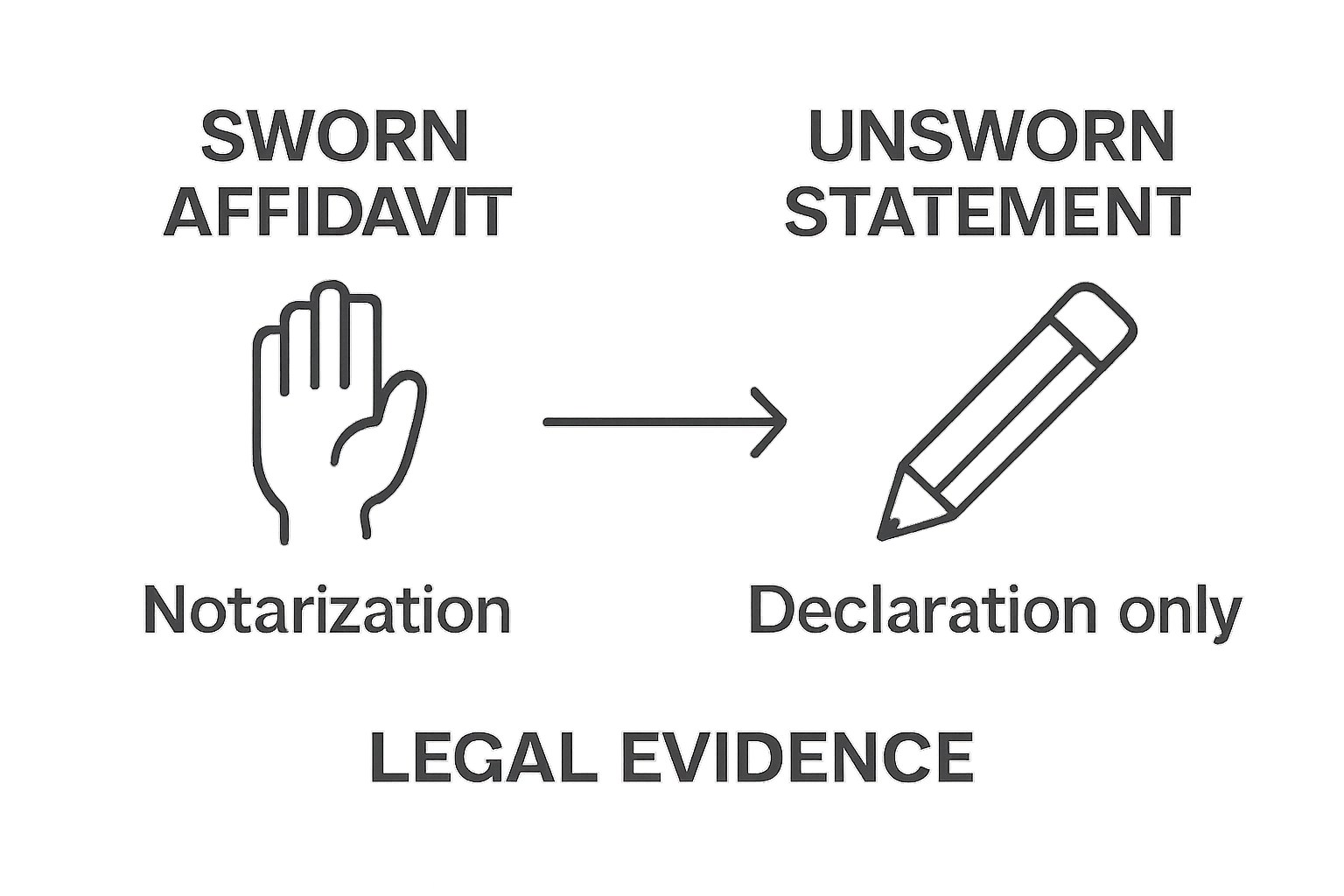
Federal legal provisions offer comprehensive guidelines for executing affidavits. According to 28 U.S.C. § 1746, unsworn declarations can sometimes substitute for traditional sworn affidavits in certain federal matters. This flexibility acknowledges the evolving nature of legal documentation while maintaining strict standards of truthfulness.
Essential Legal Components
An effective legal affidavit must incorporate several critical elements to ensure its validity and enforceability:
- Personal Appearance: The declarant must physically or electronically appear before an authorized official
- Voluntary Declaration: The statement must be made willingly, without coercion
- Oath or Affirmation: A formal commitment to truthfulness, typically administered by a notary public
- Specific Documentation: Precise details and supporting evidence must be included
Explore our comprehensive guide to creating legal documents for more insights into proper affidavit preparation.
Moreover, the California Secretary of State’s guidelines emphasize that a jurat—the notarial certificate accompanying an affidavit—requires specific procedural steps. These include the signer personally appearing, signing in the notary’s presence, and taking a formal oath, which underscores the meticulous legal standards governing these important documents.
By establishing such comprehensive legal frameworks, jurisdictions ensure that affidavits serve as reliable, trustworthy instruments for documenting critical information across various legal and administrative contexts.
Key Elements of an Affidavit for Insurance
An insurance affidavit represents a meticulously structured legal document that requires precise compilation of information to substantiate insurance claims, protect policyholder interests, and provide insurers with comprehensive evidence. Understanding these critical elements ensures accurate documentation and increases the likelihood of successful claim processing.
Comprehensive Documentation Requirements
According to the National Flood Insurance Program, a robust insurance affidavit must encompass specific details that provide a comprehensive narrative of the incident. These details transform a simple statement into a legally credible document that can withstand rigorous examination.
Essential Informational Components
A comprehensive insurance affidavit typically includes the following critical elements:
- Incident Description: Detailed account of the event, including date, time, location, and precise circumstances
- Financial Documentation: Comprehensive valuation of losses, including actual cash value and replacement costs
- Supporting Evidence: Photographs, repair estimates, receipts, and other corroborating documentation
- Insurance Interest Disclosure: Clear statement of the claimant’s insurable interest and any additional parties with potential claims
Discover our expert guidance on preparing insurance documents to streamline your claims process.
Moreover, insurance regulators like the Texas Department of Insurance mandate specific formatting and content standards. The sworn statement must include a formal jurat—a notarial certificate confirming the document was subscribed and sworn before an authorized official—which transforms the document from a simple statement to a legally binding declaration.
By meticulously addressing each required element, policyholders create a robust legal instrument that significantly enhances the credibility and potential success of their insurance claims.
The following table outlines the essential components that should be included in an insurance affidavit, offering a clear checklist for preparing a legally sound document.
| Key Element | Description |
|---|---|
| Incident Description | Detailed narrative about the event, including date, time, location, and specific circumstances |
| Financial Documentation | Itemized valuation of losses, such as actual cash value and replacement costs |
| Supporting Evidence | Relevant photos, repair estimates, receipts, and other documentation supporting the claim |
| Insurance Interest Disclosure | Statement identifying the claimant’s insurable interest and any additional parties with claim potential |
| Formal Jurat | Notarial certificate indicating the affidavit was signed and sworn before an authorized official |

Real-World Applications and Examples of Affidavits
Affidavits serve as critical legal instruments across multiple insurance scenarios, providing structured documentation that validates claims, establishes facts, and facilitates complex administrative processes. These sworn statements bridge the gap between personal testimony and official documentation, offering a legally recognized method for individuals to communicate crucial information.
Insurance Claims Documentation
In practical scenarios, affidavits play a fundamental role in substantiating insurance claims. According to the National Flood Insurance Program, policyholders must submit a Proof of Loss—a sworn statement detailing the extent and circumstances of property damage—which serves as a quintessential example of an insurance affidavit in action.
Diverse Insurance Application Scenarios
Affidavits demonstrate remarkable versatility across different insurance domains:
- Life Insurance Claims: Documenting death circumstances and beneficiary information
- Property Insurance: Detailing damage, theft, or loss conditions
- Health Insurance: Verifying medical conditions or treatment histories
- Disability Insurance: Confirming employment status and medical restrictions
Learn how to prepare precise insurance documentation to streamline your claims process.
Moreover, government agencies like the Office of Federal Employees’ Group Life Insurance utilize specialized affidavits to expedite claim processing. For instance, when standard death certificates are unavailable, a sworn statement from a licensed funeral home official can facilitate faster insurance claim resolutions.
By providing a legally binding mechanism for documenting complex scenarios, affidavits ensure transparency, reduce fraudulent claims, and create a standardized approach to insurance claim verification.
Ensure Your Insurance Affidavit Meets Every Legal Standard
Worried about preparing an affidavit that stands up to legal scrutiny and protects your insurance claim? Navigating documentation like sworn statements and notarial jurats can feel overwhelming, especially if you are concerned about accuracy, risk assessment, or preventing delays caused by paperwork errors. Your peace of mind matters. With professional online notary support in Ontario, you can submit insurance affidavits with confidence, knowing every legal detail is covered.

Choose The Online Notary to create, notarize, and submit affidavits right from your home. Get expert help with insurance claim affidavits, invitation letters, statutory declarations, and more. Streamline your claims and avoid costly mistakes — our secure online service delivers precision and fast turnaround. Ready to protect your rights and speed up your insurance process? Book your online notary session now and put your next step in capable hands.
Frequently Asked Questions
What is an affidavit for insurance?
An affidavit for insurance is a formal written statement made under oath that provides critical documentation to verify facts, validate claims, and establish legal evidence in insurance processes.
Why are affidavits important in insurance claims?
Affidavits are important in insurance claims as they provide legally binding documentation that helps verify the accuracy of claims, establish accountability, and prevent fraudulent activities, enhancing the integrity of the insurance process.
What key components should an insurance affidavit include?
An insurance affidavit should include an incident description, financial documentation of losses, supporting evidence, and a disclosure of the claimant’s insurable interest to ensure it is legally credible and comprehensive.
How can affidavits help in dispute resolutions?
Affidavits help in dispute resolutions by serving as clear, legally binding evidence that provides a structured account of the incident and the claim, which can be referred to during investigations or legal proceedings.
Recommended
- How to Get an Affidavit Online in Ontario 2025 – The Online Notary CA
- Everything You Need to Know About Online Notarization in Ontario: Fast, Legal, and Convenient for Affidavits and Declarations (2025) – The Online Notary CA
- How to Commission and Get Affidavits Notarized Online in Ontario – The Online Notary CA
- What Does a Notary Do in Ontario? 2025 Guide – The Online Notary CA
- Understanding Insurance Coverage for Theft: A Complete Guide – Unparalleled Global Benefits
- Understanding The Role Of Insurance In Roof Repairs | Midlands Roofing & Exteriors, LLC