
TL;DR:
- Correctly authorized commissioners, including new roles like First Nation Officers and students at law, are essential for valid affidavits in 2026.
- Proper affidavit drafting involves a clear structure, accurate exhibits, and strict adherence to jurat and formatting requirements.
- Final verification should ensure signatures, stamps, exhibits, and wording are complete to prevent rejection or delays.
Getting an affidavit rejected because of a missing signature, an unstamped exhibit, or an unauthorized commissioner is more common than you might think. These aren’t minor technicalities. A rejected affidavit can delay court proceedings, stall immigration applications, or hold up real estate transactions by days or even weeks. Ontario’s rules around affidavits are specific, and 2026 has brought meaningful changes that every individual and business needs to understand. This guide walks you through every step, from gathering your documents to final submission, so you can get it right the first time.
Table of Contents
- What you need: Key requirements and who can commission in 2026
- How to draft your affidavit: Step-by-step instructions
- Commissioning your affidavit: In person and online options
- Verification, common mistakes, and final compliance check
- The overlooked challenges and what smart filers do differently
- Commission your affidavit the easy way with expert help
- Frequently asked questions
Key Takeaways
| Point | Details |
|---|---|
| Expanded commissioner list | As of March 2026, more officials can commission affidavits in Ontario, including new designated roles. |
| Remote commissioning is legal | You can commission an affidavit online with ID verification under Ontario regulations in 2026. |
| Avoid common compliance errors | Most rejections happen due to missing signatures or documents, so follow the checklist closely. |
| Preparation is key | Gather all documents and confirm you’re using an authorized commissioner before drafting your affidavit. |
| Expert help available | Ontario notary experts can simplify complex affidavit and commissioning requirements for you. |
What you need: Key requirements and who can commission in 2026
Now that you understand the importance of compliance, let’s start by identifying the exact requirements and authorized persons for affidavits in 2026.
An affidavit is a written sworn statement of facts. It only becomes legally valid once it is signed in front of an authorized commissioner who administers the oath or affirmation. In Ontario, “authorized commissioner” means a person designated under the Commissioners for Taking Affidavits Act to witness and certify that the affiant (the person swearing the statement) has taken a formal oath.
Some commissioners hold this power “by virtue of office,” meaning their professional role automatically grants them the authority. They don’t need a separate appointment. Others must apply to the Attorney General for a personal appointment. Understanding which category applies to the person commissioning your document helps you avoid an invalid affidavit.
As of March 1, 2026, the following new roles were formally added as commissioners by virtue of office under O. Reg. 386/12:
- First Nation Officers
- Students at Law
- MPP constituency staff
- First Nation Chiefs
- Service Ontario staff
- Conservation Reserve Managers
These additions significantly expand access for people in rural, northern, and First Nations communities who previously faced barriers in finding a qualified commissioner nearby.
Who is authorized to commission affidavits in Ontario in 2026?
The table below breaks down the main categories of authorized commissioners.
| Category | Examples | Authority source |
|---|---|---|
| By virtue of office | Lawyers, judges, paralegals, MPPs, municipal officials | O. Reg. 386/12 |
| New (effective March 1, 2026) | First Nation Officers, Service Ontario staff, Students at Law, MPP constituency staff | O. Reg. 386/12 amendment |
| By appointment | Members of the public appointed by the Attorney General | Commissioners for Taking Affidavits Act |
What to gather before you start
Before approaching any commissioner, make sure you have these items ready:
- Government-issued photo ID (passport, driver’s license, or permanent resident card)
- A complete draft of your affidavit, including all factual statements
- All exhibits or attachments referenced in the document, labeled with exhibit stickers (e.g., “Exhibit A”)
- Knowledge of the oath or affirmation you will be asked to take
Knowing who can sign affidavits in Ontario before your appointment prevents last-minute surprises. For example, asking a friend who works as a notary public is not automatically sufficient. A notary public in Ontario holds specific powers under a separate statute and may or may not be authorized to commission affidavits, depending on their appointment.
Pro Tip: The Ontario Ministry of the Attorney General provides a “Guide for Newly Appointed Commissioners” and offers virtual training for individuals recently added to the commissioner list. If you’re unsure whether your commissioner is properly authorized, ask them directly to confirm their authority and the regulation it falls under.
How to draft your affidavit: Step-by-step instructions
With your requirements in hand, it’s time to actually draft your affidavit step by step.
The good news is that no major 2026 changes affect the basic mechanics of how affidavits are structured. The rules around who can commission expanded, but what goes inside the document stays consistent. Getting the structure right is critical because courts, government agencies, and financial institutions all look for the same key elements before accepting your affidavit.
The standard affidavit structure
Follow these steps to draft a properly structured Ontario affidavit:
- Title block: Start with the jurisdiction (Province of Ontario), the court or body the affidavit is submitted to (if applicable), and the full legal name of the affiant.
- Introduction paragraph: State who you are, your address, and your relationship to the matter at hand. For example: “I, Jane Smith, of the City of Toronto, in the Province of Ontario, make oath and say as follows.”
- Statement of facts: Number each paragraph. Each paragraph should contain a single, clear, factual statement. Avoid opinions, speculation, or hearsay. Every claim should be something you personally know to be true.
- Exhibits: If you reference any documents, label them clearly in the text (“attached as Exhibit A”) and attach them to the back of the affidavit. Each exhibit must be initialed or stamped by the commissioner at the time of signing.
- Signature block and jurat: The jurat is the section at the bottom where the commissioner certifies the oath was administered. It includes the date, location, and the commissioner’s signature and stamp.
For detailed guidance on writing your affidavit correctly the first time, following a proven template saves significant time and reduces the risk of rejection.
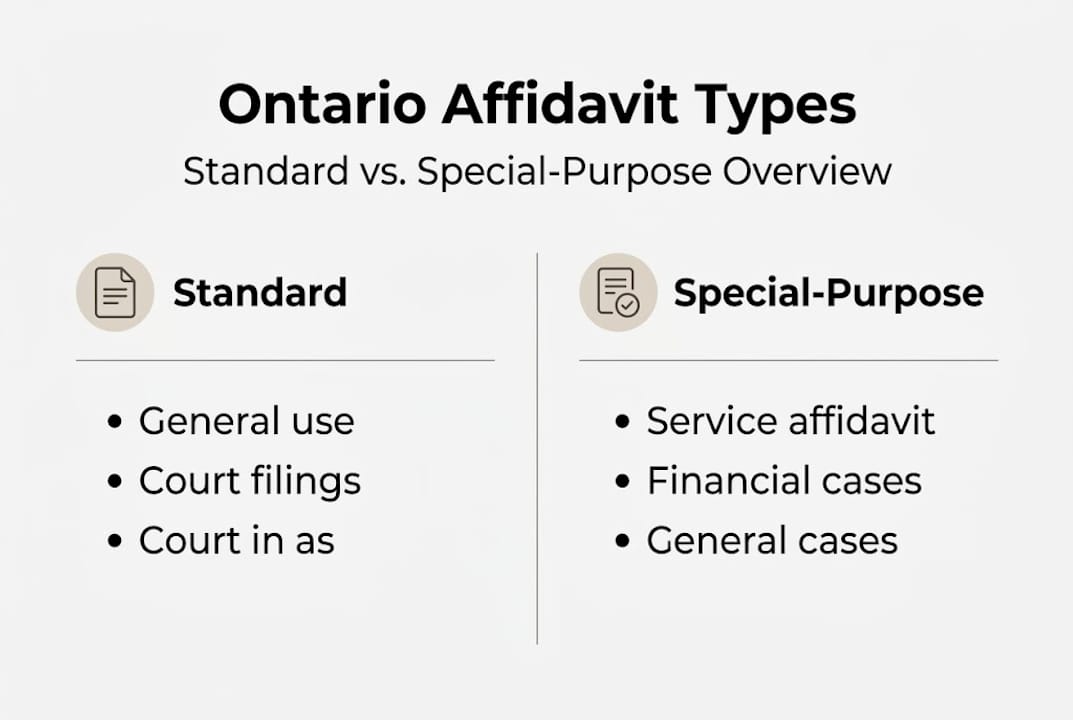
Standard vs. special-purpose affidavits
| Feature | Standard affidavit | Special-purpose affidavit |
|---|---|---|
| Use case | General sworn statements | Immigration, court proceedings, real estate |
| Language requirements | Plain, factual statements | May require specific prescribed language |
| Exhibits | Optional | Often mandatory |
| Commissioner type | Any authorized commissioner | Some require lawyers or notaries only |
The most common special-purpose affidavits in Ontario include affidavits of service, financial affidavits for family law proceedings, and immigration-related affidavits of support. Each has prescribed formatting requirements set by the relevant authority. When creating affidavits in Ontario for a specialized purpose, always check the specific rules of the court or agency receiving the document.
Pro Tip: The most common drafting mistakes are including hearsay statements (things you heard but didn’t personally witness), leaving the signature block blank, and forgetting to attach or stamp exhibits. Any one of these errors will cause rejection. Write in the first person, keep statements factual, and confirm that every exhibit is physically attached before you go to your commissioning appointment.
Commissioning your affidavit: In person and online options
Once your affidavit is drafted and ready, the next crucial step is commissioning it, either in person or remotely.

Commissioning is the formal step that transforms your written statement into a legally binding sworn document. Without it, your affidavit is simply a piece of paper. Ontario law requires that the commissioner personally verify your identity, administer the oath or affirmation, witness your signature, and then sign and stamp the jurat. Each of these steps matters.
In-person commissioning process
- Bring your ID: Present one piece of valid government-issued photo ID. The commissioner will inspect it and confirm your identity.
- Review the document together: The commissioner will read through the affidavit to confirm it is complete before proceeding.
- Take the oath or affirmation: You will be asked to swear (religious) or affirm (secular) that the contents of the affidavit are true. This is a legal act. Swearing a false affidavit is perjury.
- Sign in front of the commissioner: Never sign your affidavit before you get to the appointment. The signature must be witnessed in real time.
- Commissioner signs and stamps: The commissioner adds their signature, official stamp (if applicable), and the date to the jurat. They also initial or stamp each exhibit.
Remote commissioning under O. Reg. 431/20
Ontario allows remote commissioning under O. Reg. 431/20, which permits the process to be completed via two-way video technology with ID verification and a modified jurat that identifies the remote format used.
Regulatory note: Remote commissioning requires a live video connection, real-time ID presentation, and jurat language that specifies the affiant appeared remotely. Commissioners must be satisfied the ID is genuine and the affiant is the same person throughout the session.
| Feature | In-person commissioning | Remote commissioning |
|---|---|---|
| Location | Commissioner’s office or agreed place | Anywhere with video capability |
| ID check | Physical inspection | Visual inspection via video |
| Oath | Administered verbally in room | Administered verbally via video |
| Jurat wording | Standard format | Modified to reflect remote process |
| Exhibits | Physically stamped same day | Sent digitally; stamped copies exchanged |
| Legal authority | Commissioners for Taking Affidavits Act | O. Reg. 431/20 |
Remote options have become extremely practical for businesses and individuals who need fast turnaround. Reviewing the online commissioning steps before your appointment helps you prepare your technology, lighting, and documents so nothing slows the process down.
Verification, common mistakes, and final compliance check
After your affidavit is commissioned, review these final compliance steps to avoid last-minute issues.
Even after commissioning, it’s worth doing a final pass before you submit your affidavit anywhere. Courts and agencies process many documents daily and will not chase you for missing information. If something is wrong, they simply reject or return the document. A quick verification check takes five minutes and can prevent weeks of delay.
The most common reasons affidavits are rejected in 2026 remain consistent: the document is unsigned, unstamped, or missing proper ID checks. These are not difficult problems to prevent, but they require attention to detail at each step of the process.
Final compliance checklist
Use this list before submitting your affidavit to any court, agency, or institution:
- Affiant’s signature is present and was signed in front of the commissioner, not before.
- Commissioner’s signature is present in the jurat section, with their name printed clearly beneath.
- Commissioner’s stamp is applied (where required by the commissioner’s designation).
- Date and location of commissioning are filled in accurately in the jurat.
- All exhibits are attached in the correct order and labeled (Exhibit A, Exhibit B, etc.).
- Each exhibit is initialed or stamped by the commissioner at the time of signing.
- Jurat wording is correct for the type of commissioning used (standard or remote).
- No blank spaces remain in the body of the affidavit that could allow additions after signing.
- All pages are numbered to prevent page substitution concerns.
- A copy is kept for your own records before submission.
Common mistakes and how to fix them quickly
Pre-signing the document is the most frequent error. If you already signed before the appointment, many commissioners will ask you to re-draft and re-sign in their presence. Always bring a blank signature line and sign only on instruction.
Unstamped exhibits are the second most common issue. Some affiants bring exhibits but forget to have the commissioner stamp each one. If you catch this after the fact, you may need to go back and have the commissioner amend and re-stamp.
Wrong jurat format for remote sessions is increasingly common. If you commissioned remotely but used a standard in-person jurat, the affidavit may be invalid. Check affidavit preparation tips specific to the remote format before your appointment.
Hearsay in the body text is another compliance trap. If you wrote “I was told by my colleague that…” rather than something you directly know, that statement will likely be struck or cause the affidavit to be questioned. Rephrase hearsay as what you personally know or observed.
The overlooked challenges and what smart filers do differently
There is one thing we have seen consistently across the affidavits people bring to us: overconfidence with templates. Someone downloads an official-looking affidavit template online, fills in the blanks, and assumes they’re done. They arrive at a commissioning appointment without the right exhibits, or they use jurat language designed for a different province, or they forget that their specific court requires sworn original signatures rather than copies. The form looks right. It isn’t.
Smart filers treat the template as a starting point, not a finish line. They review the submission requirements of the specific institution receiving the affidavit. They confirm their commissioner is authorized under the correct regulation. When the situation involves immigration, family law, or real estate, they consult experts rather than guess. Edge cases exist everywhere in affidavit practice, and the cost of getting it wrong is always higher than the cost of getting guidance upfront.
For anything beyond a routine personal statement, consulting advanced affidavit guidance from professionals familiar with Ontario-specific rules is genuinely worthwhile. And if you are commissioning remotely, document everything: the date, the video platform used, and any communications with the commissioner. This creates a record that protects you if questions arise later.
Commission your affidavit the easy way with expert help
Ready for a smoother, error-free affidavit experience? Here’s how expert help takes the worry out of the process.

Getting an affidavit right in Ontario means navigating commissioner authorization rules, formatting requirements, exhibit stamps, jurat wording, and 2026 regulatory updates. Handling all of that alone is possible, but it introduces unnecessary risk. Our Ontario notary services are available online, seven days a week, so you can get your affidavit commissioned quickly and correctly without leaving your home or office. Whether you need help with a statutory declaration, invitation letter, or sworn affidavit, our team understands the exact notary requirements in Ontario and will make sure your document is accepted the first time.
Frequently asked questions
Who can commission an affidavit in Ontario in 2026?
In 2026, authorized commissioners include lawyers, judges, MPPs, paralegals, certain officials, and new roles like First Nation Officers, MPP constituency staff, and Service Ontario staff, all designated under O. Reg. 386/12.
What must be included in a legally valid Ontario affidavit?
A valid Ontario affidavit must include the affiant’s sworn statement of facts, a signature made in front of an authorized commissioner, a properly completed jurat, and any exhibits referenced in the text, each initialed or stamped.
Can I commission an Ontario affidavit remotely in 2026?
Yes, affidavits can be commissioned remotely in 2026 using live video with proper ID verification and modified jurat wording that identifies the remote process under O. Reg. 431/20.
What are common reasons for affidavit rejection in Ontario?
Affidavits are most often rejected for being unsigned, missing commissioner stamps, having unstamped exhibits, or using incorrect jurat language, especially after remote commissioning.
Where can I find official training or resources for new commissioners?
The Ontario Ministry of the Attorney General offers a guide and virtual training for individuals newly designated as commissioners for taking affidavits in 2026.