
TL;DR:
- Anyone in Ontario with a valid ID and a genuine legal need can access notary services, provided there is no conflict of interest. Notaries cannot serve themselves, immediate family members, or those with a financial stake and only verify signatures and identities, not the legal accuracy of documents. Remote online notarization is fully authorized, with proper procedures ensuring legal validity and security across different document types.
Notary services in Ontario are available to any individual, business, or legal entity that needs a qualified, impartial witness to authenticate signatures on legally binding documents. A notary public is a state-commissioned official appointed under Ontario law to verify identity, witness signatures, and certify documents for use in legal and formal transactions. Whether you are signing a power of attorney, submitting an affidavit for court, or finalizing a real estate deal, understanding who can use notary services and when you need one prevents costly rejections and legal complications. Providers like Theonlinenotary, the National Notary Association, and LegalClarity each serve this need in distinct ways.
Who can use notary services: individuals, businesses, and legal entities
Almost anyone with a legitimate legal need can access notary services in Ontario. The key requirement is that you are the actual signer of the document, you appear voluntarily, and you can present valid government-issued identification. Beyond that, the door is wide open.

Individuals with personal legal documents
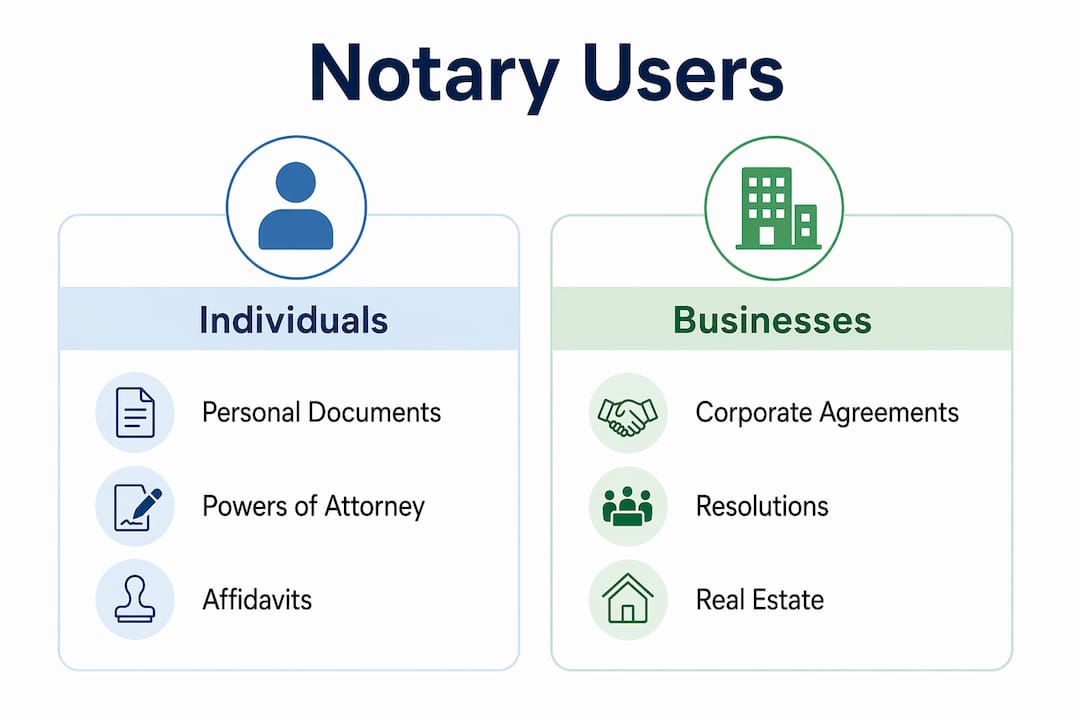
Private citizens represent the largest group of notary clients. Common situations include signing a power of attorney, executing a will, swearing an affidavit for court proceedings, or certifying copies of passports and academic credentials for immigration applications. Statutory declarations and solemn declarations also fall into this category. If you are sponsoring a family member for a Canadian visa and need to notarize an invitation letter, you are a textbook example of who needs notary services.
Businesses and corporate clients
Businesses require notarization more often than most owners realize. Corporate resolutions, shareholder agreements, real estate purchase contracts, and documents submitted to foreign governments all commonly require a notary’s seal. A small business owner in Toronto closing a commercial lease, or a startup submitting incorporation documents to a foreign jurisdiction, both qualify as eligible notary clients. The notary’s role in these transactions is to confirm that the authorized signatory is who they claim to be, not to review the legal terms of the contract.
Authorized legal entities
Beyond individuals and businesses, legal entities such as non-profit organizations, trusts, and estates also use notary services regularly. An executor of an estate, for example, may need to notarize probate documents or property transfer forms. Trustees signing on behalf of a trust require the same identity verification as any individual signer.
Common documents requiring notarization in Ontario include:
- Affidavits and statutory declarations
- Powers of attorney (personal care and property)
- Wills and estate documents
- Real estate transfer documents and mortgage agreements
- Immigration and visa support letters
- Academic and professional credential certifications
- Corporate resolutions and shareholder agreements
- Consent letters for minors traveling abroad
The breadth of this list confirms that notary services for individuals and businesses cover nearly every major life and business event that involves a formal legal record.
Who cannot use a notary or get their documents notarized
The clearest restriction in notarization law is the conflict of interest rule. A notary cannot notarize documents for themselves, their spouse, their parents, or their children. This prohibition exists because impartiality is the foundation of a valid notarization. The moment a notary has a personal stake in the outcome, the integrity of the process collapses.
LegalClarity confirms that notaries are prohibited from serving immediate family members and face criminal penalties for providing legal advice. This means that even if your sibling happens to be a commissioned notary, they should not be the one notarizing your will or your property transfer documents.
Financial interest is the second major disqualifier. A notary who is named as a beneficiary in a will cannot notarize that will. A notary who holds a financial stake in a real estate transaction cannot certify the documents for that deal. The rule applies regardless of how minor the interest appears.
Situations where notarization is prohibited or strongly discouraged:
- The notary is the document signer
- The signer is the notary’s spouse, parent, or child
- The notary is a named beneficiary in the document being notarized
- The notary has a direct financial interest in the transaction
- The signer appears to be under coercion or duress
- The signer lacks the mental capacity to understand what they are signing
Docusign notes that a notary must refuse service when coercion, fraud, or incapacity is suspected, because the notary carries personal liability for the integrity of each notarization. This is not a technicality. It is a legal protection for everyone involved.
Pro Tip: If you are unsure whether a conflict of interest exists, ask the notary directly before the appointment. A qualified notary will tell you honestly whether they can serve you, and a reputable one will refer you elsewhere rather than risk the validity of your document.
How to find and use notary services safely in Ontario
Finding a qualified notary in Ontario is straightforward once you know where to look. Banks, law firms, and local government offices often have commissioned notaries on staff. For greater convenience, online platforms like Theonlinenotary offer notarize online in Canada services that are fully authorized under Ontario law and available around the clock.
Understanding fees before you book
Standard in-person notarizations cost between $5 and $15 per signature, with mobile notaries often adding travel fees. That fee range reflects the basic administrative cost of the service. For complex transactions or multiple documents, fees can accumulate quickly, so confirm pricing before your appointment.
Steps to prepare for a valid notarization
- Gather your documents. Bring the unsigned original document to the appointment. Do not sign it in advance. The notary must witness the act of signing.
- Bring valid government-issued ID. Most jurisdictions, including Ontario, require at least one piece of photo ID such as a passport or driver’s license. LegalClarity confirms that valid government-issued ID is critical to notarization validity, though some jurisdictions allow credible witnesses as a substitute when the signer lacks ID.
- Confirm the notary’s commission. Ask to see proof of their current commission. An expired commission invalidates the notarization.
- Appear in person or via live video. Physical or live video presence is mandatory. You cannot send a document to be notarized without appearing yourself.
- Sign in front of the notary. The notary witnesses the signature, verifies your identity, and applies their seal and signature.
In-person vs. remote online notarization
| Feature | In-person notarization | Remote online notarization (RON) |
|---|---|---|
| Location requirement | Must travel to notary | Anywhere with internet access |
| Availability | Business hours only | 24/7 with platforms like Theonlinenotary |
| Document security | Physical seal and signature | Tamper-evident digital seal and audit trail |
| ID verification | Physical ID presented | Government ID verified via video |
| Cost | $5 to $15 per signature | Comparable, often with platform fees |
Remote Online Notarization allows notarization via live video with commissioned officers, complete with tamper-evident seals and digital audit trails. For Ontario residents managing time-sensitive documents or living outside major urban centers, RON removes a significant practical barrier.
Pro Tip: For immigration documents or court affidavits, confirm with the receiving institution that they accept remotely notarized documents before booking. Most do in 2026, but some older institutional processes have not updated their requirements.
Common misconceptions about who can use notary services
The single biggest misunderstanding about notaries is that they function as legal advisors. They do not. Notaries are ministerial officers who verify signatures and identities. They cannot explain what a contract means, advise you on whether to sign, or draft legal documents on your behalf. Treating a notary as a substitute for a lawyer is a mistake that can leave you legally exposed.
The second common misconception is about what notarization actually certifies. A notary verifies only the identity of the signer and the act of signing. They do not confirm that the document’s contents are accurate, truthful, or legally sound. A notarized affidavit containing false statements is still a false affidavit. The notary’s seal confirms you signed it. It does not confirm you told the truth.
A third area of confusion involves notarizing for friends or family. While some jurisdictions technically permit a notary to serve distant relatives or friends, Docusign warns that notarizing for family is risky when money or property is involved, because the resulting document can be challenged on conflict-of-interest grounds. The risk of document rejection or legal challenge far outweighs the convenience.
“A notary’s job is to be a reliable, impartial witness. The moment that impartiality is in question, the entire value of the notarization disappears.” — LegalClarity
Finally, notaries are private citizens appointed by the state, not courthouse employees. They work in banks, law firms, and mobile operations. Over 51% of notaries are self-employed mobile notaries or loan signing agents. This means the person notarizing your document may be an independent contractor working from a home office, which is entirely legal and common.
Key takeaways
Anyone in Ontario with a legitimate legal need and valid identification can use notary services, but the notary must remain impartial and free from any personal or financial interest in the document being notarized.
| Point | Details |
|---|---|
| Open access for most users | Individuals, businesses, and legal entities can all use notary services with valid ID. |
| Conflict of interest bars service | Notaries cannot serve themselves, immediate family, or anyone they have a financial stake with. |
| Notarization confirms identity, not truth | A notary’s seal verifies the signature was witnessed, not that the document’s contents are accurate. |
| Remote notarization is fully valid | RON via live video with tamper-evident seals is legally accepted in Ontario in 2026. |
| Preparation prevents rejection | Bring unsigned originals, valid government ID, and confirm the notary’s active commission before signing. |
What I’ve learned from watching notarizations go wrong
After years of working in and around Ontario’s notarization process, the pattern I see most often is not fraud or bad intent. It is simple, avoidable confusion about what a notary can and cannot do for you.
The most common mistake I encounter is people arriving with already-signed documents. The notary cannot retroactively witness a signature. The document has to be signed in front of them. This single error sends people back to square one, sometimes with time-sensitive immigration or court deadlines bearing down on them.
The second mistake is assuming that any notary will do. For documents destined for foreign governments or courts, the receiving institution often specifies the type of notarization required, whether that is a simple signature witnessing, a certified true copy, or an apostille. Using the wrong type of notarization means the document gets rejected regardless of how valid the notarization itself was.
My honest advice: use a platform that specializes in Ontario notarization rather than walking into a bank and hoping for the best. Theonlinenotary, for example, handles affidavits, statutory declarations, invitation letters, and solemn declarations with staff who understand exactly what each document type requires. That specialization matters more than convenience alone.
The broader point is that notarization is a process, not just a stamp. Understanding who can use notary services, what restrictions apply, and what the seal actually certifies gives you the foundation to get it right the first time.
— Ken
Get your documents notarized the right way in Ontario
Theonlinenotary provides fully authorized online notary services for Ontario residents and businesses, available 24 hours a day, seven days a week. Whether you need an affidavit sworn, a statutory declaration certified, or an invitation letter notarized for a visa application, the platform connects you with commissioned Ontario notaries who know exactly what each document requires.

Pricing is transparent, the process is straightforward, and every notarization meets Ontario’s legal standards. Individuals and businesses can access expert notary services without scheduling conflicts, travel, or uncertainty about whether the notary is properly commissioned. For a full comparison of available options, the best online notary solutions guide covers what to look for and how platforms differ in 2026.
FAQ
Can anyone use a notary in Ontario?
Yes. Any individual, business, or legal entity with a legitimate legal need and valid government-issued ID can use notary services in Ontario. The only people excluded are those who would create a conflict of interest for the notary, such as the notary’s own immediate family members.
Who needs notary services most often?
Individuals signing powers of attorney, affidavits, and immigration documents use notaries most frequently, followed by businesses notarizing contracts and corporate resolutions. Anyone submitting formal documents to a court, government agency, or foreign institution typically needs notarization.
Can a notary refuse to notarize my document?
Yes. A notary must refuse if they suspect coercion, fraud, or that the signer lacks mental capacity. They are also required to refuse if a conflict of interest exists, such as when the signer is an immediate family member or the notary has a financial stake in the document.
Does notarization mean my document is legally accurate?
No. Notarization confirms only that the signature was witnessed and the signer’s identity was verified. A notary does not certify the truthfulness or legal accuracy of the document’s contents.
Can I get documents notarized online in Ontario?
Yes. Remote Online Notarization is legally valid in Ontario. Platforms like Theonlinenotary conduct notarizations via live video with commissioned officers, producing tamper-evident digital seals that are accepted by courts, government agencies, and most institutions in 2026.