
Everyone talks about doing everything online these days and you might assume that in Ontario, you can get your documents notarized with just a laptop and webcam. Yet here’s the shocker. As of 2025, Ontario still forbids online notarization and insists on an in-person visit. So if you want that official stamp, you cannot rely on digital shortcuts and have to meet a notary face to face, no matter how advanced technology feels.
Table of Contents
- Understanding Online Notarization In Ontario
- Step-By-Step Process For Getting Notarized Online
- Legal Validity And Accepted Documents In 2025
- Benefits For Individuals And Ontario Businesses
Quick Summary
| Takeaway | Explanation |
|---|---|
| Online notarization is not permitted | As of 2025, Ontario law requires in-person notarization only, restricting online methods. |
| Prepare documents accurately before meeting | Ensure all documents are complete, original, and legible to avoid issues during notarization. |
| Schedule in-person appointments | Contact notaries in advance to confirm availability and prepare necessary identification and documents. |
| Understand document types for notarization | Personal legal documents, financial agreements, and educational credentials are typically acceptable for notarization. |
| Stay informed about regulations | Future changes may allow online notarization; keep updated to adapt to potential legal evolution. |
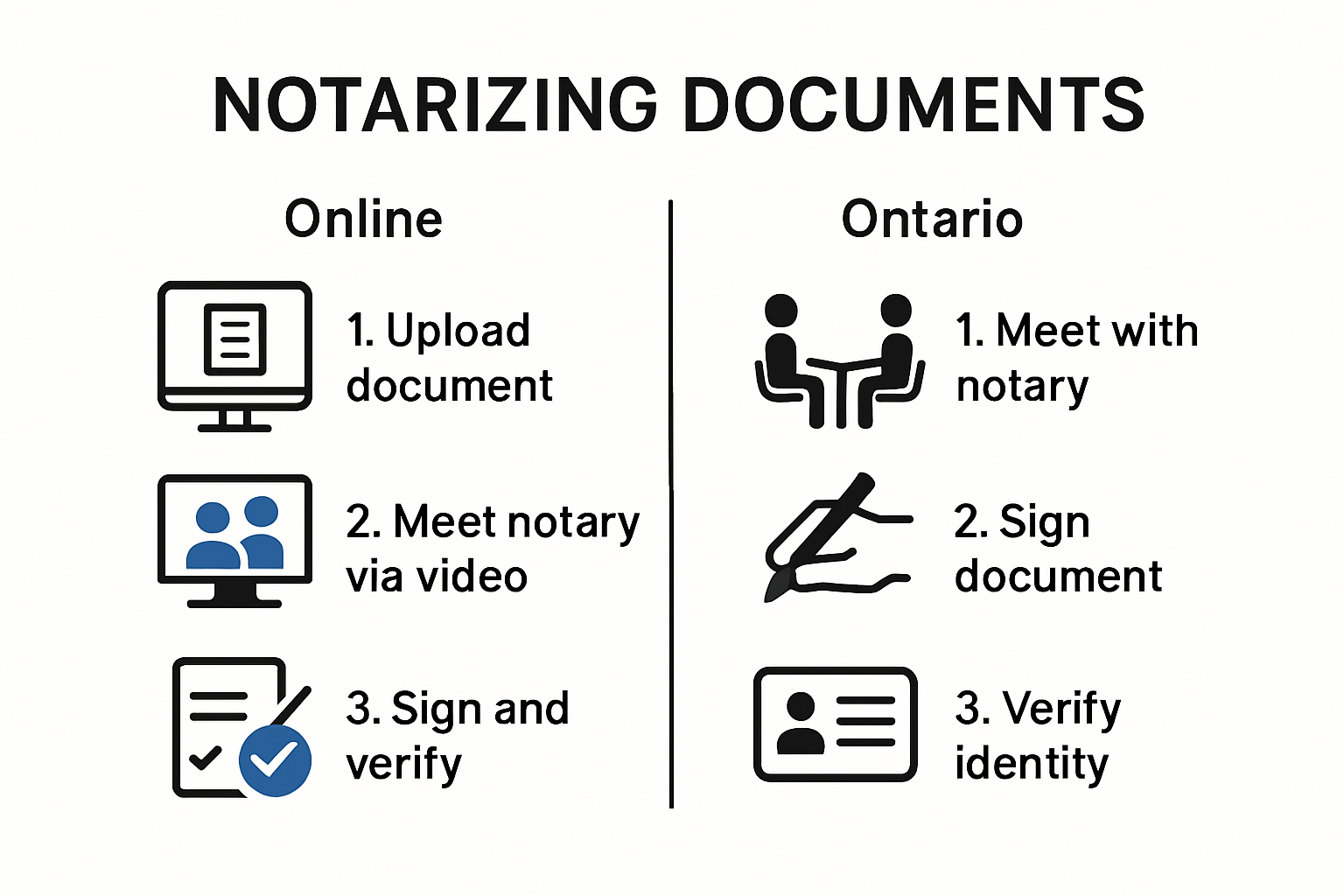
Understanding Online Notarization in Ontario
Notarization represents a critical legal process where documents receive official authentication through a certified professional. In Ontario, the landscape of document certification is complex and constantly evolving. Online notarization remains a nuanced topic with specific legal constraints that residents must understand.
The Current Legal Framework for Notarization
As of 2025, online notarization in Ontario presents unique challenges. The Law Society of Ontario clearly states that remote or virtual notarization is currently not permitted under existing regulations. The Notaries Act allows for potential remote notarization, but no specific regulations have been enacted to implement this provision.
According to legal research from Hull and Hull LLP, notarization must be conducted in person. This means that individuals seeking document authentication must physically meet with a notary public or commissioner for taking affidavits. The requirement ensures direct verification of identity and document integrity through face-to-face interaction.
Implications for Document Authentication
The restrictions on online notarization create significant practical challenges for Ontario residents. Traditional notarization requires scheduling in-person appointments, traveling to a notary’s office, and managing complex scheduling logistics. These requirements can be particularly challenging for individuals with mobility limitations, those living in remote areas, or professionals with demanding work schedules.
Businesses and individuals must carefully navigate these legal constraints. While digital document preparation and submission have become increasingly common, the final authentication step still demands physical presence. This means that despite technological advancements, the core process of notarization remains fundamentally unchanged in Ontario.
Key considerations for Ontario residents include:
- Physical Verification: All notarization requires direct, in-person identity confirmation.
- Legal Compliance: Documents must be authenticated according to current provincial regulations.
- Professional Expertise: Only authorized notaries can perform legal document certification.
The ongoing legal discussions suggest that future regulatory changes might eventually permit more flexible notarization methods. However, as of 2025, individuals must adhere to the existing framework of in-person document authentication. Staying informed about potential legislative updates remains crucial for anyone requiring official document certification in Ontario.
Step-by-Step Process for Getting Notarized Online
Navigating the document notarization process in Ontario requires careful attention to legal requirements and procedural details. While full online notarization is not currently permitted, individuals can prepare and streamline their document authentication process through strategic planning and understanding of current regulations.
Document Preparation and Verification
Before initiating the notarization process, thorough document preparation is crucial. The Ontario Official Documents Services emphasizes the importance of document accuracy and completeness. This means ensuring all documents are:
- Fully Completed: All sections must be filled out accurately
- Original Copies: Original documents are preferred over photocopies
- Clear and Legible: No smudges, stains, or unclear text
According to Hull and Hull LLP legal research, physical documents remain the standard for notarization in Ontario. Individuals must prepare hard copies of their documents, understanding that electronic submissions are not accepted for official authentication.

Scheduling and In-Person Authentication
Given the current legal framework, scheduling an in-person notarization appointment is mandatory. The process involves:
- Researching authorized notaries public in your local area
- Contacting the notary to confirm availability and required documentation
- Preparing valid government-issued photo identification
- Bringing original documents to the appointment
Notaries will verify your identity, witness document signing, and apply their official seal. The Law Society of Ontario recommends scheduling appointments in advance to ensure smooth processing.
While full online notarization remains unavailable, individuals can optimize their experience by:
- Digitally preparing documents beforehand
- Scanning and organizing supporting materials
- Confirming appointment requirements in advance
- Understanding specific notary fees and payment methods
The current regulatory environment requires physical presence, but technological preparation can significantly streamline the traditional notarization workflow. Staying informed about potential future changes in remote authentication regulations will help Ontario residents adapt quickly as legal frameworks evolve.
To help clarify the required steps for in-person notarization in Ontario, here’s a table summarizing the process and key actions:
| Step | Action | Details |
|---|---|---|
| 1 | Document Preparation | Ensure all documents are completed, original, and legible |
| 2 | Research Notaries | Find authorized notaries public in your area |
| 3 | Schedule Appointment | Contact the notary to confirm time, documentation, and requirements |
| 4 | Prepare Identification | Bring valid government-issued photo ID |
| 5 | Attend Appointment | Present documents and ID for in-person verification |
| 6 | Document Signing & Notarization | Sign in presence of notary; notary applies seal |
Legal Validity and Accepted Documents in 2025
Understanding the legal landscape of document authentication in Ontario requires careful attention to current regulations and specific requirements. In 2025, the process of document notarization remains strictly governed by precise legal standards that determine which documents can be officially validated and under what circumstances.
Types of Acceptable Documents
The Law Society of Ontario provides clear guidance on the types of documents that can be notarized. Typically, acceptable documents include:
- Personal Legal Documents: Affidavits, statutory declarations, power of attorney
- Financial Documents: Loan agreements, property transfer documents
- Identity Verification Papers: Consent letters, invitation letters
- Educational Credentials: Degree certificates, academic transcripts
According to Ontario’s Official Documents Services, documents must meet specific criteria for authentication. As of July 10, 2023, certain court-issued documents from the Superior Court of Justice or the Ontario Court of Justice can be authenticated without traditional notarization if they were issued after this date.
Below is a table that organizes the types of documents typically eligible for notarization in Ontario, as described in this section:
| Document Type | Examples |
|---|---|
| Personal Legal | Affidavits, Statutory Declarations, Power of Attorney |
| Financial | Loan Agreements, Property Transfer Documents |
| Identity Verification | Consent Letters, Invitation Letters |
| Educational Credentials | Degree Certificates, Academic Transcripts |
| Court-Issued (post July 10, 2023) | Certain documents from Superior or Ontario Court of Justice |
Verification and Authentication Requirements
The legal validity of notarized documents hinges on strict procedural requirements. Professional notaries must physically verify the identity of the document signatories and apply their official seal in person. This means that despite technological advances, the fundamental process remains unchanged in 2025.
Key authentication criteria include:
- Original documents must be presented
- Government-issued photo identification is mandatory
- Notary must witness the document signing
- Official seal and signature must be applied in person
Documents that do not meet these stringent requirements may be considered legally invalid. Hull and Hull LLP legal research emphasizes that virtual or online notarization remains prohibited, with any attempts to circumvent these regulations potentially rendering documents unenforceable.
Individuals and organizations must exercise extreme caution when seeking document authentication. The legal landscape continues to evolve, but as of 2025, physical presence and direct verification remain the cornerstone of reliable document notarization in Ontario. Staying informed about current regulations is crucial to ensuring the legal validity of important documents.
Benefits for Individuals and Ontario Businesses
Despite the current limitations on online notarization in Ontario, businesses and individuals can still derive significant advantages by understanding and strategically navigating the existing legal framework. The document authentication process, while requiring physical presence, offers numerous opportunities for efficiency and strategic planning.
Efficiency in Document Preparation
Wikipedia’s overview of eNotary services highlights the potential for digital document preparation, even within traditional notarization constraints. Businesses and individuals can optimize their workflow by:
- Digitally drafting and organizing documents beforehand
- Preparing comprehensive supporting documentation
- Creating digital backups of physical documents
- Streamlining administrative processes through digital tools
According to research on electronic notarization platforms, digital preparation enhances document security and reduces potential errors. While full online notarization remains unavailable, technological preparation can significantly expedite the traditional authentication process.
Strategic Time and Resource Management
Small business owners and professionals can leverage strategic approaches to minimize time spent on document notarization. Research from MyCorporation suggests that proactive planning can mitigate typical challenges associated with in-person document authentication.
Key strategies include:
- Scheduling notary appointments during less busy periods
- Bulk processing multiple documents in a single session
- Selecting conveniently located notary services
- Maintaining comprehensive digital document portfolios
Individuals can significantly reduce time investment by meticulously preparing documents in advance. This approach ensures smoother interactions with notary professionals and minimizes potential delays or complications during the authentication process.
Businesses operating in Ontario must recognize that while technological limitations exist, strategic document management remains crucial. The ability to adapt to current regulatory frameworks while maintaining efficient documentation processes distinguishes successful organizations. By understanding the nuanced requirements of document notarization, businesses can develop robust strategies that accommodate existing legal constraints while preparing for potential future regulatory changes.
Ultimately, the key to navigating Ontario’s notarization landscape lies in proactive preparation, thorough understanding of legal requirements, and a flexible approach to document authentication. Staying informed about potential regulatory updates and maintaining organized, well-prepared documentation will continue to be essential for both individuals and businesses in the province.
Frequently Asked Questions
Is online notarization allowed in Ontario as of 2025?
As of 2025, online notarization is not permitted in Ontario. Individuals must meet with a notary in person for document authentication.
What steps should I follow to get my documents notarized?
To get your documents notarized, first prepare them accurately, then schedule an appointment with a notary, bring valid identification, and meet them in person to complete the notarization process.
What types of documents can be notarized in Ontario?
In Ontario, acceptable documents for notarization include personal legal documents (like affidavits and power of attorney), financial agreements, identity verification papers, and educational credentials.
How can I prepare for an in-person notarization appointment?
To prepare for an in-person notarization appointment, ensure all documents are fully completed and legible, gather original copies and valid government-issued photo identification, and confirm the notary’s appointment details in advance.
Overcome Ontario’s Notarization Barriers with a Faster, Stress-Free Solution
Struggling with the burden of Ontario’s in-person notarization requirements described above? You are not alone. Many people feel frustrated by lost time, scheduling hassles, and the inconvenience of finding a notary just for documents like affidavits or invitation letters. If you are tired of organizing appointments and physically traveling for each statutory declaration or solemn declaration, it is time to rethink your approach.

Why wait and risk delays when you can prepare everything online in advance and enjoy clear, guided steps for your notarization needs? Visit The Online Notary to learn how our secure platform is changing document preparation in Ontario. Start your journey toward quick, reliable, and streamlined notary service now and let us help you take control of your time.
Ready to skip the wasted hours and get your important documents moving? See how easy it is to get started at https://theonlinentoary.ca.