
TL;DR:
- Failing to follow Ontario’s strict notarization rules can cause contract delays, legal voids, or customs issues.
- Proper preparation, in-person attendance, and avoiding pre-signed documents are essential to ensure valid notarizations.
Many Ontario business owners discover the hard way that a single notarization error can delay a contract closing, void a corporate filing, or get an international shipment stuck at customs. Notarizing business documents is not a bureaucratic formality you can improvise. The rules in Ontario are specific, the consequences of getting them wrong are real, and the process trips up even experienced managers. This guide walks you through exactly what to prepare, how the process works step by step, where mistakes happen, and what you need to do after notarization to protect your business legally.
Table of Contents
- Key Takeaways
- Notarizing Business Documents: what you need to prepare
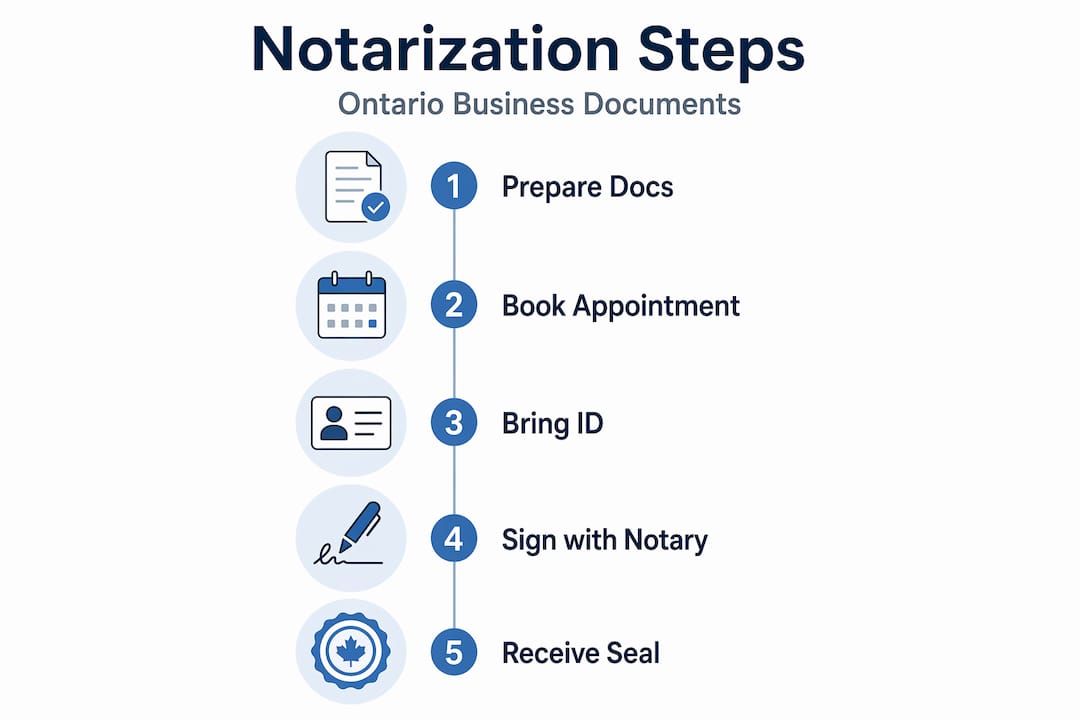
- Steps to notarize business documents in Ontario
- Common mistakes that derail notarization
- After notarization: compliance and international use
- My honest take on notarization for Ontario businesses
- Get notarization done right with Theonlinenotary
- FAQ
Key Takeaways
| Point | Details |
|---|---|
| Preparation prevents rejection | Gather original unsigned documents, valid government-issued photo ID, and any corporate authorization before your appointment. |
| In-person attendance is mandatory | Ontario law requires physical presence for notarization; remote notarization is not permitted under the Notaries Act. |
| Never pre-sign documents | Signing before meeting the notary causes automatic rejection for jurat notarial acts. |
| Post-notarization steps matter | International documents often require an apostille or consular legalization after notarization. |
| Remote commissioning is not notarization | Confusing the two services leads to compliance failures and rejected documents. |
Notarizing Business Documents: what you need to prepare
Before you book an appointment, you need to know what you are actually preparing for. Common documents requiring notarization include contracts, affidavits, powers of attorney, and corporate resolutions. If your business is signing a commercial lease, authorizing a representative to act on your behalf, or submitting paperwork to a foreign government, you are almost certainly looking at a notarized document requirement.
Ontario has specific identification rules. Acceptable IDs include government-issued photo identification like a passport or a driver’s license. Expired ID will get you turned away, full stop. If you are signing on behalf of a corporation, you may also need to bring a corporate resolution or a power of attorney showing that you have the legal authority to execute the document. This step catches a surprising number of business owners off guard.
There is also a distinction that confuses a lot of people: the difference between an acknowledgment and a jurat. An acknowledgment confirms that you signed the document voluntarily and that your identity has been verified. A jurat goes further. It requires you to sign the document in the physical presence of the notary and swear or affirm that the contents are true. If you have ever wondered why you cannot just hand over a pre-signed document, this is why.
Here is a quick pre-appointment checklist:
- Original, unsigned documents (for jurat acts; for acknowledgments, confirm in advance)
- Government-issued photo ID (passport or driver’s license, current and not expired)
- Corporate resolution or power of attorney (if signing on behalf of a business entity)
- Any attachments or exhibits referenced in the document body
- The receiving agency’s specific instructions, if the document is going to a court, government office, or foreign institution
Pro Tip: Call the receiving agency or check their written requirements before booking your notary appointment. Some courts and foreign consulates have formatting rules that go beyond basic notarization, and finding out after the fact costs you time and money.
You can also review key notary documents for Ontario businesses to understand which paperwork your specific business type is most likely to need notarized.
Steps to notarize business documents in Ontario
Following the right steps to notarize business documents saves you from the frustration of rejected appointments and invalid paperwork. Here is exactly how the process works.
Find a commissioned notary public in Ontario. You can locate one at law firms, certain financial institutions, or through mobile notary services. Mobile notaries will come to your office or location, which is convenient for large signing parties. Be aware that mobile notaries charge travel fees typically ranging from $50 to $150 on top of standard notary fees. That cost is not regulated by law, so it varies widely.
Verify the notary’s credentials. Not every person calling themselves a notary in Ontario is authorized to perform all notarial acts. A notary public in Ontario must be a licensed lawyer or paralegal in good standing with the Law Society of Ontario. If you are unsure about who is authorized to notarize in Ontario, it is worth confirming before you show up with a stack of documents.
Present your documents and identification. Bring everything on the checklist from the previous section. Keep documents unstapled if possible, since notaries often need to apply seals to specific pages. Have your ID ready and in good condition.
Sign in the presence of the notary. This is non-negotiable for jurat acts. The notary must witness you signing. For an acknowledgment, the notary confirms your identity and your voluntary intent. Either way, the notary records the notarial act, verifies your identity with your photo ID, and confirms you are signing of your own free will.
The notary applies their seal and signature. The notary completes the notarial certificate, applies their official seal, and signs the document. That seal is what gives the document its legal weight. Without it, the paperwork is just paper.
Collect your documents and copies. Ask for certified copies if you need them. For important filings, keep at least one certified copy for your records before submitting originals anywhere.
Time expectations vary. A straightforward single-document appointment typically takes 15 to 30 minutes. Complex corporate signings with multiple documents and signatories can take considerably longer. Book accordingly.
Pro Tip: If your business regularly needs notarized documents, establish a relationship with one notary public rather than searching for a new one each time. A notary who already knows your business structure and signing authority setup will process your documents faster and with fewer questions.
For a full walkthrough of Ontario-specific procedures, the Ontario notarization process guide at Theonlinenotary covers additional details worth reviewing.
Common mistakes that derail notarization
Even well-prepared business owners make errors that result in rejected documents or wasted appointments. Here are the ones that come up most often.
Pre-signing documents. This is the most frequent and most avoidable mistake. Documents must remain unsigned when presented for a jurat notarial act. If you signed at the office before your appointment, the notary must refuse the job. You then need a new, unsigned version of the document before you can proceed.
Bringing expired or wrong ID. A notary is legally required to verify your identity with acceptable documentation. If your passport expired last month or your license is from a jurisdiction the notary cannot verify, the appointment ends there.
Missing attachments or incomplete forms. If your affidavit references a Schedule A and that schedule is not attached, the notarization is incomplete. Review every reference in the document body and make sure every referenced exhibit is physically attached and clearly labeled.
Confusing remote commissioning with notarization. This one causes real legal problems. Remote notarization is not legally permitted in Ontario, though remote commissioning of certain document types is allowed. These are not the same service. Submitting a remotely commissioned document where a notarized one is required will result in rejection.
Skipping corporate authorization documents. If you are signing for a company rather than yourself personally, the receiving agency often requires proof that you have authority to bind the company. A corporate resolution or registered power of attorney covers this. Without it, even a perfectly notarized document may be rejected on the other end.
“Failure to require the personal appearance of the signer is the most common notary misconduct cause, and it undermines the entire legal validity of the notarial act.”
If your notarization is rejected or delayed, contact the notary immediately to understand why, then address the specific deficiency. In most cases, the fix is straightforward, but it does require starting the signing process fresh.
After notarization: compliance and international use
Getting the notary seal is not always the final step. For domestic use within Ontario, a properly notarized document with the notary’s seal and signature is usually sufficient. But for international business, the requirements go further.

Understanding the difference between notarization, apostille, and consular legalization is critical for any business operating across borders.
| Document Purpose | Process Required | Applicable Countries |
|---|---|---|
| Domestic Ontario use | Notarization only | Canada |
| Use in Hague Convention countries | Notarization + apostille | Over 120 countries including the US, UK, and EU members |
| Use in non-Hague countries | Notarization + consular legalization | Countries outside the Hague Convention |
| Court or government submission | Notarization + any agency-specific requirements | Varies by jurisdiction |
Apostilles authenticate notarized documents for use in countries that are party to the Hague Apostille Convention. Consular legalization applies when you are submitting documents to a country that has not adopted the Hague Convention. Getting this wrong creates delays that can stall deals, shipments, and legal proceedings by weeks.
Notarization establishes three core facts: the signer’s identity, the voluntary nature of the signature, and the application of a proper notarial certificate or seal. This is the legal foundation. Everything else, including the apostille or legalization, builds on top of it. That is why for international trade, notarization is the first step before further authentication and should never be skipped or substituted.
Before submitting any notarized document internationally, confirm the following:
- The destination country’s specific document requirements (apostille vs. consular legalization)
- Whether original documents are required or certified copies are accepted
- Whether the notary’s seal format meets the receiving country’s standards
- Whether additional translation or certification of the notary’s credentials is needed
Ontario’s physical seal requirement for notarized documents is not flexible. An electronic signature or digital certificate does not substitute for an ink seal in most international contexts.
My honest take on notarization for Ontario businesses
I have worked with enough Ontario business owners through the notarization process to notice a consistent pattern. Most of the problems I see are not about documents being rejected because of legal complexity. They happen because of assumptions.
Business owners assume that signing the document at the office first is fine. They assume that the remote commissioning they did last month is the same as notarization. They assume that a photocopy of their passport will work for ID. Every one of those assumptions has cost someone a deal, a deadline, or a filing.
What I have found is that the businesses that get through notarization without friction are the ones that treat it as seriously as they treat the documents themselves. They read the instructions from the receiving agency before booking. They call ahead to confirm what ID is needed. They ask the notary if the document type requires a jurat or an acknowledgment. It takes ten minutes of preparation and saves hours of rework.
There is also a misconception I hear often: that Ontario’s in-person notarization requirement is outdated in 2026. My view is that it reflects something important. Physical presence makes identity fraud substantially harder. In a world where document fraud is increasingly sophisticated, that requirement exists for a reason your business should actually appreciate. The legal protection it provides runs both ways.
The businesses I see struggle most are the ones that treat notarization as a last-minute checkbox. It is not. It is the step that makes your documents legally enforceable.
— Ken
Get notarization done right with Theonlinenotary
Notarizing for business documents requires a notary who understands Ontario law, your document type, and what the receiving agency needs. Theonlinenotary provides professional notarization and commissioning services tailored specifically for Ontario businesses, with experienced notaries who can guide you through preparation, confirm your document requirements, and complete the process efficiently.

Whether you need an affidavit, a statutory declaration, a corporate resolution notarized, or guidance on what steps follow notarization for international use, Theonlinenotary has the expertise to handle it. Remote commissioning options are also available for document types where Ontario law permits it. Book through Theonlinenotary’s services page for same-week appointments, transparent pricing, and a notary who knows exactly what your documents need to clear every compliance checkpoint.
FAQ
What types of documents require notarization for businesses?
Business documents commonly requiring notarization include contracts, affidavits, powers of attorney, corporate resolutions, and property deeds. The receiving agency or document itself typically specifies whether notarization is required.
Can I notarize a business document remotely in Ontario?
No. Remote notarization is not legally permitted in Ontario under the Notaries Act. Physical presence is mandatory. Remote commissioning is available for certain document types, but it is a different service and cannot substitute for notarization where notarization is specifically required.
What happens if I sign my document before the notary appointment?
For jurat notarial acts, signing before the appointment results in automatic rejection. The notary must witness the signature. You will need a fresh, unsigned copy of the document before the notary can proceed.
Do notarized documents need an apostille for international use?
For use in countries that are part of the Hague Convention, a notarized document typically requires an apostille as an additional authentication step. For non-Hague countries, consular legalization is required instead. Check destination country requirements before submitting.
How do I find a qualified notary public for businesses in Ontario?
A notary public in Ontario must be a licensed lawyer or paralegal in good standing with the Law Society of Ontario. You can find one through law firms, select financial institutions, or mobile notary services. Verify credentials before your appointment to confirm the notary is authorized to perform the specific notarial act your document requires.