

Getting a document notarized in Ontario feels simple enough. You show up with a government-issued photo ID like a driver’s license or passport and you are good to go. Yet many people are caught off guard by strict new rules coming in 2025. Physical presence is still 100 percent required and remote notarization is not allowed under any circumstances in Ontario. So even as digital IDs and online services expand across Canada, the in-person notarization process refuses to budge. Now you are about to see why these measures are more vital than ever and what to do if your ID situation is less than perfect.
Table of Contents
- Understanding Notary Identification Requirements In Ontario
- Accepted Types Of Identification For Notarization
- What To Do If You Lack Standard Identification
- Tips For Businesses And Individuals Preparing Documents
Quick Summary
| Takeaway | Explanation |
|---|---|
| Government-Issued Photo ID is Mandatory | For notarization in Ontario, individuals must present current, original government-issued photo identification, such as a driver’s license, passport, or provincial photo card to confirm their identity. |
| Supplementary Documentation is Allowed | If primary identification is not available, individuals may provide supplementary documents like birth certificates and social insurance cards to establish identity. |
| Physical Presence Required | Individuals must appear in person for notarization as remote or digital notarization is not permitted in Ontario’s legal framework, emphasizing the need for advance planning. |
| Alternative Verification Methods Exist | Those lacking standard ID can utilize sworn affidavits and certified copies from recognized institutions as alternative verification methods, ensuring their identity is sufficiently proven. |
| Thorough Document Preparation is Crucial | Individuals and businesses should ensure that all documents are complete and valid, and all required signatures are present, to avoid delays during the notarization process. |
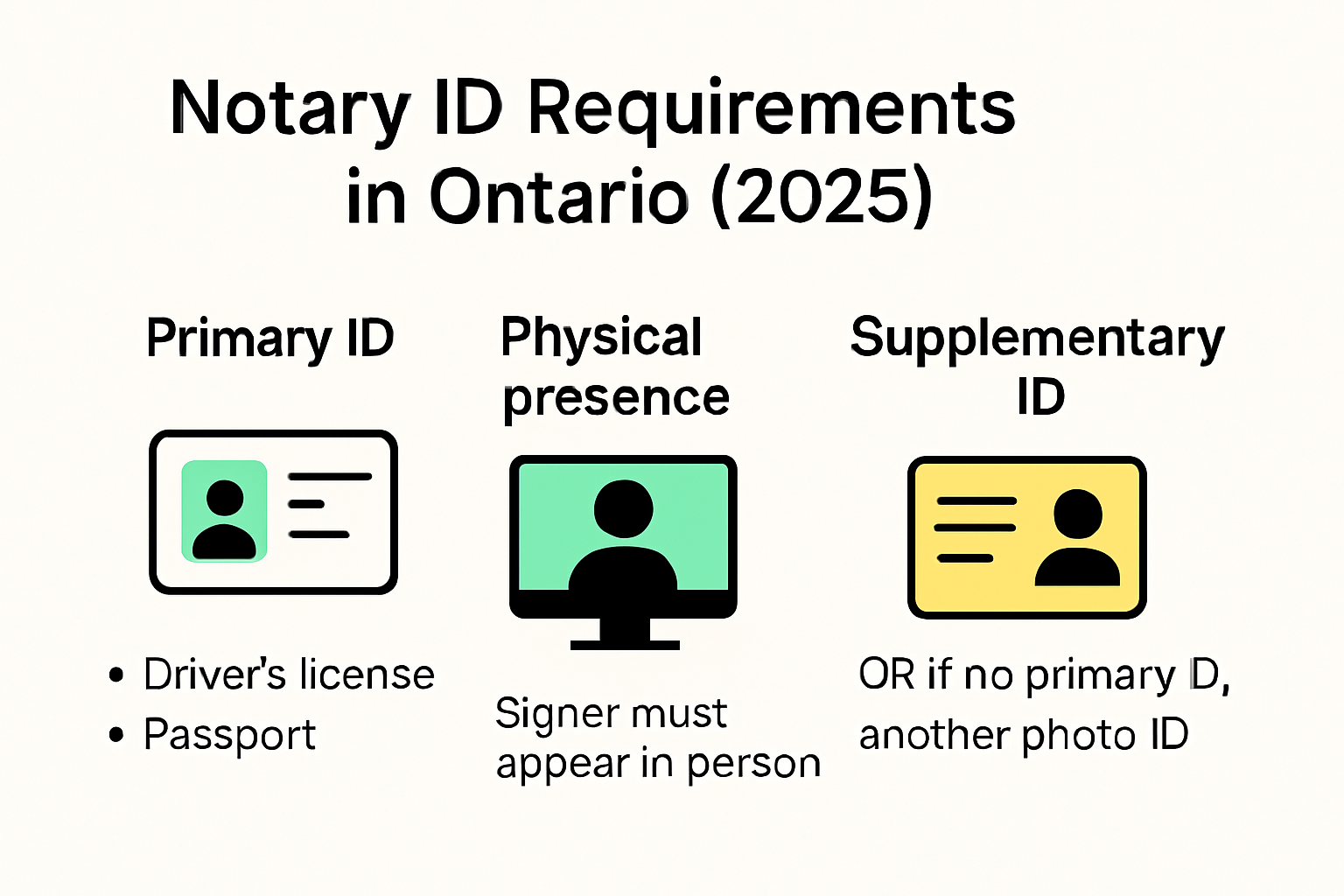
Understanding Notary Identification Requirements in Ontario
Notary identification requirements in Ontario represent a critical legal framework ensuring secure and valid document authentication. As of 2025, individuals seeking notarization must adhere to strict protocols that protect against fraud and verify personal identity.
Acceptable Identity Documentation
The identification process for notarization in Ontario demands comprehensive verification. Explore our comprehensive notary guide to understand the nuanced requirements. According to the Government of Ontario, acceptable identification must meet specific criteria:
- Government Issued Photo ID: Primary documents like driver’s licenses, passports, and provincial photo cards are preferred.
- Original Documents: Photocopies or digital images are generally not acceptable for notarization.
- Current Validity: Identification must be current and not expired.
Notaries are legally obligated to carefully examine these documents, confirming both the individual’s identity and the document’s authenticity. The examination process involves visual inspection, checking security features, and comparing the presented photo with the individual present.
Legal Verification Procedures
The Law Society of Ontario mandates rigorous verification procedures. According to their official notice, physical presence remains a critical component of the notarization process. This means digital or remote notarization is not currently permitted, requiring individuals to appear in person with valid identification.
Notaries must confirm identity through multiple layers of verification. This includes not just visual matching but also understanding the context of the document being notarized and ensuring the individual’s comprehension and willingness to sign.
Additional Identification Scenarios
Some scenarios require supplementary identification methods. When primary government-issued photo identification is unavailable, individuals might need to present multiple pieces of supporting documentation. These could include combination of documents like birth certificates, social insurance cards, or other official records that collectively establish identity.
For individuals facing unique identification challenges specific legal provisions exist. Notaries are trained to handle complex identification scenarios while maintaining legal and ethical standards. This might involve additional sworn statements or alternative verification methods approved by legal authorities.
Understanding these identification requirements protects both the individual seeking notarization and the broader legal ecosystem. Proper identification ensures document integrity, prevents potential fraud, and maintains the trust inherent in official legal processes.
Accepted Types of Identification for Notarization
Notarization in Ontario requires precise identification standards to ensure legal integrity and prevent potential fraud. The identification process serves as a critical safeguard in authenticating an individual’s identity during important legal transactions.
Primary Government-Issued Photo Identification
The Law Society of Ontario mandates strict guidelines for acceptable identification. Primary documents must meet specific criteria:
- Passport: Canadian or foreign government-issued passports with clear photographic identification
- Driver’s License: Provincial photo driver’s license with current validity
- Provincial Photo Card: Official government-issued photo identification card
These documents must be original, current, and contain a clear photograph matching the individual presenting them. Notaries conduct thorough visual inspections, checking security features and comparing the presented photo with the person present.
Secondary and Supplementary Identification
When primary identification is unavailable, individuals may need to provide multiple supporting documents. According to government regulations, acceptable supplementary documentation might include:
- Birth certificates
- Social insurance cards
- Permanent resident cards
- Official immigration documents
Learn more about document verification for those facing unique identification challenges. The goal is to establish a comprehensive and reliable method of identity confirmation.
Special Identification Scenarios
Some individuals may encounter unique identification circumstances. The Law Society of Ontario recognizes that not all identification scenarios are straightforward. In cases where standard documentation is challenging to obtain, notaries can:
- Request additional sworn statements
- Utilize alternative verification methods
- Consult with legal authorities for guidance
It is crucial to understand that physical presence remains mandatory for notarization. Remote or digital verification is not currently permitted under Ontario law.
Notaries play a critical role in maintaining the integrity of legal documents. Their careful examination of identification ensures that only verified individuals can complete important legal transactions. This rigorous process protects both the individual and the broader legal system from potential fraud and misrepresentation.
Individuals seeking notarization should prepare their most current and official government-issued photo identification. Understanding these requirements in advance can streamline the notarization process and prevent potential delays or complications.
Here is a summary table outlining the types of identification accepted for notarization and their key requirements:
| Type of Identification | Examples | Requirements |
|---|---|---|
| Primary Government-Issued Photo ID | Driver’s License, Passport, Provincial Photo Card | Original, current, clear photo |
| Supplementary Identification | Birth Certificate, Social Insurance Card, Permanent Resident Card, Immigration Documents | May require multiple documents, original and valid |
| Alternative Methods | Sworn Affidavit, Institutional Record, Certified Copies | Used if standard ID unavailable, must be official |
What to Do if You Lack Standard Identification

Lacking standard identification can create challenges during the notarization process. However, Ontario provides alternative pathways for individuals who cannot produce primary government-issued photo identification.
Alternative Documentation Strategies
Learn about alternative verification methods when standard identification is unavailable. According to the Ontario government, individuals can utilize multiple strategies to establish their identity:
- Sworn Affidavits: A legally signed statement providing personal details and explaining identification limitations
- Supplementary Supporting Documents: Certified copies from recognized institutions like schools, employers, or places of worship
- Institutional Records: Original documents with official seals confirming identity
Notaries will carefully review these alternative documents, ensuring they provide sufficient evidence of personal identity. The goal is to create a comprehensive verification process that maintains legal integrity while accommodating individuals with unique identification circumstances.
Official Alternative Identification Options
Ontario offers several official identification alternatives for residents. The Ontario Photo Card provides an excellent solution for non-drivers aged 16 and older who need government-issued identification. This card serves as a legitimate form of identification for various official purposes.
For newcomers or individuals with complex identification histories, additional options exist. Immigration documents, permanent resident cards, and other official government records can supplement or replace traditional identification methods. Notaries are trained to work with diverse documentation and can guide individuals through complex verification processes.
Emerging Digital Identity Solutions
Ontario is actively developing innovative identity verification technologies. The Digital ID program represents a forward-thinking approach to identification, offering secure electronic verification methods. While not yet a complete replacement for physical identification, this initiative demonstrates the province’s commitment to accessible and flexible identification solutions.
Below is a table that summarizes your options if you do not have standard identification for notarization in Ontario:
| Alternative Option | Description | Requirement/Notes |
|---|---|---|
| Sworn Affidavit | Legally signed statement with personal details | Must explain ID limitations; may need notary/institution |
| Supplementary Documents | Certified copies from recognized institutions | Must be original, official, and recent |
| Institutional Record | Documents with official seals (schools, employers, etc.) | Must be original and authentic |
| Ontario Photo Card | Government-issued card for non-drivers aged 16+ | Must be current and valid |
| Immigration Documents | PR card, official immigration record | Must be official, original |
| Digital Identity Program | Secure electronic verification (emerging, not yet standalone) | May supplement, not replace, physical presence |
Individuals facing identification challenges should:
- Gather all available official documents
- Consult with the notary in advance about specific documentation
- Be prepared to provide additional context or supporting evidence
- Consider obtaining alternative government-issued identification
The notarization process prioritizes legal integrity and personal verification. Even without standard identification, individuals can successfully navigate notarization by working closely with qualified professionals and presenting comprehensive documentation.
Understanding these alternative pathways reduces stress and confusion. By being proactive and prepared, individuals can effectively address identification challenges and complete their required legal documentation.
Tips for Businesses and Individuals Preparing Documents
Preparing documents for notarization requires careful attention to detail and understanding of legal requirements. Businesses and individuals must take proactive steps to ensure smooth and efficient document authentication in Ontario.
Document Preparation Fundamentals
Successful document notarization begins with thorough preparation. Check out our comprehensive notary preparation guide to understand the critical steps. According to the Law Society of Ontario, physical presence is mandatory for notarization, making advance preparation crucial.
Key preparation steps include:
- Ensuring all documents are complete and fully filled out
- Verifying that all required signatures have appropriate spaces
- Checking that documents do not contain blank spaces
- Having all original documents ready for inspection
Businesses should establish internal protocols that guarantee document completeness before scheduling a notarization appointment. This proactive approach minimizes potential delays and complications during the verification process.
Identification and Documentation Requirements
The Ontario government provides clear guidelines for acceptable identification. Individuals and businesses must carefully gather and organize identification documents before notarization. Recommended preparation includes:
- Collecting primary government-issued photo identification
- Preparing alternative supporting documents if standard ID is unavailable
- Ensuring all identification documents are current and valid
- Understanding specific requirements for different types of documents
Particularly for businesses, maintaining a systematic approach to document preparation can streamline the notarization process. This might involve creating internal checklists and training staff on identification verification protocols.
Special Considerations for Complex Documents
Some documents require additional layers of preparation and verification. Complex legal documents, international agreements, or specialized corporate paperwork may need extra attention. Businesses should:
- Consult legal professionals when preparing intricate documents
- Review document language and terminology carefully
- Ensure all parties understand the document’s contents
- Verify that all required signatories will be present during notarization
Notaries play a critical role in verifying document integrity. Their careful examination helps prevent potential legal complications arising from improperly prepared documentation.
While digital solutions continue to evolve, the current legal framework in Ontario requires physical presence for notarization. Businesses and individuals must adapt their document preparation strategies accordingly, prioritizing thoroughness and accuracy.
Frequently Asked Questions
What identification is required for notarization in Ontario in 2025?
For notarization in Ontario, individuals must present a current, original government-issued photo ID, such as a driver’s license, passport, or provincial photo card.
Can I use secondary documents if I don’t have a primary ID?
Yes, if primary identification is unavailable, you can provide supplementary documents like birth certificates or social insurance cards to help establish your identity.
Is remote notarization allowed in Ontario?
No, remote notarization is not permitted in Ontario. Individuals must appear in person for the notarization process.
What should I do if I lack standard identification for notarization?
If you lack standard identification, you can utilize alternatives such as sworn affidavits, certified copies from recognized institutions, or official documents like the Ontario Photo Card to verify your identity.
Struggling With Notary Identification? Get Reliable Help Now
You have just read how strict notary identification rules in Ontario can leave you feeling concerned about missing documents or in-person requirements. Many people worry about being turned away because they cannot present the right government-issued photo ID or need support navigating supplementary documents or sworn affidavits. With confusing legal procedures and no remote notary option, the risk of delay and rejection is real.

Ready to take the stress out of notarization? Visit The Online Notary to access simple step-by-step guidance and secure online support for affidavits, invitation letters, statutory declarations, solemn declarations, and more. Make sure your identification challenges do not stand in the way. Discover how our experienced team can walk you through requirements just like those explained in our notary services overview and help prepare your documentation quickly and accurately. Do not wait until you are facing a deadline. Get started with Ontario’s trusted online notary today.
Recommended
- Why Opt for an Online Notary in Ontario – The Online Notary CA
- The Complete Guide to Using an Online Notary Public for Affidavits and Declarations in Ontario (2025) – The Online Notary CA
- What is an Online Notary? – The Online Notary CA
- Professional Online Notary Services in Canada – The Online Notary CA