
Online notaries are changing how people in Ontario handle legal paperwork, making it possible to get documents notarized without ever leaving home. Here is the wild part. Ontario officially legalized online notarization under Regulation 431/20 and even requires advanced identity checks and encrypted platforms for security. Not all documents are eligible for this digital convenience and some might still demand the old-fashioned in-person approach.
Table of Contents
- Ontario Laws on Online Notarization
- How Online Notary Services Work
- Benefits and Limitations for Ontario Residents
- Choosing a Legal Online Notary in Ontario
Quick Summary
| Takeaway | Explanation |
|---|---|
| Online notarization is legally recognized in Ontario. | Ontario Regulation 431/20 outlines guidelines for electronic commissioning, ensuring remote notarization is legally valid. |
| Use secure technology for notarization. | Notaries must utilize encrypted platforms and maintain detailed audit trails for safe and compliant digital document verification. |
| Know the limitations of online notarization. | Certain documents may require in-person notarization, and online services depend on reliable internet connectivity. |
| Verify a notary’s credentials thoroughly. | Ensure the notary is officially appointed, holds active certification, and has received specialized training in digital notarization. |
| Choose reputable online notary platforms. | Evaluate security standards, pricing, customer support, and turnaround times to find a trustworthy notary service provider. |
Ontario Laws on Online Notarization
Online notarization in Ontario represents a complex legal landscape that has rapidly evolved with technological advancements. Understanding the current regulatory framework is crucial for individuals and businesses seeking remote authentication services.
Legal Framework for Electronic Commissioning
The Ontario government has implemented specific regulations that officially recognize online notarization as a legal process. Ontario Regulation 431/20, enacted under the Commissioners for Taking Affidavits Act, provides comprehensive guidelines for electronic commissioning of documents. This regulation explicitly outlines the conditions under which remote notarization is permitted, establishing a clear legal pathway for digital document authentication.
Key requirements for legal online notarization include:
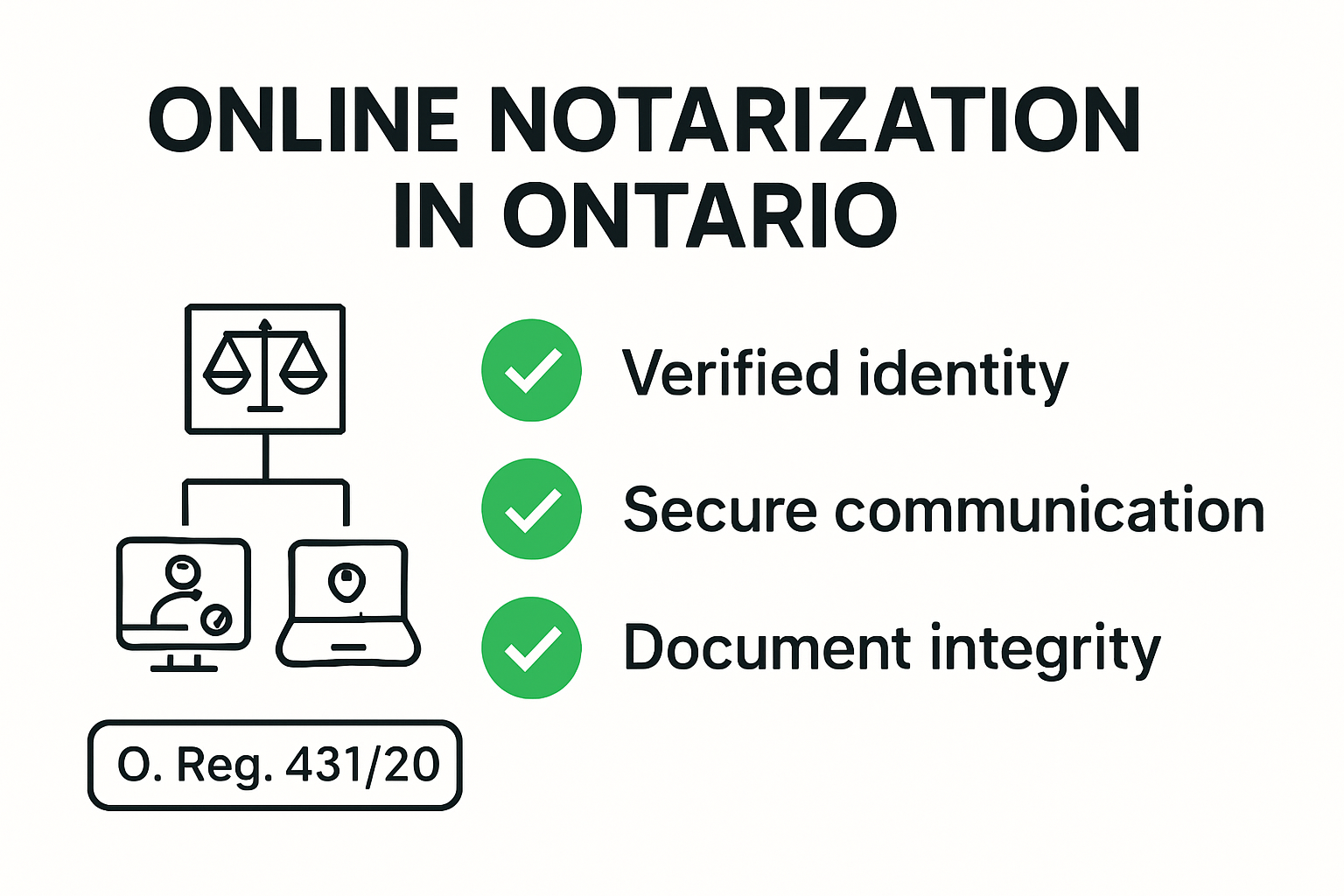
- Verified Identity: Commissioners must use robust electronic methods to confirm the identity of individuals signing documents.
- Secure Communication: Electronic platforms must ensure a reliable and private communication channel during the notarization process.
- Document Integrity: Digital signatures and electronic records must maintain the same legal validity as traditional paper documents.
To help you quickly understand what is required for legal online notarization in Ontario, here is a summary table of the core regulatory and technological requirements mentioned in Regulation 431/20.
| Requirement | Description |
|---|---|
| Verified Identity | Use robust electronic methods to confirm signer’s identity |
| Secure Communication | Private and reliable communication channel during notarization |
| Document Integrity | Digital signatures and records must maintain same validity as paper documents |
| Electronic Recordkeeping | Maintain detailed electronic records and audit trails |
| Encrypted Platforms | Utilize encrypted technology for all documentation and video sessions |
Technological and Legal Compliance
The legal acceptance of online notarization hinges on strict technological and procedural standards. Official Documents Services in Ontario emphasizes that while remote commissioning is permitted, certain documents may have additional authentication requirements, particularly for international use.
Notaries and commissioners must adhere to specific protocols to ensure legal compliance. This includes maintaining detailed electronic records, using encrypted communication platforms, and following precise identification verification procedures. The goal is to create a digital process that matches the security and reliability of in-person notarization.
Businesses and individuals seeking online notary services should carefully review the comprehensive guide to online notarization to understand the nuanced legal requirements and ensure their documents remain legally valid.
The evolution of online notarization laws reflects Ontario’s commitment to modernizing legal processes while maintaining rigorous standards of document authentication. As technology continues to advance, these regulations will likely adapt to provide even more streamlined and secure methods of remote document certification.
How Online Notary Services Work
Online notary services have transformed document authentication by leveraging digital technologies to provide convenient and secure verification processes. Understanding the mechanics of these services helps individuals and businesses navigate the modern landscape of legal document certification.
Digital Identification and Authentication
The cornerstone of online notary services is robust digital identification. According to Official Documents Services in Ontario, notaries must employ stringent verification methods to confirm a person’s identity. This typically involves multiple steps:
- Government ID Verification: Uploading clear images of government-issued photo identification
- Live Video Confirmation: Real-time video interaction to match the individual with their submitted documents
- Knowledge-Based Authentication: Answering specific personal history questions that only the true document signer would know
These multi-layered verification processes ensure that online notarization maintains the same level of security as traditional in-person authentication methods.
Technological Platform Requirements
Successful online notarization depends on sophisticated technological platforms that meet strict legal standards. Learn more about the technical aspects of online notarization to understand the complex infrastructure supporting these services.
The digital platforms must provide:
- Encrypted Communication: Secure channels that protect personal and document information
- Document Tracking: Comprehensive audit trails recording every step of the notarization process
- Electronic Signature Capabilities: Advanced digital signature technologies that meet legal requirements
Workflow of Online Notarization
Ontario’s guidelines for becoming a commissioner outline the professional standards that online notaries must follow. The typical workflow involves:
- Document Upload: Client submits documents through a secure online portal
- Identity Verification: Comprehensive digital identity checks
- Live Video Session: Interactive meeting with a certified notary public
- Document Witnessing: Real-time review and electronic certification
- Secure Document Delivery: Authenticated documents returned via encrypted channels
This streamlined process eliminates geographical barriers while maintaining the legal integrity of document authentication. Online notary services represent a significant advancement in making legal processes more accessible and efficient for Ontario residents.
Here is a step-by-step overview of the typical workflow for online notarization in Ontario, helping you visualize the remote digital process:
| Step | What Happens |
|---|---|
| 1. Document Upload | Client submits documents through a secure online portal |
| 2. Identity Verification | Comprehensive digital ID checks (ID upload, video, knowledge questions) |
| 3. Live Video Session | Interactive meeting with certified notary public |
| 4. Document Witnessing | Real-time review and electronic certification |
| 5. Secure Document Delivery | Authenticated documents are returned to client via encrypted channels |
Benefits and Limitations for Ontario Residents
Online notary services offer Ontario residents a modern approach to document authentication, bringing both significant advantages and potential challenges. Understanding these nuanced aspects helps individuals make informed decisions about utilizing digital notarization services.
Advantages of Online Notarization
Online notary services provide remarkable convenience for Ontario residents. Explore the latest digital notarization solutions to understand how technology is transforming document verification.
Key benefits include:
- Accessibility: Residents can authenticate documents from anywhere in Ontario without geographical constraints
- Time Efficiency: Eliminates travel time and reduces waiting periods associated with traditional notarization
- Flexible Scheduling: Available outside standard business hours, accommodating diverse work schedules
- Cost Effectiveness: Often more affordable than in-person notarization services
Potential Limitations and Considerations
According to Official Documents Services in Ontario, while online notarization offers significant benefits, certain limitations exist. Not all documents are suitable for electronic authentication, and some legal contexts may require traditional in-person verification.
Critical limitations include:
- Document Type Restrictions: Some specialized documents might still require physical presence
- Technology Requirements: Reliable internet connection and compatible digital devices are necessary
- Privacy Concerns: Individuals must be comfortable with digital identity verification processes
- International Recognition: Some foreign jurisdictions may not immediately accept electronically notarized documents
Navigating Digital Notarization Effectively
To maximize the benefits of online notary services, Ontario residents should:
- Verify document eligibility for electronic notarization
- Ensure robust internet connectivity
- Prepare valid government identification
- Choose reputable online notary platforms
- Understand specific requirements for intended document use
While online notarization represents a significant advancement in legal document processing, residents must approach it with an understanding of both its capabilities and limitations. The technology continues to evolve, promising increasingly sophisticated and secure methods of remote document authentication.
To help compare the key advantages and limitations of online notarization in Ontario, the following table summarizes the primary points discussed in this section:
| Aspect | Online Notarization: Key Points |
|---|---|
| Advantages | Accessible from anywhere; time efficient; flexible scheduling; cost effective |
| Limitations | Some documents excluded; needs reliable internet; privacy considerations; not always internationally recognized |
Choosing a Legal Online Notary in Ontario
Selecting a reputable and legally compliant online notary in Ontario requires careful consideration of multiple factors. The digital landscape of document authentication demands a strategic approach to ensure your documents are processed accurately and legally.
Legal Credentials and Professional Certification
According to the Government of Ontario, not all individuals can become notaries. When choosing an online notary, verify their professional credentials meticulously. Key considerations include:
- Official Appointment: Confirm the notary is officially appointed under Ontario regulations
- Professional Background: Preferably a lawyer, paralegal, or professional with documented legal authorization
- Current Certification: Active and valid commissioning credentials
- Specialized Training: Additional digital authentication training
Learn more about selecting professional online notary services to understand the nuanced requirements of legal document authentication.
Technology and Security Standards
Legal experts at Hull and Hull LLP emphasize the critical importance of technological compliance in online notarization. When evaluating an online notary, assess their technological infrastructure:
- Secure Communication Platforms: End-to-end encrypted video conferencing
- Document Management: Robust digital storage and transmission protocols
- Identity Verification: Advanced multi-factor authentication mechanisms
- Compliance Tracking: Comprehensive audit trail capabilities
Essential Selection Criteria
Beyond legal and technological considerations, several practical factors determine the quality of an online notary service:
- Transparent Pricing Structure
- Quick Turnaround Times
- Clear Communication Channels
- Comprehensive Customer Support
- Positive Professional Reputation
Ontario residents must approach online notarization with diligence. While digital document authentication offers unprecedented convenience, selecting the right service provider remains crucial. Thoroughly research potential online notaries, verify their credentials, and prioritize services that demonstrate unwavering commitment to legal standards and technological security.

Remember that the legal landscape of online notarization continues to evolve. Staying informed about current regulations and choosing a forward-thinking, compliant service will ensure your documents are processed efficiently and legally.
Frequently Asked Questions
Are online notaries legal in Ontario?
Yes, online notarization is legally recognized in Ontario under Regulation 431/20, which outlines the guidelines for electronic commissioning of documents.
What requirements must be met for online notarization in Ontario?
Online notarization in Ontario requires verified identity, secure communication channels, document integrity, electronic recordkeeping, and the use of encrypted platforms.
What are the advantages of using online notary services?
Online notary services offer accessibility from anywhere, time efficiency, flexible scheduling, and often more affordable costs compared to traditional notarization methods.
Are there limitations to online notarization in Ontario?
Yes, certain documents may still require in-person notarization, and online services depend on reliable internet connections, privacy considerations, and may not be recognized internationally in some cases.
Take the Guesswork Out of Online Notarization in Ontario
Are you struggling to navigate the new digital landscape created by Ontario’s Regulation 431/20? It is common to feel overwhelmed when it comes to identifying which documents qualify, choosing the right notarization platform, or ensuring that your documents will stand up to legal scrutiny. If you have wondered how to confidently notarize sensitive items like affidavits, invitation letters, or statutory declarations online, you are not alone. Many Ontario residents worry about issues like secure identity verification, the legal validity of electronic signatures, and whether a platform truly complies with provincial laws.

You do not have to face these challenges by yourself. At theonlinentoary.ca, you will find expert online notary solutions designed to address every concern highlighted in the article. Our service guarantees:
- Fast and legally recognized notarization from anywhere in Ontario
- Advanced identity verification and encrypted document handling
- Support with affidavits, invitation letters, statutory and solemn declarations, and more
Do not risk your time or legal peace of mind. Discover how our secure online notary platform brings clarity and compliance to your next notarization. Get started now to make your Ontario documents legally valid—without the confusion or the wait.