
Notary publics in Ontario do more than just stamp documents and sign forms. Believe it or not, notaries handle everything from certifying life-changing legal contracts to authenticating documents for use in over 190 countries. Most people think a notary’s job is all paperwork and routine, but the real surprise is how much legal power and responsibility sits behind every signature they witness.
Table of Contents
- What A Notary Public Does In Ontario
- Key Responsibilities And Legal Requirements
- Common Documents Notarized For Individuals And Businesses
- Choosing The Right Notary Public In Ontario
Quick Summary
| Takeaway | Explanation |
|---|---|
| Notaries authenticate important documents | Notaries public verify documents through authentication services, ensuring their legality and validity for various purposes. |
| Oath administration is a key duty | They administer oaths and declarations, essential for legal documents requiring sworn statements, like affidavits. |
| Choose a qualified notary public | Always verify the credentials of a notary public to ensure they are current and experienced in the relevant field. |
| Specialization can affect service quality | Different notaries may specialize in specific areas, such as immigration or corporate documents, impacting their effectiveness. |
| Protect client confidentiality | Notaries must handle sensitive information with care and cannot provide legal advice beyond their authentication role. |
What a Notary Public Does in Ontario
Notary public duties in Ontario involve critical legal authentication and verification services that help individuals and businesses validate important documents and legal transactions. These professionals play a significant role in ensuring the integrity and legitimacy of various official documents and legal processes.
Document Authentication and Certification
A notary public in Ontario serves as an official witness who provides crucial authentication services. According to the Ontario Ministry of the Attorney General, their primary responsibilities include administering oaths, taking affirmations and declarations, attesting the execution of documents, and certifying true copies of original documents for official use. This means when you need a document to be legally recognized, a notary public can verify its authenticity and validity.
The scope of document authentication is broad. Notaries can help with various documents such as passport copies, educational transcripts, corporate documents, real estate paperwork, and international business contracts. Their official seal and signature provide a level of credibility that many institutions and organizations require.
Legal Witnessing and Oath Administration
One of the most important notary public duties involves administering oaths and statutory declarations. When individuals need to make a formal statement under oath, a notary public can oversee this process. This is particularly important for affidavits, statutory declarations, and other legal documents that require a sworn statement.
For instance, if someone needs to declare something as true for legal purposes, they can do so in the presence of a notary public. The notary ensures that the person understands the significance of their statement and witnesses their signature, adding legal weight to the document.
International Document Verification
Notaries in Ontario also play a crucial role in international document verification. Many documents used across borders require additional authentication to be legally recognized. A notary public can provide the necessary certification to ensure documents meet international standards.
Research from Global Affairs Canada highlights the importance of proper document authentication for international transactions. Notaries help individuals and businesses navigate complex legal requirements by providing official verification that can be recognized in different jurisdictions.
For those seeking comprehensive notary services, our guide on notary public roles offers more detailed insights into the specific processes and legal implications of document authentication in Ontario.
Key Responsibilities and Legal Requirements
Notary public duties in Ontario are governed by strict legal frameworks that define their professional responsibilities and ethical obligations. Understanding these requirements is crucial for maintaining the integrity of legal document authentication and verification processes.
Appointment and Professional Standards
According to the Notaries Act of Ontario, notaries public are appointed through a rigorous process that ensures only qualified professionals can perform these critical legal functions. The appointment involves thorough background checks and verification of professional credentials. Notaries must demonstrate a comprehensive understanding of legal documentation, verification protocols, and ethical standards.
The National Occupational Classification outlines specific professional competencies required for notaries public in Canada. These include exceptional attention to detail, strong communication skills, and a deep understanding of legal documentation requirements. Notaries must maintain professional standards that include accuracy, confidentiality, and impartiality in all their official duties.
Legal Documentation and Verification Protocols
Notaries public in Ontario are responsible for implementing stringent verification protocols for various legal documents. This involves carefully examining original documents, confirming the identity of signatories, and ensuring the authenticity of legal instruments. They must verify that individuals signing documents are doing so willingly and understand the legal implications of their actions.
The verification process includes several critical steps:
- Identity Confirmation: Checking government issued photo identification
- Document Examination: Ensuring documents are complete and unaltered
- Signature Witnessing: Verifying that signatures are genuine and voluntary
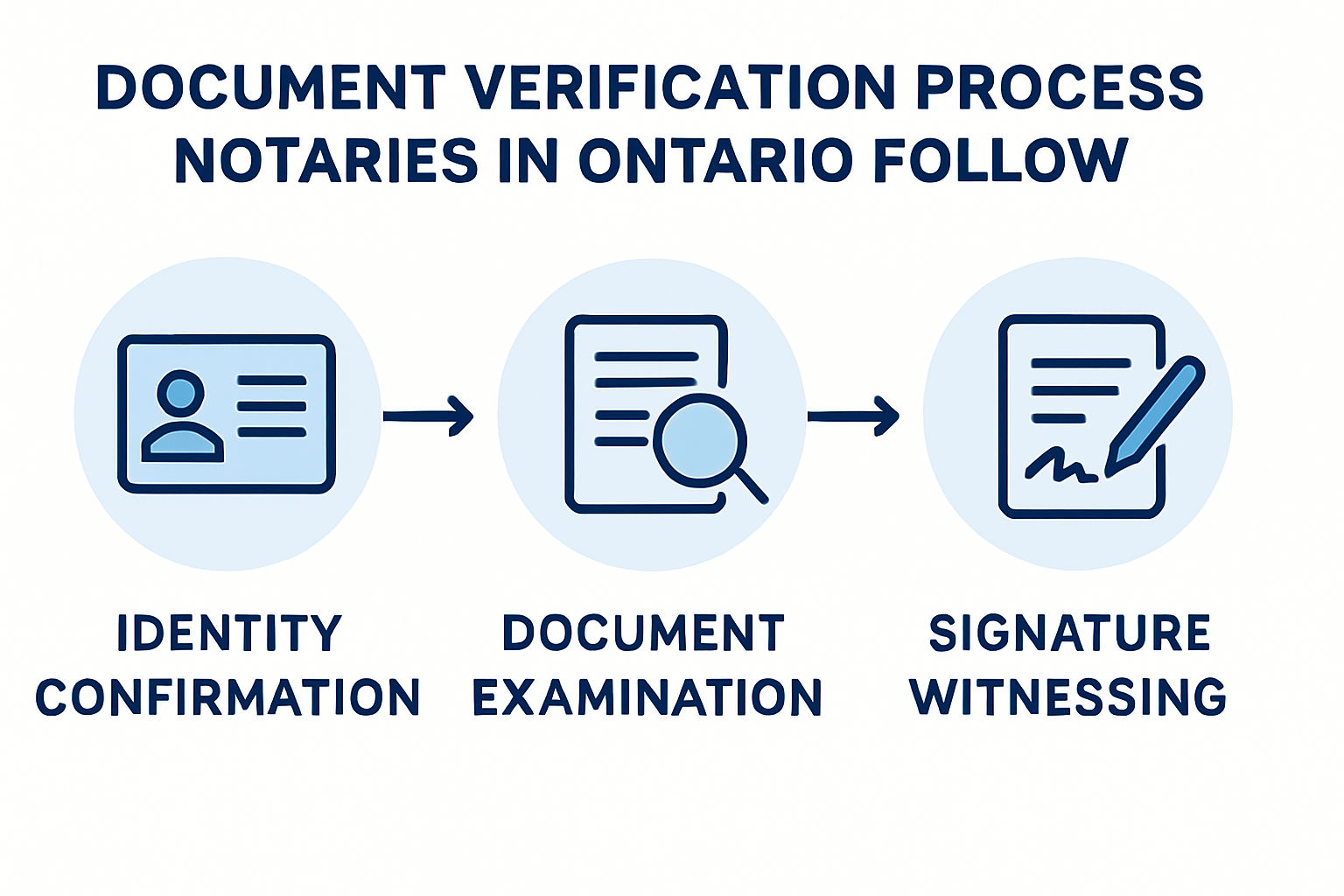
The process of legal document verification by a notary public in Ontario involves several important steps. The table below outlines this standard protocol for ensuring document authenticity and legal compliance.
| Verification Step | Description |
|---|---|
| Identity Confirmation | Checking government-issued photo identification of the signatories |
| Document Examination | Ensuring all documents are complete, original, and unaltered |
| Signature Witnessing | Verifying that each signature is genuine and provided voluntarily |
| Record Keeping | Maintaining detailed records of all notarized/authenticated documents |
| Legal Testimony | Being prepared to provide testimony about the verification process if needed |
Professionals must maintain detailed records of all authenticated documents and be prepared to provide testimony about the verification process if required by legal authorities.
Ethical and Professional Limitations
Notaries public operate within strict ethical boundaries that prevent conflicts of interest and protect the integrity of legal processes. They cannot authenticate documents in which they have a personal or financial interest. This requirement ensures objective and unbiased document verification.
Additionally, notaries must protect client confidentiality and handle sensitive information with the utmost discretion. They are prohibited from providing legal advice beyond their specific authentication responsibilities. Read more about the nuanced role of notaries to understand the precise boundaries of their professional practice.
The legal requirements for notaries public in Ontario are designed to maintain the highest standards of document authentication, ensuring that legal and official documents can be trusted across various jurisdictions and legal contexts.
Common Documents Notarized for Individuals and Businesses
Notary public services in Ontario cover a wide range of documents for both individuals and businesses, ensuring legal authenticity and providing critical verification across various personal and professional contexts. Understanding the types of documents that require notarization can help streamline important legal and administrative processes.
Personal Document Authentication
Individuals frequently need notarization for numerous personal documents. Passport copies, educational transcripts, and immigration-related paperwork often require official verification. Affidavits and statutory declarations are particularly common personal documents that demand notarial certification. These documents serve critical purposes in legal proceedings, identity verification, and official communications.
Travelers and students, in particular, rely on notary services for document authentication. Individuals preparing for international travel, applying for educational programs, or managing complex legal situations need precise document verification. When navigating document requirements, understanding which documents need notarization can save significant time and prevent potential legal complications.
Business and Corporate Documentation
Businesses in Ontario require extensive notarial services for various corporate documents. Articles of incorporation, partnership agreements, and commercial contracts frequently need official authentication. Power of attorney documents, which grant legal representation, are another critical area where notary public services become essential.
International business transactions demand rigorous document verification. Export agreements, trademark registrations, and international contract documents often require notarial certification to ensure legal recognition across different jurisdictions. Notaries help businesses establish credibility and legal compliance in complex transactional environments.
Real Estate and Financial Documentation
Real estate transactions represent a significant domain for notary public services. Property transfer documents, mortgage agreements, and lease contracts typically require official verification. Individuals and businesses alike depend on notaries to authenticate these critical financial instruments.
Additionally, financial institutions often mandate notarized documents for loan applications, investment agreements, and other significant monetary transactions. Online notarization services have made these processes more accessible, allowing individuals and businesses to complete critical documentation efficiently.
Notary public services ensure that documents maintain legal integrity, providing individuals and businesses with the confidence that their important paperwork is properly authenticated and recognized by relevant authorities.
To help readers better understand the types of documents commonly notarized for both individuals and businesses in Ontario, the following table summarizes key document categories and provides examples for each.
| Document Category | Common Examples | Typical Purpose |
|---|---|---|
| Personal | Passport copies, educational transcripts, affidavits | Identity verification, legal proceedings |
| Immigration | Statutory declarations, application forms | Visa/immigration processes |
| Business/Corporate | Articles of incorporation, partnership agreements | Corporate setup, official transactions |
| International Transactions | Export agreements, power of attorney (international) | Cross-border business/legal recognition |
| Real Estate | Mortgage agreements, property transfer documents | Property sale, leasing, ownership transfer |
| Financial | Loan applications, investment agreements | Securing loans, financial validation |
Choosing the Right Notary Public in Ontario
Selecting the appropriate notary public in Ontario requires careful consideration of several critical factors. The right professional can make a significant difference in ensuring your documents are authenticated accurately and efficiently.
Professional Qualifications and Credentials
According to the Government of Ontario, notary public appointments are typically valid for three-year terms, with opportunities for renewal. When choosing a notary, verifying their current credentials is essential. Look for professionals who have a current appointment and demonstrate a comprehensive understanding of legal documentation requirements.
Key qualifications to consider include:
- Current provincial appointment
- Experience in your specific document type
- Professional reputation
- Knowledge of legal authentication processes
Verifying a notary’s credentials can help ensure you are working with a legitimate and competent professional who can meet your specific documentation needs.
Specialization and Document Expertise
Employment and Social Development Canada highlights that notaries often receive specialized training for various document types. Different notaries may have expertise in specific areas such as international documents, corporate paperwork, or personal authentication.
When selecting a notary public, consider their specialization. A notary experienced in immigration documents might differ from one specializing in real estate transactions. Understanding their specific area of expertise can help you choose a professional most suited to your requirements.
Accessibility and Service Options
Modern notary services offer various accessibility options to accommodate different client needs. Consider factors such as:
- Location flexibility: In person versus online services
- Turnaround time for document authentication
- Communication responsiveness
- Technology integration for document processing
Can anyone notarize a document in Ontario? Understanding the legal requirements helps you make an informed decision about your notarization needs.
Choosing the right notary public involves balancing professional credentials, specialized expertise, and service accessibility. Taking time to research and select a qualified professional ensures your documents receive proper authentication and legal recognition.

Frequently Asked Questions
What does a notary public do in Ontario?
Notaries public in Ontario authenticate important documents, administer oaths, and certify true copies of legal documents to ensure their legitimacy for various purposes.
How can I verify the credentials of a notary public in Ontario?
You can verify the credentials of a notary public by checking their current appointment status through the Government of Ontario’s official resources or by exploring their professional reputation and experience in specific document types.
What types of documents commonly require notarization in Ontario?
Common documents that require notarization in Ontario include passport copies, educational transcripts, affidavits, real estate paperwork, and corporate documents like articles of incorporation and partnership agreements.
Can a notary public provide legal advice?
No, notaries public in Ontario cannot provide legal advice beyond their specific role in authenticating documents. They must remain neutral and unbiased in the verification process.
Simplifying Document Authentication in Ontario
Are you feeling overwhelmed by the complexities of document authentication and the strict legal requirements discussed in this article? Whether you need affidavits, invitation letters, or statutory declarations notarized, the risk of errors or delays can be stressful, especially when your documents are required for legal or international purposes. With the demand for accurate verification and the need to protect sensitive information, finding a trusted solution is critical.

Skip the uncertainty and get your documents notarized with ease. Experience secure, fully online notary public services for Ontario residents at theonlinentoary.ca. We guide you through each step of document authentication and help you avoid common mistakes. Start now and feel confident knowing your paperwork meets Ontario’s highest legal standards. Learn more about our online process and how we can assist with your specific needs at theonlinentoary.ca. The right solutions are only a click away.