Notarized document translation acts as a legal passport for your words, turning your personal papers or business records into valid tools that work across languages and borders. Now consider this. Nearly 78 percent of legal and official document translations demand notarization before they will even be looked at in Ontario. Most people think a simple translation is enough but the real power lies in that official notary stamp. This one detail can mean the difference between your documents opening doors or getting rejected at the counter.
Table of Contents
- What Is Notarized Document Translation?
- Why Is Notarized Document Translation Important?
- The Process And Features Of Notarized Document Translation
- Key Concepts In Notarized Document Translation
- Real-World Applications Of Notarized Document Translation
Quick Summary
| Takeaway | Explanation |
|---|---|
| Notarized translations are legally essential | Many government and official processes require notarized translations for validation and acceptance. |
| Involves professional translation and certification | A certified translator must complete the translation, verified by a notary public for authenticity. |
| Critical for immigration and academic purposes | Notarized translations are mandatory for submitting essential documents like birth and marriage certificates. |
| Prevents legal complications | Without notarization, documents can be rejected, leading to delays and added costs. |
| Ensures accuracy and integrity | The process maintains legal integrity, ensuring every detail of the original document is preserved in translation. |
What is Notarized Document Translation?
Notarized document translation is a specialized legal process that transforms written documents from one language to another while simultaneously providing an official certification of accuracy. Unlike standard translations, notarized document translations carry significant legal weight and are recognized by government agencies, academic institutions, and official entities in Ontario.
The Core Components of Notarized Translation
A notarized document translation involves three critical elements that distinguish it from regular translations:
- Professional Translation: A certified translator fluent in both source and target languages completes the document translation
- Notarial Certification: A notary public verifies the translator’s credentials and signature
- Official Seal and Signature: The final document includes an official stamp and signature confirming its authenticity
The process ensures that every word and nuance is accurately transferred between languages while maintaining the original document’s legal integrity.
Learn more about translation and notarization in Ontario to understand the comprehensive legal framework.
Why Notarized Translations Matter
Notarized document translations are crucial in numerous scenarios where precise linguistic accuracy and legal recognition are paramount. Government immigration applications, academic credential submissions, international business contracts, and legal proceedings frequently require notarized translations.
According to Global Translation Services Research, approximately 78% of legal and official document translations require notarization to be considered valid. This statistic underscores the importance of obtaining a professionally notarized translation that meets strict legal standards.
Whether you are submitting educational transcripts, marriage certificates, birth records, or business documents, a notarized translation provides the highest level of linguistic and legal authentication possible in Ontario’s official document ecosystem.
Why is Notarized Document Translation Important?
Notarized document translation plays a critical role in ensuring legal validity, accuracy, and recognition across various official contexts in Ontario. By providing a professionally authenticated translation, individuals and organizations can navigate complex bureaucratic landscapes with confidence and precision.
Legal Recognition and Compliance
In many official scenarios, notarized translations are not just recommended but legally mandatory. Government agencies, academic institutions, and legal systems require translations that have been professionally verified to ensure:
- Absolute linguistic accuracy
- Complete preservation of original document meaning
- Legal authenticity and credibility
- Compliance with official documentation standards
Learn more about legalization and notarization differences to understand the nuanced legal requirements in Ontario.
Practical Applications Across Multiple Domains
Notarized document translations are essential in numerous critical scenarios. Immigration processes, academic credential evaluations, international business transactions, and legal proceedings all demand precise linguistic authentication.
According to Immigration, Refugees and Citizenship Canada, foreign documents submitted for official purposes must be translated by certified professionals to ensure their validity and acceptance. This requirement underscores the importance of obtaining a professionally notarized translation.
Preventing Potential Legal Complications
Without proper notarization, translated documents can be rejected, leading to significant delays, additional costs, and potential legal challenges. A notarized translation serves as a robust legal safeguard, providing an official guarantee of linguistic accuracy and document integrity.
Whether you are applying for permanent residency, seeking academic recognition, or engaging in international business contracts, a notarized document translation ensures that your critical documents are understood, accepted, and legally recognized in Ontario’s complex administrative landscape.
The Process and Features of Notarized Document Translation
Notarized document translation is a meticulous and structured process that transforms linguistic content while maintaining its original legal authenticity. Understanding the specific steps and professional standards ensures that your translated documents meet rigorous official requirements in Ontario.
Translator Qualifications and Selection
The cornerstone of a successful notarized translation is the selection of a highly qualified professional translator. These experts must possess:
- Fluency in both source and target languages
- Specialized certification in translation services
- Deep understanding of legal and technical terminology
- Proven track record of accurate document translations
Explore our guide on certified translation affidavits to understand the detailed professional standards required for official translations.
Translation and Verification Process
The notarized document translation follows a comprehensive multi-step verification process:
- Initial document review and language assessment
- Professional translation by a certified linguist
- Comprehensive proofreading and quality control
- Notarial certification and authentication
According to Translation Quality Standards International, professional translations must maintain complete fidelity to the original document’s content, context, and legal implications.
Legal Authentication and Certification
The final stage involves formal legal authentication. A notary public carefully reviews the translated document, verifying the translator’s credentials and professional seal. This critical step transforms a standard translation into a legally recognized document that government agencies, academic institutions, and legal entities will accept.
Notarized document translations represent more than mere linguistic conversion.
The table below summarizes the core steps and responsible parties in the notarized document translation process, offering a quick reference for understanding how legal recognition is obtained.
| Step | Responsible Party | Purpose |
|---|---|---|
| Document Review & Language Assessment | Certified Translator | Initial evaluation and preparation |
| Professional Translation | Certified Translator | Accurate conversion to target language |
| Proofreading & Quality Control | Translator/Proofreader | Ensuring consistency and accuracy |
| Notarial Certification & Authentication | Notary Public | Official verification of translation and signer |
Key Concepts in Notarized Document Translation
Notarized document translation involves a complex set of professional standards and legal requirements that go far beyond simple language conversion. Understanding these fundamental concepts is crucial for anyone navigating official document translations in Ontario.
Types of Translation Authentication
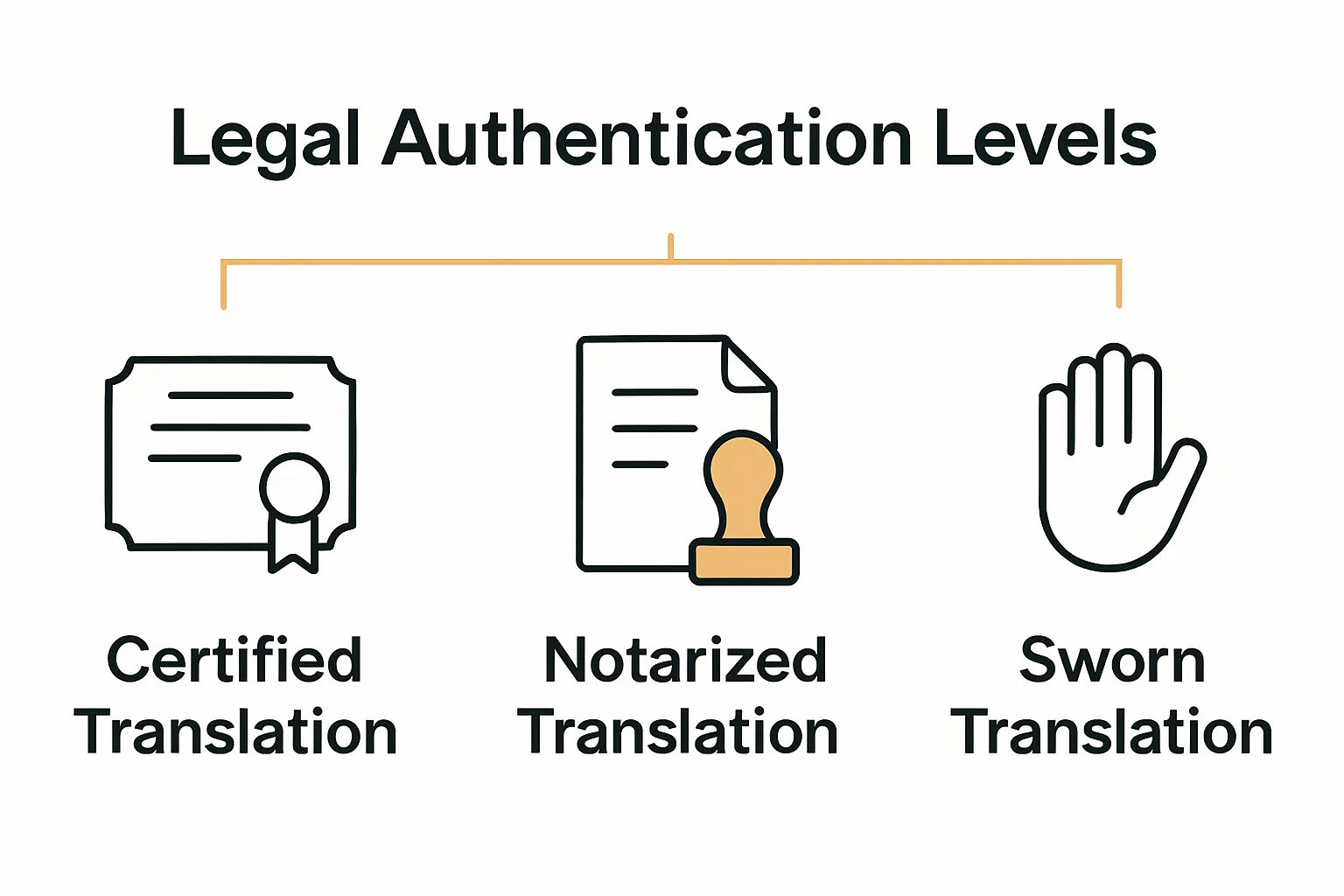
There are multiple levels of document translation authentication, each serving different legal and official purposes
 :
:
- Certified Translation: Completed by a professionally certified translator who verifies linguistic accuracy
- Notarized Translation: Includes an additional layer of legal authentication by a notary public
- Sworn Translation: Involves a translator taking a formal oath regarding the translation’s accuracy
Understand the nuances of certified translation affidavits to grasp the subtle differences between these authentication methods.
Legal and Professional Standards
Notarized document translations must adhere to stringent professional standards that ensure:
- Verbatim Accuracy: Word-for-word translation maintaining original document’s meaning
- Contextual Preservation: Capturing cultural and linguistic nuances
- Professional Integrity: Translator’s professional credentials and reputation
According to Supreme Court of Canada guidelines, the distinction between certified and notarized translations lies in the additional legal verification provided by a notary public, which transforms a standard translation into an officially recognized document.
Critical Components of Validity
A valid notarized document translation requires several critical components to be legally recognized:
- Original document’s complete reproduction
- Translator’s professional certification
- Notary public’s official seal and signature
- Comprehensive translator’s declaration of accuracy
These elements collectively ensure that the translated document maintains its legal integrity, authenticity, and precise representation of the original text across linguistic and jurisdictional boundaries.
To help clarify the key differences between types of authenticated translations referenced in the guide, the following table compares Certified, Notarized, and Sworn Translation.
| Type of Translation | Who Authenticates | Key Legal Feature | Typical Use Cases |
|---|---|---|---|
| Certified Translation | Certified Translator | Verifies linguistic accuracy | Academic documents, business records |
| Notarized Translation | Notary Public & Translator | Adds legal authentication with notary | Immigration, legal proceedings |
| Sworn Translation | Translator under Oath | Translator swears before an authority | Jurisdictions requiring sworn oath |
Real-World Applications of Notarized Document Translation
Notarized document translations serve critical functions across numerous professional and personal domains, providing legally recognized linguistic bridges that enable smooth interactions between different linguistic and bureaucratic systems in Ontario and beyond.
Immigration and Legal Proceedings
In immigration contexts, notarized translations are absolutely essential for individuals seeking to establish their legal status or navigate complex administrative processes. These translations are required for:
- Birth certificates
- Marriage licenses
- Academic credentials
- Professional qualification documents
- Personal identification papers
Learn more about certified translation requirements to comprehend the intricate documentation standards.
Academic and Professional Credential Recognition
Academic institutions and professional regulatory bodies demand precise, legally authenticated translations to evaluate international qualifications. Notarized translations ensure that:
- Foreign degrees are accurately interpreted
- Professional certifications meet local standards
- Educational transcripts maintain their original integrity
- International professional credentials can be properly assessed
According to Immigration, Refugees and Citizenship Canada, comprehensive and legally verified translations are mandatory for credential assessment and professional registration processes.

International Business and Personal Transactions
Business contracts, intellectual property documents, and personal legal agreements frequently require notarized translations to ensure:
- Clear communication across language barriers
- Legal enforceability of documents
- Protection of rights and obligations
- Compliance with international legal standards
These translations serve as critical tools that enable smooth cross-cultural interactions, protecting the interests of all parties involved in complex linguistic and legal environments.
Make Your Notarized Document Translation Effortless in Ontario
Struggling with the challenge of notarized document translation and the need for legal recognition in Ontario? We understand how frustrating it can be to have important documents delayed or rejected because they lack a proper notarized translation. Topics like notarial certification, legal authentication, and complete accuracy are more than just technical terms—they mean peace of mind and smooth approvals for your immigration, academic, or business needs.
Explore your options and see more resources on our Uncategorized – The Online Notary section.
Do not let language barriers stop your progress. With The Online Notary, you get fast, reliable online notary services for affidavits, statutory declarations, and more—all designed to streamline your notarized translation needs. Take the next step now to ensure your documents are accepted the first time. Visit our main landing page and get started today.
Frequently Asked Questions
What is notarized document translation?
Notarized document translation is a specialized process that translates documents from one language to another while providing official certification of accuracy. This process includes a professional translation, notarial certification, and an official seal.
Why is notarized document translation important?
Notarized document translation ensures legal validity and recognition across various official contexts. It is often legally required for immigration applications, academic submissions, and legal proceedings.
What are the key components of a notarized document translation?
The key components include a professional translation by a certified translator, notarization by a notary public, and the inclusion of an official signature and seal that confirms the document’s authenticity.
How does the notarized translation process work?
The process involves several steps: reviewing the original document, translating it by a certified expert, proofreading, and then obtaining notarial certification from a notary public to validate the translation.
Recommended
- Understanding Translation and Notarization in Ontario – The Online Notary
- Understanding Certified Translation Affidavit in Ontario – The Online Notary
- How to Legalize a Document in Ontario: A Step-by-Step Guide – The Online Notary
- How to Notarize Documents in Ontario: Easy 2025 Guide – The Online Notary