
TL;DR:
- Ontario notaries are appointed by the Attorney General under the Notaries Act and distinguished by license type.
- Notaries licensed by the Law Society of Ontario have lifetime appointments with a one-time fee, while others need renewals.
- Proper notarization requires valid government-issued ID, current appointment expiry date, and compliance with specific powers and limits.
Ontario Notary Laws 2026: Your Complete Compliance Guide
Not all notarizations in Ontario carry the same legal weight, and that distinction matters more than most people realize. Many individuals and businesses assume any signature with a stamp is good enough, only to have documents rejected weeks later by immigration offices, banks, or foreign authorities. With 2026 bringing renewed scrutiny around notarial compliance, understanding who can notarize what, under which rules, and with what limitations is no longer optional. This guide walks you through the current appointment framework, the qualifications required, what notaries can legally do, and the practical steps that keep your documents valid and accepted.
Table of Contents
- How notaries are appointed and regulated in Ontario
- Requirements and fees for becoming a notary in 2026
- Key notarial powers and legal limits in Ontario
- Identification, special limitations, and compliance in 2026
- What most guides miss about notary laws in Ontario
- Get notary help and expert solutions for Ontario in 2026
- Frequently asked questions
Key Takeaways
| Point | Details |
|---|---|
| Appointment process | Notaries public in Ontario are appointed by the Attorney General under the Notaries Act. |
| Eligibility and fees | Lawyers and paralegals pay $145 for lifetime notary appointment if in good standing. |
| ID requirements | Valid government-issued photo identification is required for all notarizations in Ontario. |
| Non-LSO notary limits | Non-lawyer notaries must show expiry date and may face restrictions on powers. |
| Compliance tips | Following updated 2026 notary rules helps avoid rejected legal documents and delays. |
How notaries are appointed and regulated in Ontario
Understanding Ontario’s notary system starts at the top. Notaries public in Ontario are appointed by the Attorney General under the Notaries Act, RSO 1990, c N.6. That single sentence carries enormous practical weight. It means notarial authority in this province flows directly from a specific statute, not from professional associations, private certifications, or informal designations. If someone claims to be a notary without that appointment, their seal means nothing legally.
The Notaries Act itself is a relatively concise piece of legislation, but its scope shapes every notarization that happens in the province. It defines who can hold the title, what powers come with it, and what limitations apply. For anyone seeking public notary requirements in Ontario, the Act is the starting point, not a sidebar.
Here is a clear breakdown of who falls under which appointment category:
| Applicant type | Appointment authority | Term length | Key condition |
|---|---|---|---|
| Lawyers licensed by LSO | Attorney General | Lifetime | Must be in good standing |
| Paralegals licensed by LSO | Attorney General | Lifetime | Must be in good standing |
| General public applicants | Attorney General | Fixed term with expiry | Must meet eligibility criteria |
The distinction between lifetime and fixed-term appointments matters enormously for clients. When you hire a lawyer who is also a notary, their notarial authority does not expire. When you use a non-LSO notary, their stamp should display an expiry date, and that date must be current at the time of signing.
Several core qualifications apply across the board for anyone seeking appointment:
- Must be a Canadian citizen or permanent resident
- Must be at least 18 years old
- Must be a resident of Ontario
- Must not have a criminal record that would disqualify appointment
- Must submit a complete application with supporting documentation
For those following the Ontario notary appointment checklist, every item on that list ties back to the Notaries Act requirements. Missing even one supporting document can delay or void an application. Ontario does not have a provisional notary designation. You are either appointed or you are not.
Lawyers and paralegals licensed by the Law Society of Ontario operate under a streamlined path because their professional background already satisfies many of the competency and ethics thresholds the Attorney General considers. That is why their appointment is lifetime rather than term-based. For general public applicants, the fixed-term model reflects ongoing oversight, since the province wants periodic confirmation that non-legal professionals still meet the relevant standards.
Requirements and fees for becoming a notary in 2026
Knowing the framework is useful. Knowing the exact steps and costs to get appointed is what actually moves things forward. As of 2026, the process has two distinct paths depending on whether you hold an LSO license.
For lawyers and paralegals licensed by the Law Society of Ontario in good standing, the appointment is lifetime and requires a one-time $145 application fee. That is the most direct path available. Good standing means no active disciplinary proceedings, no suspended license, and compliance with LSO annual reporting requirements. If any of those conditions are not met, the application will not proceed.
For general public applicants, the requirements are more involved:
- Confirm eligibility: Canadian citizen or permanent resident, Ontario resident, at least 18 years old, no disqualifying criminal history.
- Gather supporting documentation: proof of identity, proof of Ontario residency, character references where required.
- Complete the official application form provided by the Ministry of the Attorney General.
- Submit the application package with the applicable fee.
- Wait for the Attorney General’s office to review and issue the appointment.
- Once appointed, obtain your official notary seal and register your signature as required.
Statistic to know: LSO-licensed notaries hold a lifetime appointment after a single $145 payment, while general public notaries face recurring term renewals, making the long-term cost and administrative burden for non-LSO notaries considerably higher.
The $145 fee for LSO professionals reflects the streamlined review process. For general public applicants, fees may differ and the application timeline is typically longer given the additional review involved. Always verify the current fee schedule directly with the Ministry before submitting.

Pro Tip: If you are a paralegal or lawyer in good standing with the LSO and have not yet applied for notary appointment, doing so now costs little and significantly expands your service offering to clients who need documents notarized regularly.
For clients rather than aspiring notaries, understanding notary requirements in Ontario helps you verify whether the professional you are working with is properly appointed. Ask to see their official seal, check that the name on the seal matches their identification, and for non-LSO notaries, confirm the expiry date is in the future. These three checks alone prevent most problems before they start.
Key notarial powers and legal limits in Ontario
A notary’s stamp does not give them unlimited authority. The powers are specific, the limits are real, and understanding both is essential for 2026 compliance.
Under the Notaries Act, the core powers of a notary include witnessing and attesting to the execution of documents, certifying true copies of original documents, exercising commissioner powers for taking affidavits in Ontario, and performing other regulated functions as specified in the Act. These are meaningful powers, but they are not the same as the broader authority held by lawyers when acting in a legal advisory capacity.
One of the most common sources of confusion is the difference between a notary public and a commissioner for taking affidavits. Many clients use the terms interchangeably. They are not the same.
| Role | Appointed by | Can certify copies | Can witness affidavits | Can provide legal advice |
|---|---|---|---|---|
| Notary public | Attorney General | Yes | Yes | Only if also a lawyer |
| Commissioner for affidavits | Various authorities | No | Yes | No |
| LSO lawyer/notary | Attorney General | Yes | Yes | Yes |
A commissioner for affidavits has a narrower scope. They can administer oaths and take sworn statements, but they cannot certify true copies. A notary can do both, making a notary the more versatile choice for documents that require multiple types of authentication.
“The notary’s role is to authenticate, not to advise. When clients need both, they need a lawyer who also holds a notary appointment.”
For non-LSO notaries, the limitations become more significant. They cannot provide legal advice. They may face restrictions on certain document types depending on the receiving institution. Some foreign countries and government agencies specifically require notarizations performed by a lawyer-notary, not a general public notary. Knowing when a notary is needed and what type of notary is appropriate for your document type prevents costly rejections.
The ongoing obligations in 2026 are also worth noting. Notaries must maintain accurate records of notarial acts, keep their appointment credentials current, use only their official seal, and refuse to notarize documents where there is any conflict of interest or doubt about the signatory’s identity or intent. These are not new rules, but they are enforced more consistently as institutions digitize their verification processes.
Identification, special limitations, and compliance in 2026
This is where many notarizations fall apart, not in the paperwork, but in the verification steps right before the seal goes down.
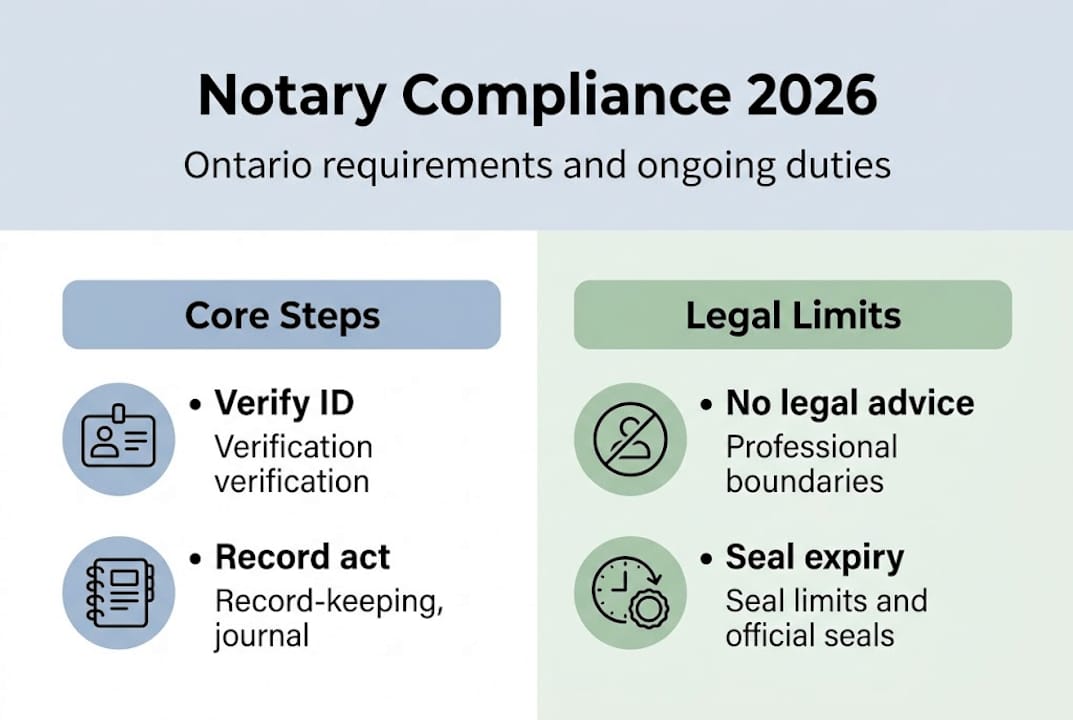
Under the Notaries Act, non-LSO notaries must stamp their expiry date and any applicable limitations on their notarial seal. And all notaries, regardless of their appointment type, are required to verify the signatory’s identity using government-issued photo identification. These two requirements together form the foundation of a valid notarization in Ontario.
Valid government photo ID for notarial purposes typically includes:
- Canadian passport
- Ontario driver’s license
- Provincial photo identity card issued by ServiceOntario
- Permanent resident card with photo
- Federally issued identity documents with photo
Expired identification is not acceptable. A driver’s license that expired three months ago does not satisfy the government photo ID requirement, regardless of how familiar the notary is with the person presenting it. This rule applies universally.
For non-LSO notaries specifically, the compliance checklist for 2026 includes several practical items:
- Confirm your appointment expiry date before every session
- Ensure your official seal displays the correct expiry date visibly
- Decline to notarize document types outside your authorized scope
- Keep a log of each notarial act with the date, document type, and ID presented
- Update your contact and registration information with the Ministry if anything changes
For clients, knowing what to look for during a valid notarization protects you. Check that the notary’s seal is clear and legible. Confirm the expiry date is visible on the seal if you are working with a non-LSO notary. Make sure you present photo ID before the document is signed, not after. Review your notary identification needed in 2026 requirements before your appointment to arrive fully prepared.
Pro Tip: Always bring two pieces of government-issued ID to a notary appointment in Ontario. If there is any question about the primary ID, having a backup prevents the appointment from being rescheduled entirely.
In 2026, institutions processing notarized documents have become more rigorous about rejection. Banks, immigration agencies, and foreign embassies are flagging documents with missing expiry stamps, mismatched notary seal names, and expired ID dates more frequently than in previous years. A rejected document does not just cause inconvenience. It can delay immigration applications by months or cause loan closings to fall through. Getting the compliance details right the first time is not just good practice. It is essential.
What most guides miss about notary laws in Ontario
Most guides on Ontario notary compliance focus on the process and stop there. What they skip is why documents still fail at a surprisingly high rate even when people follow the basic steps.
The single most overlooked issue is the expiry stamp for non-LSO notaries. Many clients do not know to check it. Many notaries, especially those who were appointed years ago and have not actively notarized documents recently, forget that their term has lapsed. A document notarized by an expired non-LSO notary is not just questionable. It is invalid.
The second overlooked reality is that Ontario is actively expanding its acceptance of online notarization in Ontario processes, and both notaries and clients are behind the curve. Many professionals do not yet understand the audio-visual verification requirements or the secure document handling rules that apply to remote notarizations. The legal framework for online notarization exists. The competency gap for using it correctly is wide.
Hard-earned advice: if your document is going to a foreign institution, verify the specific notarial requirements of that country or agency before the appointment, not after. Ontario notarial practices do not automatically satisfy foreign standards, and assuming they do is one of the most expensive mistakes clients make.
Get notary help and expert solutions for Ontario in 2026
Understanding the rules is the first step. Getting properly notarized documents is the goal.

Whether you need an affidavit, an invitation letter, a statutory declaration, or a certified true copy, working with trusted Ontario notary services that understand the 2026 compliance landscape makes the process straightforward. At The Online Notary, we handle a full range of notarial services designed specifically for Ontario residents and businesses. You can also review detailed guides on Ontario notary requirements to understand exactly what applies to your situation before your appointment. And if you are preparing for an upcoming notarization, our 2026 notary identification guide walks you through exactly what to bring and what to expect.
Frequently asked questions
Who has the authority to appoint notaries public in Ontario?
The Attorney General of Ontario appoints notaries public under the Notaries Act, RSO 1990, c N.6. No other authority in Ontario can make this appointment.
What identification is required for notarial services in Ontario in 2026?
You must present valid government-issued photo ID for any notarial act, such as a passport, Ontario driver’s license, or permanent resident card. Expired identification is not accepted under any circumstances.
Are notaries who aren’t lawyers or paralegals limited in Ontario?
Yes, non-LSO notaries must stamp their expiry date on their seal and may face restrictions on certain document types or scopes of practice. Clients should verify the expiry date is current before proceeding.
What is the application fee for notary appointment for lawyers or paralegals in 2026?
LSO-licensed lawyers and paralegals in good standing pay a $145 application fee for a lifetime notary appointment through the Attorney General’s office.
What documents can an Ontario notary witness or certify in 2026?
A notary can witness document execution, certify true copies of original documents, and administer affidavits as specified in the Notaries Act. The exact scope may vary based on the notary’s appointment type.