
TL;DR:
- Ontario law distinguishes clearly between notaries public and commissioners of oaths, with different remote service rules.
- Fully online notarizations by notaries public are not permitted in Ontario as of 2026, requiring physical presence.
- Remote commissioning of oaths and declarations is legal if conducted via real-time audio-visual communication with proper identity verification.
Many people in Ontario assume that getting a document notarized online is as simple as joining a video call and clicking a button. That assumption is understandable given how much has moved online since 2020, but the reality is more layered. Ontario law draws a sharp distinction between notaries public and commissioners of oaths, and those two roles carry very different rules about what can happen remotely. This guide cuts through the confusion, explains what is actually legal in 2026, and helps you figure out the right path for your specific document needs.
Table of Contents
- Understanding Ontario’s rules: Notaries vs. commissioners of oaths
- The status of online notarization under Ontario law in 2026
- Remote commissioning: What’s actually permitted online
- Common misconceptions: Online notary myths debunked
- Why the line between digital and legal isn’t likely to disappear
- Get compliant, secure notary services in Ontario
- Frequently asked questions
Key Takeaways
| Point | Details |
|---|---|
| Notaries require in-person | Ontario law still requires notaries public to meet clients face-to-face for full notarization. |
| Remote commissioning allowed | Commissioners of oaths can legally commission certain documents online using video calls. |
| 2026 laws unchanged | No new rules in 2026—remote notarization remains limited and tightly regulated. |
| Fraud prevention prioritized | Strict regulations are in place to ensure identity verification and prevent document fraud. |
| Choose legal providers | Always verify your Ontario notary or commissioner’s credentials and compliance before proceeding online. |
Understanding Ontario’s rules: Notaries vs. commissioners of oaths
The single most important thing to understand before seeking any remote legal document service in Ontario is that notaries public and commissioners of oaths are not the same thing. People use these terms interchangeably all the time, but legally, they are distinct roles with different powers, different oversight, and very different rules about working remotely.
A notary public in Ontario is authorized to authenticate and certify documents, administer oaths, and perform a range of formal legal acts that carry significant evidentiary weight. Think certified copies of passports, authentication of documents for international use, or formal affidavits intended for court. Their work carries a high level of legal authority, which is exactly why online notarization by notaries public is not permitted in Ontario under the Notaries Act, requiring physical presence unless regulations specify otherwise, and no such regulations exist as of 2026.
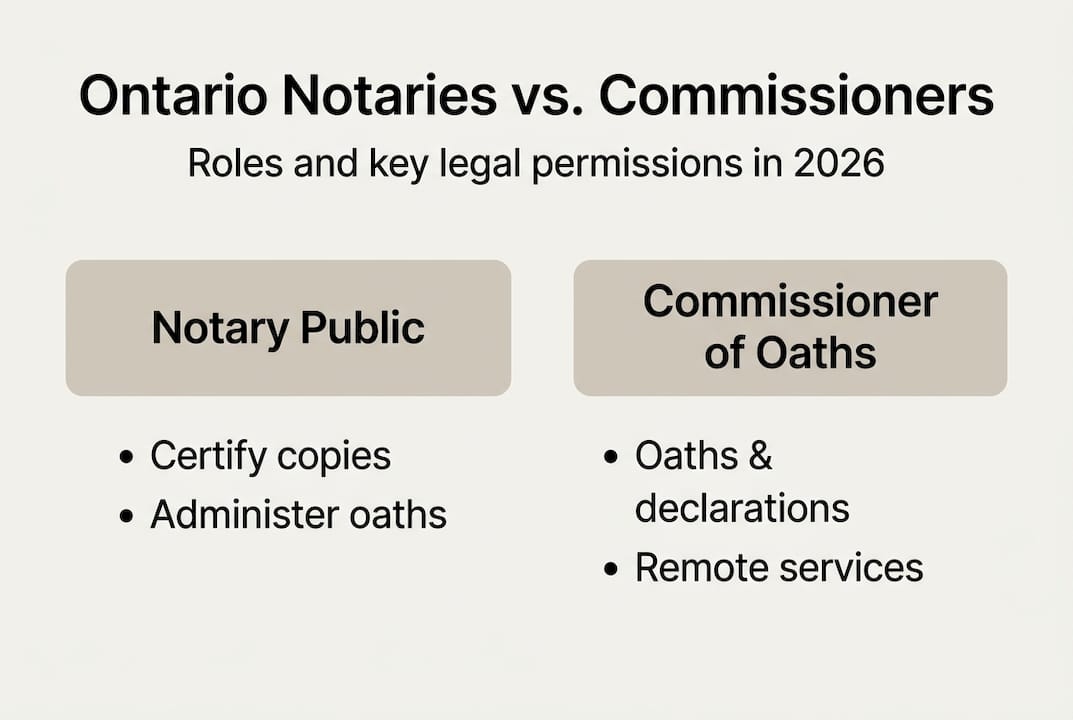
A commissioner of oaths, by contrast, is authorized to administer oaths and take statutory declarations and affidavits. Their scope is narrower, but for many everyday documents, a commissioner is exactly what you need. And critically, commissioners have access to a remote process under specific conditions.
Here is a side-by-side look at how these two roles compare:
| Feature | Notary public | Commissioner of oaths |
|---|---|---|
| Certify copies of documents | Yes | No |
| Administer oaths | Yes | Yes |
| Take statutory declarations | Yes | Yes |
| Remote services permitted | No | Yes, with conditions |
| Physical presence required | Yes (always) | No (if Reg 431/20 is followed) |
| International document authentication | Yes | No |
For a deeper look at how remote services work in practice, the remote notary guide and the Ontario online notary guide both break this down with practical examples.
Key terms worth knowing:
- Notarization: The formal act performed by a notary public to authenticate or certify a document
- Commissioning: The act of a commissioner of oaths administering an oath or taking a declaration
- Remote commissioning: A legally permitted process where a commissioner and declarant connect via real-time audio-visual communication
- Jurat: The clause at the bottom of an affidavit or declaration confirming it was sworn before an authorized official
“The distinction between these two roles is not a technicality. It determines whether your document will be legally accepted by courts, government agencies, or foreign institutions.”
The status of online notarization under Ontario law in 2026
Now that you understand the roles, it is essential to know where the legal line currently stands. As of 2026, notaries public in Ontario are still required to be physically present with the person signing a document. No legislative update has changed this.
Ontario Regulation 431/20 remains the primary regulation governing remote legal services in Ontario, and it was designed primarily to allow commissioners of oaths to operate remotely during and after the pandemic. It does not extend those remote permissions to notaries public. The Notaries Act prohibitions remain unchanged.
Here is a breakdown of what is and is not permitted online:
| Function | Notary public (online) | Commissioner of oaths (online) |
|---|---|---|
| Administer oaths | Not permitted | Permitted under Reg 431/20 |
| Take statutory declarations | Not permitted | Permitted under Reg 431/20 |
| Certify true copies | Not permitted | Not applicable |
| Authenticate for foreign use | Not permitted | Not applicable |
| Witness signatures remotely | Not permitted | Not applicable |
Why is Ontario holding this line? Two major reasons drive the strict approach:
- Fraud prevention: Physical presence makes it significantly harder to impersonate someone or submit forged documents. Digital environments introduce identity risks that current technology cannot fully eliminate to the legal standard required.
- Evidentiary reliability: Documents notarized in person carry stronger weight in court and in international legal systems. Relaxing the standard risks undermining that reliability.
If you are trying to get documents notarized online and are unsure whether your document qualifies for remote commissioning, reviewing how online notarization works in Ontario will help clarify your options before you book anything.
Pro Tip: If a service claims to offer full online notarization by a notary public in Ontario, that is a red flag. The law does not currently allow it, and documents processed that way may not be legally valid.
Remote commissioning: What’s actually permitted online
With the limitations on online notarization clarified, let’s focus on what you actually can do remotely in Ontario. Remote commissioning of oaths and declarations is legal under Ontario Regulation 431/20 for commissioners of oaths via real-time audio-video communication, with identity verification and modified jurats. This covers a meaningful range of documents, including statutory declarations, affidavits, and solemn declarations.
Here is how a compliant remote commissioning session works:
- Schedule a real-time video session: The commissioner and the declarant must be connected simultaneously via a live audio-visual platform. Pre-recorded video is not acceptable.
- Verify your identity: You will need to present valid government-issued photo ID on camera. The commissioner must be able to clearly see and confirm your identity before proceeding.
- Read and sign the document: You sign the document in view of the commissioner during the live session. The commissioner then signs their own copy or a counterpart.
- Modified jurat is added: The certificate of commissioning must include a statement that the oath or declaration was taken remotely by audio-visual means, as required by the regulation.
- Documents are exchanged: Signed copies are exchanged, typically by secure digital transmission or mail, depending on the document’s requirements.
For guidance on online options for notary services and what digital notary security protocols look like in practice, those resources explain the technical and procedural standards in detail. You should also review ID requirements for notaries before your session to avoid delays.

Pro Tip: Before booking any remote commissioner, ask them directly which regulation they operate under and how they document compliance. A legitimate commissioner will answer that question clearly and confidently.
Common misconceptions: Online notary myths debunked
Before you choose a provider, arm yourself with the truth about common online notary myths. Misinformation in this space is widespread, and acting on bad information can result in documents that are rejected, delayed, or legally invalid.
Myth 1: Any notary can work fully online in Ontario.
This is false. Notaries public in Ontario must be physically present with the person signing. No regulation permits them to conduct notarizations entirely online as of 2026.
Myth 2: If a website says “online notary,” it’s legal.
Marketing language is not the same as legal compliance. Many services use “online notary” loosely to mean remote commissioning by a commissioner of oaths, which is legal. But some providers blur the line in ways that create real legal risk for you.
Myth 3: Remote commissioning works for all document types.
Remote commissioning under Reg 431/20 applies to oaths and statutory declarations. It does not cover certified copies, international authentication, or notarial certificates. Knowing your document type matters.
Myth 4: Email or asynchronous video is acceptable for remote commissioning.
It is not. The regulation requires real-time, simultaneous audio-visual communication. Sending a video of yourself signing and emailing it to a commissioner does not meet the standard.
Myth 5: All online services are equally trustworthy.
They are not. Always verify that your commissioner holds a valid Ontario license and follows Reg 431/20 protocols. Resources like notary accessibility in Ontario and locating a notary can help you find verified professionals.
Pro Tip: Before you proceed with any remote service, ask the provider to explain their compliance steps in plain language. If they cannot, or will not, walk away.
Why the line between digital and legal isn’t likely to disappear
Stepping back from the specifics, Ontario’s approach to digital legal services reveals something important about how the province thinks about legal integrity. The rules are not simply behind the times. They reflect a deliberate judgment that the risks of moving too fast outweigh the benefits of convenience.
Fraud in legal documents is not hypothetical. International digital signature fraud, identity spoofing, and document manipulation are real and growing threats. Ontario’s regulators are aware of the convenience gap, but they are choosing to protect evidentiary standards rather than chase digital trends. As Reg 431/20 shows, the province is willing to allow remote services where the risk profile is manageable, but not where it could compromise the integrity of the legal system.
The honest truth is that full online notarization by notaries public is unlikely to arrive quickly in Ontario. The legal infrastructure, fraud detection standards, and international recognition frameworks are not yet in place to support it safely. For individuals and businesses, the practical takeaway is this: plan ahead for documents that require a notary public, and use compliant remote commissioning for declarations and oaths. Explore more on online notary rules to stay current as the landscape evolves.
Get compliant, secure notary services in Ontario
With these realities in mind, finding a trustworthy and compliant notary or commissioner is your best move. Working with a provider who understands Ontario’s legal framework is not just a formality. It is the difference between a document that holds up and one that gets rejected when it matters most.

We offer Ontario online notary services for affidavits, statutory declarations, invitation letters, solemn declarations, and more, all handled by professionals who follow Ontario’s legal requirements precisely. Whether you need remote commissioning or in-person notarization, we make the process straightforward. Review notary requirements in Ontario to understand what you will need before your appointment, and book with confidence knowing your documents will be legally sound.
Frequently asked questions
Can notaries public legally notarize documents online in Ontario?
No. Notaries public in Ontario must complete notarizations with physical presence required by the Notaries Act, and no regulation as of 2026 permits fully online notarization.
What documents can be commissioned remotely in Ontario?
Oaths and statutory declarations can be commissioned remotely using real-time video by authorized commissioners, provided all Reg 431/20 requirements are met, including ID verification and a modified jurat.
Is there any sign Ontario will allow full online notarial acts soon?
As of 2026, no changes have been announced. The Notaries Act prohibitions remain in place, and regulatory priorities continue to center on fraud prevention over digital convenience.
What are the main requirements for remote commissioning in Ontario?
Remote commissioning requires real-time audio-visual communication, government-issued ID verification, and a modified jurat stating the declaration was taken remotely, all as specified under Ontario Regulation 431/20.
How can I verify if a remote notary or commissioner is legitimate?
Check their credentials with Ontario’s official registry and confirm they follow Reg 431/20 protocols before proceeding, including real-time video and proper ID verification steps.