
TL;DR:
- Proper identification and understanding of authorized officials are essential for valid document notarization in Ontario.
- Pre-signing documents or using the wrong official can cause rejection and require starting over.
- Working with experienced, specialized notaries and preparing all necessary documents ensures first-time acceptance.
Imagine submitting an affidavit for a visa application or a real estate transaction, only to have it rejected because the notary’s seal was missing or the wrong official witnessed your signature. In Ontario, this happens more often than most people expect. The province has several categories of authorized officials, each with different powers, and mixing them up can cost you days or even weeks. This guide walks you through exactly who can verify your documents, what you need to bring, and how the process works from start to finish, so your documents are accepted the first time.
Table of Contents
- Who can verify documents: notaries, commissioners, and more
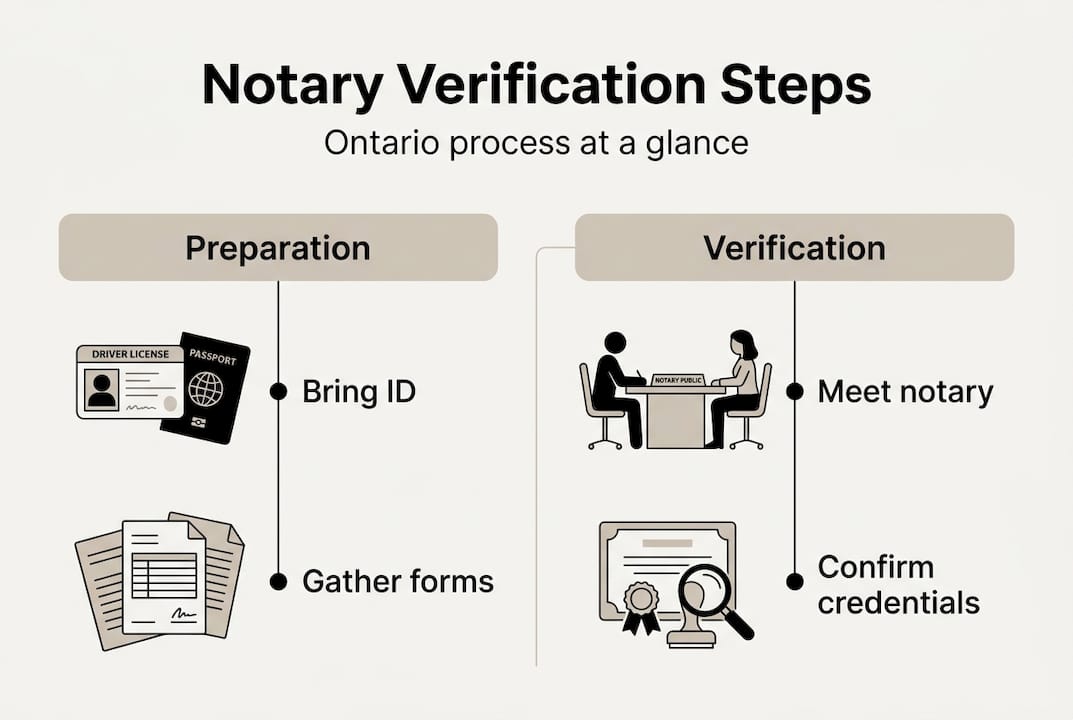
- What you need before verification: ID, forms, and preparation
- Step-by-step notary verification process in Ontario
- Troubleshooting and common mistakes with notary verification
- The hidden realities of notary verification in Ontario
- Need help with Ontario notary verification?
- Frequently asked questions
Key Takeaways
| Point | Details |
|---|---|
| Know official roles | Notaries, commissioners of oaths, and certain lawyers have different powers—always confirm who you need. |
| Prepare documents and ID | Bring the correct government-issued photo ID and complete your forms in advance to avoid delays. |
| Follow proper steps | Carefully follow each step during the notary process to ensure your document is accepted. |
| Avoid common mistakes | Do not sign before meeting the notary and always check for their seal and credentials. |
Who can verify documents: notaries, commissioners, and more
Understanding who can legally verify your document is the critical first step before you begin the process. Ontario recognizes several distinct roles, and using the wrong one is one of the most common reasons documents get rejected.
The Notaries Act RSO 1990 confirms that authorized officials include licensed lawyers and paralegals appointed as notaries by the Attorney General, notaries public, commissioners of oaths, court clerks, and certain government employees. Each role carries a specific scope of authority.
Here is a quick breakdown of who does what:
- Notary public: Can certify true copies, notarize documents for international use, administer oaths, and witness signatures on a wide range of legal documents.
- Commissioner of oaths: Can administer oaths and take affidavits, but generally cannot certify true copies or notarize documents for use outside Canada.
- Licensed lawyer or paralegal (appointed as notary): Has the broadest authority, including all notary and commissioner functions.
- Court clerk: Can administer oaths in specific legal proceedings.
- Government official: Limited authority tied to their specific government role.
This table shows which official you need for each document type:
| Document type | Notary public | Commissioner of oaths | Lawyer/paralegal | Court clerk |
|---|---|---|---|---|
| Affidavit | Yes | Yes | Yes | Yes (limited) |
| Statutory declaration | Yes | Yes | Yes | No |
| Certified true copy | Yes | No | Yes | No |
| International document | Yes | No | Yes | No |
| Witnessed signature | Yes | Yes | Yes | No |
A practical example: if you need a certified true copy of your passport for a foreign embassy, only a notary public or appointed lawyer can help. A commissioner of oaths cannot. Knowing this distinction before you book an appointment saves real time. You can learn more about notary public duties and when a notary is needed to match your situation to the right official.
For a broader look at how document verification works across different contexts, a document verification overview can help frame the bigger picture.
Pro Tip: To confirm someone’s status as an authorized official in Ontario, ask to see their appointment certificate or check with the Law Society of Ontario for lawyers and paralegals. Do not assume a title on a business card is enough.
What you need before verification: ID, forms, and preparation
With the official roles clear, the next step is to ensure you have all required items to avoid failed appointments or rejected documents. Walking in unprepared is the fastest way to waste your time and the notary’s.
Ontario notaries must verify identity before witnessing or certifying anything. That means you need valid, government-issued photo ID. Accepted options typically include:
- Canadian passport
- Ontario driver’s license
- Ontario Photo Card
- Permanent Resident Card
- Canadian Citizenship Card (with photo)
- Federal or provincial government employee ID
Expired ID is never accepted, even if it expired recently. Make sure your ID is current before your appointment. You can review the full list of Ontario notary ID requirements and identification requirements to avoid surprises.
Beyond ID, your document preparation matters just as much. Before your appointment:
- Read the entire document. You will be swearing or declaring that its contents are true. Know what you are signing.
- Leave the signature line blank. You must sign in front of the notary. Signing beforehand voids the process.
- Fill in all other fields completely. Blank fields can cause rejection.
- Bring supporting documents if required. For example, a statutory declaration about a lost item may require a police report or purchase receipt.
- Make copies in advance. If you need certified true copies, bring the originals and enough copies for each recipient.
Pro Tip: If your document is in a language other than English or French, arrange for a certified translation before your appointment. Many notaries will not certify a document they cannot read, and last-minute translation requests cause delays.
Step-by-step notary verification process in Ontario
With your documents and ID in hand, here is exactly how the notary verification unfolds, both in-person and online.
In-person notarization steps:
- Book your appointment. Contact a licensed notary public or authorized official and confirm they handle your specific document type.
- Arrive with your ID and unsigned document. Bring originals, not photocopies, unless certified copies are specifically what you need.
- Present your ID. The notary will examine it carefully to confirm your identity.
- Review the document together. The notary may ask you to confirm you understand the contents and that the information is accurate.
- Sign in front of the notary. This is the moment that makes the document legally valid. Do not skip this step or do it beforehand.
- The notary witnesses and applies their seal. They will sign, stamp, and sometimes add a notarial certificate depending on the document type.
- Receive your notarized document. Check that the seal is clear, the signature is present, and all details are correct before you leave.
For remote or online notarization in Ontario, the Notaries Act RSO 1990 confirms that notaries may notarize documents in person or remotely where permitted by law, verifying identity and witnessing execution via secure video platforms. The steps are similar, but identity verification happens through live video and may require additional ID checks.
Here is a summary of document types and their typical requirements:
| Document | Signature required in front of notary | Seal required | Supporting documents |
|---|---|---|---|
| Affidavit | Yes | Yes | Sometimes |
| Statutory declaration | Yes | Yes | Sometimes |
| Certified true copy | No (original presented) | Yes | Original document |
| Solemn declaration | Yes | Yes | Rarely |
| Invitation letter | Yes | Yes | Proof of relationship |
For guidance on verifying a notary’s credentials before your appointment, it is worth taking a few minutes to confirm their standing.

Pro Tip: After receiving your notarized document, photograph both sides immediately. If it is lost or damaged in transit, having a clear digital record can speed up the replacement process significantly.
Troubleshooting and common mistakes with notary verification
Even with careful preparation, it is easy to make simple errors. Here is what to watch for and how to recover smoothly.
According to the Notaries Act RSO 1990, improper ID, unsigned documents, or unauthorized officials are leading causes of notary rejections in Ontario. The good news is that most of these errors are completely preventable.
Common mistakes that cause rejection:
- Pre-signing the document. This is the single most frequent error. If you sign before the notary witnesses you, the document is void and must be redone.
- Expired or invalid ID. A driver’s license that expired last month is still expired. Always check the date.
- Using the wrong type of official. Asking a commissioner of oaths to certify a true copy for international use will result in rejection.
- Missing notary seal. A signature without a seal is incomplete. Always check before leaving the office.
- Incomplete document fields. Blank spaces in an affidavit or declaration raise red flags for receiving institutions.
- Wrong document version. Some institutions require their own specific form. Using a generic template may not be accepted.
Warning: Never sign your document before appearing in front of the notary. This single mistake voids the entire notarization, regardless of how minor it seems. You will need to start over with a fresh, unsigned copy.
If your document is rejected after notarization, the fix depends on the reason. A missing seal or incomplete certificate usually means returning to the same notary for correction. If you pre-signed or used the wrong official, you will need a fresh document and a new appointment. Reviewing ID problems for notary appointments and knowing how to check notary credentials in advance can prevent most of these situations entirely.
The hidden realities of notary verification in Ontario
Understanding error sources is crucial, but the realities of notary verification in Ontario are deeper than most guides reveal. Official rules describe what should happen. They rarely capture what actually happens when someone walks into an appointment unprepared or assumes that any lawyer can notarize any document.
Here is a misconception we see constantly: people believe that because someone is a licensed lawyer, they can automatically notarize documents. That is not always true. A lawyer must be specifically appointed as a notary public by the Attorney General of Ontario to perform notarial acts. Without that appointment, their notarization may be invalid.
Another overlooked reality is that institutions receiving your documents, whether foreign embassies, banks, or government agencies, often have their own internal standards that go beyond what Ontario law technically requires. A document that is legally valid may still be rejected because the receiving institution wants a specific format, an apostille, or additional certification.
The lesson we have drawn from helping clients navigate notary rules is simple: work with a notary who specializes in your document type. A generalist may get the basics right. A specialist knows the receiving institution’s expectations and can flag issues before they become rejections.
Need help with Ontario notary verification?
If you have made it this far, you now have a clear picture of the process. But knowing the steps and executing them flawlessly are two different things, especially when the stakes are high.

Our trusted online notary services are built specifically for individuals and businesses in Ontario who need fast, reliable document verification without the back-and-forth. Whether you need help with affidavits, statutory declarations, solemn declarations, or invitation letters, we handle the details so your documents are accepted the first time. If you are preparing an affidavit and want to understand exactly what is involved, our Ontario affidavit notarizing guide is a great next step. Book your appointment online and get it done right.
Frequently asked questions
What forms of ID are accepted for notary verification in Ontario?
Government-issued photo ID such as a driver’s license, passport, or Ontario Photo Card are accepted. The Notaries Act RSO 1990 requires notaries to verify identity before witnessing any document, so your ID must be current and valid.
Can I use an online notary for document verification in Ontario?
Yes, as long as the notary is authorized and all legal requirements for remote notarization are met. Ontario law permits remote notarization where identity can be verified and execution witnessed through secure video technology.
Who is recognized as an authorized official to notarize my documents?
Licensed notaries public, appointed lawyers and paralegals, commissioners of oaths, and certain court or government officials are recognized. The Notaries Act RSO 1990 defines each category and their specific authority.
What are common reasons for notary verification rejection?
Common reasons include invalid ID, pre-signed documents, and unauthorized officials performing the notarization. The Notaries Act RSO 1990 identifies these as leading causes of rejection, all of which are avoidable with proper preparation.