
TL;DR:
- An affidavit in Ontario must meet strict formalities including personal details, organized facts, and authorized witnessing.
- Proper signing and witnessing by authorized commissioners are essential; pre-signing invalidates the affidavit.
- Using professional guidance and verified sources helps prevent common mistakes, delays, and legal invalidity.
Submitting an affidavit with a missing detail, an incorrect format, or a signature in the wrong place can bring a legal or administrative matter to a complete stop. For individuals navigating court processes and small business owners dealing with regulatory filings, that kind of delay is more than inconvenient. It can cost time, money, and credibility. Ontario has specific legal requirements for what makes an affidavit valid, and understanding them before you sit down to draft one is the best way to avoid preventable setbacks.
Table of Contents
- Key requirements for a valid affidavit in Ontario
- Step-by-step process to prepare your affidavit
- Who can swear or affirm your affidavit?
- Common mistakes and how to avoid them
- Why even law-abiding people make affidavit mistakes and how to stop repeating them
- Need help with affidavits or notarization? Let experts guide you
- Frequently asked questions
Key Takeaways
| Point | Details |
|---|---|
| Follow all formalities | A valid affidavit in Ontario must be sworn or affirmed before an authorized official and include all required details. |
| Avoid common errors | Missing information, premature signatures, or wrong formats are top reasons affidavits are delayed or rejected. |
| Authority matters | Lawyers, notaries, and commissioners can commission affidavits—choose the right one for your needs. |
| Double-check for accuracy | Factual errors or false statements can have serious legal consequences, including perjury charges. |
| Business-specific needs | Small business affidavits may require additional proof of authority or supporting documents. |
Key requirements for a valid affidavit in Ontario
Let’s begin by reviewing what makes an affidavit officially valid in Ontario.
An affidavit is a written statement of facts that you confirm to be true under oath or affirmation. Courts, government agencies, and administrative tribunals rely on affidavits as sworn evidence. Because the statement carries legal weight, Ontario law sets out strict formalities for how they must be prepared and executed.
The core requirements for a valid Ontario affidavit include:
- Full legal name, address, and occupation of the person making the statement (called the deponent)
- A clear, organized body setting out facts, typically numbered paragraph by paragraph
- A jurat, which is the section at the bottom where the deponent signs and the commissioner witnesses that signature
- The signature and seal of an authorized commissioner
- Proper format when used in court proceedings, such as Form 14A under the Rules of Civil Procedure
One of the most important requirements is who can actually witness the affidavit. An affidavit must be sworn or affirmed before an authorized commissioner, which includes lawyers, notary publics, commissioners for taking affidavits, and certain government officials. Signing in front of anyone else renders the document invalid, regardless of how accurate the facts are.
You also have a choice between swearing and affirming. Swearing is a religious oath, typically made on a holy book. Affirming is a non-religious solemn promise that carries exactly the same legal weight. Either option is acceptable in Ontario, and you should choose whichever aligns with your personal beliefs.
Statistic callout: False statements made in an affidavit constitute perjury under Canadian criminal law. This is not a technicality. The consequences include potential imprisonment.
Pro Tip: Review your draft against an Ontario affidavit guide before scheduling a commissioner appointment. Catching errors early saves you from booking a second session.
Understanding who can witness affidavit documents in Ontario is equally important. Not every official you encounter in daily life qualifies. A bank manager, a justice of the peace in some contexts, or a neighbor who happens to be a retired lawyer may not have current authority.
Step-by-step process to prepare your affidavit
Now that you know the main requirements, here’s how to follow each critical step in preparing your affidavit.
Gather your supporting documents. Before writing a single word, collect every piece of evidence, record, or documentation that relates to your statement. This includes contracts, government-issued IDs, correspondence, or corporate records if you are acting for a business.
Draft the opening statement. The opening should identify you by your full legal name, residential address, and occupation. It should also state the purpose of the affidavit and the jurisdiction. For court matters, full legal name, address, and occupation of the deponent must appear at the top, and Form 14A applies under the Rules of Civil Procedure.
Write your facts in numbered paragraphs. Each paragraph should address one distinct point. Keep sentences direct. Avoid opinion, argument, or language that sounds like advocacy. Stick to facts you personally know to be true. If you are relying on information from another source, you must say so explicitly and explain why you believe it.
Attach exhibits properly. If your affidavit refers to supporting documents, label them as exhibits (Exhibit A, Exhibit B, and so on). Reference them by that label within the body text. The commissioner will usually sign the exhibits as well to confirm they are attached.
Review thoroughly before the appointment. Read every line carefully. Look for spelling errors in your own name and address, check that dates are accurate, and confirm that every fact you state is one you can genuinely swear to.
Bring valid government-issued photo ID. When you attend the commissioner, bring at least one piece of government-issued photo identification. Many commissioners require two pieces. Do not assume a business card or employee badge will suffice.
Sign only in front of the commissioner. This is the step most people get wrong. Do not pre-sign the document. The signature must happen in the physical or virtual presence of the authorized commissioner as part of the swearing or affirming process.
| Step | Action required | Common error to avoid |
|---|---|---|
| 1 | Collect all supporting documents | Starting to write before reviewing your evidence |
| 2 | Draft the opening with personal details | Using a nickname or shortened address |
| 3 | Write numbered factual paragraphs | Including opinions or hearsay without attribution |
| 4 | Label and reference exhibits | Forgetting to have exhibits signed by commissioner |
| 5 | Review for accuracy and completeness | Rushing through the draft without fact-checking |
| 6 | Attend with valid photo ID | Bringing only one expired piece of ID |
| 7 | Sign before the commissioner | Pre-signing at home before the appointment |
Pro Tip: Use writing affidavits for Ontario resources to confirm formatting expectations before your appointment. Different uses, such as court filings versus administrative appeals, may have slightly different formatting standards.
When creating an affidavit for a business context, you may also need to include your corporate title and attach documentation that proves you have authority to speak on behalf of the company. This step is often overlooked by first-time filers.
Who can swear or affirm your affidavit?
With your draft ready, the next step is identification, ensuring the right person witnesses your sworn statement.
Ontario law is specific about who holds legal authority to commission an affidavit. An affidavit must be sworn or affirmed before an authorized commissioner. This includes lawyers in good standing with the Law Society of Ontario, notary publics, commissioners for taking affidavits, and certain government officials who have been granted this authority.
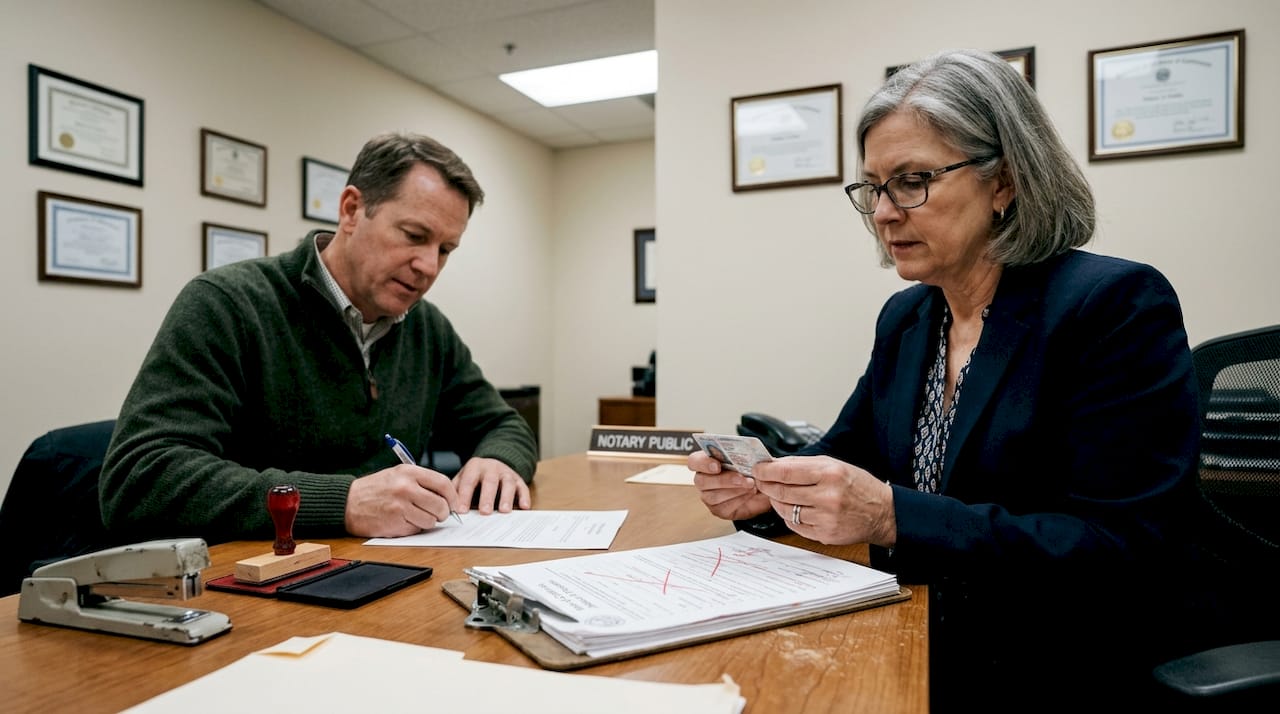
Here is how these options compare:
| Commissioner type | Typical setting | Best for |
|---|---|---|
| Notary public | Private offices, online platforms | Broad range of personal and business documents |
| Lawyer | Law offices | Documents tied to ongoing legal matters |
| Commissioner for taking affidavits | Government offices, some private services | Administrative filings and court documents |
| Government official | Specific government offices | Specific government-related declarations |
For small business owners, the process involves a few extra considerations. If you are a corporate officer, director, or signing agent for a business, you should be prepared to prove that role. Bring articles of incorporation, a corporate profile report, or a board resolution that identifies your authority. The commissioner may ask to see this documentation before proceeding.
Remote and online affidavit commissioning is now a recognized option in Ontario, following legislative changes that allow virtual witnessing under specified conditions. This means you can complete your affidavit from your office or home, connecting with an authorized commissioner through a secure video platform. For busy business owners, this flexibility removes a significant barrier.
“Not all online platforms offering notary services have the proper authority. Always confirm the commissioner’s credentials before proceeding with a virtual session.”
Choosing the right commissioner matters more than people realize. How to notarize affidavits correctly depends on the purpose of the document. A notary public is often the most convenient and widely accepted option for general use, while a lawyer is better suited when your affidavit forms part of active litigation.
Understanding who can sign affidavits in Ontario also protects you from a costly mistake. Affidavits signed before an unauthorized person are void, meaning all your careful drafting becomes worthless.
Common mistakes and how to avoid them
Even with a checklist in place, these are the pitfalls many individuals and businesses encounter.
Omitting required personal details. Leaving out your full legal address or occupation seems minor, but it gives the receiving party grounds to question or reject the document entirely. Always verify that your name appears exactly as it does on your government-issued ID.
Signing before meeting the commissioner. This is the single most common and damaging error. An affidavit signed outside the presence of an authorized commissioner is legally invalid. The entire point of commissioning is that the official witnesses the act of signing.
Including inaccurate or vague information. Facts stated in an affidavit must be precise. Approximate dates, fuzzy address descriptions, or uncertain numerical figures weaken your statement and may cause a tribunal or court to disregard it.
Using the wrong format for the purpose. An affidavit prepared for a court filing in Ontario often requires Form 14A. An affidavit for an administrative appeal may follow a different template. Using the wrong format can mean starting over entirely.
Underestimating perjury risk. False statements constitute perjury, punishable under Canadian criminal law. This applies even when you believe you are close enough to the truth. Every statement in your affidavit should be something you know with certainty.
Pro Tip: If you are unsure whether a specific fact qualifies as personal knowledge versus hearsay, flag it with language such as “I am informed by [name] and believe it to be true.” This language is recognized in Ontario practice and does not disqualify the paragraph.
Getting affidavits online through a qualified service reduces your exposure to formatting errors significantly because professionals check for these issues before commissioning takes place. That layer of review is especially valuable when the stakes are high.
Why even law-abiding people make affidavit mistakes and how to stop repeating them
Here is the uncomfortable truth about affidavit errors: the vast majority of rejected or problematic affidavits were not prepared by dishonest people. They were prepared by careful, well-meaning individuals who simply did not know what they did not know.
The affidavit process is deeply technical. It was designed by lawyers for lawyers, and it has not been simplified much for general public use. The language in the jurat, the specific formatting rules for exhibits, the nuance between swearing and affirming, and the question of who holds valid commissioning authority on any given day are all details that feel invisible until they become problems.
Small business owners face a compounded challenge. You are already managing legal obligations across multiple fronts, from employment standards to regulatory compliance. Adding affidavit preparation to that list without proper guidance creates real risk. A corporate officer who signs an affidavit without confirming their own authority to do so, or who forgets to attach proof of their corporate role, creates a document that may be challenged at exactly the wrong moment.
The deeper issue is one of process design. Most people approach affidavits as one-time tasks and try to piece together the requirements from multiple sources, each written for a slightly different audience or purpose. That fragmented approach leaves gaps.
The practical solution is to treat affidavit preparation as a professional task rather than a DIY exercise. Clear, current guidance combined with qualified commissioning closes the gap between what people think they have done and what they have actually done legally. Affidavit creation details are readily available, but absorbing them once, before you need them, puts you in a fundamentally different position than scrambling during a deadline.
Small errors delay serious matters. That truth does not reflect badly on the people who make them. It reflects the gap between a technical legal process and the practical realities of everyday life in Ontario.
Need help with affidavits or notarization? Let experts guide you
Preparing an affidavit correctly the first time is not just about following steps. It is about having someone in your corner who knows exactly what Ontario requires and can catch the details you might miss.

The Online Notary provides Ontario notary services for individuals and small businesses across the province, including affidavit preparation, swearing, and commissioning. Available online and designed for your schedule, the service removes the guesswork from a process that genuinely demands precision. Whether you need a standard affidavit for a court filing or a business-related sworn statement, understanding notary requirements ahead of time means you arrive prepared and leave with a document that holds up. Reach out to get your affidavit completed correctly, efficiently, and with full legal authority.
Frequently asked questions
What information must be included in an Ontario affidavit?
You must state your full legal name, address, and occupation at the top of the document, along with clearly numbered factual paragraphs describing the matter at issue. For court use, Form 14A under the Rules of Civil Procedure is typically required.
Who is authorized to witness or commission an affidavit in Ontario?
Lawyers, notaries public, commissioners for taking affidavits, and select government officials hold legal authority to witness your affidavit in Ontario. Signing before anyone without that designation makes the document void.
What happens if an affidavit is not properly sworn or affirmed?
An affidavit that was not properly sworn before an authorized commissioner will be rejected by the court or agency receiving it, requiring you to redo the entire commissioning process from the signature step.
Can I prepare an affidavit for a business matter in Ontario?
Yes, the same process applies, but you may need to include corporate documents proving authority to sign on behalf of your company, such as articles of incorporation or a board resolution identifying your role.