
TL;DR:
- Notarized affidavits are crucial in Ontario for legal, property, immigration, and business matters, carrying significant weight due to sworn testimony. Proper administration requires strict adherence to presence, verification, and legal requirements, with errors risking rejection and fines up to $2,000. Confirming recipient requirements and adhering to evolving remote and international rules are essential for effective and compliant affidavit use.
Notarized affidavits quietly shape some of the biggest decisions in Ontario life, from property transfers and court proceedings to immigration applications and business filings. Yet most people only think about them when they’re already in a deadline crunch, scrambling to understand what they actually need. That reactive approach leads to costly mistakes, rejected documents, and unnecessary delays. This guide breaks down exactly what notarized affidavits are, where you need them, what can go wrong, and how to get them right the first time.
Table of Contents
- What is a notarized affidavit and why does it matter?
- Top practical uses for notarized affidavits in Ontario
- Legal risks and compliance mistakes to avoid
- Remote notarization and cross-border affidavit challenges
- Most people underestimate affidavit “use” — what really matters in 2026
- How we make notarizing your affidavit easier in Ontario
- Frequently asked questions
Key Takeaways
| Point | Details |
|---|---|
| Critical for legal processes | Notarized affidavits are essential for many Ontario legal and business matters. |
| Must meet Ontario law | Improper execution can lead to court rejection or fines up to $2,000. |
| Different uses, different rules | Requirements change between local, remote, and international affidavit use. |
| Always verify the recipient’s needs | Check with the authority requesting the affidavit to avoid unnecessary complications. |
What is a notarized affidavit and why does it matter?
To understand why notarized affidavits are so important, we first need to clear up what they are and what sets them apart from ordinary paperwork.
A notarized affidavit is a written statement of facts that you swear or affirm to be true under oath, before a qualified commissioner or notary public. The moment you sign it in front of that authorized person, the document becomes legally binding. Lying in a notarized affidavit is not just a paperwork error, it can be treated as perjury, which is a serious criminal matter in Canada.
What makes Ontario’s rules particularly important is the physical presence requirement. The Commissioners for Taking Affidavits Act establishes that the oath or declaration must be taken in the physical presence of the commissioner or notary unless specific remote-commissioning conditions are met. This means you cannot simply scan a document, email it to a notary, and consider the job done. The law has strict requirements around presence, identity verification, and the administration of the oath itself.
Notarized affidavits carry considerably more legal weight than a signed letter, a witnessed contract, or a simple declaration. Courts, government agencies, and financial institutions treat them as reliable evidence precisely because they involve sworn testimony with legal consequences for dishonesty. For a thorough breakdown of this distinction, the Ontario affidavit guide is a helpful resource, and learning who can witness an affidavit in Ontario will save you from submitting documents that get bounced back.
Here is a quick summary of what makes a notarized affidavit legally valid:
- The deponent (the person making the statement) must appear before the commissioner
- The commissioner must administer the oath or affirmation verbally
- The document must be signed by both the deponent and the commissioner
- The commissioner must be authorized under Ontario law to take affidavits
- Remote commissioning requires meeting specific regulatory criteria
“Not all affidavits are created equal. Some legal proceedings require a notarized affidavit specifically, while others may accept a commissioned affidavit. Verify the requirement before you book your appointment.”
Pro Tip: Before visiting any notary or commissioner, contact the receiving organization (court, government office, or immigration authority) and ask exactly which type of sworn statement they will accept. This five-minute conversation can prevent weeks of rework.
Understanding affidavit regulations in Canada more broadly is useful if your affidavit will be used in multiple jurisdictions. Rules can differ significantly between provinces.
Top practical uses for notarized affidavits in Ontario
Now that we have defined notarized affidavits, let’s see where they matter most in everyday Ontario life and business.
The range of situations that call for a notarized affidavit is wider than most people realize. Missing this step or using the wrong document type can stall important life events and business deals at the worst possible moment. Here are the most common scenarios where Ontario residents and businesses rely on them:
- Court and legal proceedings: Affidavits are used in small claims court, family court, and civil litigation to present sworn factual evidence without live testimony. Judges rely on them as part of the evidentiary record.
- Real estate and property transactions: Title transfers, mortgage applications, and estate-related property dealings frequently require sworn statements confirming ownership history, identity, or compliance with legal conditions.
- Immigration and sponsorship applications: Sponsors and applicants use affidavits to confirm relationships, financial support, and other facts required by Immigration, Refugees and Citizenship Canada.
- Landlord and tenant disputes: The Landlord and Tenant Board often requires sworn affidavits to support applications for rent increases, evictions, or maintenance claims. Understanding affidavit types for rental disputes is especially valuable if you are navigating that process.
- Probate and estate administration: Executors must submit sworn affidavits when applying for a certificate of appointment of estate trustee, commonly known as probate.
- Business and corporate filings: Companies registering under Ontario law or responding to regulatory inquiries may need to file affidavits as part of required documentation.
- Travel consent for minors: When a child travels internationally without one parent, many border authorities and airlines require a notarized consent affidavit.
The table below shows when full notarization is typically required versus when a simpler commissioned affidavit may be acceptable:
| Situation | Notarized affidavit required | Commissioned affidavit sufficient |
|---|---|---|
| Ontario Superior Court filings | Yes | Sometimes (check rules) |
| Landlord and Tenant Board | Usually | Often yes |
| International immigration use | Yes | Rarely |
| Real estate title transfers | Yes | Rarely |
| Small claims court | Rarely | Yes |
| Travel consent for minors | Yes (foreign use) | Yes (domestic) |
| Ontario probate applications | Yes | No |
| Business regulatory filings | Depends on regulator | Often yes |
It is also worth knowing that creating affidavits correctly from the start makes the notarization step far smoother. Disorganized or vague statements can prompt a notary to refuse to commission the document until revisions are made.

One frequently overlooked point: using an affidavit that was not properly commissioned is itself an offense under Ontario law. Knowingly using an improperly sworn affidavit can result in a fine, making it critical to get the process right the first time, not after a rejection.
Legal risks and compliance mistakes to avoid
Correct use is essential, but it is equally critical to know the risks and mistakes people often make with affidavits in Ontario.
The consequences of getting an affidavit wrong go beyond inconvenience. Courts can strike affidavits from the record entirely. Immigration applications can be delayed by months. Real estate deals can collapse when a title company or lawyer discovers that a sworn statement does not meet legal standards.
The financial exposure is real. Ontario’s Commissioners for Taking Affidavits Act specifies that knowingly using an oath or affidavit that was not taken in conformity with the Act is an offense that can carry a fine. The ceiling on that fine is up to $2,000, a painful price for a procedural shortcut.
Key stat: Fines for using an improperly commissioned affidavit in Ontario can reach $2,000, not counting the cost of delays, legal fees, or the rescheduling of transactions that depend on the document.
Here is a data summary of the most common compliance mistakes and their typical impact:
| Mistake | Likely consequence | Severity |
|---|---|---|
| Signing before appearing before the notary | Affidavit invalid, must redo | High |
| Using an unauthorized commissioner | Document rejected | High |
| Vague or contradictory statements | Court may reject evidence | Medium to High |
| Missing witness signature or seal | Affidavit incomplete | High |
| Wrong affidavit type for the intended use | Rejected by recipient | Medium |
| Not confirming remote-commissioning eligibility | Affidavit may be void | High |
Before you submit any affidavit, run through this red-flag checklist:
- Did you sign the document before appearing before the commissioner? (This voids it.)
- Is the commissioner’s name, title, and stamp clearly on the document?
- Does the affidavit clearly state the facts in the first person without ambiguity?
- Have you confirmed that the receiving authority accepts this format?
- If used remotely, were all regulatory criteria formally met?
Learning how to write an affidavit in Ontario before drafting your own is one of the smartest steps you can take. Even small wording errors can create major legal headaches down the line. For law firms managing multiple clients with affidavit requirements, tools for compliance tracking can reduce the risk of procedural errors at scale.
Remote notarization and cross-border affidavit challenges
Having covered the risks, let’s look at the evolving landscape: what has changed for online affidavits and global use?
Remote (online) notarization has become a meaningful option in Ontario, but it is not a free-for-all. The rules are specific. Ontario introduced remote commissioning provisions to accommodate situations where physical presence is genuinely impractical, but meeting the remote-commissioning conditions requires using approved audio-visual technology, verifying identity through regulated methods, and ensuring the commissioner is properly authorized for remote practice.
If you are considering an online affidavit in Ontario, here is what you need to confirm before proceeding:
- The notary or commissioner is authorized to conduct remote commissionings under Ontario regulations
- The technology platform meets the security and recording standards required by law
- Your identity can be verified through the required digital means
- The receiving authority (court, government body, etc.) will accept remotely commissioned documents
The online notary public guide explains this process clearly and is worth reading before booking any remote session.
Cross-border use adds another layer of complexity. Just because an affidavit is notarized in Ontario does not mean it will be automatically accepted by a foreign government, embassy, or foreign court. According to the Global Affairs Canada authentication guide, cross-border recipients may require authentication steps beyond a standard Ontario commissioning, meaning the affidavit’s practical acceptance depends entirely on what the downstream authority actually requests.
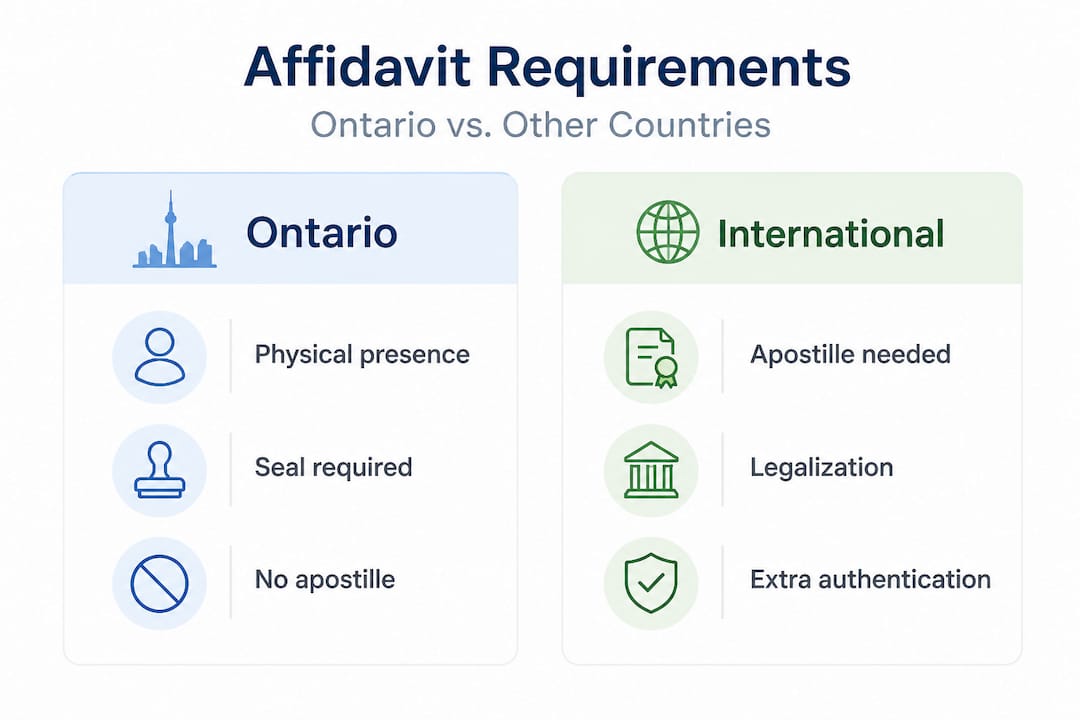
For example, using an Ontario affidavit in a country that requires an apostille (a specific international authentication certificate) means you will need to get that apostille from Global Affairs Canada after the notarization. Skipping that step can result in complete rejection by the foreign authority, no matter how perfectly your affidavit was prepared locally.
The Ontario remote commissioning overview provides additional context on how these rules apply in practice.
Pro Tip: Before commissioning any affidavit intended for use outside Ontario, email or call the receiving institution and ask for their specific requirements in writing. Get their checklist, not just a verbal confirmation. Requirements for embassies, foreign courts, and international agencies change frequently, and what worked last year may not work today.
Most people underestimate affidavit “use” — what really matters in 2026
With a working knowledge of notarized affidavits, here is a frank look at what most guides and even professionals do not tell you.
Here is the uncomfortable truth: a perfectly executed affidavit can still fail. Not because of legal errors, but because of a mismatch between what you prepared and what the recipient actually needed. We have seen clients go through the full notarization process, correctly and completely, only to have a foreign consulate reject the document because it lacked a specific phrase or was missing an additional authentication layer nobody mentioned upfront.
This is why the question should never be “did I notarize this correctly?” It should be “does this meet the exact requirements of the person or institution receiving it?” Those are two very different questions. The Ontario affidavit guide walks through this distinction in detail, which is why it remains one of the most practical resources we offer clients before they start the process.
Legal processes also move faster than most people expect. Rules for digital affidavits, international authentication, and remote commissioning are being updated regularly. What the Global Affairs Canada guidelines required in 2024 may not match the 2026 requirements. Old templates, advice from friends, or guidance from a prior lawyer engagement may all be outdated.
In 2026, our strongest advice is this: treat every affidavit as a custom document for a specific recipient, not as a generic legal form you fill out once and reuse. Confirm the recipient’s requirements before you write a single word. Build the affidavit to meet their checklist, then get it notarized. That order of operations prevents the most common and expensive mistakes we see repeatedly.
How we make notarizing your affidavit easier in Ontario
If you are ready to put this advice into action, here is how our team can help make the process seamless.

At The Online Notary, we specialize in helping Ontario individuals and businesses notarize affidavits, statutory declarations, solemn declarations, invitation letters, and more, with options for both online and in-person appointments. Our process is built around your schedule, not the other way around. We offer document templates, guidance on which affidavit type fits your situation, and clear answers to questions before you book. Whether you are handling a court matter, a property deal, or an international application, explore our full range of Ontario notary services or review the detailed Ontario affidavit preparation guide to understand exactly what you will need before your appointment. Getting it right the first time saves you time, money, and stress.
Frequently asked questions
When do Ontario courts require a notarized affidavit?
Ontario courts require notarized affidavits for sworn evidence, applications, and motions in proceedings ranging from family court to civil litigation; always verify the specific court’s rules before preparing your document, as requirements vary by proceeding type under the Commissioners for Taking Affidavits Act.
Can you use an Ontario notarized affidavit outside the province or country?
Yes, but cross-border recipients often require additional authentication steps such as an apostille or embassy legalization that go beyond standard Ontario notarization, so always confirm requirements with the receiving authority before finalizing the document.
What happens if an affidavit is not notarized correctly?
Improperly notarized affidavits can be rejected by courts and government agencies, and under Ontario’s Commissioners for Taking Affidavits Act knowingly using a non-compliant affidavit can result in fines reaching $2,000, making correct commissioning essential from the start.
Can a notarized affidavit be done online in Ontario?
Online notarization is permitted in Ontario only when specific remote-commissioning conditions are fully met, including approved technology, identity verification, and a properly authorized commissioner; not every notary offers this service, so confirm eligibility before scheduling.