
TL;DR:
- Notaries in Ontario verify identities, witness signatures, and certify documents but cannot conduct residential real estate closings. Only licensed lawyers can handle such closings, including title searches, mortgage preparations, and fund registration, requiring legal expertise. Proper notarization of supporting documents is essential to prevent delays, with remote online notarization becoming available in Ontario by 2026 for added convenience.
The role of notaries in real estate Ontario transactions is to verify identities, witness signatures, and certify documents. Notaries do not close residential real estate deals independently. That responsibility belongs exclusively to lawyers licensed by the Law Society of Ontario. Most homebuyers and investors confuse these two roles, which leads to delays, missed steps, and unexpected costs at closing. Understanding the distinction between notary public responsibilities in Ontario and the legal work performed by conveyancing lawyers gives you a real advantage before you sign anything.
What the role of notaries in real estate Ontario actually covers
Notaries in Ontario perform authentication and verification services. Under the Notaries Act of Ontario, both licensed lawyers and non-lawyer appointees can serve as notaries public. Every practicing lawyer in Ontario is automatically a notary, but not every notary is a lawyer. That distinction matters enormously in real estate.
The specific notary services in Ontario relevant to real estate transactions include:
- Administering oaths and affidavits: Statutory declarations confirming facts about a property or transaction must be sworn before a notary. This is common when a buyer needs to declare they are purchasing a property as a principal residence.
- Certifying true copies: Lenders and government offices often require certified copies of passports, deeds, or corporate documents. A notary confirms the copy matches the original.
- Witnessing signatures: Powers of attorney authorizing someone to sign real estate documents on your behalf require notarization. So do certain acknowledgment forms.
- International document authentication: If you are buying property in Ontario from abroad, or if foreign documents are part of your transaction, notarization and apostille certification are standard requirements.
Notaries verify identity, confirm the signer’s mental competence and willingness, and authenticate documents. They do not perform title searches, register mortgages, or distribute funds.
Pro Tip: If you need a power of attorney notarized before your real estate closing, do not wait until the week of closing. Notarization of a power of attorney can take several days if the signing party is traveling or located in another province.

Why lawyers must handle residential real estate closings in Ontario
Ontario law is unambiguous on this point. Residential closings require lawyers licensed by the Law Society of Ontario. A notary who is not also a licensed lawyer cannot independently conduct a residential real estate closing in Ontario. This is not a technicality. It is a structural protection for buyers and lenders.
“Homebuyers should view lawyers as protectors of their legal interests conducting complex requirements beyond document witnessing.” — propertylaw.ca
A conveyancing lawyer’s responsibilities go far beyond witnessing a signature. Lawyers handle title searches, review the purchase agreement, prepare mortgage documents, and manage the registration of title and distribution of funds. If a title search reveals an undisclosed lien or an encroachment issue, your lawyer identifies it before you take ownership. A notary has no authority to act on that information.
The dual retainer scenario is worth understanding. When you take out a mortgage, your lender typically requires their own legal representation. In many Ontario transactions, the same lawyer represents both the buyer and the lender under a dual retainer arrangement. This is permitted under Law Society rules provided there is no conflict of interest. The lawyer’s job in this scenario is to protect both parties’ interests in the transaction, which requires legal training and licensing that a notary alone does not possess.
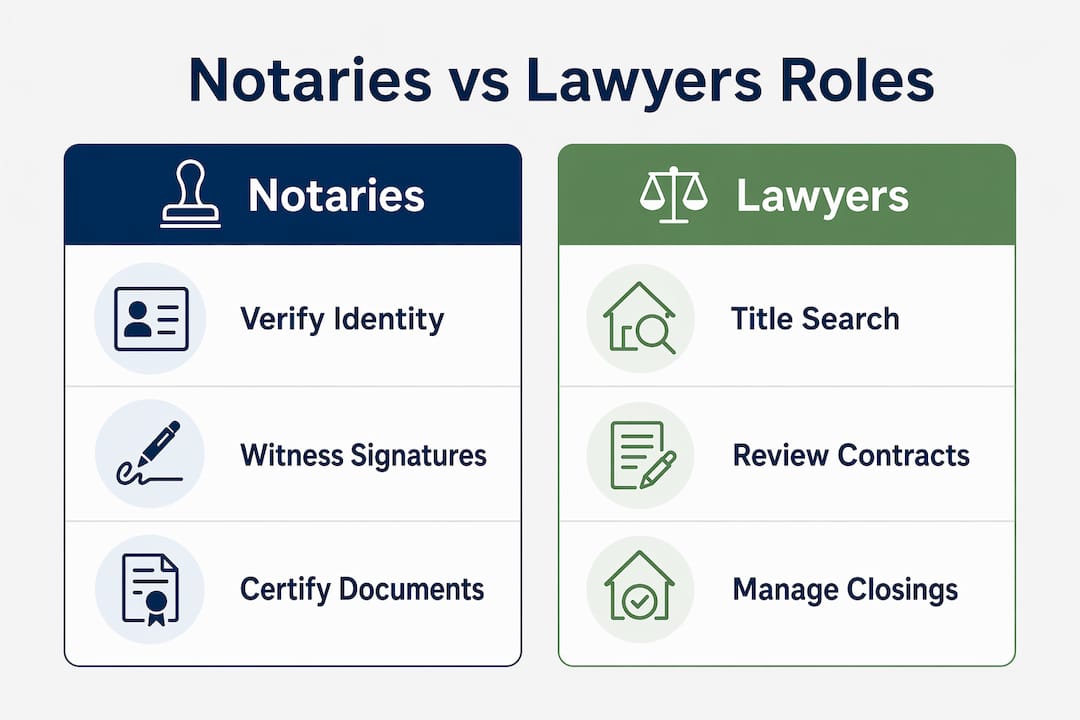
Skipping proper legal representation at closing is not a cost-saving measure. It is a liability. Title defects, improperly registered mortgages, and misdirected funds are real risks that Ontario’s lawyer-only closing requirement exists to prevent.
How notaries and lawyers work together in a real estate transaction
The two roles are complementary, not competing. Notaries often work alongside lawyers to handle documents requiring authentication within the broader transaction. Understanding who does what prevents confusion and keeps your closing on schedule.
| Task | Who handles it |
|---|---|
| Title search and registration | Licensed conveyancing lawyer |
| Mortgage document preparation | Licensed conveyancing lawyer |
| Fund distribution at closing | Licensed conveyancing lawyer |
| Certifying true copies of ID | Notary public |
| Witnessing power of attorney | Notary public |
| Administering sworn affidavits | Notary public |
| Legal advice on purchase terms | Licensed conveyancing lawyer |
| Apostille for foreign documents | Notary public |
Even in a lawyer-led closing, certain documents require separate notarization. A statutory declaration confirming marital status, a certified copy of a corporate resolution authorizing a purchase, or a sworn affidavit of execution all fall within notary territory. Your lawyer may handle these directly since all Ontario lawyers hold notary powers. Alternatively, you may engage a standalone notary service for speed or convenience, particularly for documents needed before the closing date.
The key insight is that lawyers automatically hold notary powers in Ontario but prioritize their conveyancing work. When a document needs notarization outside the closing itself, a dedicated notary service is often faster and more accessible.
What are typical real estate notary fees in Ontario?
Real estate notary fees in Ontario are a small but real line item in your closing costs. Notary fees for closings typically range from $100 to $250 and are bundled into the closing costs paid by the buyer or lender. That fee appears as a line item in your Closing Disclosure. It is separate from your lawyer’s legal fees, which cover the full scope of conveyancing work.
A few factors affect where your notary fee lands within that range:
- Document complexity: Certifying a single copy of a passport costs less than notarizing a multi-page power of attorney with multiple signatories.
- Loan signing agents: In some transactions, a specialized loan signing agent handles the signing of mortgage documents. Their fees are typically higher than standard notary fees and reflect their training in mortgage document packages.
- Who pays: The buyer typically covers notary fees as part of closing costs, though lender-required notarizations are sometimes paid by the lender directly.
Pro Tip: Ask your real estate lawyer for a full breakdown of closing costs at least two weeks before your closing date. Notary fees, land transfer tax, title insurance, and legal fees should all appear as separate line items so you are not surprised at the table.
The importance of notaries in real estate is not measured by the size of their fee. A missing or improperly notarized affidavit can delay a closing by days. Getting the notarization right the first time is worth far more than the cost of the service.
When is notarization required during a home purchase or sale?
Knowing when a notary is required in Ontario saves you time and prevents last-minute scrambles before closing. Here are the most common scenarios:
- Power of attorney for property: If you cannot attend the closing in person, a power of attorney authorizing another person to sign on your behalf must be notarized before your lawyer can use it.
- Statutory declarations: Lenders and the Canada Revenue Agency sometimes require sworn declarations confirming facts such as principal residence status or marital status.
- Certified copies for identity verification: Mortgage lenders and title insurance companies require certified copies of government-issued ID when original documents cannot be presented in person.
- Corporate resolutions: If a corporation is buying or selling property, a notarized corporate resolution confirming the transaction is authorized is standard practice.
- Cross-border transactions: Buyers purchasing Ontario property from outside Canada often need documents notarized and authenticated for use in a foreign jurisdiction, or foreign documents authenticated for use in Ontario.
Remote online notarization is increasingly accepted in Ontario as of 2026, allowing secure video-based notarization for real estate and other legal documents. This is particularly useful for buyers who are relocating from another province or country and cannot appear in person before a notary.
Skipping required notarization is not a shortcut. A power of attorney that was not properly notarized is invalid. A lender who receives an uncertified copy of a document will reject it. The cost of fixing these errors after the fact, including rescheduled closings and additional legal fees, far exceeds the original notary fee.
Key takeaways
Notaries in Ontario real estate handle verification and authentication, while licensed lawyers conduct the legal closing. Both roles are required, and neither can fully substitute for the other.
| Point | Details |
|---|---|
| Notaries verify, lawyers close | Notaries authenticate documents; only licensed Ontario lawyers can conduct residential closings. |
| Lawyers hold notary powers | Every Ontario lawyer is automatically a notary, but not every notary is a licensed lawyer. |
| Fees are modest but matter | Notary fees typically range from $100 to $250 and appear as a line item in closing costs. |
| Notarization prevents delays | Missing or improperly notarized documents can delay a closing by days and trigger additional legal costs. |
| Remote notarization is available | As of 2026, remote online notarization is accepted in Ontario for real estate documents, including powers of attorney. |
What I’ve learned from watching buyers confuse these two roles
I have seen homebuyers arrive at closing week without a notarized power of attorney because they assumed their lawyer would handle it automatically. I have seen corporate buyers miss their closing date because a notarized resolution was not prepared in advance. These are not rare edge cases. They are predictable problems that come from not understanding where the lawyer’s role ends and the notary’s role begins.
The conventional wisdom is that your real estate lawyer handles everything. That is mostly true for the legal closing itself. But the supporting documents, the affidavits, the certified copies, the powers of attorney, these often need to be notarized before the lawyer can use them. If your lawyer is billing by the hour, having them handle every notarization is also the most expensive approach.
What I recommend is treating notarization as its own checklist item, separate from your lawyer’s work. Identify early which documents in your transaction require notarization, who will notarize them, and when. If you are buying from abroad or cannot appear in person, look into Ontario notary responsibilities and whether remote online notarization fits your timeline.
The shift toward remote notarization is real and accelerating. Buyers who understand this option avoid the logistical friction that used to make notarization a bottleneck. The legal validity is the same. The convenience is significantly better.
— Ken
Get your real estate documents notarized without the wait

Theonlinenotary provides 24/7 online notary services in Ontario for the documents that real estate transactions actually require. Affidavits, statutory declarations, certified true copies, powers of attorney, and solemn declarations are all available through a secure, video-based process that meets Ontario’s legal standards. You do not need to take time off work or travel to an office. If you are a homebuyer, investor, or corporate purchaser preparing for a closing, you can explore all available notary services online and book when it works for you. You can also review the document types for notarization in Ontario to confirm exactly what your transaction requires before your closing date.
FAQ
What does a notary do in an Ontario real estate transaction?
A notary in an Ontario real estate transaction verifies identity, administers oaths, witnesses signatures, and certifies true copies of documents. Notaries do not conduct the legal closing, register title, or handle mortgage filings. Those tasks require a licensed lawyer.
Can a notary replace a lawyer for a home purchase in Ontario?
No. Ontario law requires that residential real estate closings be handled by lawyers licensed by the Law Society of Ontario. A notary who is not also a licensed lawyer cannot independently close a residential real estate transaction in the province.
How much do notary services cost for a real estate closing in Ontario?
Notary fees for real estate closings typically range from $100 to $250 and are included in the buyer’s closing costs. This fee is separate from your conveyancing lawyer’s legal fees and appears as its own line item in the Closing Disclosure.
When do I need a notary during a home purchase?
You need a notary when your transaction involves a power of attorney, a statutory declaration, certified copies of identity documents, a corporate resolution, or any document requiring authentication for cross-border use. These needs often arise before the closing date itself.
Is remote online notarization valid for Ontario real estate documents?
Yes. Remote online notarization is accepted in Ontario as of 2026 for real estate documents including powers of attorney and statutory declarations. The process uses secure video technology and carries the same legal validity as in-person notarization.
Recommended
- Master the notary signing process in Ontario: 2026 guide – The Online Notary
- Online Notary Legality in Ontario: What You Need to Know – The Online Notary
- Online Notary Myths Debunked: What Ontario Residents Must Know – The Online Notary
- Public Notary Requirements in Ontario: What You Need to Know – The Online Notary