
TL;DR:
- Many online notary services in Ontario are misleading or operate in legal gray areas, risking document rejection and delays. Ontario permits remote commissioning for oaths and declarations under strict conditions but does not allow full online notarization or certification of true copies remotely. To ensure document validity, individuals must verify service credentials, understand legal requirements, and confirm acceptance criteria with recipients before proceeding.
Searching for online notary services in Ontario turns up hundreds of websites, all promising fast, legal, and convenient document authentication. The problem? A significant number of these services either misrepresent what they can legally do or operate in a gray area that could get your documents rejected. For individuals trying to notarize an invitation letter, and for small business owners handling statutory declarations or affidavits, picking the wrong provider is not just inconvenient. It can derail immigration applications, business deals, and legal filings entirely.
Table of Contents
- What can (and cannot) be done online in Ontario?
- Top online notary myths debunked
- What Ontario’s rules actually require
- Document authenticity: What really counts for acceptance
- Why online notary confusion persists—and what actually works
- Find reliable online notary services in Ontario
- Frequently asked questions
Key Takeaways
| Point | Details |
|---|---|
| Remote commissioning is limited | Ontario only permits remote commissioning of oaths and declarations, not full online notarization. |
| Myths cause rejections | Assuming all documents can be notarized online leads to rejected paperwork and wasted effort. |
| Extra steps are vital | Proper technology, identity checks, and modified documentation are required by law. |
| Check recipient requirements | Always verify with the recipient if remote-commissioned documents will be accepted, especially for business or international use. |
| Choose Ontario-compliant providers | Protect yourself by using providers who strictly follow provincial legal requirements for online notarization. |
What can (and cannot) be done online in Ontario?
Ontario’s rules on this topic are specific, and the details matter more than most people realize. The province has made real progress toward digital document services, but it stopped well short of allowing everything to happen online.
Under Ontario Regulation 431/20, remote commissioning is permitted for oaths and declarations when all statutory requirements are met, but this is not the same as full online notarization by a notary public. That distinction is critical. Remote commissioning allows a commissioner for oaths to witness you swearing or affirming a document over live video. Online notarization by a notary public is a different and broader power that Ontario law has not fully extended to the digital space.
Here is a clear breakdown of what’s currently allowed versus what is not:
| Service type | Online allowed? | Notes |
|---|---|---|
| Commissioning an oath (sworn declaration) | Yes, with conditions | Must meet O. Reg. 431/20 requirements |
| Commissioning a statutory declaration | Yes, with conditions | Modified jurat required |
| Notarizing a true copy of a document | No | Requires in-person presence |
| Certifying a signature as a notary public | No | Physical presence needed |
| Affidavits for court proceedings | Varies | Check specific court rules |
Understanding the remote notary rules in Ontario before you book any service can save you from submitting documents that are rejected outright. Many Ontarians are unaware that these categories even exist, much less that the rules are different for each.
What documents most commonly run into trouble? Certified true copies are the number one culprit. People assume that because they signed and swore something online, a copy certified by the same commissioner must also be valid. It is not. True copy certification requires the commissioner or notary to physically compare the original document with the copy. No amount of video technology substitutes for that physical act under current Ontario law.
Reviewing the legality of online notary in Ontario is a smart first step for anyone preparing important documents remotely.
- Remote commissioning of oaths: permitted under O. Reg. 431/20
- Online notarization by a notary public: not generally permitted
- Certified true copies online: not permitted
- Live video witnessing without proper protocol: invalid
Industry professionals estimate that a notable portion of documents prepared through non-compliant online services are later rejected. The cost of reprocessing, rebooking, and resubmitting documents is real, and in time-sensitive situations like visa applications, the delays can be devastating.
Top online notary myths debunked
Having defined what’s permitted, let’s tackle the biggest misconceptions directly. These myths are widespread, and they cost people real time and money every year.
Myth 1: If a website says “online notary,” the service must be legal
This is the most dangerous assumption you can make. The phrase “online notary” is a marketing term, not a legal certification. Any website can use it. The Law Society of Ontario warns that “online notary services” are not permitted under the Notaries Act unless specific regulations provide for them. A website using that phrase is not evidence of legal compliance. It may simply be a business that has not carefully checked its obligations under Ontario law.
Myth 2: A video call automatically satisfies Ontario’s requirements
Using Zoom, Microsoft Teams, or any other video platform does not, by itself, make a remote commissioning legally valid. Ontario requires specific identity verification steps, real-time two-way audio and visual communication, modified document wording, and formal record-keeping. A commissioner who simply hops on a video call without following these steps is not creating a legally valid document, even if both parties feel like the process was official.

Myth 3: Commissioners for oaths and notaries public have the same online powers
They do not. Commissioners for oaths can remotely commission certain oaths and declarations when they follow the required protocol. Notaries public, whose powers are broader under provincial law, are subject to the Notaries Act and cannot generally exercise those broader powers remotely. When you compare online to in-person notary services, the differences in scope become very clear. Choosing the wrong type of service provider for your document type is a common and avoidable mistake.
Myth 4: International recipients will accept Ontario remote-commissioned documents without question
Foreign governments, embassies, and international organizations often have their own standards for document authentication. Ontario’s remote commissioning rules are domestic rules. The receiving country or institution may require apostilles, in-person notarization, or additional authentication steps that Ontario’s online options simply do not cover. Details on Ontario notary legality details can help you understand where the province’s rules end and international requirements begin.
The Law Society of Ontario has made it clear: using the label “online notary” without complying with the applicable Ontario legislation and regulations can expose service providers to regulatory consequences, and can leave clients with invalid documents and no easy recourse.
Pro Tip: Before booking any online service, ask the provider two specific questions. First, are you a commissioner for oaths or a notary public? Second, which specific Ontario regulation authorizes you to perform this service remotely? A reputable provider will answer both questions without hesitation.
What Ontario’s rules actually require
Now that we’ve dissected the myths, let’s get clear on the actual requirements Ontario enforces for remote commissioning. These are not suggestions. They are mandatory steps that must all be present for the document to be legally valid.
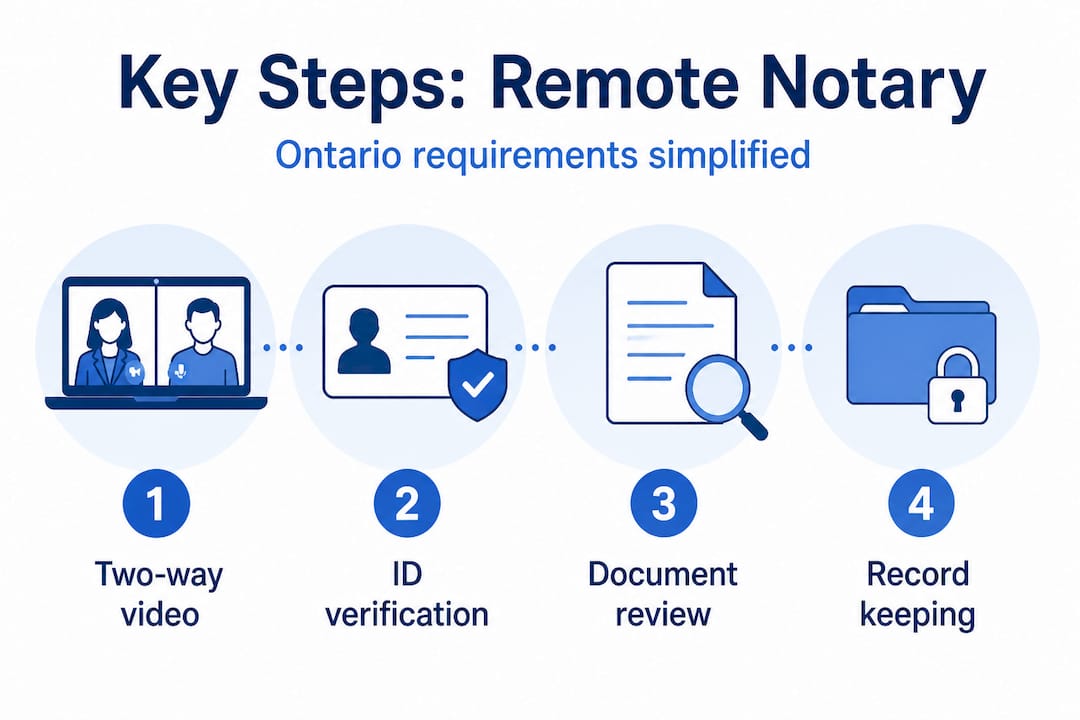
Ontario’s framework, grounded in O. Reg. 431/20, requires real-time see, hear, and communicate capability, identity confirmation, and document modifications. Each element is essential, and missing any one of them can invalidate the entire process.
Here is the full list of what a valid remote commissioning session must include:
Live two-way audio-visual communication — Both parties must be able to see and hear each other in real time. Pre-recorded video is never acceptable. Lag or technical failure that prevents real-time communication could compromise the session’s validity.
Identity confirmation — The commissioner must take reasonable steps to verify who you are. This typically involves presenting government-issued photo identification directly to the camera, clearly enough for the commissioner to compare your face and document details.
Modified jurat or declaration wording — The document itself must include specific language acknowledging that the oath or declaration was administered remotely. Standard in-person wording is not sufficient.
Accurate record-keeping — The commissioner must keep a record of the remote commissioning act, including the date, the technology used, and the identity verification steps taken. These records are not optional.
| Requirement | Why it matters | What happens if skipped |
|---|---|---|
| Live two-way AV | Proves real-time witnessing | Document may be void |
| Identity confirmation | Prevents fraud and impersonation | Commissioner’s validity questioned |
| Modified jurat | Signals remote process to recipient | Document may be rejected |
| Record-keeping | Audit trail for disputes | Commissioner may face regulatory issues |
A helpful guide to online notary in Ontario walks through these steps in practical terms for those preparing for a remote session. For a broader legal overview, the online notarization legality guide explains how these requirements interact with other provincial rules.
Pro Tip: Ask your provider to share their record-keeping policy before your appointment. Any legitimate commissioner will have a clear process for documenting remote sessions. If they seem uncertain or dismissive about this step, treat it as a red flag.
Document authenticity: What really counts for acceptance
Finally, let’s explore how to make sure your remote-commissioned document is actually accepted by the party you need to satisfy. Completing a technically valid remote commissioning session is only half the battle.
The authenticating purpose of a document matters enormously. Government agencies and international recipients often require more than Ontario’s remote commissioning can provide. The receiving body, not Ontario’s regulations, gets the final say on whether your document is accepted.
Here are the most important practical considerations:
- Check with the recipient first. Before deciding whether to use an online or in-person service, ask the embassy, government office, court, or business what they specifically require. Many recipients have a checklist of acceptable authentication methods, and remote commissioning may or may not be on it.
- International submissions often need extra steps. Documents going to foreign governments frequently require apostilles (a form of international certification) or legalization through Global Affairs Canada. Ontario’s remote commissioning, even if perfectly executed, is often only the starting point.
- Business use requires careful vetting. Small business owners using statutory declarations or solemn declarations for licensing, banking, or regulatory purposes should verify their specific needs. Some regulators explicitly require notarization by a notary public in person.
- Immigration documents are especially sensitive. Invitation letters, statutory declarations, and supporting documents for immigration applications go through multiple layers of review. A document rejected for improper authentication can delay an application by months.
For those handling online notarization for multiple documents in a single session, the rules apply consistently to each document. There are no shortcuts for volume.
Pro Tip: When in doubt, confirm both the provider’s credentials and the recipient’s acceptance criteria before finalizing any appointment. A five-minute phone call to the receiving agency can save weeks of frustration.
Why online notary confusion persists—and what actually works
The confusion around online notary services in Ontario is not accidental. It is baked into how the information reaches people.
Legal and regulatory language is dense by design. Ontario Regulation 431/20 is a precise legal document, and the distinction between “commissioner for oaths” and “notary public” is not something most people encounter in everyday life. When media coverage or government announcements use simplified language, the nuance disappears, and people walk away with an oversimplified picture.
The marketing problem makes things worse. Many websites use “online notary” as a broad umbrella term because it ranks well in search engines and resonates with users looking for convenience. These sites are not necessarily fraudulent. Many are simply selling a service without being precise about its legal limits. But for a person trying to commission an affidavit for an immigration file, imprecision is costly.
Understanding remote notary in Ontario from a reputable, Ontario-focused source is one of the simplest ways to cut through the noise.
Here is what actually works. Ask specific questions about service type, regulatory authority, and document requirements before committing. Match the type of service to your document. A statutory declaration for personal use may work well online. A certified true copy for an embassy will not. Evaluate your risk tolerance honestly. For low-stakes internal documents, the convenience of remote commissioning may be worth any residual uncertainty. For immigration, court, or international filings, in-person services remove doubt entirely.
The honest truth is that most online misinformation about Ontario notary services persists because both providers and users want a simple answer to a question that has a complicated one. Reliable services are transparent about what they can and cannot do. That transparency is your clearest signal of trustworthiness.
Find reliable online notary services in Ontario
Ready to move forward with confidence? Knowing the rules is a strong start, but choosing the right provider is what protects your documents.

At The Online Notary, we provide Ontario-compliant online notary services for affidavits, invitation letters, statutory declarations, solemn declarations, and more. Every service is conducted in strict alignment with Ontario law, using verified identity protocols, modified document language, and proper record-keeping at every step. We do not use vague marketing language. We tell you clearly what we can do, and when your document requires in-person or specialized handling, we say so. For document-specific guidance and a look at notary public requirements in Ontario, our resource pages are available before you book. Complex or international document needs? Our team is available to consult before your appointment.
Frequently asked questions
Can I get any document notarized online in Ontario in 2026?
No. Remote commissioning of oaths and declarations is permitted when all requirements are met, but other notarial acts such as certifying true copies require in-person presence.
Is using a live video platform like Zoom enough for legal remote notarization?
No. Ontario’s rules require much more than a video call, including real-time identity verification, modified document wording, and formal record-keeping by the commissioner.
How do I know if my online-commissioned document will be accepted?
Confirm directly with the recipient. The authenticating purpose matters for acceptance, and government agencies or international bodies may require steps beyond what Ontario’s remote commissioning allows.
What’s the difference between a notary public and a commissioner for oaths online?
Under Ontario rules, commissioners can perform remote commissioning of oaths and declarations, while notary public acts generally require physical presence and are not covered by the remote commissioning framework.