
Securing legal documents like affidavits and declarations can bring unexpected stress for Ontario business owners. Without proper notarization, paperwork often gets stuck in limbo, causing costly delays with banks, lenders, or government agencies. A notary public serves as an official and impartial witness, preventing fraud and verifying identities so your business documents hold legal weight. Discover how affordable online notary solutions can save you time, keep transactions moving, and simplify everyday business administration.
Table of Contents
- What Is A Notary And Why It Matters
- Types Of Documents That Require Notarization
- Legal Framework For Notarization In Ontario
- Small Business And Entrepreneur Notary Scenarios
- Risks, Costs, And Online Notary Solutions
Key Takeaways
| Point | Details |
|---|---|
| Role of Notaries | Notaries serve as impartial witnesses, verifying identities and ensuring signatures are valid, which adds legal credibility to documents. |
| Importance of Notarization | Many critical documents like powers of attorney and affidavits require notarization for acceptance by banks and government agencies, preventing delays and legal issues. |
| Types of Documents | Essential documents needing notarization include affidavits, powers of attorney, and certified copies, making it crucial for business operations. |
| Benefits of Online Notarization | Online notarization offers faster, more cost-effective solutions, allowing entrepreneurs to handle multiple transactions efficiently without travel delays. |
What Is a Notary and Why It Matters
A notary public is a state-appointed official authorized to witness signatures, verify identities, and authenticate documents. Think of them as impartial gatekeepers who prevent fraud and ensure that signatories actually understand what they’re signing. For small business owners, notaries are the trusted intermediaries who give your critical paperwork legal weight.
In common law jurisdictions like Canada and Ontario, notaries serve as public officers to witness and authenticate document signatures and administer oaths. Unlike lawyers, notaries cannot provide legal advice—they’re strictly witnesses to the transaction. Their job is straightforward but powerful: verify that the person signing is who they claim to be and that they’re signing voluntarily.
Notaries handle core tasks that protect your business:
- Witnessing signatures on affidavits and statutory declarations
- Certifying that document copies match the originals
- Administering oaths when someone swears statements are truthful
- Verifying identities to prevent fraudulent document execution
- Creating an official record that a transaction occurred
Why does this matter for your Ontario business? Without notarization, many important documents lack legal credibility. Banks won’t accept unnotarized powers of attorney. Immigration authorities reject unauthorized affidavits. Lenders demand notarized declarations before funding. A notary’s seal transforms your paperwork from questionable to legitimate.
Consider a common scenario: you need to verify that someone else has authority to act on your behalf. That requires an affidavit—a sworn statement—and only a notary can make it official. Or imagine selling a business asset remotely; the buyer demands proof that your signature is genuine. The notary provides that assurance.
A notary’s primary role is preventing fraud through impartial witness testimony and identity verification, giving your documents legal authenticity.
For entrepreneurs managing multiple transactions, notarization saves headaches downstream. Customers, partners, and government bodies trust notarized documents instantly. Without that stamp, you’re explaining and re-submitting endlessly. The small investment in notarization upfront pays dividends in credibility and speed.
Pro tip: Keep a list of documents requiring notarization before you need them urgently—affidavits, declarations, and powers of attorney should be identified early so you can schedule notary appointments without last-minute scrambling.
Types of Documents That Require Notarization
Not every document needs a notary’s signature. But certain paperwork carries legal weight only when notarized. As a business owner, knowing which documents require notarization saves you from costly delays and rejected submissions.
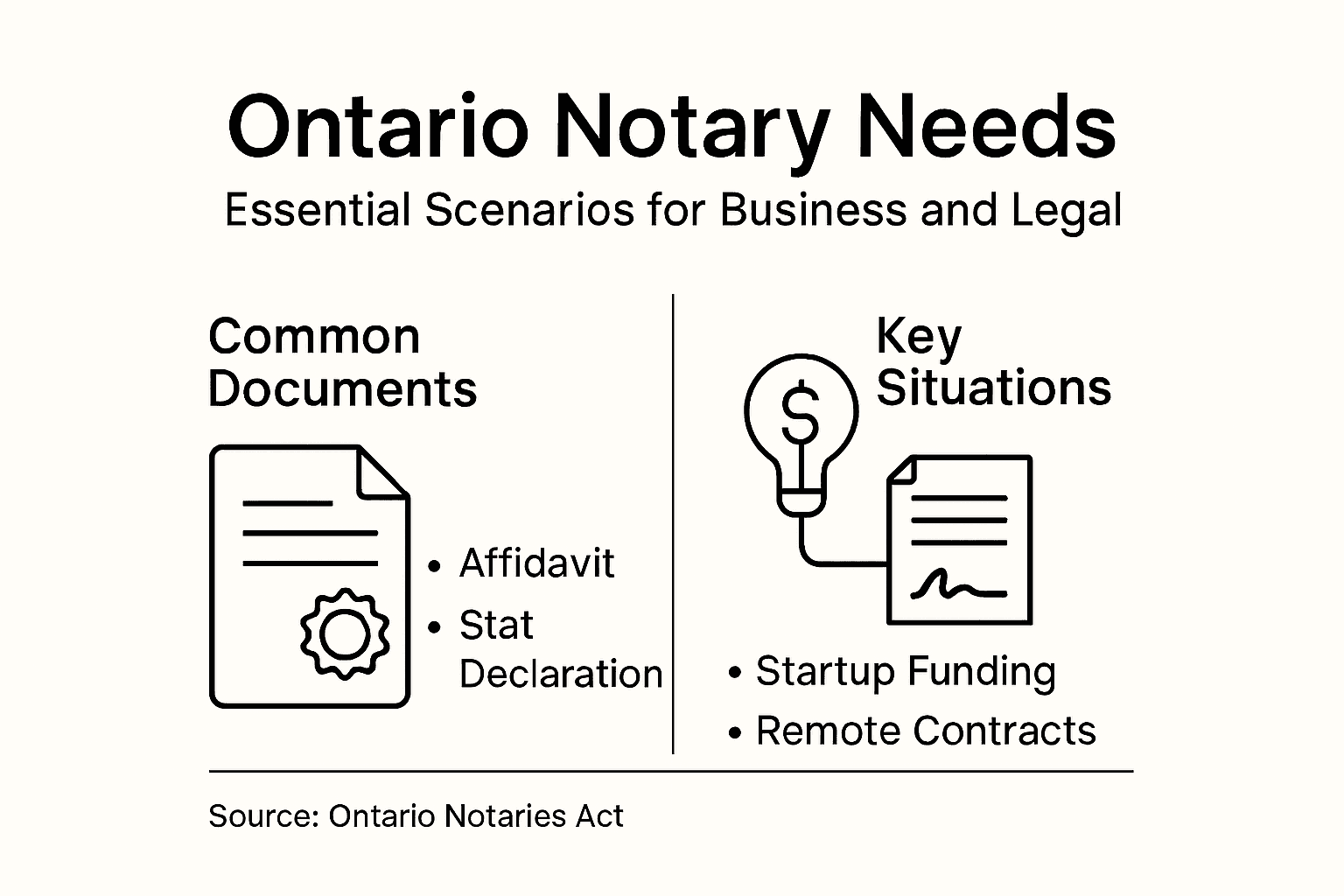
Affidavits and statutory declarations top the list of documents requiring notarization. These are sworn statements where someone declares facts under oath. Banks, courts, and government agencies rely on notarized affidavits because they carry legal consequences for false statements. When you submit an affidavit in Ontario, a notary must witness your signature and verify your identity.

Powers of attorney demand notarization in Ontario. This document grants someone authority to act on your behalf—financially, legally, or medically. Without notarization, third parties won’t accept it. A notary confirms you signed willingly and understand what authority you’re giving away.
Common documents requiring notarization include:
- Affidavits and statutory declarations
- Powers of attorney (financial, medical, legal)
- Certified copies of original documents
- Real property deed acknowledgments
- Statutory declarations for immigration or family law
- Loan or mortgage documents
- Business partnership agreements
- Authorization letters for minors
Certified document copies are another critical category. You need an original document verified and a notarized copy created. This matters when submitting birth certificates, diplomas, or business licenses to lenders or government bodies. The notary compares the copy to the original and certifies they match.
Acknowledgments for real property transactions require notarization to prevent fraud. If you’re signing a deed or transferring property rights, the notary verifies your identity and confirms you’re signing voluntarily. This protects both buyer and seller.
Immigration documents frequently demand notarization. Sponsorship letters, statutory declarations, and affidavits supporting visa applications must be notarized. Canadian immigration authorities reject unnotarized supporting documents automatically.
Notarized documents prevent fraud by creating an official record that verifies the signer’s identity and voluntary participation.
For business owners handling contracts, loan agreements, or partnership documents, check with your lender or partner about notarization requirements. Some transactions don’t strictly require it, but many parties request it anyway for extra security. It’s cheaper to notarize upfront than negotiate later.
The type of notarial act matters too. Some documents need an acknowledgment (notary verifies you signed), while others need a jurat (you swear the contents are truthful under oath). Understanding the distinction prevents submission errors.
Pro tip: Contact your bank, lender, or government agency before preparing documents—ask specifically what notarization format they require (acknowledgment vs. jurat) so you don’t waste time correcting errors after signing.
Legal Framework for Notarization in Ontario
Ontario’s notarization system operates under specific legislation that defines who can notarize, what they can do, and how they do it. Understanding this framework protects your business from using improper notarization methods that might be rejected by banks, courts, or government agencies.
The Notaries Act is the primary legislation governing notaries in Ontario. This statute allows the Attorney General to appoint notaries public who are authorized to witness signatures, certify document execution, and verify document copies. The Act also sets qualification standards and territorial restrictions for non-lawyer notaries operating in the province.
Lawyers and paralegals with good standing in Ontario automatically possess notarial authority. They don’t need separate appointment because their professional credentials grant them these powers. This is why many entrepreneurs use their lawyers as notaries when handling sensitive business documents.
Notarial powers in Ontario include:
- Witnessing signatures on documents
- Administering oaths and affirmations
- Certifying that document copies match originals
- Notarizing statutory declarations and affidavits
- Authenticating powers of attorney
- Verifying identity before document execution
Remote notarization in Ontario operates under specific regulatory restrictions. The Notaries Act permits certain powers to be exercised remotely through video conferencing for affidavits and statutory declarations, but not all notarial acts qualify for remote execution. Full remote notarization remains limited compared to in-person services.
Current regulations allow video commissioning for affidavits and statutory declarations when the notary can verify the signer’s identity through secure means. However, certified document copies typically require in-person verification where the notary physically compares the original to the copy.
Ontario’s legal framework balances accessibility through remote commissioning while maintaining fraud prevention through identity verification requirements.
For business owners, this means understanding which notarial services can happen online versus in-person. An affidavit for a bank might qualify for remote notarization, but a certified copy of your business license might require a physical appointment.
The Attorney General’s office maintains oversight of notary conduct and compliance. Notaries who breach their duties—forging signatures, failing to verify identity, or exceeding their authority—face disciplinary action, suspension, or removal.
Different types of notarial acts carry different legal weight. An acknowledgment confirms you signed the document, while a jurat means you swore the contents are truthful. Courts and agencies specify which type they require, and using the wrong one invalidates the notarization.
Quick reference for notarial acts and business impact:
| Notarial Act Type | How It Works | Business Applications |
|---|---|---|
| Acknowledgment | Confirms identity, voluntary signature | Real estate, contracts, powers of attorney |
| Jurat | Swears truthfulness of content under oath | Affidavits, declarations for banks and courts |
| Certified Copy | Matches copy to original, certifies authenticity | Submission of diplomas, business licenses |
| Remote Commissioning | Notary verifies identity via video | Affidavits for banks, basic declarations |
Pro tip: Before submitting notarized documents to any agency or lender, confirm whether they accept remote commissioning or require in-person notarization—this prevents resubmitting documents that don’t meet their specific regulatory requirements.
Small Business and Entrepreneur Notary Scenarios
As an entrepreneur in Ontario, you’ll encounter notary requirements at nearly every business milestone. From startup formation through daily operations, notarization protects your interests and satisfies regulatory demands. Understanding where notaries fit into your business journey saves time and prevents costly document rejections.
Startup formation demands notarized documents immediately. When registering a new business, you’ll need statutory declarations confirming your identity, address, and ownership stake. Lenders won’t fund ventures without notarized proof of business authorization and ownership structure. This happens before you generate first revenue.
Business licensing and permits frequently require notarization. Municipal licenses, professional certifications, and regulatory approvals often demand notarized applications or declarations. When applying for a liquor license, food service permit, or professional designation, the issuing authority expects notarized supporting documents to verify your qualifications and intentions.
Common notary needs for entrepreneurs include:
- Business registration and ownership declarations
- Partnership agreements and ownership verification
- Powers of attorney for business operations
- Loan applications and financial affidavits
- Employee authorization letters
- Vendor contracts and business-to-business agreements
- Statutory declarations for licensing applications
- Consent letters from co-owners or shareholders
Funding applications require heavy notarization. Banks and investors demand notarized financial statements, ownership affidavits, and authorization letters before releasing capital. When seeking a business loan, expect to notarize declarations confirming business structure, personal financial status, and loan purpose. A single missing notarization delays funding by weeks.
Small businesses often need notarial services for contracts, licensing, and statutory declarations to verify document authenticity and protect legal compliance throughout operations. This applies whether you’re operating solo or managing multiple employees.
Employee authorization presents another critical scenario. When granting someone power to sign checks, negotiate contracts, or represent your business, you’ll notarize authorization letters. This protects both your business and the employee by creating documented proof of delegated authority.
Notarized documents shield entrepreneurs from disputes by creating an official record that agreements were genuine and all parties understood their obligations.
Remote business transactions create notary demand. Selling inventory to distant buyers, licensing your intellectual property, or entering nationwide distribution agreements often require notarized proof of authority and consent. The other party won’t accept your word—they need a notary’s seal confirming you’re authorized to make binding commitments.
Payroll and tax compliance sometimes demands notarization. Government agencies may request notarized declarations of payroll compliance or tax filing status. Preparing these documents upfront prevents emergency notary visits during audit situations.
Pro tip: Build relationships with a notary early in your entrepreneurial journey—having a trusted contact prevents scrambling during time-sensitive transactions like funding closings, licensing deadlines, or urgent business agreements.
Risks, Costs, and Online Notary Solutions
Skipping notarization or using improper notary services creates legal and financial risks. For entrepreneurs managing tight budgets, understanding these dangers helps justify the notarization investment. Traditional in-person notarization carries hidden costs that online solutions can eliminate.
Missing notarization invalidates critical documents. Banks reject unnotarized loan applications, forcing you to restart the process. Government agencies return unnotarized licensing applications, delaying business permits by weeks. Immigration authorities deny unnotarized sponsorship letters outright. Each rejection costs time you can’t afford to lose during growth phases.
Fraudulent notarization creates serious legal exposure. Using unqualified notaries or falsifying notarization voids contracts and exposes you to criminal liability. Courts won’t enforce agreements notarized by unregistered individuals. Worse, you may face fraud charges if someone challenges the validity of your notarized documents.
Costs of traditional notarization include:
- Travel time to notary offices (30 minutes to 2 hours per appointment)
- Appointment fees ($15 to $50 per document)
- Missed work hours and lost productivity
- Multiple trips for complex transactions requiring many signatures
- Urgent appointment premiums for time-sensitive documents
- Document courier services when in-person presence isn’t required
For small businesses, these costs compound quickly. Notarizing five documents for a funding application costs $75 to $250 in fees alone. Add travel time and lost productivity, and the true cost exceeds $400 per transaction.
Here’s how traditional and online notarization compare for Ontario businesses:
| Factor | Traditional Notarization | Online Notarization |
|---|---|---|
| Appointment Method | In-person visit required | Remote video conferencing |
| Typical Cost per Document | $15 – $50 | $9 – $30 |
| Turnaround Time | Hours to days | Minutes to hours |
| Document Security | Physical paper storage | Encrypted digital archive |
| Ideal For | Complex or in-person needs | Routine or remote transactions |
Online notary services eliminate travel friction entirely. You notarize documents from your office or home through secure video conferencing. No scheduling around business hours. No travel delays. No lost productivity. Online notary solutions in Ontario offer fast, legal, and secure services that cost 40 percent less than traditional options while delivering documents same-day.
Online notarization reduces costs by removing intermediaries. You connect directly with licensed notaries who verify your identity through video, witness your signature, and complete notarization in minutes. Digital document handling means no printing, mailing, or storage requirements.
Security improves with online notarization. Encrypted video conferencing protects sensitive business information. Digital signatures create tamper-proof audit trails. Document records stay secure in cloud storage rather than physical files vulnerable to loss or theft.
Online notary services reduce costs while increasing security, speed, and accessibility for entrepreneurs managing multiple transactions simultaneously.
Cybersecurity concerns about online notarization are overblown. Licensed online notaries use bank-level encryption and identity verification protocols. Your documents receive stronger protection than traditional paper-based notarization.
For entrepreneurs with remote teams or multiple locations, online notarization solves coordination nightmares. Employees in different cities notarize documents without traveling. Partners in distant provinces complete agreements without delays. Global teams maintain operational velocity.
Pro tip: Schedule notarizations during business planning cycles rather than responding reactively—batch multiple documents into single online appointments to minimize costs and streamline your administrative workflow.
Simplify Your Notary Needs with Trusted Online Solutions
Navigating the essential scenarios where notarization plays a critical role can feel overwhelming. From affidavits and statutory declarations to powers of attorney and authorization letters every step requires accuracy and legal authenticity to prevent costly delays and rejection. If you are seeking a fast, secure, and reliable way to notarize your important documents in Ontario without the hassle of in-person visits our online notary services offer the solution you need.
Experience how Uncategorized – The Online Notary makes notarization straightforward and accessible. Imagine eliminating travel time and appointment scheduling struggles by completing affidavits, invitation letters, and solemn declarations from anywhere with confidence. With proven security measures and licensed professionals ready to assist you instantly you can protect your business and personal interests today.

Take control of your paperwork now by visiting The Online Notary and explore how easy it is to get your documents notarized remotely. Don’t wait for urgent deadlines or risk submission errors. Empower yourself with trustworthy online notarization designed specifically for Ontario residents and businesses. Get started at https://theonlinentoary.ca and ensure your documents carry the legal weight they deserve.
Frequently Asked Questions
Who typically needs a notary in Ontario?
Business owners, entrepreneurs, individuals involved in real estate transactions, and those managing legal or financial matters usually need a notary to authenticate documents, witness signatures, and ensure legal compliance.
What types of documents require notarization in Ontario?
Common documents requiring notarization include affidavits, statutory declarations, powers of attorney, real estate deeds, certified copies of original documents, and certain loan or mortgage agreements.
How does notarization protect my business transactions?
Notarization provides legal credibility to important documents by verifying signers’ identities and ensuring that signatures are made willingly. This helps prevent fraud and assures that documents are recognized by banks, courts, and other entities.
Can I get documents notarized online in Ontario?
Yes, online notarization is available in Ontario. Licensed online notaries can verify identities via video conferencing and complete notarization efficiently, making it a convenient option for businesses managing remote transactions.
Recommended
- When Is a Notary Required in Ontario? Essential 2025 Guide – The Online Notary
- When Is a Notary Required in Ontario? Essential 2025 Guide – The Online Notary
- When Is Notary Required in Ontario: Key Legal Situations – The Online Notary
- When Is Notary Required in Ontario: Key Legal Situations – The Online Notary