
Over 70 percent of legal proceedings in Ontario rely on written statements like statutory declarations to confirm facts without a court appearance. Many people encounter these documents when dealing with government paperwork, business transactions, or personal legal matters. Understanding what a statutory declaration means in court can protect your rights and prevent costly mistakes, especially when the consequences for a false statement are so severe.
Table of Contents
- What Is A Statutory Declaration In Court
- Differences Between Statutory Declaration And Affidavit
- Requirements For Ontario Court Statutory Declarations
- Process Of Commissioning A Statutory Declaration
- Legal Risks And Consequences For False Declarations
- Statutory Declaration Alternatives In Ontario
Key Takeaways
| Point | Details |
|---|---|
| Legal Basis | A statutory declaration is a formal legal document, recognized under the Canada and Ontario Evidence Acts, allowing individuals to affirm specific facts without court testimony. |
| Commissioning Process | Validity requires appearing before an authorized official who verifies identity and witnesses the signing of the document. |
| Consequences of Falsehood | Providing false information can lead to severe penalties including criminal charges, fines, and imprisonment. |
| Document Alternatives | Alternatives to statutory declarations include affidavits and sworn statements, each serving different legal or administrative purposes. |
What Is A Statutory Declaration In Court
A statutory declaration is a powerful legal document that allows an individual to formally confirm the truthfulness of specific facts under legal authority. According to ontario.ca, a statutory declaration is a formal written statement affirmed to be true by the declarant, carrying significant legal weight equivalent to evidence given under oath in court.
In the Ontario legal system, statutory declarations serve a critical purpose. They are authorized by both the Canada Evidence Act and the Ontario Evidence Act, providing a mechanism for individuals to make solemn statements about important matters without requiring immediate court testimony. These declarations can cover a wide range of scenarios, from confirming personal identity and marital status to substantiating business transactions or supporting legal claims.
The key characteristics of a statutory declaration include its sworn authenticity and legal recognition. Unlike casual statements, these declarations must be:
- Signed in the presence of an authorized official
- Made voluntarily
- Affirmed as true to the best of the declarant’s knowledge
- Potentially subject to legal consequences if found to be intentionally false
To make a statutory declaration legally valid, the individual must appear before an authorized professional such as a lawyer, notary public, or commissioner for taking affidavits. Understanding the Purpose of Statutory Declaration provides additional insight into the nuanced legal applications of this important document type.
Differences Between Statutory Declaration And Affidavit
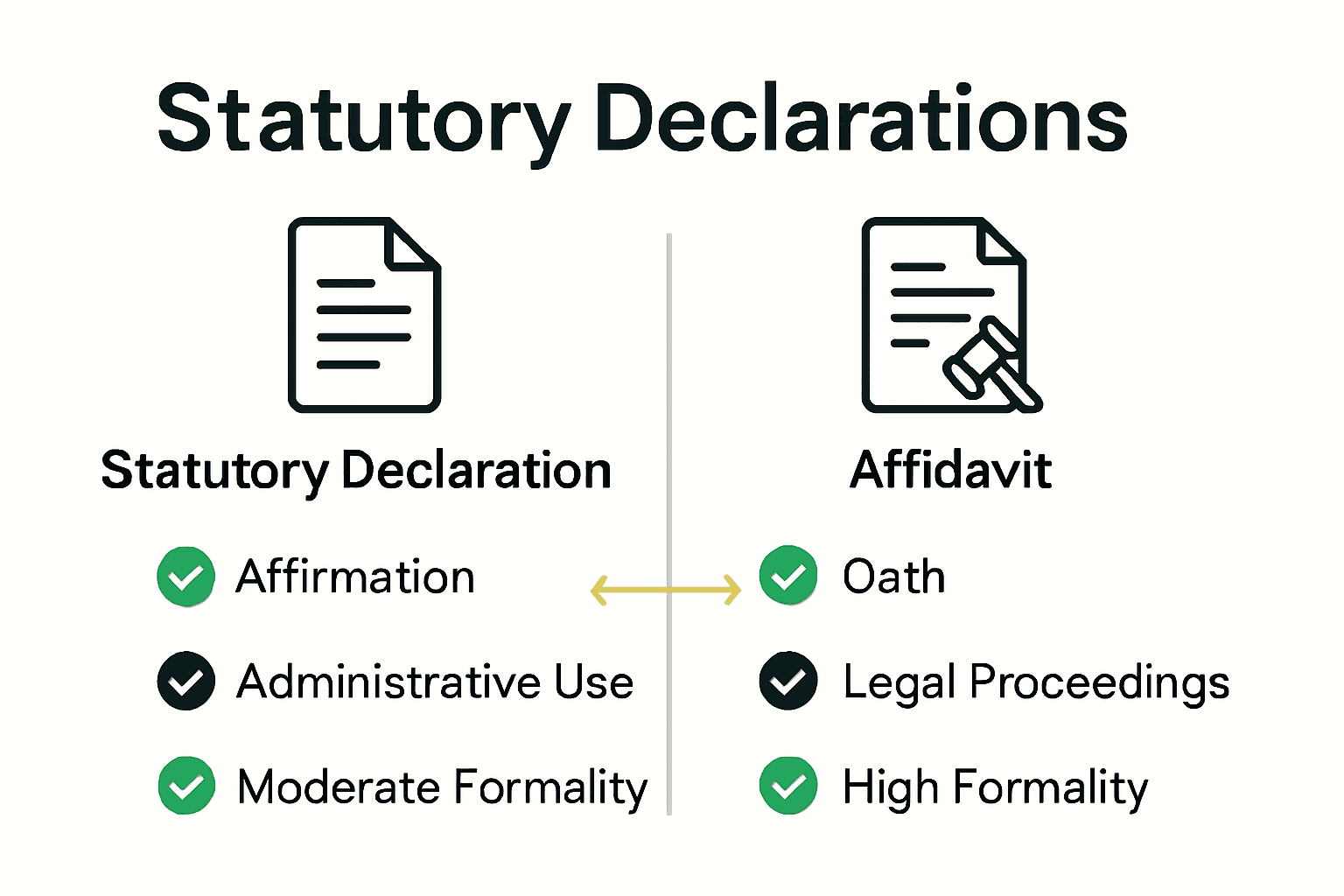
While both statutory declarations and affidavits are legal documents used to convey sworn statements, they have distinct characteristics and purposes in the legal system. The primary difference lies in the method of confirmation and the specific legal contexts in which they are typically used.
Affidavits are typically used in more direct legal proceedings, serving as written evidence that is sworn under oath before an authorized official. They are commonly employed in court cases, legal disputes, and formal legal documentation. In contrast, statutory declarations offer a more flexible form of sworn statement that can be used in a broader range of administrative and legal contexts where a formal but less stringent verification is required.
Key differences between statutory declarations and affidavits include:
Here’s a comparison of statutory declarations and affidavits in Ontario:
| Feature | Statutory Declaration | Affidavit |
|---|---|---|
| Confirmation Method | Solemn affirmation | Oath or affirmation |
| Typical Usage | Administrative Non-court settings | Court proceedings Legal disputes |
| Required Official | Commissioner, Notary Public | Commissioner, Notary Public |
| Formality Level | Moderate | High |
| Legal Weight | Evidence under statute | Evidence under oath |
| Consequence of Falsehood | Criminal offense Fines Possible jail | Criminal offense Fines Possible jail |
- Oath vs. Affirmation: Affidavits require a formal oath, while statutory declarations can be made through a solemn affirmation
- Legal Setting: Affidavits are more commonly used in court proceedings, whereas statutory declarations are often used in administrative or non-court settings
- Consequence of Falsehood: Both carry legal penalties for intentional misrepresentation, but the specific legal implications can vary
- Formality Level: Affidavits tend to be more formal and strictly regulated compared to statutory declarations
Understanding Affidavit vs Statutory Declaration provides additional nuanced insights into the subtle legal distinctions between these two important legal document types. For individuals navigating legal or administrative processes, understanding these differences is crucial in selecting the most appropriate form of documented statement.
Requirements For Ontario Court Statutory Declarations
In Ontario, statutory declarations are legal documents with specific and stringent requirements that must be carefully followed to ensure their validity and legal standing. According to ontario.ca, these declarations must be completed in the presence of an authorized official, such as a commissioner for taking affidavits or a notary public.
The process of executing a statutory declaration involves several critical steps. Newmarket emphasizes that the declarant must make a solemn declaration, understanding that the statement carries the same legal weight as an oath under the Canada Evidence Act. This means the individual must be fully aware of the serious legal implications of their statement.
Key requirements for a valid statutory declaration in Ontario include:
- Authorized Witness: Must be completed before a Commissioner for Taking Affidavits or a Notary Public
- Identity Verification: The official must verify the identity of the declarant
- Voluntary Declaration: The statement must be made willingly and without coercion
- Truthful Content: The declarant must affirm the complete truthfulness of the statement
- Signature Witnessing: The official must witness the declarant’s signature
- Procedural Compliance: All steps must follow the guidelines in the Commissioner for Taking Affidavits Act

How to Complete a Statutory Declaration Online in Ontario offers additional guidance for those navigating the complexities of preparing a legally sound statutory declaration. Careful attention to these requirements ensures the document will be recognized and respected in legal proceedings.
Process Of Commissioning A Statutory Declaration
Commissioning a statutory declaration in Ontario requires a precise and formal process that ensures the legal integrity of the document. According to ontario.ca, the declarant must personally appear before an authorized official such as a commissioner for taking affidavits or a notary public to complete this important legal procedure.
The commissioning process involves several critical steps designed to validate the authenticity and reliability of the declaration. The authorized official plays a crucial role by carefully verifying the declarant’s identity, ensuring they fully comprehend the contents of the declaration, and witnessing the actual signing of the document. This meticulous approach guarantees that the statutory declaration meets all legal requirements and carries the appropriate weight in official proceedings.
Key steps in the commissioning process include:
- Prepare Documentation: Bring a completed statutory declaration draft
- Personal Appearance: Declarant must appear in person before the authorized official
- Identity Verification: Present valid government-issued photo identification
- Document Review: Official reviews the entire declaration for completeness
- Understanding Confirmation: Declarant affirms understanding of the document’s contents
- Signature Witnessing: Sign the document in the presence of the official
- Official Validation: Receive official stamp and signature confirming the declaration
Understanding Who Signs Statutory Declarations in Ontario provides additional context for navigating the intricacies of this legal process. Proper commissioning ensures your statutory declaration will be recognized as a legitimate and binding document within the Ontario legal system.
Legal Risks And Consequences For False Declarations
Making a false statutory declaration is a serious legal offense with potentially severe consequences. According to ontario.ca, a person who knowingly makes a false declaration is guilty of an offense that carries significant legal penalties, as the declaration holds the same legal weight as an oath given in court.
Notariz emphasizes that providing false information in a statutory declaration is equivalent to lying under oath, which can result in criminal charges of perjury or fraud. This means the legal repercussions extend far beyond simple administrative penalties and can potentially impact an individual’s personal and professional reputation for years to come.
Potential legal consequences of false statutory declarations include:
- Criminal Charges: Potential prosecution for perjury or fraud
- Financial Penalties: Substantial fines that can reach thousands of dollars
- Imprisonment: Possible jail time depending on the severity of the false declaration
- Professional Consequences: Loss of professional licenses or certifications
- Civil Liability: Potential lawsuits from parties harmed by the false declaration
- Permanent Record: Criminal record that can affect future opportunities
What is a Declaration? Understanding Its Importance offers additional context about the serious nature of these legal documents. The bottom line is clear: always ensure complete accuracy and truthfulness when preparing a statutory declaration.
Statutory Declaration Alternatives In Ontario
In Ontario’s legal landscape, individuals have several alternatives to statutory declarations that can serve similar documentary purposes. NotaryPro highlights that while statutory declarations and affidavits are both written statements of fact, they differ significantly in their legal application and formality.
The primary alternatives to statutory declarations in Ontario include affidavits, sworn statements, and solemn declarations. Each of these documents serves a unique purpose and carries different legal implications. Affidavits, for instance, are typically sworn under oath and commonly used in court settings to establish specific facts, whereas statutory declarations are often used in administrative or non-judicial contexts.
Key alternatives to statutory declarations include:
- Affidavits: Formal sworn statements used primarily in legal proceedings
- Solemn Declarations: Similar to statutory declarations but with slight procedural differences
- Sworn Statements: Written declarations made under oath
- Notarized Documents: Legally verified documents with official authentication
- Witness Statements: Formal accounts of events provided by individuals with direct knowledge
- Certified Copies: Officially verified duplicates of original documents
Understanding Affidavit vs Statutory Declaration offers deeper insights into navigating these complex legal document alternatives. Choosing the right document depends on your specific legal or administrative requirements.
Simplify Your Statutory Declaration Process with Expert Online Notary Services
Facing the complexities of creating a valid statutory declaration in Ontario can feel overwhelming. Between understanding legal requirements, verifying your identity before an authorized official, and avoiding the serious consequences of false declarations, the process demands careful attention to detail. If you want to confidently navigate this important step with ease and avoid costly mistakes, professional support is essential.

Explore trusted solutions at The Online Notary where we provide reliable online notary services tailored for Ontario’s unique legal framework. Whether you need help with statutory declarations, affidavits, or solemn declarations, our streamlined process allows you to complete your documents securely and quickly. Start now by visiting our Uncategorized – The Online Notary page to learn more. Don’t wait until the last minute to ensure your declaration meets all legal standards—take control today with expert guidance from The Online Notary.
Frequently Asked Questions
What is a statutory declaration?
A statutory declaration is a formal legal document in which an individual affirms the truthfulness of specific facts under legal authority, carrying the same weight as evidence given under oath in court.
How is a statutory declaration different from an affidavit?
The primary difference is that affidavits are typically used in legal proceedings and require a formal oath, while statutory declarations can be used in administrative settings and only require a solemn affirmation.
What are the requirements for a valid statutory declaration in Ontario?
To be valid, a statutory declaration must be signed in the presence of an authorized official, such as a commissioner for taking affidavits or a notary public, and must include verified identity, voluntary declaration, and truthful content.
What are the consequences of making a false statutory declaration?
Making a false statutory declaration can lead to serious legal penalties, including criminal charges, financial fines, potential imprisonment, and damage to personal and professional reputations.
Recommended
- Complete Guide to Statutory Declaration Samples Canada – The Online Notary
- Understanding Who Signs Statutory Declarations in Ontario – The Online Notary
- Understanding the Purpose of Statutory Declaration – The Online Notary
- Understanding Who Signs Statutory Declarations in Ontario – The Online Notary
- Divorce Law UK: Complete Guide to Legal Process | Ali Legal
- Real Estate Legal Basics for Buyers & Sellers in Toronto & Durham – Fanis Makrigiannis
Realtor®