
You’re searching for online notary services in Ontario, expecting a convenient digital solution for your affidavit or statutory declaration. Here’s the surprise: Ontario law currently prohibits online notarization, leaving many people confused about their options. This guide cuts through the confusion, explaining what services claim to exist, why they may be invalid, and how to get your documents notarized legally and efficiently in 2026.
Table of Contents
- Why Online Notary Services Are Currently Restricted In Ontario
- Types Of Online Notary Services Claimed And Their Limitations
- Practical Alternatives For Notarizing Documents In Ontario Safely
- Comparing Online Notarization Legality And Practices: Ontario Versus Other Jurisdictions
- Explore Trusted Online And In-Person Notary Services In Ontario
- Frequently Asked Questions About Online Notary Services In Ontario
Key takeaways
| Point | Details |
|---|---|
| Legal prohibition | Ontario’s Notaries Act requires physical presence, making online notarization illegal without regulatory changes. |
| Invalid documents | Documents notarized through unauthorized online services may be rejected by courts and institutions. |
| Regulatory warnings | The Law Society has issued warnings about regulatory action against licensees offering prohibited online notary services. |
| Practical alternatives | In-person notarization remains the only legally compliant option, though hybrid preparation services exist. |
| Jurisdictional differences | Unlike some US states and other provinces, Ontario has not enacted regulations permitting remote notarization. |
Why online notary services are currently restricted in Ontario
The legal foundation for notarization in Ontario rests on clear statutory requirements. The Notaries Act does not permit notaries to exercise their powers without the person’s physical presence, unless regulations provide otherwise. No such regulations exist today, creating an absolute barrier to online notarization.
This restriction isn’t arbitrary. The physical presence requirement serves multiple purposes:
- Protects against identity fraud by requiring face-to-face verification
- Ensures the person signing understands the document’s contents and consequences
- Creates accountability through direct witness of the signing process
- Maintains documentary integrity that courts and institutions rely upon
- Establishes a clear chain of custody for legal proceedings
Licensing and enforcement mechanisms support these rules. The Law Society of Ontario oversees notary activities, ensuring professionals adhere to statutory requirements. Violations can result in disciplinary action, license suspension, or even criminal charges for fraud.
Understanding online notary accessibility in Ontario requires accepting this regulatory reality. While technology has transformed many legal services, notarization remains anchored to in-person requirements. Other jurisdictions have modernized, but Ontario’s legislature has not yet followed suit.
The distinction matters for your documents. An affidavit notarized through prohibited online means carries no legal weight. Courts may reject it, government agencies may refuse it, and you’ll face delays restarting the entire process. The question isn’t whether online notaries are legal in Ontario, it’s how to navigate the current system effectively.
Types of online notary services claimed and their limitations
Despite clear legal prohibitions, various providers market online notary services to Ontario residents. These offerings fall into several categories, each carrying significant risks.
Some services operate entirely online, conducting notarization through video calls and digital signatures. They may use verification technology like ID scanning or biometric authentication. The problem? Licensees offering online notary services may be subject to regulatory action, and documents notarized this way may be invalid.

Other providers claim to offer “remote” notarization by connecting you with notaries in jurisdictions where online notarization is legal. This creates a jurisdictional mismatch. An Ontario court examining your affidavit doesn’t care that a Texas notary followed Texas law. The document fails Ontario’s requirements.
Hybrid models present the most confusion. These services prepare documents online, schedule appointments, and handle administrative tasks digitally. Then they require in-person signing. If the final step genuinely occurs in person with a licensed Ontario notary, this approach complies with law. The devil lives in the details.
The Law Society issued explicit warnings in 2025:
“Members of the legal profession should be aware that offering or providing online notary services that do not comply with the physical presence requirement may result in regulatory action. Documents notarized in contravention of the Notaries Act may be deemed invalid.”
Consumers face three primary risks:
- Document rejection when submitted to courts, government agencies, or financial institutions
- Wasted time and money when restarting the notarization process properly
- Legal complications if relying on invalid documents for important transactions
- Potential fraud charges if knowingly using improperly notarized documents
Comparing best online notary solutions in 2025 reveals that truly compliant services maintain in-person requirements. Services advertising “fully online” notarization for Ontario residents should raise immediate red flags. The convenience they promise comes with legal consequences that far outweigh any time savings.
Practical alternatives for notarizing documents in Ontario safely
Navigating Ontario’s notarization requirements doesn’t mean abandoning efficiency. Legal compliance and convenience can coexist with proper planning.
Start by identifying authorized notaries. Lawyers and paralegals licensed by the Law Society can perform notarizations. Many law firms offer notary services as standalone appointments, separate from other legal work. Banks sometimes provide notary services for account holders, though availability varies.
Hybrid preparation services offer legitimate value. You can complete document preparation entirely online, reviewing requirements, filling forms, and gathering supporting materials digitally. The critical distinction: these services require you to appear in person for the actual notarization. This model respects legal requirements while maximizing convenience.
Verification prevents costly mistakes. Before scheduling an appointment:
- Confirm the notary holds current licensing through the Law Society directory
- Ask explicitly whether the final signing occurs in person or remotely
- Request clarification on any “online” aspects of their service
- Verify they can notarize your specific document type
Understanding how to notarize documents in Ontario helps you prepare properly. Bring government-issued photo ID, the unsigned document, and any supporting materials. Arrive early to review contents. Ask questions about anything unclear.
Pro Tip: Schedule your notary appointment during business hours at a law office rather than relying on bank notaries. Law offices typically have more flexible availability, handle a wider range of documents, and employ notaries with deeper expertise in complex situations.
Planning reduces delays. Many notaries accept appointments within 24 to 48 hours. Mobile notary services will travel to your location for an additional fee, useful for businesses needing multiple employees to sign statutory declarations simultaneously.
The key insight: documents notarized online through prohibited methods might not be usable or valid. Taking the in-person route initially saves you from redoing everything later. When selecting services, verify credentials using resources like how to verify a notary in Ontario to ensure legitimacy.
Comparing online notarization legality and practices: Ontario versus other jurisdictions
Ontario’s conservative approach to online notarization stands in stark contrast to developments elsewhere. This jurisdictional patchwork creates confusion for anyone comparing options.
The United States pioneered remote online notarization (RON). Virginia enacted the first RON statute in 2012. Today, over 40 states permit some form of online notarization. These states implemented detailed regulations addressing identity verification, audiovisual recording requirements, technology standards, and electronic signature protocols.
Within Canada, provinces vary significantly. British Columbia launched pilot programs exploring digital notarization. Alberta examined frameworks for remote services. Quebec’s notarial system, distinct from common law provinces, developed its own digital authentication methods. Ontario remains the outlier, maintaining strict physical presence requirements.
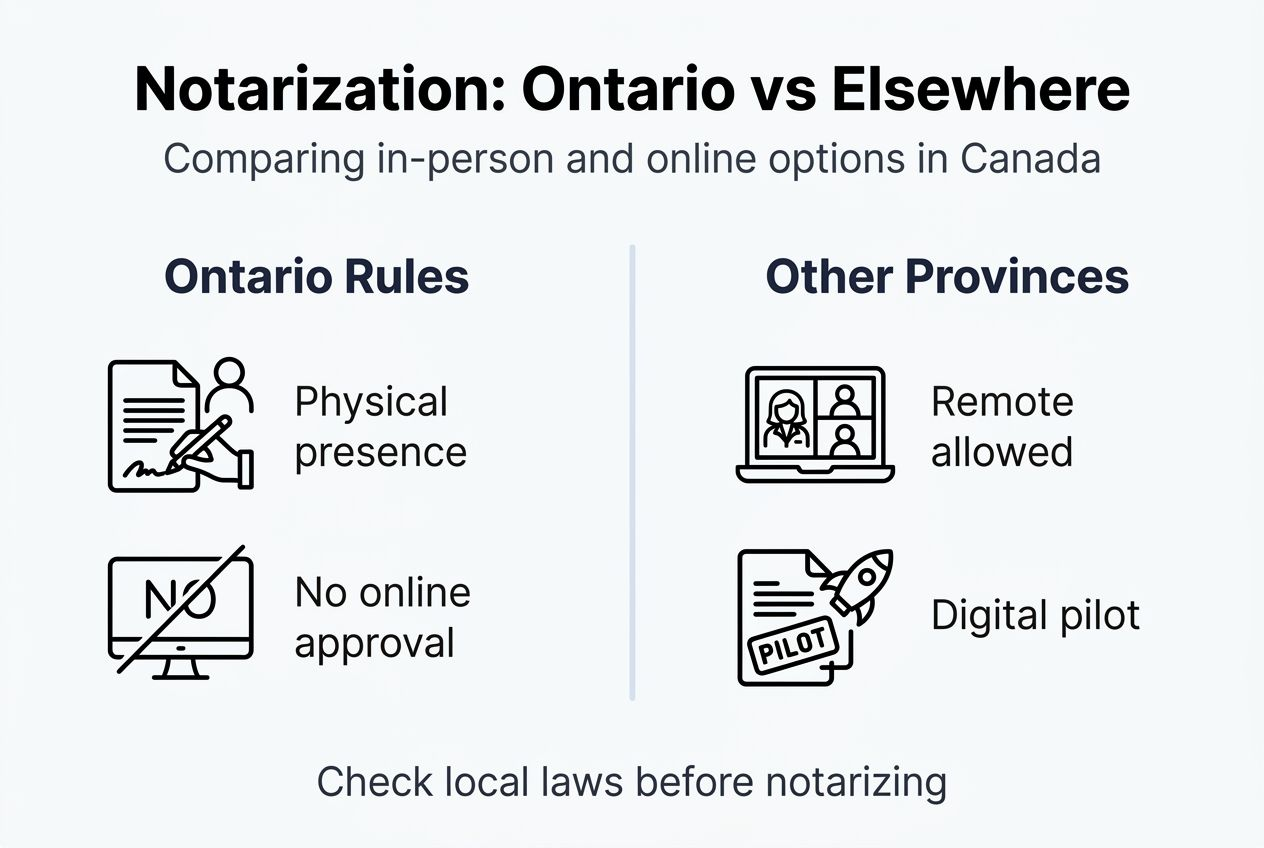
| Jurisdiction | Online Notarization Status | Key Requirements | Document Validity in Ontario |
|---|---|---|---|
| Ontario | Prohibited | Physical presence mandatory | Valid when done in-person |
| US States (40+) | Permitted | Varies by state, typically requires audiovisual recording | May not satisfy Ontario requirements |
| British Columbia | Pilot programs | Limited scope, regulatory oversight | Depends on document type and receiving institution |
| Alberta | Under review | No current regulations | Must meet Ontario standards if used here |
This comparison illuminates why online notarization practices differ significantly across jurisdictions. A document notarized online in Florida follows Florida law perfectly but may fail Ontario’s legal tests. Courts apply the law of the jurisdiction where the document will be used, not where it was created.
Cross-border considerations matter for businesses. A company with operations in multiple provinces might obtain valid online notarization in one location, then face rejection when submitting the same document type in Ontario. Standardization across Canada remains years away.
For Ontario residents and businesses, understanding these differences prevents expensive mistakes. Don’t assume a service legal elsewhere works here. Focus on notarization guidance specific to Ontario in 2025 rather than generic Canadian or North American information.
The regulatory landscape may evolve. Technology advances, public demand grows, and legislative priorities shift. Until Ontario enacts regulations explicitly permitting remote notarization, physical presence remains non-negotiable. Watching developments in other jurisdictions offers insight into potential future changes, but provides no shortcut around current requirements.
Explore trusted online and in-person notary services in Ontario
Navigating Ontario’s notarization requirements becomes simpler with expert guidance that respects legal boundaries while maximizing efficiency. The Online Notary specializes in helping individuals and businesses prepare documents online, then connects you with licensed professionals for compliant in-person notarization.

Our notary services in Ontario streamline preparation without cutting legal corners. We handle administrative tasks digitally, verify documentation requirements, and schedule appointments with licensed notaries who understand affidavits, invitation letters, statutory declarations, and solemn declarations. You save time on preparation while maintaining full legal compliance.
Explore our comprehensive guide on how to notarize documents in Ontario for step-by-step instructions. Compare your options using our best online notary solutions for 2025 to understand which approach fits your specific situation. Expert support meets legal requirements, giving you confidence your documents will be accepted the first time.
Frequently asked questions about online notary services in Ontario
Are there any legally recognized online notary services in Ontario?
No legally recognized online notary services currently operate in Ontario. The Notaries Act requires physical presence during notarization, and no regulations have been enacted to permit remote or online alternatives. Services claiming to offer fully online notarization for Ontario documents operate outside legal boundaries and may produce invalid documents.
What risks do I face using unauthorized online notarization?
Using unauthorized online notarization carries three major risks: document rejection by courts, government agencies, or institutions; wasted time and money restarting the process; and potential legal complications if relying on invalid documents for transactions. The Law Society has warned that such documents may be deemed invalid, forcing you to redo everything properly.
What practical alternatives exist for getting documents notarized?
Practical alternatives include scheduling in-person appointments with licensed lawyers or paralegals, using bank notary services if you’re an account holder, or employing hybrid services that handle preparation online but require in-person signing. Mobile notaries can travel to your location for added convenience. Review our online notaries legal status FAQ for detailed guidance.
How can I verify a notary’s legitimacy in Ontario?
Verify legitimacy by checking the Law Society of Ontario’s directory for current licensing status. Ask explicitly whether final signing occurs in person or remotely. Request clarification on any “online” service aspects. Confirm they can notarize your specific document type before scheduling.
What documents typically require notarization in Ontario?
Common documents requiring notarization include affidavits for legal proceedings, statutory declarations for government applications, invitation letters for visa purposes, solemn declarations for official statements, and various contracts or agreements requiring sworn statements. Each document type has specific requirements, so confirm your notary handles your particular need.
Could Ontario’s online notarization laws change in the future?
Ontario’s laws could change as other jurisdictions adopt remote notarization and public demand grows. However, no legislative proposals currently exist to permit online notarization. Until regulations explicitly authorize remote services, physical presence remains mandatory. Monitor Law Society announcements for any regulatory developments.