
Submitting an application letter without proper notarization can lead to immediate rejection by banks, government agencies, and educational institutions. Whether you’re applying for a mortgage, visa, or professional license, a notarized application letter verifies your identity and signature authenticity, preventing costly delays and resubmissions. Understanding the notarization process in Ontario ensures your application meets legal standards and gains acceptance the first time. This comprehensive guide walks you through everything you need to know about getting your application letter properly notarized in 2026, from preparation to verification.
Table of Contents
- What You Need Before Notarizing Your Application Letter
- Step-By-Step Process To Notarize Your Application Letter In Ontario
- Common Mistakes And How To Avoid Notarization Issues
- Verifying Your Notarized Application Letter For Acceptance
- Get Professional Online Notary Services In Ontario
- What Is A Notarized Application Letter?
- Who Can Notarize An Application Letter In Ontario?
- Do I Need To Sign The Application Letter Before Notarization?
- What Happens If My Notarized Application Letter Is Rejected?
Key takeaways
| Point | Details |
|---|---|
| Identity verification required | Notarization confirms your identity through government-issued photo ID and validates your signature. |
| Documents stay unsigned | Bring your application letter unsigned and sign it directly in front of the notary. |
| Prevents rejection risks | Proper notarization eliminates the chance of institutional rejection due to authentication concerns. |
| Legal compliance matters | Following Ontario’s Notaries Act requirements ensures your letter meets all legal standards. |
| Multiple institutions require it | Banks, schools, and government offices often mandate notarized letters for official applications. |
What you need before notarizing your application letter
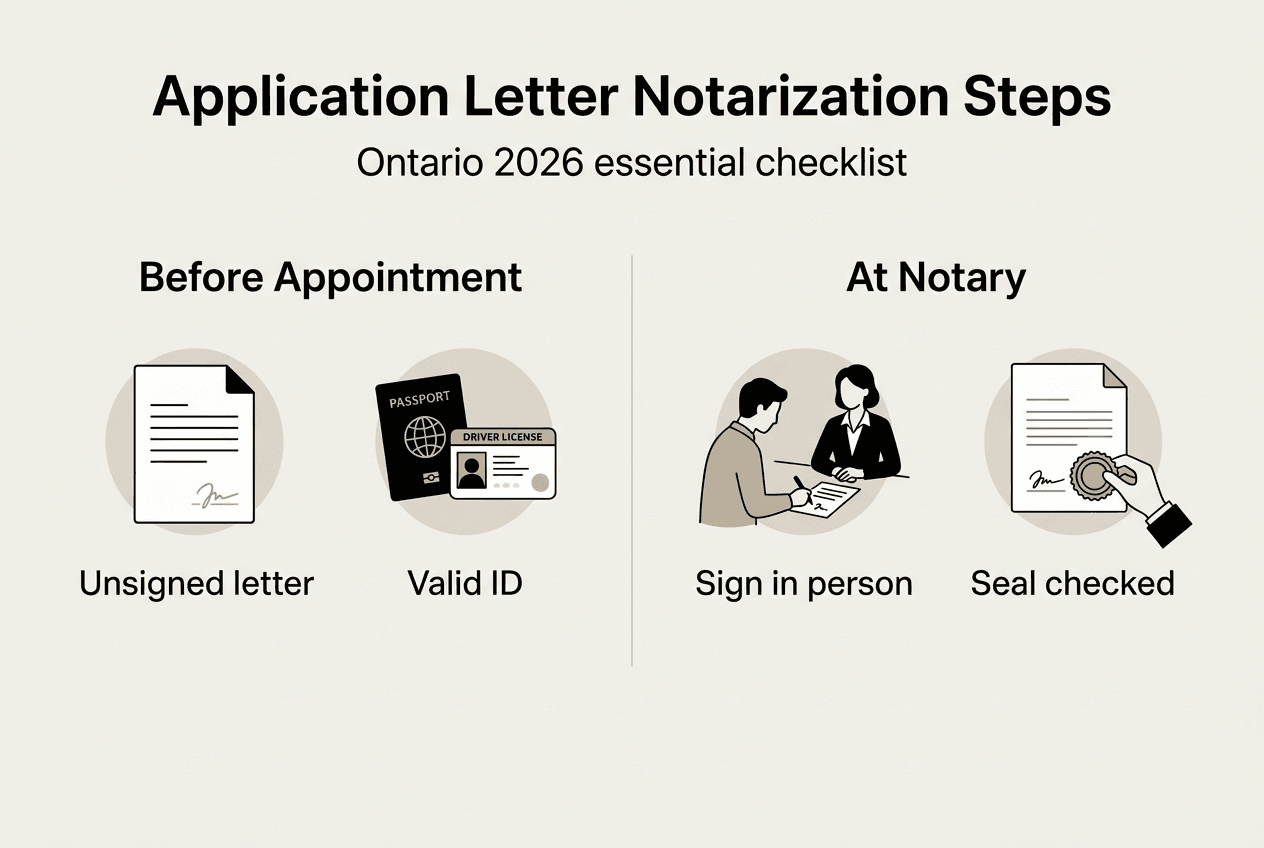
Preparing the right documents before visiting a notary saves time and prevents frustration. Applicants should bring valid government-issued photo ID and unsigned documents to the notary office. Acceptable forms of identification include a valid Ontario driver’s license, Canadian passport, Ontario photo card, or permanent resident card. Each ID must display your current legal name, photograph, and signature.
Your application letter must remain unsigned until you meet with the notary. Signing beforehand invalidates the notarization process because the notary cannot verify that you personally executed the signature. Bring the original document, not a photocopy, as most institutions reject notarized copies. If you’re notarizing multiple application letters for different purposes, prepare separate originals for each.
Understanding public notary requirements ontario helps you select a qualified professional. Ontario’s Notaries Act specifies that only licensed notaries public or commissioners for taking affidavits can perform notarizations. These professionals must verify your identity, witness your signature, and apply their official seal to certify the document’s authenticity.
Pro Tip: Call ahead to confirm the notary’s availability and ask about specific requirements for your application letter type, as some institutions have unique formatting or certification needs.
Here’s what to bring to your notarization appointment:
- Valid government-issued photo identification
- Original unsigned application letter
- Any supporting documents the receiving institution requires
- Payment for notary services (fees typically range from $20 to $50)
| Document Type | Acceptable | Not Acceptable |
|---|---|---|
| Identification | Driver’s license, passport, photo card | Expired ID, health card, credit card |
| Application Letter | Original unsigned document | Photocopy, pre-signed letter |
| Supporting Docs | Original certificates, transcripts | Unofficial copies, digital printouts |
Step-by-step process to notarize your application letter in Ontario
The notarization process follows a structured sequence that protects both you and the receiving institution. The process involves verifying identity, witnessing signature, and certifying the document. Understanding each step ensures you complete the notarization correctly the first time.
First, present your valid government-issued photo ID to the notary. The notary examines your identification to confirm it matches your name on the application letter and verifies the ID hasn’t expired. They may ask you questions about the document’s purpose to ensure you understand what you’re signing. This identity verification step prevents fraud and protects you from signing documents under duress or misunderstanding.

Next, the notary reviews your application letter to ensure it’s complete and ready for notarization. They check for blank spaces that could be filled in later, which would compromise the document’s integrity. If the letter contains errors or incomplete sections, the notary will ask you to correct them before proceeding. Never leave blank spaces in a notarized document, as this creates opportunities for unauthorized alterations.
You then sign the application letter directly in front of the notary while they watch. This witnessed signature is the core of notarization. The notary observes you signing to confirm you’re the person identified on the ID and that you’re signing voluntarily. After you sign, the notary completes their certification by adding their signature, official seal or stamp, commission number, and the date. This certification transforms your application letter into a legally notarized document.
Pro Tip: Read your application letter thoroughly before signing, even if you drafted it yourself, because once notarized, making changes requires starting the entire process over with a new document.
Follow these steps for successful notarization:
- Schedule an appointment with a licensed notary or commissioner
- Bring your valid photo ID and unsigned original application letter
- Present your identification for verification
- Review the document with the notary to ensure completeness
- Sign the application letter in the notary’s presence
- Watch the notary apply their official seal and signature
- Receive your notarized document and verify all certifications are present
Learning how to notarize documents ontario provides additional context for various document types beyond application letters.
Common mistakes and how to avoid notarization issues
Many applicants unknowingly make errors that result in rejected notarizations and wasted time. Improperly notarized documents are often rejected, causing delays and financial losses. Understanding these common pitfalls helps you avoid them entirely.
The most frequent mistake is signing the application letter before meeting the notary. Pre-signed documents cannot be properly notarized because the notary didn’t witness the signature execution. If you accidentally sign early, you must create a completely new application letter and start over. Similarly, using photocopies instead of originals leads to automatic rejection by most institutions, as they require notarization of original documents.
Bringing expired or invalid identification causes immediate appointment cancellation. Your ID must be current and government-issued with a photo. Health cards, student IDs, and credit cards don’t qualify as acceptable identification for notarization purposes in Ontario. Some applicants bring the wrong person’s ID or documents with name mismatches, which the notary cannot notarize due to identity verification requirements.
Another critical error involves leaving blank spaces or incomplete sections in the application letter. Notaries cannot certify documents with gaps that could be filled in later, as this compromises document integrity. Complete every section before your appointment, or clearly mark unused spaces with “N/A” or a line through them. Failing to understand specific institutional requirements also causes problems. Some organizations require specific notarial wording or additional certifications beyond standard notarization.
“The notary’s role is to verify identity and witness signatures, not to provide legal advice or validate the content of your application letter. Ensure your letter is accurate and complete before seeking notarization.”
Avoid these common notarization mistakes:
- Signing the document before meeting the notary
- Using photocopies instead of original documents
- Bringing expired or non-government identification
- Leaving blank spaces or incomplete sections
- Failing to research the receiving institution’s specific requirements
- Assuming all notaries offer the same services and availability
Knowing can anyone notarize a document ontario clarifies who legally can perform notarizations and prevents wasted trips to unqualified individuals.
Verifying your notarized application letter for acceptance
Once you receive your notarized application letter, verification ensures it meets all requirements before submission. Proper notarization is crucial for acceptance by banks, schools, and government offices. Different institutions have varying verification processes, but all check for specific notarization elements.
Banks typically verify that the notary’s seal is clear and legible, the signature matches official records, and the commission number is valid. They may contact the notary directly to confirm authenticity if they have concerns. Educational institutions often require additional certifications beyond basic notarization, such as apostille services for international applications. Government agencies maintain strict standards and frequently reject documents with any irregularities in the notarial certificate.
Examine your notarized application letter carefully before leaving the notary’s office. Check that the notary’s official seal or stamp is clearly visible and includes their commission number and expiration date. Verify that both your signature and the notary’s signature appear on the document. Confirm the date of notarization is correct, as backdating or future-dating can invalidate the certification. Ensure no blank spaces remain and that all required sections are complete.
| Institution Type | Verification Focus | Common Requirements |
|---|---|---|
| Banks | Seal clarity, signature match | Original document, recent notarization |
| Schools | Educational credentials | Transcript verification, apostille for international |
| Government | Legal compliance | Specific wording, original seal impression |
| Immigration | Identity verification | Translation if needed, certified copies |
If your notarized application letter gets rejected, identify the specific reason before proceeding. Contact the receiving institution to understand exactly what element failed verification. Common rejection causes include illegible seals, missing notarial information, or failure to meet institution-specific requirements. You’ll need to obtain a new original application letter and repeat the notarization process, addressing the identified issues.
Verify these elements on your notarized letter:
- Clear, legible notary seal or stamp
- Notary’s signature and printed name
- Commission number and expiration date
- Your signature executed in the notary’s presence
- Correct notarization date
- No blank spaces or incomplete sections
- All required institutional certifications
Understanding when is a notary required ontario helps you determine if your specific application genuinely needs notarization or if alternative certification suffices.
Get professional online notary services in Ontario
Navigating notarization requirements doesn’t have to be complicated or time-consuming. Professional notary online ontario services provide convenient, legally compliant solutions for getting your application letter notarized from anywhere in Ontario. Online notary platforms offer 24/7 availability, eliminating the need to take time off work or travel to physical offices during limited business hours.

Experienced online notaries understand the specific requirements of various institutions and ensure your application letter meets all legal standards. They guide you through the process, verify your identity remotely using secure technology, and provide properly certified documents that institutions accept without question. Learning how to notarize documents ontario through professional services saves time and reduces the risk of costly mistakes. Whether you need to understand when is a notary required ontario or complete urgent notarizations, online services deliver reliable results.
What is a notarized application letter?
What is a notarized application letter?
A notarized application letter is a document that has been signed, verified, and certified by a licensed notary public to confirm its authenticity. The notary witnesses your signature, verifies your identity through government-issued photo ID, and applies their official seal to certify that you voluntarily signed the document. This certification helps prevent fraud and ensures the receiving institution can trust the letter’s legitimacy.
Why do institutions require notarized application letters?
Institutions require notarized application letters to protect against fraud and verify the applicant’s identity. Banks, government agencies, and educational institutions process thousands of applications and need assurance that documents are genuine. Notarization provides this legal verification, reducing the risk of identity theft, forged signatures, and fraudulent applications that could harm both the institution and legitimate applicants.
Who can notarize an application letter in Ontario?
Who can notarize an application letter in Ontario?
Only licensed notaries public or commissioners for taking affidavits authorized under Ontario law can notarize documents. These professionals have completed specific legal training and received official appointments from the provincial government. They follow strict procedures to verify identity and authenticity, ensuring notarized documents meet legal standards. Understanding who can notarize ontario prevents wasted time visiting unqualified individuals.
How do I find a qualified notary in Ontario?
You can find qualified notaries through the Law Society of Ontario’s directory, local law firms, or professional online notary services. Many lawyers hold notary public commissions and offer notarization services alongside their legal practice. Online notary platforms provide convenient access to licensed professionals who can notarize your application letter remotely using secure video conferencing technology approved under Ontario regulations.
Do I need to sign the application letter before notarization?
Do I need to sign the application letter before notarization?
You should bring your application letter unsigned to the notary appointment. The core purpose of notarization is for the notary to witness you signing the document, which they cannot do if you’ve already signed it. Signing beforehand invalidates the notarization process and requires you to create a new application letter and start over.
What happens during the signing process?
During the appointment, you present your valid photo ID to the notary, who verifies your identity. After confirming the application letter is complete and ready, you sign it directly in front of the notary while they watch. The notary then applies their official seal, signature, and certification to the document, transforming it into a legally notarized application letter that institutions will accept.
What happens if my notarized application letter is rejected?
What happens if my notarized application letter is rejected?
Rejections typically occur due to missing notarization elements, illegible seals, invalid identification used during notarization, or failure to meet institution-specific requirements. Contact the receiving institution immediately to understand the exact reason for rejection. This information helps you correct the problem when obtaining a new notarized letter.
Can I fix a rejected notarized letter?
You cannot modify or fix a notarized document after certification, as any alterations invalidate the notarization. You must prepare a new original application letter, addressing the issues that caused rejection, and complete the entire notarization process again with a qualified notary. Working with experienced notary professionals reduces the likelihood of rejection by ensuring all requirements are met initially.